Child and Adolescent Development is a rich and continuously evolving field that offers a wealth of career opportunities. Careers in Child and Adolescent Development is the first textbook to guide students along each step of the career path—from the levels of academic degrees and programs available, to preparations for the professional world. It presents a brief description of the field, explores a broad array of career paths available to students, and offers some practical ideas for constructing a career plan. Students are provided with practical, up-to-date information about career opportunities, combined with real-life vignettes to illustrate the challenges and rewards these careers hold. The book presents traditional career paths in fields such as child and adolescent development, elementary education, educational leadership, and school counseling, as well as non-traditional or emerging career paths in child life and behavior analysis, research, academia, non-profit work, children's ministry, and family law. It will serve as a go-to reference for students, and can be used in a fieldwork class, a service learning class, a professional development class, or a capstone class.
eBook - ePub
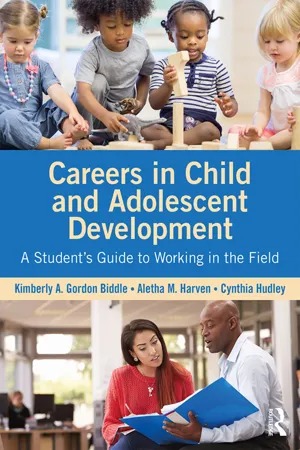
Careers in Child and Adolescent Development
A Student's Guide to Working in the Field
- 146 pages
- English
- ePUB (mobile friendly)
- Available on iOS & Android
eBook - ePub
Careers in Child and Adolescent Development
A Student's Guide to Working in the Field
About this book
Information
Part 1
Getting Started
Chapter 1
The Field of Child and Adolescent Development
To successfully work within the field of child and adolescent development, educators must understand the ways in which humans develop cognitively, socially, emotionally, and physically across the lifespan. Therefore, effective professionals must understand the principles of development (e.g., development is orderly and cumulative), the domains in which development occurs (e.g., cognitive, social, emotional, and physical), the interrelated nature of the domains (e.g., social interactions influence cognitive growth), the developmental periods (e.g., toddlerhood, early childhood, adolescence), the factors influencing development across the domains (e.g., heredity), and the contexts in which development takes place (e.g., home, school, peer groups). It is equally important for educators to understand both developmental and educational theories of children’s development and learning, so as to cultivate the skills to effectively engage youth in developmentally appropriate practices. By acquiring a solid understanding of children and their development, educators should be able to effectively (a) identify and address the unique needs of diverse children and adolescents; (b) engage youth in curricular activities that speak to their individual needs; and (c) assist caregivers and other educators in promoting the healthy development of all youth. The purpose of this introductory chapter is to provide a lens for current and prospective educators to better understand the field of child and adolescent development, from its history and theoretical frameworks to the exciting careers associated with this field of study.
Past, Present, and Future
Past State of the Field
The field of child and adolescent development has evolved over time due to shifting societal views of children. Prior to the 19th and 20th centuries, most societies treated children like small adults, where they are given great responsibility and expected to fully contribute to family and community life. It was not uncommon for children, particularly in rural communities, to work alongside their caregivers during the day, assist with cooking meals for their families, and to provide care for their siblings. Also not uncommon was children’s exposure to sexual play and exploitation—and work within the labor market (Lowe, 2009). Children were not seen as having rights and were often exposed to various forms of abuse at a very early age (Lowe, 2009). School attendance did not become mandatory until compulsory education laws were enacted, which required children to attend school from early childhood through late adolescence. These laws were enacted to increase literacy rates and to protect children from child labor practices. In the United States, Massachusetts in 1852 was the first state to enact a compulsory education law, while in 1917 Mississippi was the last state to enact a compulsory education law. These education laws helped pave the way for a more educated society and an increase in high-level jobs outside of the home environment.
Noteworthy is how the idea of “childhood” became recognized as a stage separate from that of “adulthood” between the 13th century and modern times, but it was during the early modern period (17th century) that the term “childhood” began to take on some of its modern meanings, particularly among the middle class (Lowe, 2009). And by the 18th century, the term was acknowledged as a valuable stage to be explored (Lowe, 2009). This societal shift in thinking was important in moving beyond viewing children as small adults and laborers to viewing children as innocent young people, whose needs were separate from that of adults. This evolving view led to an increase in the creation of appropriate clothing, developmentally appropriate games, and other pastime activities that spoke to the needs of children (Lowe, 2009). Also unique to this shift in thinking was the emergence of laws in 1875 in the United States that were created to protect the rights of children. Additionally, there was an increase in the scholarship on children, which was inspired by the work of William Preyer, who founded child psychology in 1882 when he authored the book, Die Seele des Kindes (The Soul of the Child). Preyer also pioneered research methods such as empirical observation and experimentation for work within the field of human development, thereby laying the groundwork for the study of “childhood.” Other scholars who have contributed to the field of child and adolescent development include John Piaget, who identified four stages of cognitive growth from birth to adolescence; Erik Erikson, who identified eight stages of psychosocial development across the lifespan; John B. Watson, who emphasized the role of social environmental factors, such as caregivers, on children’s development; Lev Vygotsky, who focused on the link between social interactions and cognitive development; and Albert Bandura, who emphasized the relation between children’s perceptions and their subsequent behavior and learning outcomes. In regards to understanding appropriate pedagogical practices for increasing children’s overall development, many educators consult the work of John Dewey, whose progressive education approach emphasized the need for educational activities to be practical and relevant to children’s lives. Maria Montessori is also renowned for her emphasis on self-correcting learning tools for aiding in children’s individual learning. Further , Loris Malaguzzi developed the Reggio Emilia education approach, which was inspired by Italian culture and the residents of Reggio Emilia, Italy. This approach emphasizes the development of individualized curriculums that emerge from the creativity of each child. Many of the scholars mentioned here were constructivists who believed that children should be allowed the freedom to construct their own knowledge with guidance and collaborative efforts from adults. The work of the aforementioned scholars has helped shape societal views on children, including their development and learning. However, there is still much debate on the amount of freedom children should be given over their own learning and development, as well as on the educational tools and activities that educators should use to promote development. As educators, it is our duty to continue learning about “childhood,” given the growing scholarship on children and our shifting societal values, so as to effectively guide the development and learning of all children.
Present State of the Field
Given the diversity among children and adolescents in terms of culture, race, ethnicity, gender, socioeconomic status, sexual orientation, disability status, and the like, it has been imperative for educators to understand the role that diversity plays in the lives of children and adolescents. It is well known that the developmental models utilized to assess children and adolescents are primarily based on research emphasizing the experiences of White middle-class youth. This generalized framework often leads to the negative devaluation of youth whose cultural norms differ from that of White youth. Therefore, educators must become culturally competent, so as to find value in children’s cultural differences and to become comfortable with those differences in learning and development. “Cultural competence” is defined here as understanding and finding value in the cultural differences that children and their families bring to educational contexts, so as to design meaningful assessments and effective learning opportunities, and to provide appropriate support, among other activities (McAllister & Irvine, 2000). Cultural competence also includes the understanding that all children are not having the same experiences due to many factors. For instance, many African American adolescents will experience racial discrimination in school, which has been associated with poor mental health and academic functioning (Wong, Eccles, & Sameroff, 2003; Eccles, Wong, & Peck, 2006). However, African American students who possess a strong racial identity are less likely to experience the negative consequences associated with school racial discrimination (Wong, Eccles, & Sameroff, 2003; Eccles, Wong, & Peck, 2006). Thus, educators seeking to be culturally competent could use these research findings to understand the unique challenges faced by Black youth. Also, educators could increase their vigilance of discriminatory practices, explore and disrupt their own biases, and assist Black youth in developing a strong racial identity (see Harven & Soodjinda, 2016, for a discussion on social justice teaching). Another example is of an Asian American girl with a learning disability, who feels a great deal of pressure to perform well in school due to her teachers’ endorsement of the model minority stereotype, which posits that Asian American students are naturally smart. This seemingly positive stereotype often leaves many Asian and Asian American students with a lack of academic support, while also placing them at risk for poor mental health (Lee, 1994). Thus, educators seeking to be culturally competent should challenge their stereotypes about Asian and Asian American students, so as to provide these youth with appropriate support mechanisms. A final example is of a young child who has two mothers and is teased regularly by his classmates. Educators seeking to be culturally competent should not shy away from engaging their classes in an open discussion about differing family types, so as to normalize the unique family structures of all their students. This normalization could be done through class discussions and readings on diverse family types—and engaging children in art activities to depict their family structures. Please note that being culturally competent includes being aware of children’s intersecting and overlapping social identities (e.g., an American Indian child who is a male soccer player). Noteworthy is how children’s intersecting identities are likely to influence their development in different ways. For instance, the educational experiences of children who are Latinx and male might differ from children who are Latinx and female, due to males of color receiving harsher forms of punishment in school (see Noguera, 2003a, for a discussion on school disciplinary practices). Also, a White male with a learning disability might receive more assistance in school than a Black male with a learning disability, due to stereotypes about the educability of Black male youth (see Noguera, 2003b and Reynolds, 2010 for a discussion on teacher bias in the classroom). Thus, it is imperative for educators to explore the diverse and intersecting identities that children bring with them to the educational context, so as to develop a basic level of cultural competence in which to understand children and provide them with equitable educational experiences.
Equally important to the field of child and adolescent development is the recognition of children’s rights. The Reggio Emilia approach to early childhood education (ECE) espouses the idea that children have the right to learn, develop, and express themselves in many different ways across diverse sociocultural contexts (Hewett, 2001). This approach makes the distinction between child-time and adult-time, as educators should acknowledge that children have the right to learn on their own time and at their own pace, so as to process information in a meaningful way. All too often, educators are consumed with their own curricular goals—forgetting that learning objectives should emerge from the curiosity and interests of the child (Rinaldi, 1993; Hewett, 2001). That is, if while playing outdoors, children become interested in the color of the sky, teachers could create developmentally appropriate activities that assist children in making sense of the sky. Teachers could facilitate learning by inquiring about children’s current knowledge of the sky; encourage children to view the sky at different times throughout the day; and encourage them to use authentic art supplies to depict the sky and its natural surroundings (e.g., coloring pencils, real grass, bark from a tree, etc.). These varied activities will support the curiosity of children, thereby helping them to make sense of their worlds. Noteworthy is how Jean Piaget felt that children were constantly moving from a state of disequilibrium (e.g., curiosity about the sky) to a state of equilibrium (e.g., understanding the colors of the sky) through the processes of assimilation (i.e., incorporating new information into existing schemes or linking new information with current knowledge) and accommodation (modifying or developing a scheme or making room for new information). Thus, child-time allows children to investigate their questions in a state of disequilibrium through observations, discussions, readings, playing, painting, drawing, coloring, and other creative activities. Therefore, educators who value children’s developmental rights should allow curricular activities to emerge naturally from the child, pace curricular activities to accordance with the child’s understanding of the material, and provide guidance and collaborative efforts. This pacing of curricula is not always easy given the various standards to which classroom educators must adhere, but it is important for educators to utilize developmental theory to assist children in developing knowledge to effectively function in their worlds. Also important is the recognition of caregiver rights, where educators should assist caregivers in their efforts to advocate for the equitable treatment of their children, as well as to obtain access to important educational services. For instance, caregivers who perceive their child to have a learning disability should be informed by educators on the protocol for requesting assessments and on receiving appropriate intervention services. Lastly, educators must understand and engage children in developmentally appropriate practice (DAP), which is a teaching approach grounded in research on the ways in which young children develop and learn at different stages of development (Copple & Bredekamp, 2009). Educators engaged in DAP should have knowledge of normative developmental patterns and outcomes at each age and stage of development; utilize observations of children to meet their individual needs; and make an effort to become familiar with the cultural values and expectations of children’s families, so as to provide respectful and relevant experiences for children and their families (Copple & Bredekamp, 2009). Educators working with adolescents should build upon DAP by seeking research regarding appropriate practices to use with teens. In sum, it is imperative for professionals within the field of child and adolescent development to learn as much as the...
Table of contents
- Cover
- Title
- Copyright
- Dedication
- Contents
- Preface
- Foreword
- PART 1 Getting Started
- PART 2 Careers
- PART 3 Discovering Your Path
- Index
Trusted by 375,005 students
Access to over 1.5 million titles for a fair monthly price.
Study more efficiently using our study tools.
Frequently asked questions
Yes, you can cancel anytime from the Subscription tab in your account settings on the Perlego website. Your subscription will stay active until the end of your current billing period. Learn how to cancel your subscription
No, books cannot be downloaded as external files, such as PDFs, for use outside of Perlego. However, you can download books within the Perlego app for offline reading on mobile or tablet. Learn how to download books offline
Perlego offers two plans: Essential and Complete
- Essential is ideal for learners and professionals who enjoy exploring a wide range of subjects. Access the Essential Library with 800,000+ trusted titles and best-sellers across business, personal growth, and the humanities. Includes unlimited reading time and Standard Read Aloud voice.
- Complete: Perfect for advanced learners and researchers needing full, unrestricted access. Unlock 1.5M+ books across hundreds of subjects, including academic and specialized titles. The Complete Plan also includes advanced features like Premium Read Aloud and Research Assistant.
We are an online textbook subscription service, where you can get access to an entire online library for less than the price of a single book per month. With over 1.5 million books across 990+ topics, we’ve got you covered! Learn about our mission
Look out for the read-aloud symbol on your next book to see if you can listen to it. The read-aloud tool reads text aloud for you, highlighting the text as it is being read. You can pause it, speed it up and slow it down. Learn more about Read Aloud
Yes! You can use the Perlego app on both iOS and Android devices to read anytime, anywhere — even offline. Perfect for commutes or when you’re on the go.
Please note we cannot support devices running on iOS 13 and Android 7 or earlier. Learn more about using the app
Please note we cannot support devices running on iOS 13 and Android 7 or earlier. Learn more about using the app
Yes, you can access Careers in Child and Adolescent Development by Kimberly A. Gordon Biddle,Aletha M. Harven,Cynthia Hudley in PDF and/or ePUB format, as well as other popular books in Psychology & Developmental Psychology. We have over 1.5 million books available in our catalogue for you to explore.