Reading Retail captures contemporary debates on the geography of retailing and consumption spaces. It is constructed around a series of 'readings' from key works, and is designed to encourage readers to develop a sense of engagement with the rapidly evolving debates in this field. More than 60 edited readings are integrated into the text, providing a guided route map through the literature and into the study of the geographies of retailing and consumption. The volume also introduces readers to the exciting and interdisciplinary developments unfolding in the 'new retail geography', drawing on up-to-the-minute research material from areas ranging from anthropology to business studies, and tackling issues as diverse as retail internationalization and e-commerce.
Reading Retail is unique in bringing together a huge range of perspectives on retailing and consumption spaces and will provide a key source text for students in this field.
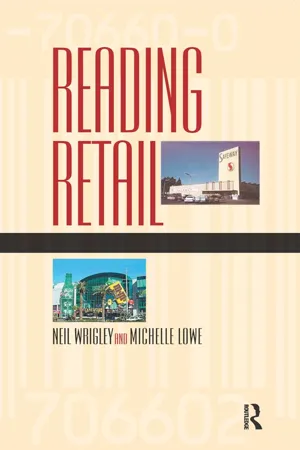
eBook - ePub
Reading Retail
A Geographical Perspective on Retailing and Consumption Spaces
- 296 pages
- English
- ePUB (mobile friendly)
- Available on iOS & Android
eBook - ePub
Reading Retail
A Geographical Perspective on Retailing and Consumption Spaces
About this book
Information
Subtopic
Retail IndustryIndex
Social SciencesPART 1
Introduction
1
Reading retail: purpose and organization of the book
The strains of ‘Teseo, Teseo, Teseo …’ drifting across the African bush in the closing scenes of the BBC’s well-known television documentary Mange Tout captures for many geographers the sense of a world at the beginning of the twenty-first century in which the geographies of production are being as actively shaped by multi-national retail capital as the familiar landscapes of consumption – the shopping malls, superstores and retail streetscapes – which crowd the daily experiences of their predominantly western, urban lives. But how are they to understand this world of retail capital and its production and consumption spaces? How are they to ‘read’ retail?
In this book we offer a guide. Essentially our approach is to build on and expand our well-known, but more abstract, argument (Wrigley and Lowe, 1996) that within human geography a reconstructed sub-discipline of retail geography emerged during the 1990s – a ‘new retail geography’, characterized above all else by theoretical engagement and by a shared appreciation that retail geography is potentially one of the most interesting and challenging areas of study ‘given the subtlety and importance of retail capital, consumption and space’ (Blomley, 1996: 256). The ‘new retail geography’ which we and our co-authors sketched out in the mid-1990s was not only one in which retail capital and its transformation were seen as vital and relevant topics for research demanding urgent attention (Ducatel and Blomley, 1990: 225), but also a subject whose central problematic and potential lay in the fact that the arbitrary categories of ‘economy’ and ‘culture’ required constant shattering in its study. That is to say, a subject which to be worthy of its name needed to take both its economic and cultural geographies seriously, combining ‘an exploration of the economic structures of retail capital with an analysis of the cultural logic of retailing’ (Blomley, 1996: 239). As a result, we argued that the ‘new retail geography’ found itself at the very heart of contemporary debate within critical human geography, presenting opportunities which should be seized and challenges which should be addressed.
But this book is not about such abstract argument. Rather it is an attempt to show a largely undergraduate audience how it is possible to ‘read retail’ through the lens of a ‘new retail geography’ perspective, allowing them in the process to gain an active sense of the range, intensity and research literature sources of the swirling and rapidly developing series of debates which focus on the geographies of retailing and consumption spaces. Not only, therefore, do we adopt organizational frameworks which have proved useful in our undergraduate courses on these topics at the University of Southampton, but we also use a wide range of short ‘readings’ selected from the work of both well-known and lesser-known authors in the field. The ‘readings’ are provided both to offer depth and perspective on key issues and to encourage readers to develop a sense of engagement with the theoretical debates and research literature shaping the field. Together our organizational framework, text and selected ‘readings’ offer our readers a route map into the study of the geographies of retailing and consumption spaces. Our intention in choosing and packaging the material in the way we have is not to strait-jacket our readers. Indeed, it is the very opposite. As we go on to demonstrate below, multiple readings of particular topics are the very essence of academic writing and debate in the field. Our hope is that our choices and approaches will serve to stimulate and liberate – encouraging readers to explore and develop still further the potential of subjects which we believe are among the most interesting and challenging in human geography – subjects which lie at the very heart of contemporary theoretical debate within both the discipline and social science more generally.
Developing a sense of the debate: reading and re-reading retail
But how can our readers develop a sense of the debates shaping the study of the geographies of retailing and consumption spaces? Crucial to that development we suggest must be an appreciation of the nature of academic writing which, by its very nature, invites critical review from a variety of perspectives. In this book we essentially use three approaches to sharpen that appreciation. First, we show how single issues in retailing and consumption will inevitably be approached from a variety of angles – in particular, we contrast ‘economic’ and predominantly ‘cultural’ readings of the same topic. Second, we show how single pieces of academic writing will often be constructed to offer multiple readings of a topic. Third, we demonstrate how a single piece of academic writing may be read and re-read over time from widely differing perspectives, or in markedly different ways at the same time by a variety of audiences.
Example I – The empire filters back: Starbucks coffee
Let us begin then with a consideration of Michael D. Smith’s fascinating paper in Urban Geography (1996) on the Starbucks Coffee Company – the ‘bean and beverage’ retail and mail order enterprise, first established in Seattle in 1971, which grew phenomenally following its transition into a coffee bar format in 1987. In that paper, Smith offers two readings of Starbucks. The first attempts to situate Starbucks ‘within a broader historical and contemporary geography of coffee production closely linked to various phases in the history of Euroamerican colonialism and imperialism’ – a reading informed, in part, by recent critiques of consumption and post-colonial theory and ‘offered to suggest how consumption and production, the symbolic and the real, the local and the global are all indissolubly bound up one with the other’. The second considers key aspects of the ‘styling’ and ‘placing’ of Starbucks to ‘offer a reading of Starbucks as the site of a specific set of local consumption practices’.
Smith’s first reading is rooted in the widely held perception that coffee, one of the most important tropical commodities in international agricultural trade, ‘reflects unambiguously the relationships of dependency that connect the poor underdeveloped nations of the South to the rich industrialized countries of the North’. Having considered aspects of this dependency Smith asks the question: ‘So where in this historico-geographical matrix of coffee relations … does Starbucks fit?’ His answer goes well beyond the sheer economics (however fascinating) of a vertically integrated retail business which, in 1990, paid around $2 a pound for Columbian coffee but sold it for $8 a pound in its stores as beans or, as brewed coffee, for the liquid equivalent of $20 a pound. In Smith’s view: ‘What makes Starbucks particularly interesting is that it trades not only in the 300-year-old market for this tropical commodity, but in an equally enduring if less tangible symbolic economy of images and representations that are the cultural correlates of Euroamerican domination.’ As a result he shows how ‘Starbucks … appropriates, refashions and redistributes elements from the history and contemporary economic geography of coffee production to produce its own “cognitive map” of coffee’. He argues that ‘this is not merely an embellishment of the Starbucks marketing strategy, but is, on the contrary, an integral component of the Starbucks product, not only in the form of the commodity itself but in the symbolic meaning that is invested in that commodity and in the act of consuming it’. As a result, ‘it is for precisely this reason that… production and consumption are inseparable in the case of Starbucks, which has succeeded in creating what we might term a “cultural geography of production”’.
Smith’s second reading of Starbucks focuses on the ‘styling’ and ‘placing’ of the firm – the flair for design, positioning, service and promotion which established it as a highly successful retailer in what he terms a largely ‘privileged, urban(e) milieu of consumption’ in North America. Reading 1.1 captures the spirit of this second reading.
Reading 1.1 –‘Styling’ and ‘placing’ Starbucks
Starbucks outlets are integrally connected to those ‘landscapes of leisure’ where people with disposable income, not to mention cultural capital goto consume, display themselves, and watch others; as such they are part and parcel of the cultural geography associated with the ‘recolonization’ of North American inner cities by the yuppie shock troops of a putatively post-industrial capitalism. Starbucks’ store design thus relies upon its links not only with the city, but with those gentrified neighbourhoods and districts whose cachet it has absorbed, even as the chain expands into suburban streetscapes, airport arcades, and shopping malls …
Starbucks’ retail design could be said to revolve around an enticement to ‘eat the street’. All Starbucks outlets are equipped with floor-to-ceiling windows, behind which are lined counters and rows of elevated stools providing a perfect and legitimized vantage point for the individual voyeur Patrons are meant to watch when at Starbucks, to take in the streetscape as they sip their coffee …
The symbolic appeal of Starbucks coffee cannot be separated from the manner in which it is served, since service is so central to the Starbucks model. The preparation of specialized coffee drinks – cafe latte, espresso – is integral to the act of consumption. There is thus a performative element in Starbucks, an aestheticization of the commodity, as the ‘baristas’ transform the formerly mundane act of serving coffee into the theatrics of consumption.
Extracted from: Michael D. Smith (1996):The empire filters back: consumption, production and the politics of Starbucks Coffee. Urban Geography, 17, 502–24.
Example 2 – Questioning the globalization of Coca-Cola
In contrast to Michael D. Smith’s explicit multiple readings of Starbucks within a single journal article, our second example focuses on a case in which two pieces of academic writing approach a single topic from rather different perspectives – one a predominantly ‘economic’ reading, the other a predominantly ‘cultural’ reading. The topic itself has interesting links to the themes explored by Smith – Coca-Cola after all is a quintessential example of what Smith in that paper terms the ‘symbolic economy of images … the cultural correlates’ of American domination of certain aspects of global trade. Despite their rather different perspectives, both writers accept this, beginning their papers with phrases such as ‘the iconic status of Coca-Cola is taken for granted’ (Sparks, 1997: 153) and ‘Coca-Cola is one of three or four commodities which have obtained the status … of meta symbol’ (Miller, 1998a: 170). However, the orientation of their readings of Coca-Cola differs considerably.
The first reading by Leigh Sparks – geographer turned business school professor – is distinctly ‘economic’ in orientation and is taken from a special issue of the US agricultural economics journal Agribusiness (1997) in which economists and geographers debated issues of retailer-manufacturer relations and the convergence of food manufacturing and distribution systems (Cotterill, 1997). It focuses on the way in which Coca-Cola – a seemingly inviolate global brand – was challenged during the 1990s by the growing power of retailers and the development of retailer ‘own-label’ products. The broader issues of retailer-manufacturer relations, shifts in power within those relations, and the strategic significance of retailer own-label products within those shifts will be dealt with in detail in Chapter 3. Here we focus simply and briefly on an ‘economic’ reading of one particular facet of the Coca-Cola and globalization story The reading raises interesting issues about growing retailer power in a market which has traditionally been assumed not only to be manufacturer-dominated, but in essence merely a battlefield for global hegemony between two major corporations, Coca-Cola and PepsiCo.
Reading 1.2 – Restructuring the cola market
Retailers seeking to expand their retailer brand offer … have initially exploited weaker or newer market segments and avoided manufacturer-dominated sectors such as the cola market … The last five years or so, however, have seen even the soft drink market challenged seriously by retailer brands, both in North America and Europe. In North America, many retailers (including Wal-Mart) have followed Loblaw’s Canadian lead by introducing ‘President’s Choice’ or some similar retailer brand variant. As the title suggests, this is not the typical down-market view of retailer brands found often in North America, but is rather a statement of trust, reputation, and high quality. This change has had a dramatic effect on the perception and practice of brands and brand management. In the UK, J. Sainsbury challenged Coca-Cola head-on with its Classic Cola launch in 1994. So similar was Classic Cola in brand positioning terms (including the packaging and labelling) that Coca-Cola threatened to sue J. Sainsbury for ‘passing off unless the packaging and design were changed. In late 1994,Virgin launched its own branded cola, initially available only in selected retailers but again a threat to the established order Even in highly brand-conscious Japan, retailer brand cola (Classic Selection Cola) has been launched by Ito-Yokado (including Seven-Eleven Japan).The common element to all these examples is the Cott Corporation, a Canadian producer of retailer brands, mainly soft drinks. From 1989 it has transformed itself and thrown down a challenge to the leading cola corporations -when customers purchase Coca-Cola are they paying a brand premium or a brand tax, and are they willing to continue paying this in the light of enhanced (price and quality) competition?…
Initially Coca-Cola and PepsiCo saw retailer brands and Cott as a minor irritant, but as time passed, local markets were picked off in deals and big players such as Wal-Mart and KMart added to Cott’s portfolio, then reaction became critical. This has taken the form of brand reinforcement and pricing reductions to meet the threat and has led (in part) to a stabilisation of retailer brand penetration …The free ride that Cott had has been ended … Whatever the outcome [of this fightback, however], Cott has arguably destabilized brand markets worldwide … [Its] challenge [to the Coke/Pepsi duopoly] illustrates the desire of retailers to gain control of supply chains to extract value [and raises important issues] relating to actual and latent retail power… regulatory frameworks conditioning the ability of retailers to develop and exercise such power … the ways in which strategy and branding are interlinked and delivered by operational practices … relationship building and partnerships in vertical channels … [and] the restructuring underway in manufacturer-retailer-consumer relationships.
Extracted from: Leigh Sparks (1997): From coca-colonization to copy-cotting: the Cott Corporation and retailer brand soft drinks in the UK and the US. Agribusiness, 13, 153–67.
The second reading is by Daniel Miller (1998a), an anthropologist and well-known writer on theories of consumption (Miller, 1995, 1998b, 2001) often in collaboration with geographers such as Peter Jackson and Nigel Thrift (see Miller et al., 1998). Miller’s cultural-ethnographic reading of the production and consumption of Coca-Cola in Trinidad has at its heart an attempt to introduce vitally important nuances into conventional interpretations of archetypical global products such as Coca-Cola and to ‘assert the scholarship of contextualization’ (Miller, 1998a: 185). Rather than focusing on what he views as rather sterile debates about global homogenization focused on meta-symbols such as Coca-Cola, or discussions of corporate strategies for so-called ‘global localization’, Miller (1998a: 170) favours the slow building up of a stance towards western capitalism which is ‘informed and complex’ and which rests ‘on the comparative ethnography of practice’. His concern (Miller, 1998a: 18) is with how different groups use ‘commodities to create a much more subtle and discriminatory process of incorporation and rejection than allowed for in simple models of Americanization or globalization’. Reading 1.3 captures some of the flavour of Miller’s examination of the localization of both production and consumption of Coca-Cola in Trinidad.
Reading 1.3 – Contextualizing Coca-Cola
Coca-Cola could be argued to be a remarkably unsuitable candidate forthis role as the key globalized corporation … The enforced restitution of Classic Coke (following the company’s decision to change the composition of the drink in the 1980s as a response to the increasing popularity of Pepsi) was surely one of the most explicit examp...
Table of contents
- Cover
- Half Title
- Title Page
- Copyright Page
- Dedication
- Table of Contents
- Preface
- Acknowledgements
- Part 1 Introduction
- Part 2 Setting the scene: retail dynamics
- Part 3 Making and re-making the geographies of retail capital
- Part 4 Consumption places and spaces
- Bibliography
- Author index
- Subject index
Trusted by 375,005 students
Access to over 1.5 million titles for a fair monthly price.
Study more efficiently using our study tools.
Frequently asked questions
Yes, you can cancel anytime from the Subscription tab in your account settings on the Perlego website. Your subscription will stay active until the end of your current billing period. Learn how to cancel your subscription
No, books cannot be downloaded as external files, such as PDFs, for use outside of Perlego. However, you can download books within the Perlego app for offline reading on mobile or tablet. Learn how to download books offline
Perlego offers two plans: Essential and Complete
- Essential is ideal for learners and professionals who enjoy exploring a wide range of subjects. Access the Essential Library with 800,000+ trusted titles and best-sellers across business, personal growth, and the humanities. Includes unlimited reading time and Standard Read Aloud voice.
- Complete: Perfect for advanced learners and researchers needing full, unrestricted access. Unlock 1.5M+ books across hundreds of subjects, including academic and specialized titles. The Complete Plan also includes advanced features like Premium Read Aloud and Research Assistant.
We are an online textbook subscription service, where you can get access to an entire online library for less than the price of a single book per month. With over 1.5 million books across 990+ topics, we’ve got you covered! Learn about our mission
Look out for the read-aloud symbol on your next book to see if you can listen to it. The read-aloud tool reads text aloud for you, highlighting the text as it is being read. You can pause it, speed it up and slow it down. Learn more about Read Aloud
Yes! You can use the Perlego app on both iOS and Android devices to read anytime, anywhere — even offline. Perfect for commutes or when you’re on the go.
Please note we cannot support devices running on iOS 13 and Android 7 or earlier. Learn more about using the app
Please note we cannot support devices running on iOS 13 and Android 7 or earlier. Learn more about using the app
Yes, you can access Reading Retail by Neil Wrigley,Michelle Lowe in PDF and/or ePUB format, as well as other popular books in Social Sciences & Retail Industry. We have over 1.5 million books available in our catalogue for you to explore.