eBook - ePub
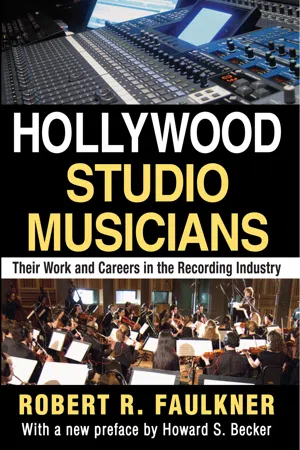
Hollywood Studio Musicians
Their Work and Careers in the Recording Industry
- 232 pages
- English
- ePUB (mobile friendly)
- Available on iOS & Android
eBook - ePub
About this book
When originally published in 1971, Hollywood Studio Musicians was the first detailed analysis of the work and careers of production personnel in an industry devoted to mass culture. Previously, most researchers overlooked mass-culture industries as work settings, preferring to focus on content rather than the artists who created it. This lucid and insightful book looks under the hood of the Hollywood film scoring and recording industry, focusing upon the careers and work of top-flight musicians. A new preface by Howard S. Becker highlights the study's historical context and importance.Based upon in-depth interviews with freelance musicians, Faulkner provides original insights into how we conceptualize occupations as well as the highly stratified system of professional prestige that results in what we now call the "A-List." Faulkner develops a framework for discovering and exploring how rapidly changing and demanding freelance work induces status hierarchies, sustains and updates collegial reputations, tightens social networks between contractors, and musicians, and restricts access to upward career paths.This volume is a gem, a masterpiece of field research combined with probing, theoretically informed analysis. Aside from the value of its own findings, the volume offers students of sociology, film, and other creative industries a prime example of how to do good social science research. In short, it is a model for investigators to turn to when their own research needs help, an exemplar of how research is done when it is done well.
Information
C H A P T E R O N E
Introduction
The film is above all a “photograph” and is already as such a technical art, with mechanical origins and aiming at mechanical repetition, in other words, thanks to the cheapness of its reproduction, a popular and fundamentally “democratic” art.
Arnold Hauser, The Social History of Art
Playing with the film track is a stiff, mechanical feeling, and I can understand why, because the composer and conductor have to catch sequences quickly on the screen. Any other way would be too expensive. What we do in one hour would probably take half a day without the click tracks …. It’s a game, you play your part and make it come out correct, that’s all.
From an interview with a bass player
To be a studio man, the ideal thing, is to do anything and everything. You play bombastic, “legit,” anything … fight scenes, solos, all that, and really crank the stuff out. You have to have it. I’m not saying I prostitute myself, but I think you must have all the tools in order to be considered for any kind of musical situation.
From an interview with a trombone player
To be a successful, good musician takes a lot of skill, a lot of hard work and study, a lot of heartbreak, and a lot of disappointment. All my colleagues have these things and I know because I am one. They are talented people, very sensitive people, very hardworking people, and I have a lot of respect for them. I think they’re a special breed.
From an interview with a violin player
One of the striking features of modern industrial society has been the rapid growth and development of the mass entertainment industries, based on the successful commercial application of developments in photography, film, sound recording, and other breakthroughs in electronics, chemistry, and mechanics. This is particularly apparent if we look at the size and influence of the television, motion picture, and phonograph recording industries, as indicated by the number and quality of talent recruited to them, the amount of capital investment absorbed by them, and the sophistication of their operations. These industries are unique in bringing together a combination of technological and organizational forces for the manufacture of popular entertainment. Their growth and influence has been a subject of speculation by social scientists, critics, and other observers, who have shown concern about the impact of popular culture on art and serious artists, and especially the effects of “commercialism” on writers, painters, poets, composers, and musicians—on both creative and performing artists. The mass culture industries are portrayed as assembly lines, where standardized, homogeneous products are cranked out, and profit is more important than culture, where the creator or performer is dominated by an impersonal technology and a complex production process. An artist who goes commercial is seen as selling out for the financial benefits of well paid, but alienating employment; he is seen as allowing his unique talents to be undermined by an industry geared toward the public, the mass audience, rather than toward culture-bearing elites.
Curiously enough, discussion about persons employed in the popular-culture and mass-communications industries has resulted in many dry remarks but little careful understanding of these settings. Indeed, research is exceedingly slim. Powdermaker’s work on Hollywood is dated and concerns only the most visible segment of the motion picture industry—the directors, producers, and actors. Huaco’s recent book is a discussion of styles of film, but it does not provide a systematic treatment of the production personnel who make them; however, some of this information can be found in Rosten’s saga of the movie colony. Nash’s article on the composer contains some ideas about commercialism and the creative artist, but his remarks are brief and not presented in detail, nor does he describe how composers actually go about their work in the commercial scene. No studies have extended Griff’s ideas about commercial artists to other work settings and occupations. While Becker offers insights into the career contingencies and motivation for “going commercial” in his articles on dance musicians, his analysis concerns mainly performers working on casual jobs and in night clubs rather than in the mass-media industries. Important leads about symphony musicians’ definition of career success, feeling of entrapment, and alternative career lines are suggested in Westby’s interviews with these performers. Most sociologists have overlooked the mass-culture industries as work settings; they have preferred to focus on the media content rather than on its employees, or on the art of popular entertainment rather than on the artists, performers, and technicians who shape it.1
In the absence of information, students interested in this aspect of society have been prone to rely on speculation. Much has been written about a so-called cultural elite who operate within “some aesthetic or literary tradition.” These are “top men in the sphere of … aesthetics and entertainment, who carry the core values and standards of the sphere and serve as models for those working in it.” “Mass pressures” in “mass society” bring about a destruction of this elite and its artistic values; the debilitation of culture is one result, and the erosion of elite values another.2 Other critics see the mass media as staffed by “anti-intellectual intellectuals” and creative hacks, driven by grubby materialism, who turn out our films, television programs, records, and magazines. Many recognize these views as overdrawn, and some realize that they may be highly romantic. But these models of mass culture have a polemical value: they are perspectives on what culture should be and what artists should do, based on what these critics think was true in the past. The past is easy to romanticize, but it is perhaps too easy to judge the current scene by these ideal standards.
While I share some of these concerns about “culture,” my perspective is different. A reader interested in the “debilitation of artists in mass society” might consider personal alienation and “artistic integrity” to be key problems. Another might see conforming to the tastes of the audience, “the democratic mass of media consumers,” as the most important problem faced by commercial artists. Others may wish to compare the man on the assembly line with the artist in the mass-media industry. These are important problems, but they are also highly evaluative standpoints. I propose that much of the behavior of creative and performing artists in mass media setting can be viewed as work. They write, perform, and produce in highly organized teams that demand coordination; they face routine work pressures, try to handle mistakes at work, control the activities of colleagues, and cope with the risks of personal failure. The structure of work itself and routine work problems faced by these talented individuals as employees are the points I wish to emphasize.
This emphasis raises several concrete questions: What is the precise impact of employment in the mass-media industries on a group of skilled artists? How do they look at their work? Do they see it as giving them opportunities to use and express their talents, and, if so, under what conditions? What is the relationship between their careers and their employment in highly technical and organized production organizations? Is the artist directly influenced by the social setting, by what he brings to the setting, or by his career aspirations? Is there something unique about artists employed in these industries, and, indeed, what are the particular characteristics of these individuals? Answers to these questions involve an exploration and detailed analysis of the commercial work setting, work problems, and careers of those who conceive, produce, and perform mass-media fare. I have chosen performing studio musicians (studio work is all inclusive; it includes motion picture and television film jobs, live and tape TV, record dates, and radio and television jingles) because they represent a unique combination of artistic talent, long training, and perfected skills located in a highly industrial and complex production process.
These performers who work in the Los Angeles recording studios are anachronistic in our age of large-scale industrial organizations. They own their instruments; their skills cannot be acquired in a short time, and years of training and persistent practice are required; and their talents are not widely usable outside the music scene. They come from a wide variety of career settings: jazz groups, big bands, symphony orchestras, the concert stages, and other types of musical jobs. In the mass-media industries, their role is only one part of a production process which is collective to an unusual extent. Film production, as an example, develops through three phases: pre-production and planning (involving producers, directors, casting directions, production managers), production and filming (involving actors, directors, cameramen, and all of the people associated with the actual filming), and post-production or final assembly. The musician enters only at this last stage, when the film is edited, special effects and the sound track are added, and the music score is composed, arranged, and timed to precisely match the film action. It is at this point that the musicians are hired. Thus, the composer, conductors, music editor, arranger, and performer comprise only one of several specialized production units. The musical underscore is subsidiary to dialogue, sound effects, and film action; and while soundtrack albums and movie themes have become important elements in the sales of films, music is essentially an adjunct to the film. It is geared to the film medium; pace, timing, dynamics, and phrasing follow the screen action. In contrast to chamber music, jazz, rock, or orchestral music, film music itself is not the thing. It comes at the end of the film assembly—after writing, casting, scripts, sets, makeup, costumes, dubbing, editing, and a host of other jobs.
Despite the assembly-line nature of motion picture, television film, and phonograph record dates, each score is unique. Melody, rhythm, harmony, orchestration, length of individual takes, and difficulty of parts vary with each film. This inherent variety in studio work requires musicians to be prepared for uncertainty. They always have something new to play, someone new to play under, and they must be on top of their musical skills all the time. On studio dates (and even on the same date) musicians find a wide variety of scores, from rock to jazz-oriented compositions to lush, symphonic music. The folklore of the studios is full of rich anecdotes about the abilities of performers to play anything at sight, in any style, to follow any conductor no matter what his abilities, and do this efficiently, with precise intonation, phrasing, and attack.
In the world of the studio musician a set of routine problems is generated that must be negotiated, handled, and rendered as predictable or manageable as possible. From the everyday viewpoint of these musicians, one persistent problem centers around the control they have over the conditions of work: the composers and conductors they play under, the studios they perform in, the colleagues they work with. Another problem is tied to their skills and musical talents: misuse and under-use of abilities in studio work, performing under imposing technological conditions, uncertainty about which skills will be demanded from day to day, and the fluctuation between routine and crisis at work. A third is the level of personal honor claimed and socially accorded by colleagues, one’s position in the studio pecking order, and one’s perception of being “inside” or “outside” influential circles. Recurrent work problems also revolve around the market situation of the individual performer in the occupation and that of the occupation in the industry: the structure and intensity of competition for scarce jobs and monetary rewards, the fluctuations in music budgets in mass-media production, and the consequences of greater consumer demand for these entertainments. These concrete work problems constitute a set of interrelated contingencies upon which the studio musician’s work and career depend; they are key features to which he must attend. This occupation must be analyzed (1) in terms of the structural context in which these problems occur, (2) from the cognitive perspective of the musician and his definitions of their relative importance, and (3) in terms of their impact on his work experience.
Work problems have theoretical relevance in linking the social situation of an occupation to the person. This identification of the individual with his occupation is best seen in the professions where, as Hughes puts it, “the culture and technique, the etiquette and skill appear in the individual as personal traits.” Culture and shared perspectives arise in response to some set of problems faced by occupational members; they constitute taken-for-granted understandings for dealing with skill, control over work, status, and market situation. These understandings are reflected in the attitudes and behavior of the individual, and they shape his inner experience. A major part of the culture of a work group, then, consists of organized solutions to these taken-for-granted problems, strains, and tensions.3
Occupational members also bring experiences, identities, and perspectives with them from other settings. They hold ideas and values which are derived from previous occupations; they carry understandings with them from other stages of their career. The expectations, wants, and tensions people bring to their work should be treated as a major variable when we look at how they view their present jobs.4 The meaning a man finds in his work and the problems that are part of his cognitive perspective are anchored not only in the technical and social organization of work, but also in his prior career experiences. The link between work problems and personality, occupational structure, and inner experience is not automatic. To examine work perspectives, I have chosen to explore the career lines which lead persons out of one setting and into another. My working hypothesis is that the actor’s own definition of his career can be regarded theoretically as mediating between the objective work setting and his subjective work experiences.
A distinction between work problems in specific settings and career problems throughout the individual’s entire work history is more important in occupations where people undergo long and difficult training before entering the world of work. Hughes notes that, “in general, we may say that the longer and more rigorous the period of initiation into an occupation, the more culture and technique are associated with it, and the more deeply impressed are its attitudes upon the person.” A performing musician’s training, for example, is extremely long, most often beginning very early in life, and the social context in which he learns and performs (his role models, repertoire, and personal success) awakens desires for artistic fulfillment and creativity in work—values often forgotten, ignored, or even not defined as relevant by many professionals and white-collar employees.
The realities of making a living in music constitute a major set of career and work problems.5 These realities often conflict with the ideals that first encouraged the player to undergo the rigors of discipline and practice, as well as the values on which his aspirations are based. The fracture between dream and reality seems particularly severe for those who are taught one set of values in their training and who then, in due course during their careers, find that these cannot possibly be fulfilled if they are to earn a living. As a major source of conflict and a matter of compromise, the way in which performing and creative artists deal with this fracture is of considerable practical and theoretical importance. Musicians working in the Hollywood recording studios represent one example of this dilemma between ideals and the system of social interaction in which the occupational role is performed. My research is based on the different meanings that members attach to their career actions, and whether and under what structural conditions these interpretations influence the perspectives they have of their work.
Market Setting
The business of music constitutes no homogeneous grouping of performers about whose characteristics one can easily summarize. The profession can be viewed in terms of its segmental features: there is a wide array of working settings, many career escalators, and diverse identities. Even within the same metropolitan area, the number of musical subcommunities or orbits varies in terms of complexity of production process and managerial organization, stability of work, size of enterprise, artistic and financial ends, colleagues, and ideologies. While the description of this complex and its impact on musicians would make an interesting study itself, the remainder of this chapter will be devoted to a brief outline of the commercial recording centers in this country, placing the Los Angeles studios and their performers in a broader context. The economic and employment setting of symphony orchestras will be discussed as a context for comparison. Later chapters will attempt to portray the wider pattern of work settings using career lines to reveal their structure and bearing on studio musicians’ decisions to go commercial. Such a selection of materials is necessary because the primary interest here is the system of studio work. Nevertheless, practical reasons lie behind this presentation. Neither the local musicians’ unions nor the Cens...
Table of contents
- Cover Page
- Title Page
- Copyright Page
- Contents
- Acknowledgments
- New Preface to the Transaction Edition
- 1 Introduction
- 2 The Hollywood Studio Scene and the Free-Lance Musician
- 3 Career Problems, Comparative Failure, and Going Commercial
- 4 Making It in the Studios
- 5 Skill, Dignity, and Flexibility
- 6 The Hiring Structure and Status Situation
- 7 The Studio Pro’s Perspectives
- 8 Concluding Observations
- Methodological Appendixes
- Index
Trusted by 375,005 students
Access to over 1.5 million titles for a fair monthly price.
Study more efficiently using our study tools.
Frequently asked questions
Yes, you can cancel anytime from the Subscription tab in your account settings on the Perlego website. Your subscription will stay active until the end of your current billing period. Learn how to cancel your subscription
No, books cannot be downloaded as external files, such as PDFs, for use outside of Perlego. However, you can download books within the Perlego app for offline reading on mobile or tablet. Learn how to download books offline
Perlego offers two plans: Essential and Complete
- Essential is ideal for learners and professionals who enjoy exploring a wide range of subjects. Access the Essential Library with 800,000+ trusted titles and best-sellers across business, personal growth, and the humanities. Includes unlimited reading time and Standard Read Aloud voice.
- Complete: Perfect for advanced learners and researchers needing full, unrestricted access. Unlock 1.5M+ books across hundreds of subjects, including academic and specialized titles. The Complete Plan also includes advanced features like Premium Read Aloud and Research Assistant.
We are an online textbook subscription service, where you can get access to an entire online library for less than the price of a single book per month. With over 1.5 million books across 990+ topics, we’ve got you covered! Learn about our mission
Look out for the read-aloud symbol on your next book to see if you can listen to it. The read-aloud tool reads text aloud for you, highlighting the text as it is being read. You can pause it, speed it up and slow it down. Learn more about Read Aloud
Yes! You can use the Perlego app on both iOS and Android devices to read anytime, anywhere — even offline. Perfect for commutes or when you’re on the go.
Please note we cannot support devices running on iOS 13 and Android 7 or earlier. Learn more about using the app
Please note we cannot support devices running on iOS 13 and Android 7 or earlier. Learn more about using the app
Yes, you can access Hollywood Studio Musicians by Robert R. Faulkner in PDF and/or ePUB format, as well as other popular books in Media & Performing Arts & Entertainment Industry. We have over 1.5 million books available in our catalogue for you to explore.