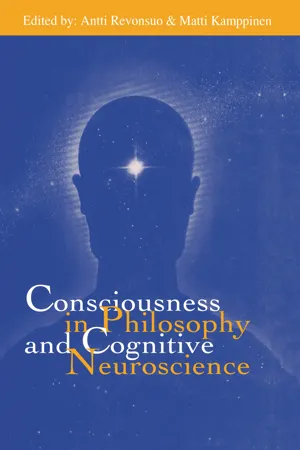
Consciousness seems to be an enigmatic phenomenon: it is difficult to imagine how our perceptions of the world and our inner thoughts, sensations and feelings could be related to the immensely complicated biological organ we call the brain. This volume presents the thoughts of some of the leading philosophers and cognitive scientists who have recently participated in the discussion of the status of consciousness in science. The focus of inquiry is the question: "Is it possible to incorporate consciousness into science?" Philosophers have suggested different alternatives -- some think that consciousness should be altogether eliminated from science because it is not a real phenomenon, others that consciousness is a real, higher-level physical or neurobiological phenomenon, and still others that consciousness is fundamentally mysterious and beyond the reach of science. At the same time, however, several models or theories of the role of conscious processing in the brain have been developed in the more empirical cognitive sciences. It has been suggested that non-conscious processes must be sharply separated from conscious ones, and that the necessity of this distinction is manifested in the curious behavior of certain brain-damaged patients.
This book demonstrates the dialogue between philosophical and empirical points of view. The writers present alternative solutions to the brain-consciousness problem and they discuss how the unification of biological and psychological sciences could thus become feasible. Covering a large ground, this book shows how the philosophical and empirical problems are closely interconnected. From this interdisciplinary exploration emerges the conviction that consciousness can and should be a natural part of our scientific world view.
- 312 pages
- English
- ePUB (mobile friendly)
- Available on iOS & Android
eBook - ePub
Consciousness in Philosophy and Cognitive Neuroscience
About this book
Information
Publisher
Psychology PressYear
2013Print ISBN
9781138876446
9780805815092
Edition
1eBook ISBN
9781134783090
| IV | THE FUTURE OF CONSCIOUSNESS |
WILL WE GET AN EXPLANATION FOR CONSCIOUSNESS?
It would be most fascinating to catch a glimpse of the future course of science and philosophy. Will we make progress in solving the problem of consciousness, or will the pendulum swing back and forth, as it has been doing for several centuries, consciousness popping up every now and then as a central problem, attacked and found insoluble, then again forgotten or ignored until discovered anew? Philosophers of science usually track scientific theories and discoveries throughout history in order to reveal the hidden patterns of the march of science. But in the case of consciousness, we unfortunately do not possess the wisdom of hindsight. Instead, we are forced to fabricate the philosophy of future science.
Philosophers of science are concerned with such questions as what the aims of science are, whether or not science is progressive, and if it is, how it is possible to measure such progress. Some of them (e.g., Laudan, 1977) propose that the goal of science is the resolution or clarification of problems. Theories ought to provide clarifying answers to baffling problems, showing that what is the case is somehow intelligible and predictable. In Laudan’s terms, “Anything about the natural world which strikes us as odd, or otherwise in need of explanation, constitutes an empirical problem” (p. 15). Now there are few things that strike us as less odd than that “technicolour phenomenology arises from soggy gray matter” (McGinn, 1989, p. 349); that the crawling caterpillars and stagnant chrysalises of the brain are magically transformed into the brilliant flying butterflies and moths of conscious experience.
The time is ripe to proceed from mere bafflement towards attempted solutions, that is, theories and models of consciousness. However, as is typical of unsolved empirical problems, it is utterly obscure whose problem, precisely, the problem of consciousness in fact is. Which branch of science actually ought to take charge of the mission? From which domain of research should we expect empirical results and relevant theoretical insights? Presently, the division of labor is in a seriously confused state when it comes to consciousness. Prima facie, consciousness seems to belong to the domain of psychology. But psychology was in the grip of behaviorism and psychiatry, accordingly, in that of psychoanalytic theory. Even now that behaviorism is dead and psychoanalysis gradually declining to a historical curiosity, it is hard to come by any serious psychological discussion concerning consciousness. Instead, we have a wealth of other credos by means of which attempts are made to conquer the mountain: Theories and models of consciousness stretch from biological, neurobiological, and neuropsychological all the way to cognitive, computational, and even “neurophilosophical.” Furthermore, some think that nothing less than a revision at the level of quantum mechanics is called for and that quantum theory can leap over physics, chemistry, and biology, directly reaching the realm of consciousness. As if this were not enough, some claim that all conceivable theories of consciousness are, in principle, doomed from the start, because they commit false existential presuppositions. That is, all theories attempting to explain consciousness in some terms or other necessarily go astray because, in fact, consciousness does not even exist, and a theory of consciousness consequently is futile.
It is presently very unclear within which domain of scientific inquiry the problem of consciousness should fall, and whether or not it should fall within any domain at all. Perhaps most of the theories claiming their share of consciousness exemplify some of the branches of cognitive science. But if we hope for a resolution from that path, we must face another restraint. From the point of view of the philosophy of science, it is not at all obvious which kind of a science cognitive science strives to be. If it is taken to be just a label referring to practical collaboration between psychology, artificial intelligence, philosophy, linguistics, and brain research, we do not get very far, because then there is no separate theoretical domain that could be named “cognitive” and to which we should deliver both the credit and the blame for explanatory successes and failures. There would still be no one really in charge. If, on the other hand, we accept the strict notion of cognitive science, entailing that there is a unique domain of study for it under which conscious phenomena fall, then we ought to be able strictly to explicate the basic categories of this science and their relationships to other levels of natural phenomena. One would certainly like to know what those basic categories might be—the manipulation of symbolic representations, operations on those representations, computations? Pylyshyn (1989), for example, defended the view that cognition “is literally a species of computing, carried out in a particular type of biological mechanism” (p. 52). Churchland and Sejnowski (1992) believed that “brains are computational in nature” (p. ix) and that “nervous systems are themselves naturally evolved computers” (p. 7).
If the concepts of “computation,” “representation,” and “biological computer” are indeed the defining notions of cognitive inquiry, then it seems that cognitive science suffers from an exceptionally weak theoretical basis. Which kinds of entities are computations, representations, and computers? Are they natural phenomena? Do they form “natural kinds”? How are they empirically discovered and distinguished from other sorts of natural phenomena? Now, it seems questionable to assume that those terms name any natural processes at all. For example, computers are those physical systems that we decide to treat as computers: Sticks and stones can be used as sundials to “compute” time; pieces of plastic put together as a slide rule may be considered to be a look-up table computer. Churchland and Sejnowski (1992, p. 65) recognized this interest-relative dimension: “We count something as a computer because, and only when, its inputs and outputs can usefully and systematically be interpreted as representing the ordered pairs of some function that interests us.”
Can the basic notions of cognitive science thus be shown to be dependent on human interests and on the world already constructed by the human mind? If so, then those concepts cannot possibly be an adequate basis for a natural science whose purpose it is to explain the existence of the very same human consciousness already presupposed by its basic concepts. If a preexisting mind is needed to decide which items in the natural world count as computations and computers, then cognitive science explanations of consciousness amount to circularity. Worse still, if computers and computations are not natural kinds, they are not adequate categories of analysis for any natural science approach to consciousness. Natural sciences are involved with discovering and explaining natural phenomena, that is, phenomena that exist independently of human interests and viewpoints (Searle, 1992). Consciousness certainly seems to be a natural enough phenomenon, but the basic notions of cognitive science do not seem to equal, much less explain, consciousness.
In sum, from the viewpoint of the philosophy of science, explaining consciousness is far from a straightforward matter. Although Sperry (1987) proposed that the replacement of behaviorism by cognitivism was no less than “the consciousness revolution” in psychological science, it now seems that major reformations might still be called for before consciousness is adequately tamed. A not so far-fetched premonition insinuates that consciousness might prove to be a fatal test case for the adequacy of cognitivism. Perhaps the problem of consciousness forces out some fundamental conceptual inconsistencies in the basics of cognitive science, which went unnoticed so far. After all, the fact of consciousness will not go away. To date, many a theoretical Goliath has fallen in the face of that fact.
In chapter 9, Bernard J. Baars and James Newman focus on the borderline between the psychological and the neurobiological, seeking for a unification of theories at these two levels. Among the various natural sciences, there are hierarchical interconnections, and it is generally considered rational e.g., for the biologist to utilize chemical concepts when referring to organic microstructures. A theory of consciousness that makes absolutely no mention of the brain should then raise our doubts. However, cognitive science, at least in its classical form, is exactly like that: The level of neurobiological inquiry is merely compatible with but not positively relevant to theorizing at the cognitive level—one level of exploration entails nothing at all about the other. Now Baars’ global workspace theory of conscious experience (see Baars, chapter 7, this volume) clearly has a positively relevant relationship to inquiries at the level of brain neurophysiology. Brain function seems to be, in many cases, organized in a way we might expect on the basis of the global workspace theory. Much work needs to be done with the details, but Baars and Newman certainly have made a promising start. After all, it would have been quite within the bounds of possibility for them to discover that neurophysiology is merely compatible with the global workspace theory, or that neurophysiology entails the implausibility of Baars’ theory, or even that the two levels of description are inconsistent with each other—that neurophysiology entails at least a partial negation of the global workspace theory. Things did not turn out that way, so perhaps we are entitled to suspect that there might be a grain of truth in this approach.
The concept of consciousness clearly is a part of the folk-psychological framework, and philosophers of science have recently had violent debates about the fate of this everyman’s science in the jaws of scientific progress. Everybody uses folk psychology to understand the behavior of fellow humans and even of themselves. If a person walks into the kitchen but, after arriving there, is utterly confused about the reason for coming, he probably starts to think that he must have wanted something from there and that he believed that it can be found in the kitchen. Beliefs, desires, and the rest of our common sense psychological vocabulary are the cornerstones of folk psychology. Some philosophers think that the whole explanatory framework should and will go down the drain: There are in reality no such things to which folk-psychological concepts refer. The implication of this view is that also the concept of consciousness ought to be tossed onto the rubbish heap. But, as we noted previously, the fact of consciousness does not disappear even if talk about it is abandoned: We must have learned at least that lesson concerning the blind spots of behaviorism. In chapter 10, Raimo Tuomela presents a philosopher’s viewpoint of folk psychology. He argues that although folk-psychological concepts must undoubtedly be revised, it does not imply a wholesale ontological elimination of consciousness and other folk concepts.
In chapter 11, Antti Revonsuo launches the search for a unified science of consciousness. It seems that the multiplicity of various theories, models, and approaches is not only an innocent enrichment for the field but also a potentially damaging or even lethal condition that might inadvertently lead to persistent bedlam in consciousness research, gradually disgracing the scientific approach to consciousness altogether. “Let all the flowers bloom” is a lofty principle, but unfortunately the weeds may shadow and eventually smother the flowers if one has no idea which plants are the ones possibly bearing fruit. Revonsuo proposes that only a consensus concerning the fundamental character of consciousness can guide future empirical research: the nature of consciousness should be made as clear for cognitive science and psychology as the nature of life has been made for biology. Laudan (1977) declared that the first and essential acid test for any theory is whether or not it provides satisfactory solutions to important and interesting problems. In appraising the merits of scientific theories, it is more important to ask whether they constitute adequate answers to significant questions than it is to ask whether they are justifiable within the framework of contemporary epistemology. Revonsuo evaluates current theories and models of consciousness by scrutinizing how they account for two important questions any theory of consciousness ought to answer clearly and unambiguously. These questions he calls “the ontological problem” or “What, basically, are conscious phenomena?” and “the binding problem” or “What mechanism makes it possible for us to experience the world and objects in it as united and coherent, although the brain mechanisms in charge of those experiences are widely scattered throughout the brain?” Are there any theories that give plausible answers to both of these questions? If there are several, do they represent compatible or rival approaches? Do some theories ignore these questions altogether or provide preposterous answers that cannot be incorporated into a larger scientific world view? Such an inquisition might show the way to the dawning of a future science of consciousness.
REFERENCES
Churchland, P. S., & Sejnowski, T. J. (1992). The computational brain. Cambridge, MA: MIT Press.
Laudan, L. (1977). Progress and its problems. London: Routledge & Kegan Paul.
McGinn, C. (1989). Can we solve the mind–body problem? Mind, 98, 349–366.
Pylyshyn, Z. W. (1989). Computing in cognitive science. In M. I. Posner (Ed.), Foundations of cognitive science (pp. 49–92). Cambribge, MA: MIT Press.
Searle, J. R. (1992). The rediscovery of the mind. Cambridge, MA: MIT Press.
Sperry, R. W. (1987). Structure and significance of the consciousness revolution. The Journal of Mind and Behavior, 8, 37–66.
| 9 | A Neurobiological Interpretation of Global Workspace Theory |
The global workspace (GW) theory described in chapter 7 (this volume) has a natural neurophysiological interpretation. We can perform a neural contrastive analysis of conscious versus unconscious events to pinpoint brain structures and processes that are clearly related to consciousness as such. The most obvious examples are well-known structures whose lesioning abolishes conscious wakefulness: the brainstem reticular formation, the reticular nucleus of the thalamus, and the nonspecific spray of neurons that emerges from the intralaminar nucleus of the thalamus to “activate” the cortex (creating the distinctive electrophysiological signature of waking consciousness). Further, studies of blindsight from damage to the primary visual projection area (V1) make a persuasive case that the contents of a conscious visual experience depend on an intact area V1. Similar results have been reported for the somatosensory primary projection area and the auditory primary projection area. This system of neural structures can indeed be interpreted as a high-level global workspace. In addition to the lesioning evidence, they appear to fit two general properties of global workspace systems, namely competition for input to the GW and widespread dissemination of its output (Baars, 1993; Newman & Baars, 1994). Recent PET scan studies of novel versus automatic perceptual-motor skills show very widespread high glucose utilization when the task is novel and therefore more conscious followed by a dramatic drop in metabolic activity as it becomes automatic, precisely as would be expected from GW theory.
Two major points made in chapter 7 (this volume) are basic to this chapter:
1. We can specify a reliable set of constraints that an adequ...
Table of contents
- Cover
- Halftitle
- Title
- Copyright
- Contents
- Contributors
- Preface
- General Introduction: The Riddle of Consciousness
- I What is Consciousness?
- II The Properties of Consciousness
- III Models of Consciousness
- IV The Future of Consciousness
- Author Index
- Subject Index
Trusted by 375,005 students
Access to over 1.5 million titles for a fair monthly price.
Study more efficiently using our study tools.
Frequently asked questions
Yes, you can cancel anytime from the Subscription tab in your account settings on the Perlego website. Your subscription will stay active until the end of your current billing period. Learn how to cancel your subscription
No, books cannot be downloaded as external files, such as PDFs, for use outside of Perlego. However, you can download books within the Perlego app for offline reading on mobile or tablet. Learn how to download books offline
Perlego offers two plans: Essential and Complete
- Essential is ideal for learners and professionals who enjoy exploring a wide range of subjects. Access the Essential Library with 800,000+ trusted titles and best-sellers across business, personal growth, and the humanities. Includes unlimited reading time and Standard Read Aloud voice.
- Complete: Perfect for advanced learners and researchers needing full, unrestricted access. Unlock 1.5M+ books across hundreds of subjects, including academic and specialized titles. The Complete Plan also includes advanced features like Premium Read Aloud and Research Assistant.
We are an online textbook subscription service, where you can get access to an entire online library for less than the price of a single book per month. With over 1.5 million books across 990+ topics, we’ve got you covered! Learn about our mission
Look out for the read-aloud symbol on your next book to see if you can listen to it. The read-aloud tool reads text aloud for you, highlighting the text as it is being read. You can pause it, speed it up and slow it down. Learn more about Read Aloud
Yes! You can use the Perlego app on both iOS and Android devices to read anytime, anywhere — even offline. Perfect for commutes or when you’re on the go.
Please note we cannot support devices running on iOS 13 and Android 7 or earlier. Learn more about using the app
Please note we cannot support devices running on iOS 13 and Android 7 or earlier. Learn more about using the app
Yes, you can access Consciousness in Philosophy and Cognitive Neuroscience by Antti Revonsuo,Matti Kamppinen in PDF and/or ePUB format, as well as other popular books in Psychology & Cognitive Psychology & Cognition. We have over 1.5 million books available in our catalogue for you to explore.