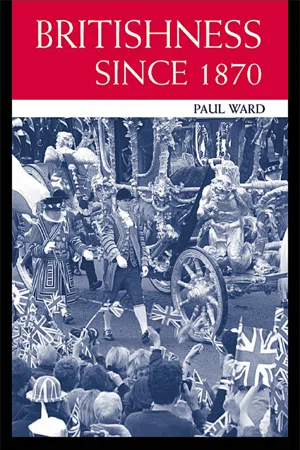
1 Monarchy and Empire
From at least the late nineteenth to at least the late twentieth century monarchy was seen as central to British national identity. Between 1876, when Disraeli gave Queen Victoria the title of Empress of India, and 1953, the monarchy was fundamentally entwined with the idea and reality of the British Empire. They were seen together as forming two basic foundations upon which Britishness could be built. As Robert Roberts recalled of his schooldays in Salford before the First World War, loyalty to the nation and state was loyalty also to both monarch and Empire:
We drew Union Jacks, hung classrooms with flags of the dominions and gazed with pride as they pointed out those massed areas of red on the world map. ‘This, and this, and this’, they said, ‘belong to us!’ When next King George [V] with his queen came on a state visit we were ready, together with 30,000 other children, to ask in song, and then . . . tell him precisely the ‘meaning of Empire Day’.1
The coronation of Elizabeth II in 1953, after the loss of India from the Empire (though not from the Commonwealth), continued to link monarch to Empire. David Cannadine has pointed out that the coronation
was still avowedly an imperial occasion, with the queen’s dress containing embroidered emblems of the dominions, with Regiments of Commonwealth and colonial troops marching in procession, with the prime ministers of the Dominions and India present in the Abbey, and an assortment of heads of state from various exotic colonial protectorates.2
The monarchy was seen as a device to maintain the loyalty of the dominions and colonies. Arthur Balfour, prime minister from 1902 to 1905, pointed out that ‘The King . . . is the greatest constitutional bond uniting together in a single Empire communities of free men separated by half the circumference of the globe.’3 Divisions within the United Kingdom too, it was hoped, could be overcome through the unifying vehicles of monarch and Empire. On the outbreak of war in 1939, for example, George VI became patron of the Empire
Day Movement.4 This chapter therefore discusses the monarchy and imperialism together, because they were intended in many ways to perform the same function of forging Britishness, and because they were seen as so fundamentally linked. As David Cannadine has argued, there was a convergence between hierarchy and the British Empire, with the monarchy at the top.5 It is clear, though, that there are also separate issues involved between monarchy and Empire, not least the survival of the centrality of monarchy to nation after the ending of Empire. Sir John Stokes, Conservative MP between 1974 and 1992, could therefore still argue in 1984 that ‘The monarch embodies the whole nation and gives us a sense of history, continuity and cohesion’, without reference to the Empire in British history.6
Furthermore, the historiographies of monarchy and imperialism in relation to British national identity have been largely separate. The study of the domestic impact of imperialism was pioneered by John MacKenzie in his book Propaganda and Empire. He argued that British society was subject to an ideological imperialist barrage through ‘vehicles of imperial propaganda’ from which there was no escape for the population between the 1880s and the 1960s. The British people received the imperial message from school textbooks and teachers, juvenile literature, youth movements, the churches, music hall, theatre, propagandist societies, exhibitions, cinema, radio and political parties, mainly, but not exclusively, the Conservatives. The imperial message also appeared in commercial advertising and packaging. Imperialism itself became a commodity to be sold to the British public. MacKenzie quotes John Julius Norwich, who remembered that in the 1930s, ‘Empire was all around us, celebrated on our biscuit tins, chronicled on our cigarette cards, part of the fabric of our lives. We were all imperialists then.’7 John Benson has, though, noted that while ‘consumption played some part in fostering British national consciousness, it also helped to reinforce other forms of identification – especially with the Dominions, with England, Wales and Scotland, and with particular regions and localities’.8
In this view, the big imperial celebrations, often part of royal occasions, were but part of a continuum with everyday expressions of imperialism. This connects with the recent conceptual work of Michael Billig, who describes ‘banal nationalism’ as ‘the ideological habits which enable the established nations of the West to be reproduced . . . Daily, the nation is indicated or “flagged” in the lives of its citizenry.’9 We might want to invoke the term banal imperialism rather than nationalism (while nonetheless not repudiating the links between the imperial and the national), but it should be clear that while empire and imperialism were extraordinary, exciting and out there, they were also centred in the metropolis, indeed in the cities, towns, villages, suburbs and homes of the imperial British ‘race’. As Raphael Samuel has remarked, ‘the imperial and the domestic’ were linked.10 They were often linked through the monarchy in architecture, coins, stamps and letterboxes as well as in ‘an amalgam of names, places, buildings, images, statues, rituals and observances’.11
In the view of MacKenzie and the ‘Manchester school’, imperialism held sway over British culture and values from the onset of ‘new’ imperialism in the 1870s, surviving the First and Second World Wars and into the 1960s.12 Michael Caine in Zulu in 1963 consoled the British that as their Empire fell the whole affair had been marked by dignity and bravery, involving not only soldiers of different classes, signified in the overcoming of the tensions between the aristocratic and middle-class officers, but also with the involvement of a Welsh regiment signifying the ‘British’ nature of the Empire. At a critical moment in the battle, the Welshness of these British soldiers is vocally revealed when the men break into the singing of ‘Men of Harlech’.13 Imperialism was therefore pervasive in British culture even after the end of Empire.
Two alternative interpretations can be set against the MacKenzie approach. Richard Price provides a necessary nuance to the debate by his implicit argument that the impact of imperialism in Britain was affected by other social identities. Writing in the early 1970s, Price stressed the importance of class. In his study of the impact of the Boer War on metropolitan Britain he argued that the working class were largely indifferent to the war in particular and the Empire in general, being more concerned with ‘the immediate and material’, that is the everyday struggle for life.14 Hence when the relief of Mafeking from an extended siege by the Boers was enthusiastically celebrated by large parts of the British population in May 1900, Bernard Porter, sharing Price’s approach, suggests that, ‘For the working classes who participated . . . the whole occasion was probably little more than a celebration of the safety of their comrades in uniform.’ Porter continues that between the wars, ‘as ever a good proportion of the working classes proved impervious to Empire Days, Empire Songs, Empire Essay Competitions, “Empire Meals on Empire Day”, and all other ingenious ploys of the imperialists’.15
These and like-minded historians suggest that the outpourings of public imperialist enthusiasm came from the middle class, who were denied the class loyalties of the aristocracy at one end of society and the organised working class at the other and looked instead to nation and Empire for a sense of collectivity. 16 The advantage of this approach is that it does see responses to imperialism as mediated by the social position of the individual, but it is rather a product of its time in its exclusive concentration on social class.
A third approach to understanding the impact of the Empire on the British comes from the imperial historian P. J. Marshall. He argues that the experience of imperialism did not divert the British but ‘seems to have accentuated certain trends already recognizable in pre-imperial England [sic]’ among which were a sense of uniqueness and superiority.17 While there is much to be said for this argument, given the clear evidence of a sense of authority and dominance among the English, at least, before imperialism, including the assumption that they were God’s Englishmen, it does rather underestimate the effects of imperialism on British society.
The monarchy has been absent from the discussion so far because it appears pretty much only as an appendage to imperialism despite its longer life – before and after – than the British Empire. MacKenzie, for example, sees monarchism as a component of an ‘ideological cluster’ comprising ‘a renewed militarism, a devotion to royalty, an identification and worship of national heroes . . . and racial ideas associated with Social Darwinism’ that constituted imperialist patriotism. 18 Monarchy does, however, have its own tradition of literature examining its relationship to national identity. First, there are the numerous celebratory materials accompanying royal events. These usually placed much emphasis upon the historical aspects of the ceremonial. The age of the institution was portrayed as an important part of the association of royalty to national identity. The King George’s Jubilee Trust, for example, explained the purpose of its production of Official Souvenir Programme of the Coronation of His Majesty King Edward VIII:
One of the principal objects of producing the Programme is to enable His Majesty’s subjects throughout the world to follow the Coronation service word for word when, as is expected, this is broadcast from Westminster Abbey. The section devoted to explaining the Coronation Ceremonial will help them to realise the symbolic character of the service, and will bring them in close touch with the historic ceremony.19
Such programmes were widely circulated, if not so widely read, and therefore retain importance in terms of the historical reading of royal ceremony. A second approach shown by literature on the monarchy is biographical. Royal biographies have been variously hagiographic, official, scurrilous, for entertainment and scholarly.20 A third recent approach has been the sceptical; works by Tom Nairn, Stephen Haseler and Edgar Wilson seek to explain the popularity of the monarchy, but also in turn seek to contribute to the end of the United Kingdom.21 In a sense, the products of these three varied approaches are primary source materials for examining attitudes towards monarchy in the time that they were written.
The fourth approach has more deliberately set out to examine the interrelationships between the monarchy and British society. In 1937 the newly founded social anthropological organisation Mass-Observation used observers to record people’s reactions to the coronation of George VI. In the same period, Kingsley Martin, editor of the New Statesman, wrote about ‘the magic of monarchy’. 22 It is in this tradition that historians have more recently approached the monarchy in relation to national identity. David Cannadine has argued that the monarchy was unpopular until the 1870s, after which its loss of political power and the development of cheap media enabled the ‘invention of tradition’ which contributed to the increasing popularity of the monarchy. Cannadine implicitly argues that traditions such as the elaborate ceremonial of jubilees and coronations were largely the work of a few individuals who intentionally sought to bring the monarchy more to the centre of the nation; so, in the Edwardian period, Viscount Esher, Edward VII and Elgar all contributed to the development of royal pageantry.23
The purpose of such pageantry was to cope with the stresses of a modern, urban, industrial society through an emphasis on the legitimacy and continuity of the monarchy in Britain. William H. Kuhn has usefully criticised Cannadine’s approach, pointing out the wider involvement than a narrow range of elite figures in the invention of tradition. He points out that more Liberals than Conservatives were involved in aiding the monarchy’s rise to the centre of national identity.24 Frank Prochaska sees the development of the monarch’s popularity as a result of the interplay of the royal family and the public through joint activity in pursuit of charitable ends. In this relationship, benefits came to both sides. The monarch not only supported charities through direct donations (Queen Victoria distributed £12,535 to 330 charities in 1882), but also provided patronage which encouraged citizens to charitable endeavours. In 1887 £80,000 was contributed by 2 million women as a ‘Women’s Jubilee Offering’ to the Queen. At the end of the twentieth century the Prince of Wales’s Charities handed out £1,367,230 in a single year and the involvement in AIDS charities by Princess Diana brought much praise. Prochaska’s conclusion about the 1920s and 1930s, when monarchies across Europe had toppled, is that, ‘There was more to the [British] monarchy’s survival strategy in the interwar years than salesmanship and insubstantial pageant. With its extensive network of patronages, the monarchy was well placed to assist the voluntary sector to deliver an array of much-needed social services.’25
This chapter continues by examining two ways in which the monarchy sought to establish its centrality to the nation: the function of royal ceremonial and celebration; and the development of the idea of a royal family. Both sections will show the profound links between monarchy and Empire, but also how the two could be so easily disengaged. Responses to the monarchy and Empire, as explained above, were affected by the variety of social identities of the British people, and the main part of this chapter suggests ways in which monarchy and Empire have been mobilised to overcome potential divisions to develop a sense of Britishness.
Ceremony, celebration and the making of the nation as family
The celebration of the monarchy as the centripetal force of the nation must occur in the public domain. The monarch must be in touch with the people. The most noticeable way in which this occurs is in the construction of ceremonial and ritual and the celebration of these by the populace. There is therefore a dialogue occurring between the monarchy and its subjects. The monarch performs in the public arena, and the people, by acting as a willing audience, by actively participating in the spectacle, ensure the continued centrality of the monarch to the nation but also seek to ascribe values to the nation. Hence the sociologists Edward Shils and Michael Young described the 1953 coronation of Elizabeth II as ‘a great act of national communion’.26
Cannadine has described how ‘Between the late 1870s and 1914 . . . there was a fundamental change in the public image of the monarchy, as its ritual, hitherto inept, private and of limited appeal, became splendid, public and popular.’27 Developments in the media in the twentieth century enabled an increasing proportion of the population to be involved in such ritual, even if only as spectators from afar. The role of the British Broadcasting Corporation (BBC) has been crucial. The first Director-General, Lord Reith, ‘rapidly recognised the power of the medium [radio] to convey a sense of participation in ceremonial which had never been possible before’, and in the pos...