- 120 pages
- English
- ePUB (mobile friendly)
- Available on iOS & Android
eBook - ePub
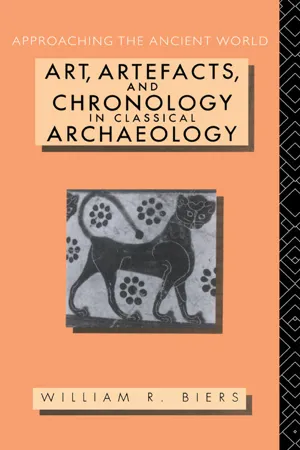
Art, Artefacts and Chronology in Classical Archaeology
About this book
The museums of the world are full of statues and other artefacts of the Greeks and the Romans. All are given a date. But how are these dates arrived at. What is the evidence?
This study provides the student with an introduction and explanation of the ways scholars date the archaeological remains of classical antiquity. Specific examples from architecture, sculpture, and painting are presented, and the differnt methods of dating them are explained. These are supplemented with many original photographs and drawings. Old, and not so old problems in chronology are thus investigated and new theories reviewed from a fresh perspective.
Chapter 1
Introduction: classical archaeology and chronology
The dictionary defines archaeology as being the scientific study of the material remains of past human activity. It is not strictly speaking a science, for its results cannot be replicated as in scientific experiments. The process of archaeology and some of its techniques can be scientific, but the discipline itself is more clearly a humanistic study in that it deals directly with material remains, the things made by humans in past times. This is one link between all the different types of archaeologies that have developed throughout the world. Whether exploring American Indian settlements in the American West, remains of medieval cities in Europe, shipwrecks under the sea, or frozen tombs in Siberia, the archaeologist concerns himself with physical remains, from the smallest objects to the largest buildings. All archaeology, as has been said, deals with physical objects and remains, and these can provide all sorts of information bearing on the life and times of the civilizations being studied; information and details not contained in any literary record that may exist. Not all this information necessarily has to come only from excavations, however. Much useful knowledge can be developed from surface surveys that seek to record and analyze remains that still exist on the surface of the ground over a specific area, looking for evidence of population density and patterns of habitation and use. Most surveying is done by topographical reconnaissance, but aerial photography has long been in use as a survey technique, joined more recently by other advanced survey methods that include geophysical investigations.1
Classical archaeology is that subdivision of the discipline of archaeology that concerns itself with the physical remains of the Greeks and the Romans. In one sense these two cultures can be seen as a unity, due to the strong influence of the earlier Hellenic culture on the Romans. Archaeologists tend, nevertheless, to be specialists in one culture or the other, thus mirroring the division between the Hellenist and the Romanist that is part of our academic culture and at least partially based on whether one reads primarily Greek or Latin! Classical archaeology traditionally concerns itself with these civilizations in their literate phases, beginning in the eighth century BC and ending sometime in Late Antiquity when the Greco-Roman civilization changes into the medieval world. The material remains of these civilizations sometimes can be considered as art, more often they are everyday objects of general use, but both have a part to play in providing information about the people who made and used or admired them.
It has been observed that art history deals with the history of aesthetically pleasing objects and archaeology covers everything else. In fact, classical archaeology quite often deals with artistically pleasing objects, which is one of its more attractive features. The archaeologist who works on Greek and Roman sites is fortunate that not only are the major works of antiquity, such as architecture, sculpture, and painting pleasing to the eye, but even many of the minor everyday articles are of high quality to the modern observer. There are also, typically, a great number of objects recovered at classical sites, and the amount of material that comes out of excavations is almost overwhelming, particularly from those in the urban centers of the classical world. Most of this material consists of what has been thrown away, discarded, or hidden intentionally, or simply lost. It is practically always broken, burned, or disfigured and often fragmentary. It can be a piece of sculpture that escaped the lime kiln or a single fragment of a common drinking cup. Ancient cemeteries, on the other hand, can provide relatively intact finds that were intentionally buried to accompany the dead, and these provide scholars with direct evidence concerning the ancient funerary customs as well as providing well-preserved examples of many categories of objects. Each excavated item is a portion of an overall story, and reconstructing that story is a part of the archaeologist’s job, as well as recovering the object from the earth in such a way that it is not harmed and that any evidence connected with it can be recovered and fully recorded.
Another feature of the discipline is that in the attempt to understand aspects of the ancient world from the objects, classical archaeology has the great advantage of dealing with literate civilizations, whose writings have been studied and interpreted for generations. From the time of Homer and Hesiod of the eighth century BC to Late Antiquity, a corpus of literature has been preserved that provides a great deal of information about the classical civilizations. The classical archaeologist has to fit his material into an already more or less established cultural framework. His evidence is, in one sense, direct evidence of the life of antiquity, unfiltered by an author, but the interpretation of what is found in the earth is often just as difficult, if not more so, than the decipherment and complete understanding of an obscure text.
These two positive features, the amount and quality of the archaeological material with which one deals and the wealth of literature that can be used as evidence, have also in a sense served to hold back the discipline of archaeology as it is practiced in classical lands. Archaeology in the lands around the Mediterranean started as a search for Beautiful Objects. This, together with the reliance on the ancient authors to provide cultural and historical information, perhaps led to a certain conservatism and an emphasis on organization and study of the constantly increasing mass of data derived from active fieldwork. Archaeologists in other areas, particularly in the New World, who were not bound by the traditions inherited by classical archaeology and did not have to deal with the great numbers of complex objects, developed new field techniques and new ways of interpreting the evidence derived from excavations that their colleagues in the Old World were slow to adopt. In many cases what seemed to be differences in research techniques between classical archaeology and New World archaeology were largely found to be differences in how they were described by their practitioners; however new approaches to looking at the archaeological evidence were developed and promoted by the so-called “new archaeology.” Classical archaeology found itself in a position to adapt or adopt what could be useful and meaningful for itself. This has happened to a certain extent, but there is still a gap between the archaeology of the New World and classical archaeology that is only occasionally bridged. Mostly the two branches of archaeology ignore each other.
What sort of evidence can classical archaeology provide to illuminate the world of the Greeks and the Romans? As has been mentioned, the general outlines of the Greek and Roman civilizations can be determined from the study of the vast literature associated with them. The basic political, military, and social histories of Athens and Rome are recorded, as is some detail concerning the day-to-day activities of their citizens, even if the information is frequently incomplete and of varying quality in different periods and areas. We also have at least a hazy notion of their religious practices and the general way of life of some people of the period, gleaned from the literature that has survived the centuries. What archaeology does is to give breadth and context to the written sources, providing a more complete view of the ancient world than is preserved in the literary tradition through the accidents of selection and preservation. Classical archaeologists are increasingly collecting and analyzing anthropological, zoological, botanical, and geological samples in an attempt to wring the most information possible from their excavated material.
This is almost a complete contrast to the situation that exists with our knowledge of the civilizations that flourished in classical lands in the Bronze Age. These cultures are termed “prehistoric,” not because they had no history, but because they flourished before written history, as we know it, existed. As a result, almost all we know of these cultures is derived from archaeology; indeed, many, such as the Minoan and Mycenaean civilizations of the Greek Bronze Age, were almost entirely unknown before the archaeologist’s spade. Although the worlds of Knossos and Mycenae of prehistoric Greece were dimly reflected in later Greek myth and literature, especially in the Homeric poems, it was not until excavators began to uncover their remains that they were actually discovered to have existed. Thus, it is mainly the actual remains of these civilizations that can be used to try and recover their history and way of life. With the exception of some inscriptional evidence, which is not historical or literary and capable of varied interpretations, all that remains are the ruins of buildings and what was recovered in them together with the contents of graves. Information on the physical environment, the diet and health of the people, their activities, and other details of life can only be determined for the Bronze Age through archaeology. Of all finds, pottery is still recovered in the greatest abundance in excavations, and for non-literate civilizations, such as those in the Bronze Age, it takes on a particular importance. To a great extent, the understanding of the Greek Bronze Age, for instance, is driven by transformations detected in the development of pottery, based on observed differences in shape or decoration, and these alterations are often taken as indicative of cultural, or even political or historical, changes. Typically, an individual site, or a portion of it, is excavated, and the pottery and other finds are studied and sequences developed for that one site. Attempts are then made to synthesize the evidence with other sites of the same culture to obtain some sort of coherent understanding of the civilization concerned and its development. The disadvantage of almost complete reliance on the archaeological record, naturally, is that it precludes certain types of evidence that can be gleaned from the written record. Moreover, the interpretation of evidence derived from excavations, no matter how scientifically conducted, is tricky at best, and the field of Bronze Age archaeology is beset with differing interpretations and constantly changing versions as excavations pile up more and more information.2
The evidence derived from the archaeology of historic civilizations is also, of course, subject to differing interpretations, and the added dimension of attempting to integrate the archaeological evidence with what we think we know from the literary tradition adds to the difficulty in coming to a “true” understanding. This will be demonstrated in Chapter 5 in relationship to the controversies concerning the chronology of the development of art and architecture in Greece of the sixth and early fifth centuries BC. As the amount of both literary and archaeological evidence increases as one goes later in time, a clearer integration of the two types of information can be achieved, and so major difficulties are more numerous in the earlier periods than in the later ones. However, that is not to say that there are no problems even in the later periods for which there is a relatively full documentation from both sources. One of these problems concerns the ability of archaeological data to provide historical information; in other words, can history actually be written from evidence derived from archaeological investigations, given the intricacies of interpretation inherent in a field that depends on often incomplete and ambiguous evidence? Many classical archaeologists were brought up to believe that one of archaeology’s goals was to add to history, and this question, a potentially vital one, has only recently been addressed. Clearly, archaeology can add to history, depending on one’s definition of the term. Even the greatest skeptic would allow that archaeology has added to our knowledge of the arts, crafts, and everyday life of antiquity. Its value, however, for the interpretation, illustration, or, indeed, recreation of history, that can be defined in this context as the record of past events, is perhaps debatable and may be a matter of degree rather than of absolutes. However, the difficulties and uncertainties of interpretation are frequently not emphasized enough by those who want to be able to read a coherent story from fractured and often incomplete remains.3
Examples of the kinds of information classical archaeology has provided are numerous. For the Greek world, for instance, excavations in the Athenian Agora, or market-place, have not only uncovered works of art and famous buildings known from our ancient sources but also artefacts and other buildings connected with the government of ancient Athens, thereby providing direct information on the workings of the administration of the ancient city. Much has been learned, for instance, about the day-to-day operations of the Athenian democracy that both illustrates and adds to the literary and historical evidence. Athens was in many ways unique in ancient Greece and not really representative of the Greek world of small, independent cities. There, archaeology has also made a contribution by investigating other smaller and perhaps more representative cities and small towns. Excavations in ancient Rome provide information about the city that was once the center of the western world, while, thanks to the preserving effects of the eruption of Vesuvius, the continuing investigations of Pompeii and Herculaneum offer a wealth of evidence concerning everyday life in smaller cities of the first century AD.4 Archaeological work throughout the vast expanses of the Roman Empire continues to provide information on the process of Romanization and the spread of Greek and Roman culture that had such an influence on the development of western civilization as we experience it today. Distinctive Roman building types occur throughout the Empire, and synthesizing studies are beginning to provide insights into sociological, technical, geographical, and historical aspects not fully considered before.5 Often the mere existence of archaeological remains discovered by surveys provides information. For instance, evidence derived from archaeology has been brought to bear on such subjects as land-use in Italy and the history, extent, and the military and political consequences of Rome’s fortifications on the edges of her Empire.
Greek painted pottery, particularly that from Athens, found all over the Greek world, preserves scenes of myth, cult, and everyday life that add immeasurably to our understanding of Greek life.6 Roman historical reliefs illustrate contemporary or near-contemporary historical events,7 and even such mundane objects as oil lamps can provide information as to methods of lighting in ancient times (Figures 21–3, pp. 55–8).8 In short, classical archaeology provides a great deal of information that can supplement and add to the rich textual tradition of the Greek and Roman world.
Excavations in classical lands have produced large numbers of finds, ranging from complete pots to unidentifiable scraps of pottery and metal to architectural remains, and even occasionally whole statues or wall paintings. The following chapters are concerned with how these individual fragments of a past world are dated; in other words, how their relationship in time to our own period is determined, and this is, of course, connected to the general questions of chronology and how it is determined. There are two ways of asserting the date of an object derived from an excavation, providing it has a recognizable form and enough is preserved to make sense of it. One of these sees it in relationship to other objects of the same kind made either before or after it. This is termed a “relative chronology,” for it dates the object in relation to other objects and assigns it a “relative date.” This is useful for an understanding of how objects develop over time, but not sufficient, since it does not relate the article to our own time, that is, it does not tell us how old it is, which is one of the first questions that is asked about any object from the ancient world. Since our method of time reckoning employs the year, the object must be placed within this framework and given a “date” of so many years BC or AD, or so many years before the present, usually expressed as “so many years ago.” The object then is not related to other objects of the same type but to an absolute scale, and this is known as “absolute chronology,” the object being given an “absolute date.” Any find can be dated either relatively or absolutely, or both relatively and absolutely, and the following chapters outline how this is done.
This chapter concludes with a simplified table of dates for general reference:

These dates are only approximate but represent a general agreement on the part of scholars as to the overall dates for the various periods listed. These periods are more or less a modern creation, rendered according to the time-scale in use today and made up from art historical or historical evidence, some of which is debatable. Many of the dates are conventional, such as the end of the Archaic period at the time of the Persian invasion in 480 BC and the death of Alexander the Great marking the beginning of the Hellenistic period in 323 BC; they bear little relation to reality, which did not arrange itself into such neat divisions. It must be emphasized that these modern divisions of the material are only generally applicable and that the numerical dates offer a precision not observable in real life.
Chapter 2
How time is recorded
The alternation of light and dark that forms day and night, the apparent movement of the sun in the sky, the waxing and waning of the moon, and the movement of the stars – all these natural phenomena were observed by ancient peoples. The concept of time – that something happened before or after something else – and the realization of its relation to changes in the natural habitat caused by the seasons must have developed quickly in the primitive mind. All ancient civilizations measured time based on these principles.1
In our own time a “day” contains periods of dark and light and begins at “midnight,” which falls during the period of darkness. In ancient times the perceived transit of the sun across the sky generally defined the unit of time known as a “day.” The division of the cycle of dark and light into twenty-four hours was already known in Egypt before 2000 BC, with t...
Table of contents
- Cover Page
- Title Page
- Copyright Page
- Contents
- Illustrations
- Preface
- Acknowledgments
- 1 Introduction: classical archaeology and chronology
- 2 How time is recorded
- 3 Relative dating
- 4 Absolute dating
- 5 Interpreting the evidence
- Notes
- Index
Trusted by 375,005 students
Access to over 1.5 million titles for a fair monthly price.
Study more efficiently using our study tools.
Frequently asked questions
Yes, you can cancel anytime from the Subscription tab in your account settings on the Perlego website. Your subscription will stay active until the end of your current billing period. Learn how to cancel your subscription
No, books cannot be downloaded as external files, such as PDFs, for use outside of Perlego. However, you can download books within the Perlego app for offline reading on mobile or tablet. Learn how to download books offline
Perlego offers two plans: Essential and Complete
- Essential is ideal for learners and professionals who enjoy exploring a wide range of subjects. Access the Essential Library with 800,000+ trusted titles and best-sellers across business, personal growth, and the humanities. Includes unlimited reading time and Standard Read Aloud voice.
- Complete: Perfect for advanced learners and researchers needing full, unrestricted access. Unlock 1.5M+ books across hundreds of subjects, including academic and specialized titles. The Complete Plan also includes advanced features like Premium Read Aloud and Research Assistant.
We are an online textbook subscription service, where you can get access to an entire online library for less than the price of a single book per month. With over 1.5 million books across 990+ topics, we’ve got you covered! Learn about our mission
Look out for the read-aloud symbol on your next book to see if you can listen to it. The read-aloud tool reads text aloud for you, highlighting the text as it is being read. You can pause it, speed it up and slow it down. Learn more about Read Aloud
Yes! You can use the Perlego app on both iOS and Android devices to read anytime, anywhere — even offline. Perfect for commutes or when you’re on the go.
Please note we cannot support devices running on iOS 13 and Android 7 or earlier. Learn more about using the app
Please note we cannot support devices running on iOS 13 and Android 7 or earlier. Learn more about using the app
Yes, you can access Art, Artefacts and Chronology in Classical Archaeology by William R. Biers in PDF and/or ePUB format, as well as other popular books in History & Ancient History. We have over 1.5 million books available in our catalogue for you to explore.