Behavioural and Mental Health Research, 2nd Edition is a thoroughly revised, updated, and expanded version of the invaluable guide to research skills for psychologists, psychiatrists, nurses, social workers, and graduates training in those disciplines. It provides a series of practical guidelines for starting and carrying through any research project: from selecting the most appropriate approach, using computers, and analysing data to applying for funding, writing reports, and even how to enjoy your research! This second edition also includes chapters on methods of assessment, studying people in their social settings, and service evaluation and audit methods.
By considering a wide spectrum of different research methods the book gives the reader an insight into the assumptions underlying research. Quantitative methods using group design are described without assuming an advanced level of statistical knowledge. Qualitative, language-based methods and single case studies are explored as possible alternatives.
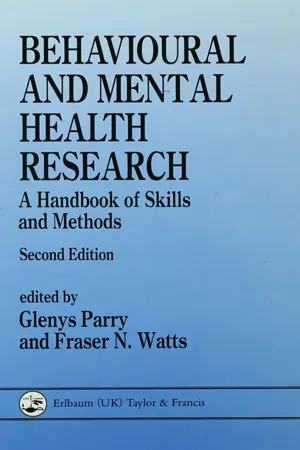
eBook - ePub
Behavioural and Mental Health Research
A Handbook of Skills and Methods
- 464 pages
- English
- ePUB (mobile friendly)
- Available on iOS & Android
eBook - ePub
Behavioural and Mental Health Research
A Handbook of Skills and Methods
About this book
Information
Publisher
Psychology PressYear
2013Print ISBN
9780863773884
9780863773877
Edition
1eBook ISBN
9781134834617
PART ONE
Skills
CHAPTER ONE
More fun, less stress: How to survive in research
Ray Hodgson and Stephen Rollnick
Cardiff Community Healthcare, Whitchurch Hospital, Cardiff
It is often said that stress is a feature of modern life. Therefore, stress management unsurprisingly is a bandwagon which is rapidly gaining momentum. Most airports and supermarkets display numerous books and articles on how to cope and how to succeed. It is very easy to find a self-help book which provides very practical advice on how to overcome stress, marital problems, alcoholism or all of these together. There are shelves full of paperbacks on how to succeed in management and how to delegate, with a strong emphasis on how to succeed without stress and without really trying. This is all well and good; but what has been published that will help the young, lively, questioning researcher who has great expectations but a lack of practical experience? As far as we know the answer is very little. The avowed aim of this chapter is therefore to provide what has come to be known as a ‘brief intervention’ which might help to prevent learned helplessness.
In the style of the non-conformist minister, John Wesley, we will begin by preaching doom and gloom, hellfire and damnation. Trouble awaits those unwary souls who believe that research flows smoothly and naturally from questions to answers via a well-organised data collection system. This is certainly not the case. Even the most experienced, systematic and hard-working research worker will have to face trials and tribulations before a project is successfully concluded. Hence to prevent relapse into more comfortable lifestyles, the problems encountered in carrying out a research investigation must be clearly anticipated. The following may appear to be simply a list of aphorisms but actually they are laws of nature. Ignore them at your peril!
1. GETTING STARTED WILL TAKE AT LEAST AS LONG AS THE DATA COLLECTION
This is not a problem provided that everybody is aware that this is the case and forward planning takes this law into account. Settling upon a key question, choosing a population or client group, devising questionnaires and a research design, guiding the proposal through the appropriate ethical committees and obtaining the co-operation of others are just a few of the time-consuming activities that seem to continue until somebody says that's enough. There may be a PhD at stake, and so one member of the team keeps adding extra conditions or novel questionnaires to make sure that his/her PhD has a strong base. The questions to be asked and the methods of answering them will repeatedly change. Complicated subsidiary projects will be grafted on until everybody is happy. We know of one study that took over 4 years to get started and about 3 years to collect the data. Although we were not closely involved we do know that the team members began to imagine that the project would never get off the ground and yet, when finally published, the study turned out to be very influential. The job satisfaction of the research team would have been much greater had they known about rule number one.
2. THE NUMBER OF AVAILABLE SUBJECTS WILL BE ONE-TENTH OF YOUR FIRST ESTIMATE
It is well known that if a particular disorder is being researched then people suffering from that problem seem to leave the district. The wider the net is spread the further they go. Recently, a trainee clinical psychologist in South Glamorgan decided that obese subjects would be very easy to obtain, and so obesity was chosen as the topic of his dissertation. You would imagine, as he did, that many people suffering from obesity would welcome the opportunity to discuss their problem with a psychologist and to obtain some advice on changing habits and self-management. Discussions with GPs indicated that at least forty subjects would be referred within a couple of months and the trainee was almost overcome by a sense of joyful anticipation. Six months later a desperate situation arose when the deadline for data collection had passed and still only three suitable clients had been referred.
Obtaining subjects is like betting on a horse. The most realistic assumption to make is that your expectations will turn out to be wrong.
3. COMPLETION OF A RESEARCH PROJECT WILL TAKE TWICE AS LONG AS YOUR LAST ESTIMATE AND THREE TIMES AS LONG AS YOUR FIRST ESTIMATE
A piece of research will almost never take less than the first estimate unless it is drastically cut down to size. Of course it should be recognized that the first estimate will be a function of personality and cognitive style. Pessimists will tend to over-estimate the time needed to carry out a variety of research tasks. Our deliberations have taken this into account but it is a very minor factor since only optimists get involved in research. Very often a project takes so long that it is never completed, but we have left these failures out of the calculation when formulating our equations.
4. A RESEARCH PROJECT WILL CHANGE TWICE IN THE MIDDLE
One common misconception of the research process is responsible for a great deal of frustration. It is a popular view that a research worker progresses as smoothly as Sherlock Holmes from questions to answers via the systematic gathering of evidence. This is not the case, as the following typical example demonstrates. A few years ago, we decided to test out the effectiveness of Drinkwatchers groups for problem drinkers attempting to control their drinking. We obtained a small grant from the Medical Research Council and started to advertise. All we needed were thirty subjects from amongst the estimated 10,000 problem drinkers in South Glamorgan. One hundred and sixty problem drinkers answered the advertisement which deliberately did not provide details of the type of help that we were intending to provide. Of these only eight volunteered to join a Drinkwatchers group, three turned up to the first meeting and one of these came to the second. There was no choice but to abandon our original plans. Since one of us had been appointed for a year to carry out a small-scale study our only option was to change the project. Our first change of direction focused upon our advertising and the general messages that we were communicating (e.g. alcoholism, alcohol and health, or alcohol and fitness). Such an investigation turned out to be unrealistic and the project ended up answering the question: what sort of help do problem drinkers really want?
Unlike some politicians, research workers have to respond flexibly when their cherished models begin to break up and well-laid plans go haywire. Funding bodies as well as apprentice researchers should be made aware that even the most experienced research workers have to do U-turns and S-bends in the middle of a project.
5. THE HELP PROVIDED BY OTHER PEOPLE HAS A HALF-LIFE OF TWO WEEKS
It is very difficult to say No when an enthusiastic and earnest research worker accosts you in the corridor. On the other hand, it is very easy to forget a promise to help. Most research projects rely upon some cooperation from others but it is wise to assume that actions won't speak as loud as words. If you are relying on ratings from nurses, spouses or GPs then you will have to set up a regular monitoring system to ensure that these tasks are carried out to your satisfaction.
6. THE TEDIUM OF RESEARCH IS DIRECTLY PROPORTIONAL TO ITS OBJECTIVITY
Some research workers manage to make use of interesting and productive research strategies such as the semi-structured interview and naturalistic observation of social interactions. Unfortunately, some questions are not amenable to this sort of methodology but have to be answered by devising experimental investigations involving very specific objective and tedious measurements. It is not easy to sustain 6 months of research activity which comprises giving a battery of reaction-time tests to 100 subjects or observing speed of drinking in alcoholics. Most research involves some activities that are repetitive and boring, but then so do most jobs. Cabinet makers, space explorers and circus clowns all have to put up with a great deal of tedium if they are going to succeed in their chosen profession. This must be recognised so that ways of coping with the boredom can be devised.
7. THE EFFORT OF WRITING UP IS AN EXPONENTIAL FUNCTION OF THE TIME SINCE THE DATA WERE COLLECTED
Not everybody writes up as soon as, or even before, the data have been collected. If the raw data lie in a filing cabinet for a year then they are likely to stay there for 2 years. If they lie there for 4 years they will never escape and will certainly never be written up. One of us has a folder entitled ‘The inhibitory effects of mental set’ which contains data collected a quarter of a century ago and never written up. It is difficult to understand why these data were not thrown away 20 years ago.
8. EVIDENCE IS NEVER ENOUGH
Although research is beset with difficulties the rewards justify the effort. Good strong evidence from good solid research is the best way to change conceptual frameworks as well as the behaviour of policy makers and practitioners. Or is it? Unfortunately, rigid views are not susceptible to change even when the evidence is overwhelming. One very good example of this phenomenon is provided by the debate between Priestley, Lavoisier and other eighteenth-century chemists, about the existence of phlogiston. When metals are burned or calcinated the modern view is that they are turned into oxides as they combine with oxygen in the air. According to the phlogiston theory a totally different process occurs since a metal is not an element but a compound which gives out phlogiston when heated. Now a crucial test would be to weigh the metal before and after calcination. The phlogiston theory would be falsified if the metal actually gains weight when it is burned. This experiment was carried out and the phlogiston theory was certainly not supported. Calcination of a metal leads to an increase in weight. It turned out that such apparently conclusive evidence did not convince the phlogiston supporters since they responded by suggesting that phlogiston must be a substance having a negative weight or that the departure of phlogiston increased the density, and therefore the weight, of the substance which held it.
One piece of evidence is never enough and an important research finding could well be ignored if it conflicts with the prevailing view. The heated debate about controlled drinking for alcoholics is a good example which should make a fascinating field of study for future philosophers of science.
There are many other laws which should be taken into account. For example, every research worker will have regrets: they will regret that they didn't include a particular measure or a particular intervention. Research workers will spend too long squeezing every last pip out of a data set. On the other hand, most of them will spend too little time plotting graphs and getting to know their data. We must now remember, however, another law of nature which we have recently uncovered: those people who teach research methods and those who write chapters about research spend too much time concentrating on problems and not enough time on solutions. Bearing this law in mind we will now change the focus of our attention.
Our views have been coloured by our own interest in relapse and particularly the work of Alcoholics Anonymous. Every year thousands of research workers start off with good intentions and high ideals. They want to push forward the frontiers of science and to help their fellow human beings. Unfortunately, most of them give up the ghost before the year is out and relapse into a more settled way of life. There are a few simple ways of preventing such a relapse process, and most of them have been adopted by AA. The first is the most important.
A. FORM A TEAM
It is almost impossible to carry out research when working alone, especially if there are strong pressures to do everything but research, as there are in the UK National Health Service for example. In the summer of 1935 Bill Wilson, a New York stockbroker, and Robert Holbrook Smith, a doctor in Akron, Ohio, worked together to overcome their drinking problems and were able, together, to achieve and maintain the sobriety that had been so elusive while each battled alone. The subsequent evolution of Alcoholics Anonymous is a remarkable success story. From its inception in 1935 AA has grown into a worldwide organisation claiming well over one-million active members. Most members of AA attend one or two groups every week and rely upon the support of like-minded people with similar problems. We believe that the best way of getting research completed is to form a team of three or four people who are interested in answering similar questions. They should meet once a week to set specific objectives and solve specific problems. Such a team can work very efficiently. They can share out a variety of tasks such as identifying appropriate measures, reading the relevant literature and speaking with key people. More importantly, such a team develops a sense of cohesion and enthusiasm. Where two or three are gathered together a sense of purpose develops which can resist the strong personal and social pressures to relapse.
If a team is formed then it is important to discuss and clarify the aspirations of team members. An open and honest approach is particularly important for a research team. One issue that must be addressed from the start is the ordering of authors and how problems relating to publications can be solved.
The next best alternative is to form a support group: a network of people working in the same locality but researching different areas and asking different questions. Ideally, a small research team would also be members of a larger support group. This larger group would make sure that they keep up with developments in computing, statistics, measurement and methodology; and this larger support group might link up with other groups in different locations. Both of us have worked alone and also in a team. The experiences are totally different, and it is our contention that most research, and certainly most PhD research, flounders simply because of the lack of adequate social support.
B. ONE DAY AT A TIME
This famous AA catch-phrase economically captures a basic element of self-control or self-management. It is easy to be overwhelmed by the size of the task, and focusing upon smaller goals has a number of important consequences. As Weick (1984) observes:
Deliberate cultivation of a strategy of...
Table of contents
- Front Cover
- Half Title
- Title Page
- Copyright
- Contents
- List of Contributors
- Preface to the first edition
- Preface to the second edition
- PART ONE: Skills
- PART TWO: Methods
- Author Index
- Subject Index
Trusted by 375,005 students
Access to over 1.5 million titles for a fair monthly price.
Study more efficiently using our study tools.
Frequently asked questions
Yes, you can cancel anytime from the Subscription tab in your account settings on the Perlego website. Your subscription will stay active until the end of your current billing period. Learn how to cancel your subscription
No, books cannot be downloaded as external files, such as PDFs, for use outside of Perlego. However, you can download books within the Perlego app for offline reading on mobile or tablet. Learn how to download books offline
Perlego offers two plans: Essential and Complete
- Essential is ideal for learners and professionals who enjoy exploring a wide range of subjects. Access the Essential Library with 800,000+ trusted titles and best-sellers across business, personal growth, and the humanities. Includes unlimited reading time and Standard Read Aloud voice.
- Complete: Perfect for advanced learners and researchers needing full, unrestricted access. Unlock 1.5M+ books across hundreds of subjects, including academic and specialized titles. The Complete Plan also includes advanced features like Premium Read Aloud and Research Assistant.
We are an online textbook subscription service, where you can get access to an entire online library for less than the price of a single book per month. With over 1.5 million books across 990+ topics, we’ve got you covered! Learn about our mission
Look out for the read-aloud symbol on your next book to see if you can listen to it. The read-aloud tool reads text aloud for you, highlighting the text as it is being read. You can pause it, speed it up and slow it down. Learn more about Read Aloud
Yes! You can use the Perlego app on both iOS and Android devices to read anytime, anywhere — even offline. Perfect for commutes or when you’re on the go.
Please note we cannot support devices running on iOS 13 and Android 7 or earlier. Learn more about using the app
Please note we cannot support devices running on iOS 13 and Android 7 or earlier. Learn more about using the app
Yes, you can access Behavioural and Mental Health Research by Glenys Parry, Fraser Watts, Glenys Parry,Fraser Watts in PDF and/or ePUB format, as well as other popular books in Psychology & History & Theory in Psychology. We have over 1.5 million books available in our catalogue for you to explore.