- 616 pages
- English
- ePUB (mobile friendly)
- Available on iOS & Android
eBook - ePub
About this book
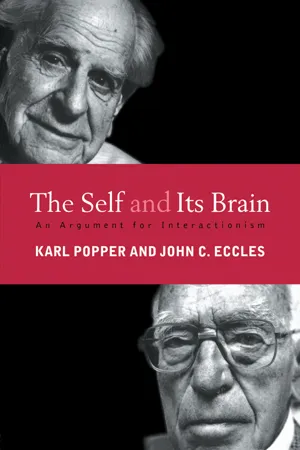
The relation between body and mind is one of the oldest riddles that has puzzled mankind. That material and mental events may interact is accepted even by the law: our mental capacity to concentrate on the task can be seriously reduced by drugs. Physical and chemical processes may act upon the mind; and when we are writing a difficult letter, our mind acts upon our body and, through a chain of physical events, upon the mind of the recipient of the letter. This is what the authors of this book call the 'interaction of mental and physical events'. We know very little about this interaction; and according to recent philosophical fashions this is explained by the alleged fact that we have brains but no thoughts. The authors of this book stress that they cannot solve the body mind problem; but they hope that they have been able to shed new light on it. Eccles especially with his theory that the brain is a detector and amplifier; a theory that has given rise to important new developments, including new and exciting experiments; and Popper with his highly controversial theory of 'World 3'. They show that certain fashionable solutions which have been offered fail to understand the seriousness of the problems of the emergence of life, or consciousness and of the creativity of our minds.
In Part I, Popper discusses the philosophical issue between dualist or even pluralist interaction on the one side, and materialism and parallelism on the other. There is also a historical review of these issues.
In Part II, Eccles examines the mind from the neurological standpoint: the structure of the brain and its functional performance under normal as well as abnormal circumstances. The result is a radical and intriguing hypothesis on the interaction between mental events and detailed neurological occurrences in the cerebral cortex.
Part III, based on twelve recorded conversations, reflects the exciting exchange between the authors as they attempt to come to terms with their opinions.
Information
Part I
Chapter P1 Materialism Transcends Itself
1. Kant’s Argument
Two things, says Kant near the end of his Critique of Practical Reason,1 fill his mind with always new and increasing admiration and respect: the starry heavens above him, and the moral law within him. The first of these two things symbolizes for him the problem of our knowledge about the physical universe,2 and the problem of our place in this universe. The second pertains to the invisible self, to the human personality (and to human freedom, as he explains). The first annihilates the importance of a man, considered as a part of the physical universe. The second raises immeasurably his value as an intelligent and responsible being.
I think that Kant is essentially right. As Josef Popper-Lynkeus once put it, every time a man dies, a whole universe is destroyed. (One realizes this when one identifies oneself with that man.) Human beings are irreplaceable; and in being irreplaceable they are clearly very different from machines. They are capable of enjoying life, and they are capable of suffering, and of facing death consciously. They are selves; they are ends in themselves, as Kant said.
This view seems to me incompatible with the materialist doctrine that men are machines.
In the present introductory chapter, my aim is to open up a number of problems, and to emphasize the importance of some things which should, perhaps, give the materialist or the physicalist pause. At the same time, I wish to do justice to the great historical achievements of materialism. But I wish to make clear, at once, that it is not my intention to raise any “what is” questions, such as “What is mind?” or “What is matter?”. (In fact, the need to avoid “what is” questions will turn out to be one of my major points.) It is still less my intention to answer such questions. (That is, I am not offering what is sometimes called an “ontology”.)
2. Men and Machines
The doctrine that men are machines, or robots, is a fairly old one. Its first clear and forceful formulation is due, it seems, to the title of a famous book by La Mettrie, Man a Machine [1747]; though the first writer to play with the idea of robots was Homer.1
Yet machines are clearly not ends in themselves, however complicated they may be. They may be valuable because of their usefulness, or because of their rarity; and a certain specimen may be valuable because of its historical uniqueness. But machines become valueless if they do not have a rarity value: if there are too many of a kind we are prepared to pay to have them removed. On the other hand, we value human lives in spite of the problem of overpopulation, the gravest of all social problems of our time. We respect even the life of a murderer.
It must admitted that, after two world wars, and under the threat of the new means for mass destruction, there has been a frightening deterioration of respect for human life in some strata of our society. This makes it particularly urgent to reaffirm in what follows a view from which we have, I think, no reason to deviate: the view that men are ends in themselves and not “just” machines.
We can divide those who uphold the doctrine that men are machines, or a similar doctrine, into two categories: those who deny the existence of mental events, of personal experiences, or of consciousness; or who say perhaps that the question whether such experiences exist is of minor importance and may be safely left open; and those who admit the existence of mental events, but assert that they are “epiphenomena” – that everything can be explained without them, since the material world is causally closed. But whether they belong to the one category or the other, both must neglect, it seems to me, the reality of human suffering, and the significance of the fight against unnecessary suffering.
Thus I regard the doctrine that men are machines not only as mistaken, but as prone to undermine a humanist ethics. However, this very reason makes it all the more necessary to stress that the great defenders of that doctrine – the great materialist philosophers – were, nevertheless, almost all upholders of humanist ethics. From Democritus and Lucretius to Herbert Feigl and Anthony Quinton, materialist philosophers have usually been humanists and fighters for freedom and enlightenment; and, sad to say, their opponents have sometimes been the opposite. Thus just because I regard materialism as mistaken – just because I do not believe that men are machines or automata – I wish to stress the great and indeed vital role which the materialist philosophy has played in the evolution of human thought, and of humanist ethics.
3. Materialism Transcends Itself
Materialism as a philosophic movement has been an inspiration to science. It has created two of the oldest and still most important of scientific research programmes, two opposed traditions, which merged only very recently. The one is the Parmenidean theory of the plenum, which developed into the continuity theory of matter and which has led with Faraday and Maxwell, Riemann, Clifford, and, in our own time, with Einstein, Schrodinger and Wheeler, to the field theory of matter, and to quantum geometrodynamics. The other is the atomism of Leucippus, Democritus, Epicurus and Lucretius, which has ultimately led to modern atomic theory, and to quantum mechanics.
Yet both these research programmes have to some extent transcended themselves. Both research programmes started from the theory that matter, in the sense of something extended in space, or occupying space (or parts of space), was ultimate; essential; substantial: an essence or substance neither capable of further explanation nor in need of it, and thus a principle in terms of which everything else had to be, and could be, explained. This view of matter was first superseded by Leibniz and Boscovich (see section 51 below). Modern physics contains explanatory theories of matter, and of the properties of matter, such as the property of occupying space (once called the property of “impenetrability”), or the properties of elasticity, of cohesion, and of the “states” of matter (or the “states of aggregation”: solid, liquid, or gaseous). In thus explaining matter and its properties modern physics transcended the original programme of materialism. In fact it was physics itself which produced by far the most important arguments against classical materialism.
I will briefly summarize the most important of these arguments. (See also sections 47–51, below.) The classical materialism of Leucippus or Democritus, like the later theories of Descartes or of Hobbes, assumes that matter or body or “extended substance” fills parts of space or perhaps the whole of space, and that a body can push another body. Push, or impact, becomes the explanation of causal interaction (“action by contact”). The world is a clockwork mechanism of bodies which push each other like cogwheels.
This theory was first transcended by Newtonian gravitation, which was (1) pull, not push and (2) action at a distance rather than action by contact. Newton himself found this absurd;1 but he and his successors (especially Lesage2) were unsuccessful in their attempts to explain gravitational pull as due to push. However, this first breach in the armour of classical materialism was repaired by an extension of the idea of materialism: gravitational pull was accepted by later Newtonians as an “essential” property of matter, neither capable nor in need of further explanation.3
One of the most important events in the history of the self-transcendence of materialism was J. J. Thomson’s discovery of the electron which he (and H. A. Lorentz) diagnosed as a tiny splinter of the atom. Thus the atom – by definition the indivisible – could be divided. This was bad; but one could adjust oneself to it by regarding the atoms as systems of smaller charged material particles, electrons and protons, which could be regarded as very small charged bits of matter.
The new theory could explain the push between pieces of matter (the “impenetrability of matter”) by the electrical repulsion of equally charged particles (the electron shells of the atoms). This was convincing, but it destroyed the idea that push was “essential”, depending on the essential space-filling property of matter, and that push was the model of all physical causal action. Other elementary particles are now known which cannot be interpreted as charged (or uncharged) bits of matter – matter in the sense of materialism – for they are unstable: they disintegrate. Moreover, even stable particles like electrons can be pairwise annihilated, with the production of photons (light quanta); and they can be created, out of a photon (a gamma ray). But light is not matter, though we may say that light and matter are forms of energy.
Thus the law of conservation of matter (and of mass) had to be given up. Matter is not “substance”, since it is not conserved: it can be destroyed, and it can be created. Even the most stable particles, the nucleons, can be destroyed by collision with their anti-particles, when their energy is transformed into light. Matter turns out to be highly packed energy, transformable into other forms of energy; and therefore something of the nature of a process, since it can be converted into other processes such as light and, of course, motion and heat.
Thus one may say that the results of modern physics suggest that we should give up the idea of a substance or essence.4 They suggest that there is no self-identical entity persisting during all changes in time (even though bits of matter do so under “ordinary” circumstances); that there is no essence which is the persisting carrier or possessor of the properties or qualities of a thing. The universe now appears to be not a collection of things, but an interacting set of events or processes (as stressed especially by A. N. Whitehead).
A modern physicist thus might well say that physical things – bodies, matter – have an atomic structure. But atoms have a structure in their turn, a structure that can hardly be described as “material”, and certainly not as “substantial”: with the programme of explaining the structure of matter, physics had to transcend materialism.
This whole development beyond materialism was a result of research into the structure of matter, into atoms, and thus a result of the materialist research programme itself. (This is why I am speaking of the self-transcendence of materialism.) It has left the importance and the reality of matter and of material things – atoms, molecules, and structures of molecules – unscathed. One might even say that it has led to a gain in reality. For as the history of materialism and especially of atomism shows, the reality of matter was regarded as dubious not only by idealist philosophers such as Berkeley and Hume but even by physicists such as Mach, at the very time of the rise of quantum theory. But since 1905 (Einstein’s paper on the molecular theory of Brownian motion), things began to look different; and even Mach changed his mind at least temporarily,5 not long before his death, when he was shown on a scintillation screen the flashes due to alpha particles, the fragments of disintegrating radium atoms. Atoms were accepted as really “real”, one might say, when they ceased to be “atomic”: when they ceased to be indivisible bits of matter; when they acquired a structure.
Thus the physical theory of matter may be said to be no longer materialist, even though it has retained much of its original character. It still operates with particles (although these are no longer confined to “bits of matter”), but it has added fields of forces, and various forms of radiating energy. But it is now bec...
Table of contents
- Cover
- Half Title
- Title Page
- Copyright Page
- Dedication
- Preface
- Acknowledgements
- Table of Contents
- PART I by Karl R. Popper
- PART II by John C. Eccles
- PART III Dialogues Between the Two Authors
- Index of Names
- Index of Subjects
Trusted by 375,005 students
Access to over 1.5 million titles for a fair monthly price.
Study more efficiently using our study tools.
Frequently asked questions
Yes, you can cancel anytime from the Subscription tab in your account settings on the Perlego website. Your subscription will stay active until the end of your current billing period. Learn how to cancel your subscription
No, books cannot be downloaded as external files, such as PDFs, for use outside of Perlego. However, you can download books within the Perlego app for offline reading on mobile or tablet. Learn how to download books offline
Perlego offers two plans: Essential and Complete
- Essential is ideal for learners and professionals who enjoy exploring a wide range of subjects. Access the Essential Library with 800,000+ trusted titles and best-sellers across business, personal growth, and the humanities. Includes unlimited reading time and Standard Read Aloud voice.
- Complete: Perfect for advanced learners and researchers needing full, unrestricted access. Unlock 1.5M+ books across hundreds of subjects, including academic and specialized titles. The Complete Plan also includes advanced features like Premium Read Aloud and Research Assistant.
We are an online textbook subscription service, where you can get access to an entire online library for less than the price of a single book per month. With over 1.5 million books across 990+ topics, we’ve got you covered! Learn about our mission
Look out for the read-aloud symbol on your next book to see if you can listen to it. The read-aloud tool reads text aloud for you, highlighting the text as it is being read. You can pause it, speed it up and slow it down. Learn more about Read Aloud
Yes! You can use the Perlego app on both iOS and Android devices to read anytime, anywhere — even offline. Perfect for commutes or when you’re on the go.
Please note we cannot support devices running on iOS 13 and Android 7 or earlier. Learn more about using the app
Please note we cannot support devices running on iOS 13 and Android 7 or earlier. Learn more about using the app
Yes, you can access The Self and Its Brain by John C. Eccles,Karl Popper in PDF and/or ePUB format, as well as other popular books in Philosophy & Mind & Body in Philosophy. We have over 1.5 million books available in our catalogue for you to explore.