- 226 pages
- English
- ePUB (mobile friendly)
- Available on iOS & Android
eBook - ePub
About this book
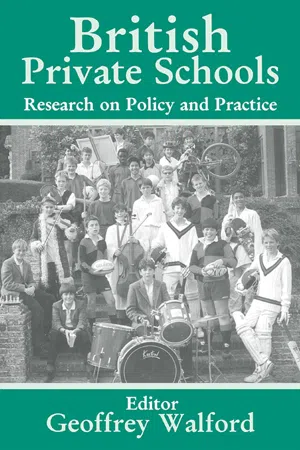
British private schools are a continuing topic of fascination for many. In particular, the leading so-called public schools have long been subjected both to criticism for their elitism and praise for their academic success. Traditionally, Conservative governments have strongly supported the private sector through special funding such as the Assisted Places Scheme, while Labour governments have reduced the private sector's support from the state and threatened to abolish it. However, the present new Labour government has reversed Labour's former oppostion to private schools and sought co-operation between the two sectors. This has led to an increasing interest in the realities of the private schools; and this book brings together the best of recently conducted research on the various aspects of private schooling, through a series of specially commissioned, previously unpublished essays.
Information
Part I
HISTORICAL PERSPECTIVES
1: From Labour to New Labour: Bridging the Divide between State and Private Schooling
Ted Tapper
INTERPRETING THE TRADITIONAL RELATIONSHIP
The private sector of schooling has always had an ambivalent relationship to the state. In the 1860s it was the spectre of government intervention that led to the foundation of the Headmasters’ Conference. Some of the leading headmasters felt the need to discuss in common their responses to the Victorian commissions of enquiry and, in particular, how they were to address their strictures (Tapper, 1997:21). Nonetheless, if the relationship has invariably been tense this has not prevented the schools contemplating government assistance during periods of financial crisis. In both the First and Second World Wars there were calls from leading public school figures for government aid. Crises of recruitment stimulated the demand for scholarship schemes underwritten by public monies (Le Quesne, 1970).
The purpose of the opening paragraph is to make the point that the analysis of the relationship between the Labour Party and the fee-paying sector of schooling needs to be placed within a wider context. The Labour Party is within the mainstream of British political life and it has been the governing party on several occasions since its foundation. It is inevitable, therefore, that the Party’s responses to private education have been shaped by its entrapment within this broader context. The Labour Party is a governing party with all the advantages and disadvantages that entails in its approach to social change.
The historical relationship between the Labour Party and the private schools can be interpreted in three different ways. For much of its history the Party’s educational policies have been driven by the desire to maximise equality of educational opportunity. Whilst the principle is sufficiently broad to encompass apparently different policy positions (for example, the acceptance of the tripartite model of secondary schooling after the 1944 Education Act and the advocacy of the comprehensive principle from the 1960s onwards), such a commitment makes it difficult to establish an accommodation with the fee-paying sector. The private sector offends the principle both directly, because it enables families to purchase a valued form of schooling, and indirectly because it questions the credibility of the state sector, that is, the implication by definition is that state schooling is inferior.
To follow the above line of argument is to imply that the Labour Party’s policy on private schooling has never been internally divisive. Or, at least, it is one of those policy areas that united more than it divided the Party across its ideological spectrum. However, social policy is not driven forward by only one dominant impulse. The drive for equality of educational opportunity was incorporated within a debate between those who saw schooling as creating opportunities for individuals (the meritocratic impulse) and those who saw it as a force for social change (the egalitarian impulse). But both camps could agree that ‘something needed to be done about the private sector’ for its presence offended both ‘the meritocrats’ and ‘the egalitarians’.
But, not surprisingly, the debate about what was to be done quickly opened up another important internal party fissure: to what extent could a governing party interfere with individual and institutional liberties (in this case the right of parents to purchase private schooling and of schools to charge fees) in order to achieve its social goals. Moreover, the Labour Party has been conscious of the need to win elections (although to both friends and critics the converse has occasionally seemed closer to the truth) and Labour governments needed to be aware of the constraints of the parliamentary process. So, even if the issue of private schooling has tended to bring the Labour Party together rather than reveal its internal contradictions (57 varieties!), the question of how to proceed has always been problematic. How else could it be in view of the desire to build brave new worlds whilst working within the constraints of established electoral and parliamentary traditions?
The pragmatic compromises suggested by the above line of argument are many. Perhaps the most notable is best described as stalling tactics. After the 1966 general election the Wilson government had more than a sufficiently commanding parliamentary majority to—at least in theory— take action, and yet the outcome was the appointment of the Public Schools Commission rather than action. The Commission, which had the obvious mandate of suggesting how closer relations between the state and fee-paying sections could be established, published its first Report in 1968 (Public Schools Commission, 1968). It satisfied few of the interested parties and was swiftly buried. The second Report, advocating the phasing out of public financial support for the direct grant schools, appeared in 1970 (Public Schools Commission, 1970). By then the Heath Government was in place and the Report was shelved. It was acted upon several years later with the return to office of the Labour Party and ironically, and disconcertingly for the Labour Party, the consequence was to increase the size of the independent sector rather than putting another nail in its coffin.
But a Labour government had learnt the art of government by prevarication from an impeccable source. This was precisely the tactic that Butler had employed to secure Churchill’s agreement to educational reform during the Second World War (Butler, 1971:120). The national government’s commitment to the 1944 Education Act was secured by Butler’s creation of the Fleming Committee, which had the task of considering ‘the public school’ question (Committee on Public Schools, 1944). The answer to the question was not forthcoming until legislation was almost on the statute book and, like the Public Schools Commission some 25 years hence, it provided an equally unacceptable answer. This is a beautiful example of very different governments, located in contrasting historical contexts but driven by similar parliamentary and societal pressures, coming up with the same solution—to stall. It illustrates the extent to which the political context creates a constraining environment within which all governments, regardless of the strength of their commitments and parliamentary majorities, have to act. And, furthermore, this is one of those issues apparently especially designed to encourage caution.
The strategy of prevarication is composed of some interesting ingredients. Labour Party hostility to private schooling would be more forthcoming in opposition than in government. Moreover, there could be clarion calls to action at party conferences only for them to be sidelined by Labour ministers. An important part of the strategy has been to threaten a number of alleged privileges that the fee-paying schools enjoyed, rather than challenge directly the principle that schools had the right to charge fees and parents to pay them. One consequence has been a very protracted debate on the charitable status of the schools. Do schools, which for the most part serve the more privileged members of society, have the right to charitable status given that, at least at face value, it would seem that a charitable pursuit should benefit the poorer members of society? This is a conundrum that has exercised some of the best legal minds over the centuries, led the Labour Party to threaten action on several occasions and the schools to mount vigorous defence campaigns (Tapper, 1997:54–75). But the interpretation of charitable status remains essentially the province of the courts and we still await intrusive legislative intervention. To be given charitable status is akin to being awarded a status symbol but it would be naïve to ignore the financial benefits that also accrue. Thus we enter the murky world of possible relief from both nationally and locally imposed taxation.
The most decisive political action against the interests of the feepaying sector has been the state’s steady withdrawal from paying the fees of privately educated pupils. This has been led mainly by the Labour Party and put in place as much at the local as at the national level. It is possible to interpret this long-term development as the manifestation of a coherent Labour-led strategy that would lead to the eventual demise of private schooling. In other words what has been interpreted as caution verging on cowardice is in fact part of a grand plan!
This alternative perspective rests upon the character of the relationship between the state and private sectors and, in particular, whether that relationship incorporates a significant element of pupil movement from the state to the private sector with fees paid for by the taxpayer. Over time the British educational system has developed pragmatically, some would say haphazardly. After the 1902 Education Act, local education authorities frequently brought places in secondary grammar schools in addition to, or in place of, building their own selective secondary schools. The 1944 Education Act made at least one major concession to the Labour Party: the selective grammar schools would be required to accept only publicly funded pupils who had successfully negotiated the required entrance hurdles (a clear attempt to put into operation the meritocratic principle). Those schools that were not willing to accept these terms would either close or become wholly fee-paying institutions. In other words, there was an intention to separate two worlds that had been entwined (Gosden, 1976:301–8). The only exception to the principle was the direct grant schools, and it was not until some 30 years later that the choice was also imposed upon them. Although it is evident that in 1944 elements within the Conservative Party, and especially Members of Parliament from those constituencies within which the direct grant schools were located, were in the vanguard of sustaining the direct grant principle, it is important to note that it was a national government, within which the Conservative Party was dominant, that took the first step to unravelling the interlocking worlds of private and state schooling. Thus again the point is made that it is unwise to polarise party policy unequivocally.
Of course what had been decided nationally could be undermined surreptitiously at the local level. Thus, local education authorities, if they were so minded, could find ways of channelling children who had been educated in the state sector into the private sector especially if they had persevering parents. So, accompanying the phasing out of the direct grant schools in the late 1970s was the closing of this apparent ‘loophole’ with stricter central guidelines on whose fees the local education authorities could, and could not, pay. The broad drift of the guidance was to permit payments if the child had special educational needs or talents (such as a gift for music) that could not be met in the local state schools. The intention therefore was to regulate and to limit the relationship, although there is a certain amount of irony in the fact that the armed services continued to pay the school fees of some of its personnel. As always, principle was regulated by pragmatism.
Once the separation had been completed then the goal was to create a level playing field with the expectation that the fee-paying sector would slowly wither on the vine. There would be two complementary dimensions to this policy: to improve the quality of schooling in the state sector whilst removing from the private schools those alleged privileges (such as charitable status) that apparently gave them unfair advantages. Thus parents would have no need to opt for private schools since the state schools would offer a quality education that was as good as, if not better than, that available in the private sector. Because it was a family tradition, a few parents might continue to choose a private education for their children but these would be insufficient in number to sustain a buoyant sector. Consequently, a declining fee-paying market would be steadily eroded, to disappear forever from the educational map.
It is impossible to demonstrate that many, indeed if any, within the Labour Party thought along such long-term strategic lines. However, it does provide a plausible way of analysing the developments in party policy that occurred between the 1944 Education Act and the emergence of New Labour. It most definitely helps us to appreciate the vitriolic hostility that greeted the Assisted Places Scheme (APS) in the early 1980s. Mrs Thatcher’s first government was, in the vivid metaphor of one of her Secretaries of State for Education and Science, Sir Keith Joseph, reversing the ratchet (Joseph, 1976). Moreover, it was a reversal that undermined a key stage in a strategy that presupposed the permanent separation of pupils in the private and state sectors. When returned to government it would require the Labour Party to unravel this counter-attack before it would be possible to move on to the promised land.
Of course, in reality there was no master plan. The three interpretations—of a broad-based principled opposition, of piecemeal pragmatism and of apparent long-term strategic thinking—interacted, overlapped and oscillated in importance over time. How else could it be, given the conflicts of principle within the Party, the differences as to how those principles should be put into effect, the failure of the Party to secure a consistent parliamentary majority and the need to work through the parliamentary process. But regardless of the constraints against taking decisive action, it is difficult not conclude that the Labour Party’s record up to the defeat of the Callaghan government in 1979 was, to put it mildly, disappointing. It failed both to curtail the overall strength of the private sector or to create a relationship between state and fee-paying schools that was widely supported and could be expected to endure. Not only did integration, however it was to be understood, remain an elusive goal but by 1979 it was not unreasonable to argue that state schooling itself was on the defensive and, moreover, the attack was being led by Callaghan himself (Lowe, 1997:68–9). Thus in a comparatively short space of time the feepaying schools changed their image from socially divisive, culturally isolated and pedagogically irrelevant institutions to desirable models of good practice.
THE POLICY MELTING POT
Whilst Callaghan’s government (the final ‘Old Labour’ administration?) undoubtedly started to question the ability of the state system of schooling to deliver higher educational standards, it took 18 years of successive Conservative governments to persuade the Labour Party that it needed to re-evaluate more broadly its understanding of the ends and means of schooling. The Labour Party has steadily redefined its policy positions in response to its exclusion from office with the intention of making itself reelectable. In the words of Pierson: ‘Labour Party policy on education (as on many other issues) has moved significantly in the past decade as it sought to re-position itself to win back power after a generation in the political wilderness’ (Pierson, 1998:139).
The consequences for the Labour Party’s relationship to private schooling have been profound. There are two key variables. First, New Labour governments are more ready to embrace the idea that they are prepared to underwrite the private provision of social goods with state monies. At least implicitly they accept the idea that sometimes the market can provide social goods more effectively than the state. But part of the definition of the effective provision of services is the attempt to achieve policy goals. Consequently, governments need to put accountability mechanisms in place that will require private sector organisations to achieve politically determined targets. The private providers therefore operate within the context of a negotiated regulatory framework. The strategy therefore is based upon the idea of a partnership between the state and the market to provide social goods. Even after five years in government, and two massive electoral successes, there is still bitter internal party controversy as to whether this is a desirable way forward but nonetheless the leadership of the parliamentary party remains determined to press ahead.
Secondly, New Labour has come to embrace the idea of diversification in the provision of schooling. ‘Bog-standard’ comprehensive schools are decidedly unfashionable so they are encouraged to seek specific labels that convey their particular strengths. The purpose is ea...
Table of contents
- COVER PAGE
- TITLE PAGE
- COPYRIGHT PAGE
- WOBURN EDUCATION SERIES
- NOTE ON CONTRIBUTORS
- INTRODUCTION
- PART I HISTORICAL PERSPECTIVES
- PART II PRESENT-DAY PRIVATE SCHOOLS
- PART III SCHOOL AND UNIVERSITY CHOICE
Trusted by 375,005 students
Access to over 1.5 million titles for a fair monthly price.
Study more efficiently using our study tools.
Frequently asked questions
Yes, you can cancel anytime from the Subscription tab in your account settings on the Perlego website. Your subscription will stay active until the end of your current billing period. Learn how to cancel your subscription
No, books cannot be downloaded as external files, such as PDFs, for use outside of Perlego. However, you can download books within the Perlego app for offline reading on mobile or tablet. Learn how to download books offline
Perlego offers two plans: Essential and Complete
- Essential is ideal for learners and professionals who enjoy exploring a wide range of subjects. Access the Essential Library with 800,000+ trusted titles and best-sellers across business, personal growth, and the humanities. Includes unlimited reading time and Standard Read Aloud voice.
- Complete: Perfect for advanced learners and researchers needing full, unrestricted access. Unlock 1.5M+ books across hundreds of subjects, including academic and specialized titles. The Complete Plan also includes advanced features like Premium Read Aloud and Research Assistant.
We are an online textbook subscription service, where you can get access to an entire online library for less than the price of a single book per month. With over 1.5 million books across 990+ topics, we’ve got you covered! Learn about our mission
Look out for the read-aloud symbol on your next book to see if you can listen to it. The read-aloud tool reads text aloud for you, highlighting the text as it is being read. You can pause it, speed it up and slow it down. Learn more about Read Aloud
Yes! You can use the Perlego app on both iOS and Android devices to read anytime, anywhere — even offline. Perfect for commutes or when you’re on the go.
Please note we cannot support devices running on iOS 13 and Android 7 or earlier. Learn more about using the app
Please note we cannot support devices running on iOS 13 and Android 7 or earlier. Learn more about using the app
Yes, you can access British Private Schools by Geoffrey Walford in PDF and/or ePUB format, as well as other popular books in Education & Education General. We have over 1.5 million books available in our catalogue for you to explore.