
- 220 pages
- English
- ePUB (mobile friendly)
- Available on iOS & Android
eBook - ePub
Heat Exchangers
About this book
This is a text/reference illustrating thermal and hydraulic design of heat exchangers. The book shows how to apply the fundamentals of thermodynamics, heat transfer, and fluid dynamics for a systematic analysis of the phenomena in heat exchangers, important to energy effective operation in process plants. Beginning with illustrative examples detailing applications of fundamentals, the text then shows the influence of flow configuration on the performance of heat exchangers. Here the equations to calculate mean temperature difference and efficiency for stirred tank, parallel, counter-and cross flow and their combinations are derived and put together in a new and very compact way. In some cases, short computer programs are given to evaluate more complicated formulas or algorithms. Chapter 3 is comprised of seven fully worked out examples showing application of the fundamentals to thermal and hydraulic design, i.e. sizing of heat exchangers. It includes problems and worked examples and is written in a self study format. The text should be useful to practicing engineers and also graduate students in chemical and mechanical engineering.
Information
CHAPTER
ONE
ONE
ANALYSIS OF SOME STANDARD TYPES OF HEAT EXCHANGERS ON AN ELEMENTARY BASIS
1. STIRRED TANK WITH JACKET
1.1 Description
The stirred tank, or stirred vessel, is one of the simplest and, at the same time, most versatile types of apparatus used in process engineering. In the model shown in Fig. 1.1, the vessel is put together from cylindrical, annular, and spherical shell segments according to structural analysis. The lower part has a double-walled construction with inlet and outlet headers, so that the contents of the vessel may be heated or cooled by a medium flowing through the jacket. In Fig. 1.2, this apparatus is drawn schematically with its most important functional features. The flows of mass and energy entering and leaving the vessel and the jacket are inserted into the sketch as arrows and denoted by symbols, such as Ṁ for mass flow rate, Q̇ for heat flow rate, and Ẇ for stirrer power, which are, if necessary, identified by subscripts for position, time, or state.
1.2 Formulation of Questions
In the next step, one has to become clear on the questions of which are exactly the unknown and which are the given—or, at least, to-be-fixed-in-advance—quantities. Reasonable questions in connection with heating a liquid in a stirred tank may be, for example,
a. How does the temperature of the contents of the vessel change with time after the steam inlet valve has been opened?
b. What is the consumption of heating steam?
c. What is the influence of the stirrer speed on the heating process?
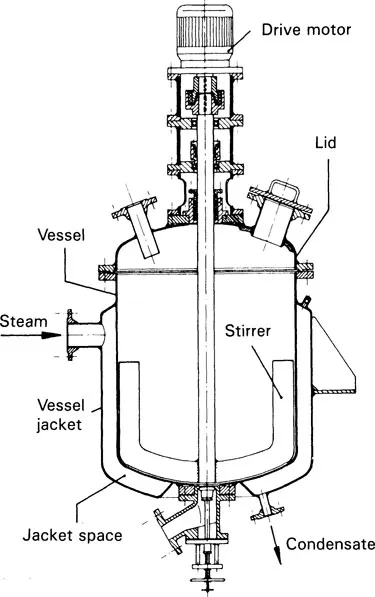
Figure 1.1 A stirred tank with jacket.
To answer these questions...
Table of contents
- Cover
- Half Title
- Title Page
- Copyright Page
- Table of Contents
- Preface to the English Edition
- Preface to the German Edition
- Chapter 1 Analysis of Some Standard Types of Heat Exchangers on an Elementary Basis
- Chapter 2 Influence of Flow Configuration on Heat Exchanger Performance
- Chapter 3 Examples in Heat Exchanger Design
- Chapter 4 Important Data for Thermal Design of Heat Exchangers
- Appendix A Crossflow over n Rows of Tubes
- Appendix B Temperature Variation and Efficiency of a Heat Exchanger with Three Passes in a Laterally Mixed Shell-Side Stream
- Appendix C Efficiency and Mean Temperature Difference of Heat Exchangers with One Shell Pass and Even Numbers of Tube Passes
- Symbols
- References
- Index
Trusted by 375,005 students
Access to over 1.5 million titles for a fair monthly price.
Study more efficiently using our study tools.
Frequently asked questions
Yes, you can cancel anytime from the Subscription tab in your account settings on the Perlego website. Your subscription will stay active until the end of your current billing period. Learn how to cancel your subscription
No, books cannot be downloaded as external files, such as PDFs, for use outside of Perlego. However, you can download books within the Perlego app for offline reading on mobile or tablet. Learn how to download books offline
Perlego offers two plans: Essential and Complete
- Essential is ideal for learners and professionals who enjoy exploring a wide range of subjects. Access the Essential Library with 800,000+ trusted titles and best-sellers across business, personal growth, and the humanities. Includes unlimited reading time and Standard Read Aloud voice.
- Complete: Perfect for advanced learners and researchers needing full, unrestricted access. Unlock 1.5M+ books across hundreds of subjects, including academic and specialized titles. The Complete Plan also includes advanced features like Premium Read Aloud and Research Assistant.
We are an online textbook subscription service, where you can get access to an entire online library for less than the price of a single book per month. With over 1.5 million books across 990+ topics, we’ve got you covered! Learn about our mission
Look out for the read-aloud symbol on your next book to see if you can listen to it. The read-aloud tool reads text aloud for you, highlighting the text as it is being read. You can pause it, speed it up and slow it down. Learn more about Read Aloud
Yes! You can use the Perlego app on both iOS and Android devices to read anytime, anywhere — even offline. Perfect for commutes or when you’re on the go.
Please note we cannot support devices running on iOS 13 and Android 7 or earlier. Learn more about using the app
Please note we cannot support devices running on iOS 13 and Android 7 or earlier. Learn more about using the app
Yes, you can access Heat Exchangers by Holger Martin in PDF and/or ePUB format, as well as other popular books in Technology & Engineering & Thermodynamics. We have over 1.5 million books available in our catalogue for you to explore.