The use of social sterotypes as a basis for judgments and behavioral decisions has been a major focus of social psychological theory and research since the field began. Although motivational and cognitive influences on stereotyping have been considered, these two general types of influence have rarely been conceptually integrated within a common theoretical framework. Nevertheless, almost every area of theoretical and empirical concern in social cognition--areas such as the interpretation of new information, memory and retrieval processes, impression formation, the use of heuristic vs. analytic processing strategies, the role of affect in information processing, and self-esteem maintenance--has implications for this important social phenomenon.
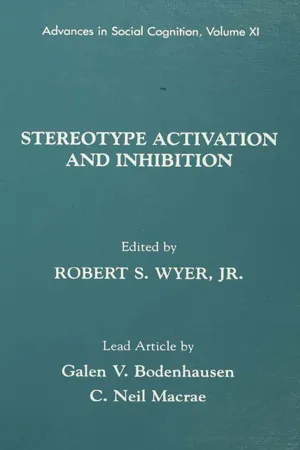
This volume's target article brings together the research of Galen Bodenhausen, Neil Macrae, and others within a theoretical framework that accounts for the processes that underlie both the activation of stereotypes and attempts to suppress their influence. They consider several stages of processing, including:
*the categorization of a stimulus person;
*the influence of this categorization on the interpretation of information about the stimulus person; and
*the social judgments and behavioral decisions that are ultimately made.
The stereotype activation and suppression mechanisms that the target article authors consider operate at all of these stages. Their conceptualization provides a framework within which the interrelatedness of processing at these stages can be understood.
The 11th in the series, this volume includes companion articles that help to refine and extend the target article's conceptualization and make important theoretical contributions in their own right. They are written by prominent researchers in cognitive and social psychology, many of whom are active contributors to research and theory on stereotyping. They address the following topics:
* the role of power and control in stereotype-based information processing;
* the influence of prejudice;
* self-regulatory processes;
* social categorization;
* the correction processes that result from perceptions of bias; and
* the conceptualization of stereotypes themselves.
eBook - ePub
Stereotype Activation and Inhibition
Advances in Social Cognition, Volume XI
- 280 pages
- English
- ePUB (mobile friendly)
- Available on iOS & Android
eBook - ePub
About this book
Information
Publisher
Psychology PressYear
2013Print ISBN
9780805823394
9780805823387
Edition
1eBook ISBN
9781134801855
Table of contents
- Cover
- Halftitle
- Title
- Copyright
- Contents
- Preface
- 1 Stereotype Activation and Inhibition
- 2 Context and the Social Self-Regulation of Stereotyping: Perception, Judgment, and Behavior
- 3 Beyond the Isolated Social Perceiver: Why Inhibit Stereotypes?
- 4 Inhibition, Aberdeen, and Other Cloudy Subjects
- 5 Further Evidence Regarding the Multiple Category Problem: The Roles of Attitude Accessibility and Hierarchical Control
- 6 Considering Correctness, Contrast, and Categorization in Stereotyping Phenomena
- 7 Rethinking Some Assumptions About Stereotype Inhibition: Do We Need to Correct Our Theories About Correction?
- 8 Rethinking the Role of Facilitation and Inhibition in Stereotyping
- 9 Power is Everywhere: Social Control and Personal Control Both Operate at Stereotype Activation, Interpretation, and Response
- 10 Stereotype Suppression in a Social Context
- 11 An Inhibited Model of Stereotype Inhibition
- 12 Varieties of Inhibition in Social Stereotyping
- 13 The Balance Between Excitation and Inhibition in Stereotype Use
- 14 On Social Judgment and Social Justice: Further Reflections on Stereotyping and Its Avoidance
- Author Index
- Subject Index
Trusted by 375,005 students
Access to over 1.5 million titles for a fair monthly price.
Study more efficiently using our study tools.
Frequently asked questions
Yes, you can cancel anytime from the Subscription tab in your account settings on the Perlego website. Your subscription will stay active until the end of your current billing period. Learn how to cancel your subscription
No, books cannot be downloaded as external files, such as PDFs, for use outside of Perlego. However, you can download books within the Perlego app for offline reading on mobile or tablet. Learn how to download books offline
Perlego offers two plans: Essential and Complete
- Essential is ideal for learners and professionals who enjoy exploring a wide range of subjects. Access the Essential Library with 800,000+ trusted titles and best-sellers across business, personal growth, and the humanities. Includes unlimited reading time and Standard Read Aloud voice.
- Complete: Perfect for advanced learners and researchers needing full, unrestricted access. Unlock 1.5M+ books across hundreds of subjects, including academic and specialized titles. The Complete Plan also includes advanced features like Premium Read Aloud and Research Assistant.
We are an online textbook subscription service, where you can get access to an entire online library for less than the price of a single book per month. With over 1.5 million books across 990+ topics, we’ve got you covered! Learn about our mission
Look out for the read-aloud symbol on your next book to see if you can listen to it. The read-aloud tool reads text aloud for you, highlighting the text as it is being read. You can pause it, speed it up and slow it down. Learn more about Read Aloud
Yes! You can use the Perlego app on both iOS and Android devices to read anytime, anywhere — even offline. Perfect for commutes or when you’re on the go.
Please note we cannot support devices running on iOS 13 and Android 7 or earlier. Learn more about using the app
Please note we cannot support devices running on iOS 13 and Android 7 or earlier. Learn more about using the app
Yes, you can access Stereotype Activation and Inhibition by Robert S. Wyer, Jr. in PDF and/or ePUB format, as well as other popular books in Psychology & History & Theory in Psychology. We have over 1.5 million books available in our catalogue for you to explore.