eBook - ePub
Infant Development
Ecological Perspectives
- 340 pages
- English
- ePUB (mobile friendly)
- Available on iOS & Android
eBook - ePub
About this book
This collection of essays by leading scholars in the field of childhood development focus on the critical issues and questions that need to be addressed at the beginning of the twenty-first century. Topics covered include the ecology of fetal development, birth and the newborn period, family ecology and infant development, infant care settings, gender influences on caregiving, culture, violence, poverty, substance abuse, social support, maternal age, risk and protective factors, the impact of legal and public policy, and historical, and future ecologies of infant development
Information
PATHWAYS TO DEVELOPMENTAL OUTCOMES IN PRETERM INFANTS
Catherine S. Tamis-LeMonda & Joanne Roberts
1
Birthweight-specific mortality has decreased tremendously over the past several years due to the use of surfactant and improvements in obstetric and neonatal intensive care. Consequently, there has been an increase in the number of preterm births over this time. As an example, from 1985 to 1995 the rate of preterm births rose 12%, from 10.0% to 11.0% of all births (March of Dimes Birth Defects Foundation, 1997). This increase has led to a growing concern about the consequences of low birthweight and its associated medical complications for infants’ developmental outcomes. Even moderately low birth weight infants are sometimes shown to be developmentally delayed and/or to suffer visual-motor impairments. Nonetheless, a great percentage of preterm infants evidence few if any developmental delays, and for many such infants initial delays virtually disappear over the course of the first few years of life. A complex web of biological, social, economic, and cultural factors explains the contrast between the seeming resilience of certain preterm infants and the vulnerability of others.
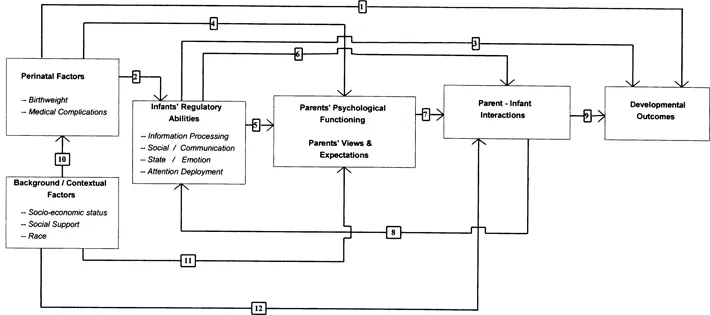
In the present chapter, a transactional, multifaceted approach is taken to understanding individual differences in the developmental trajectories of premature babies within their broader social contexts. This ecological approach is central to early diagnosis and prevention as well as to the implementation of effective interventions with infants who face the numerous obstacles associated with prematurity. figure 1 graphically depicts the model that will be discussed. A summary of the pathways in the model is in order. Low birthweight and associated medical complications in premature infants may directly influence developmental outcomes (Path 1) as well as indirectly influence outcomes through their effect on babies’ regulation of information processing, social-communicative, attentional, and emotional resources (Paths 2 and 3). In turn, infants’ perinatal status and associated regulatory difficulties may influence caregivers’ psychological functioning, views about, expectations for, and interactions with their young babies (Paths 4, 5, 6 and 7). The quality of parent-infant interactions further affects infants’ development of self-regulation (Path 8) and long-term outcomes (Path 9). In addition, the caregivers of preterm infants themselves experience a range of background/contextual factors (e.g., poverty; Path 10) that may be associated with infant perinatal status as well as further influence caregivers’ psychological functioning (Path 11) and interactions with their young babies (Path 12).
The model presented in figure 1 not only captures the plight of many premature infants, but can also be applied more generally to the ecological conditions of infants deemed to be “at risk” for other reasons, as for example, babies who are born to poverty. Thus, the focus on prematurity is meant to provide an illustrative example of the embedded contexts in which babies develop, and to further an understanding of the ways endogenous and exogenous risk and protective factors interact and influence infants more generally.
The chapter is structured around the pathways of influence presented in figure 1. We begin by discussing the medical complications or risk factors that often surround preterm birth and may directly affect a baby's long-term prognosis. We then discuss the role of babies' regulatory abilities in buffering or exacerbating the outcomes of prematurity, and address the ways in which these regulatory capacities affect and are affected by caregivers' psychological functioning, views, and behaviors. Finally, we consider the infant-caregiver relationship within its larger context by discussing factors that ameliorate and/or exacerbate the challenges faced by preterm infants and their families, such as social support and socioeconomic status.
PERINATAL FACTORS
Preterm infants are particularly vulnerable to low birthweight. Medical complications present at birth that may directly compromise their developmental outcomes (Path 1), as well as indirectly affecting their development through links to babies' regulatory abilities (Path 2) and parenting expectations (Path 4). Low birthweight infants are forty times more likely to die in the first month of life and twenty times more likely to die before the age of one (Rosenbaum, 1992). Despite these statistics, however, there has been a steady decline in birthweight-specific mortality over the past three decades, leading to a concomitant increase in investigations concerned with the long-term sequalae of prematurity, low birthweight and associated medical complications (Blackman, 1991; Landry, 1995).
Birthweight
Low birth weight is conventionally defined as less than 2,500 grams and very low birth weight is defined as less than 1,500 grams. In the United States, the major determinant of low birthweight is premature delivery (Paneth, 1995).
Figure 1 FACTORS CONTRIBUTING TO DEVELOPMENTAL OUTCOMES IN PRETERM INFANTS
Research indicates that low birthweight infants' risk for developing cognitive, attentional, and neuromotor problems increases as birthweight decreases (Hack, Klein, & Taylor, 1995); and preterm infants who are symmetrically small for gestational age (i.e., with head circumferences, length, and weight below the tenth percentile) are at increased risk of developmental delay (Vohr, Garcia-Coll, & Oh, 1990).
The rate of neuorological abnormalities for children weighing less than 1,000 grams at birth is approximately 20% (Teplin, Burchinal, Johnson-Martin, Humphry, & Kraybill, 1991; Saigal, Szatmari, Rosenbaum, Campbell, & King, 1991). Children weighing between 1,000 and 1,500 grams at birth have a 14% to 17% rate of neurological conditions, and children with a birthweight between 1, 500 and 2,499 grams have a 6% to 8% incident rate (McCormick, Brooks-Gunn, Workman-Daniels, Turner, & Peckman, 1992). Cerebral palsy is the most common neurological affliction in low birthweight children (Hack, et al., 1995). In the general population, the prevalence of cerebral palsy is 1.4 to 2.4 per 1,000 children (Pellegrino, 1997). Preterm infants who weigh less than 1,500 grams at birth are thirty times more likely to develop cerebral palsy than their fullterm counterparts (March of Dimes, 1997; Pellegrino, 1997). Moreover, low birthweight children have been found to score significantly lower on intelligence tests in comparison to their normal birthweight peers, and cognitive deficits are particularly pronounced for infants weighing less than 1,000 grams at birth (Hack, et al., 1995).
Medical Complications
The long-term prognosis of preterm babies is largely affected by the medical correlates of low birthweight, including respiratory distress syndrome (RDS), intraventricular hemorrhage (IVH) and bronchopulmonary dysplasia (BPD).
RDS is the most common physiological disorder of prematurity and results in increased levels of carbon dioxide and lowered levels of oxygen in the blood; over 50% of premature infants will have RDS (Sammons & Lewis, 1985). RDS is the fourth-leading cause of infant mortality and a leading cause of death for premature infants (MacDorman & Atkinson, 1998). RDS is the inability of the baby to breathe without support and represents a continuum of breathing problems from short breathing difficulties to a bronchopulmonary dysplasia (BPD). Babies who have BPD are at increased risk for neurodevelopmental abnormalities (Meisels, Plunkett, Roloff, Pasick, & Stiefel, 1986), particularly when placed under assisted ventilation for longer durations (Davidson, Schrayer, Weilunsky, Kricker, Lilos, & Reisner, 1990).
Intraperiventricular hemorrhage (IVH) occurs in approximately 40% of very low birthweight babies (less than 1,500 g) (Sell, Gaines, Gluckman, & Williams, 1985). Hemorrhages are classified on a scale from I to IV, with type IV— intraventricular hemorrhage with parenchymal hemorrhage— considered the most severe (Blackman, 1991). However, the presence of IVH does not necessarily indicate poor developmental outcomes, and its absence does not guarantee normal development. Nonetheless, children who have IVH perform more poorly on later indices of cognitive, motor, and neuromotor functioning (e.g., Lowe & Papile, 1990; Waikato, 1993), and developmental deficits seem to increase with the severity of hemorrhage (Papile, Munsick-Bruno, & Schaefer, 1983; Shankaran, Slovis, Bedard, & Poland, 1982). Because IVH does not typically occur without some form of RDS, it is sometimes difficult to disentangle the independent and relative contribution of IVH or RDS to developmental delays.
Infants' Self-Regulatory Abilities
While medical complications may directly affect the cognitive outcomes of preterm infants, a number of behavioral sequelae to prematurity exist that may mediate the eventual outcomes of these infants, in certain cases buffering and in others exacerbating the potentially deleterious effects of prematurity on babies' long-term functioning. Infants' ability to regulate resources necessary for effective information processing, attention, social/communicative exchanges and states and emotions may be of primary importance for optimizing interactions with individuals and objects in their environment. Limitations to regulatory abilities may directly affect babies' developmental outcomes (Path 3) as well as indirectly affecting outcomes through an effect on caregivers' psychological functioning, views, expectations, and behaviors (Paths 5 and 6). In contrast, infants who demonstrate more effective control of their regulatory capacities may be better able to negotiate and navigate their environments, and thus are somewhat protected against the challenges associated with low birthweight status.
Variation in regulatory abilities often portends long-term cognitive and social adjustment across infants generally (Path 3). Consequently, researchers have increasingly focused on whether and how regulatory mechanisms might underlie stabilities in children's cognitive and social functioning from infancy through the school-aged years (Rose & Tamis-LeMonda, 1999). In addition, developmental theorists have often asked whether and how constitutional factors in infants, including regulatory capacities, might contribute to a child's susceptibility or vulnerability in high-risk conditions (Rutter, 1985; Werner, 1993).
Information Processing
Information processing refers to an infant's ability to effectively and expediently access and retain information from the environment, and is most commonly assessed through paradigms such as habituation and recognition memory. In habituation paradigms the infant is exposed to a repeated stimulus, most typically a static visual display of geometric figures or familiar objects (e.g., faces) to assess patterns of decline in attention such as total looking time. Traditionally, the infant's response decline is thought to reflect the formation of a mental schema by the infant; thus, the time it takes an infant to habituate is thought to index the speed of information encoding. In the recognition memory paradigm, infants are initially presented with either a single visual stimulus or with two identical stimuli for a fixed period. The familiar and a novel stimulus are next presented simultaneously and differential responding is assessed during a test phase. Provided familiarization is sufficient, infants generally spend a greater percentage of the test time looking at the novel stimulus. This “novelty” response is thought to index processes of encoding, memory, retrieval, and discrimination.
Independent investigators using different stimuli, procedures, and populations, have provided converging evidence that visual information processing measures in infancy explain moderate variance in representational abilities and IQ performance in early childhood (e.g., Rose, Feldman, Wallace, & Cohen, 1991; Rose, Feldman, Wallace, & McCarton, 1991; Tamis-LeMonda & Bornstein, 1989, 1993).
Empirically, Rose and colleagues have identified significant differences between the performance of preterm and term infants as well as between preterms who have or have not experienced respiratory distress syndrome on information processing paradigms such as habituation and recognition memory (Rose, Feldman, Wallace, & Cohen, 1991; Rose, Feldman, Wallace, & McCarton, 1991). In an early study by Rose (1980), babies were brought to the laboratory when they were six months of age and were tested for recognition of abstract patterns and faces. Initially, when familiarization times were quite brief (five to twenty seconds, depending on the problem), only full-terms exhibited significant novelty preferences. However, preterms' performance improved dramatically when familiarization times were increased, suggesting that they were not as quick to encode the stimuli as their full-term counterparts. These findings were reinforced and extended in a second study in which the slower processing speed of preterms was found to persist through the first year of life (Rose, 1983). In a more recent longitudinal study in which the sample of preterms was restricted to those of very low birthweight infants (i.e., less than 1,500 g at birth), preterms not only had lower novelty scores than full-terms, but also took longer to accrue the required amounts of looking at the familiarization stimulus and showed less active comparison of the stimuli (Rose, Feldman, McCarton, & Wolfson, 1988).
Similarly, Ross and colleagues (Ross, Auld, Tesman, & Nass, 1992) compared preterm infants with and without IVH to full-term infants on habituation and novelty preference tasks as well as on Bayley Mental Development Index scores at ten months. They found poorer performance by preterm infants on information processing tasks, but differences between full and preterm infants were evident only in the presence of IVH. Babies with IVH took more trials to habituate (and fewer of them habituated at all) than the other two groups. Together, these findings suggest that a limitation to early information processing abilities may in part explain why some preterm infants continue to exhibit delays in cognitive functioning over time.
Social-Communication
Like information processing abilities, the ability to regulate social exchanges with primary caregivers is important for all infants, as social interactions provide meaningful information about the world, foster attachment security, encourage the further involvement of caregivers, and support the development of problem solving skills and language (Baumwell, Tamis-LeMonda, & Bornstein, 1997). For infants facing socio-economic or biological adversities, social regulatory capacities (e.g., successful achievement of joint attention with caregivers) may be an important “buffer” against such risks (Raver, 1996).
Numerous investigators have found that preterm infants have special difficulty in regulating their engagements with others, as indicated by increased gaze aversion, decreased joint play, and low levels of joint attention (see Landry, 1995, for a review). For example, Garner, Landry and Richardson (1991) examined the development of joint attention skills in both high-and low-risk low birthweight...
Table of contents
- Cover
- Half Title
- Full Title
- Copyright
- Contents
- Preface
- 1 PATHWAYS TO DEVELOPMENTAL OUTCOMES IN PRETERM INFANTS
- 2 INFANT ATTENTION AND THE DEVELOPMENT OF COGNITION: Does the Environment Moderate Continuity?
- 3 NUTRITION: How Does It Affect Cognitive and Behavioral Development in Young Children?
- 4 ECOLOGICAL INFLUENCES ON MOTHER-INFANT RELATIONSHIPS
- 5 UNDERSTANDING THE CAREGIVING PRACTICES OF ADOLESCENT MOTHERS
- 6 DAYCARE AND MATERNAL EMPLOYMENT IN THE 21ST CENTURY: Conflicts and Consequences for Infant Development
- 7 INFANTS' CHARACTERISTICS AND BEHAVIORS HELP SHAPE THEIR ENVIRONMENTS
- 8 WIDENING THE LENS: Viewing Fathers in Infants' Lives
- 9 ORIGINS OF ADDICTIVE BEHAVIOR: Structuring Pathways to Alcoholism during Infancy and Early Childhood
- 10 THE EFFECTS OF EXPOSURE TO VIOLENCE ON INFANTS: Current Perspectives and Directions for the Future
- 11 EARLY CHILDHOOD INTERVENTIONS: Now What?
- 12 RELATIONSHIPS AT RISK: The Policy Environment as a Context for Infant Development
- Contributors
- Author Index
- Subject Index
Trusted by 375,005 students
Access to over 1.5 million titles for a fair monthly price.
Study more efficiently using our study tools.
Frequently asked questions
Yes, you can cancel anytime from the Subscription tab in your account settings on the Perlego website. Your subscription will stay active until the end of your current billing period. Learn how to cancel your subscription
No, books cannot be downloaded as external files, such as PDFs, for use outside of Perlego. However, you can download books within the Perlego app for offline reading on mobile or tablet. Learn how to download books offline
Perlego offers two plans: Essential and Complete
- Essential is ideal for learners and professionals who enjoy exploring a wide range of subjects. Access the Essential Library with 800,000+ trusted titles and best-sellers across business, personal growth, and the humanities. Includes unlimited reading time and Standard Read Aloud voice.
- Complete: Perfect for advanced learners and researchers needing full, unrestricted access. Unlock 1.5M+ books across hundreds of subjects, including academic and specialized titles. The Complete Plan also includes advanced features like Premium Read Aloud and Research Assistant.
We are an online textbook subscription service, where you can get access to an entire online library for less than the price of a single book per month. With over 1.5 million books across 990+ topics, we’ve got you covered! Learn about our mission
Look out for the read-aloud symbol on your next book to see if you can listen to it. The read-aloud tool reads text aloud for you, highlighting the text as it is being read. You can pause it, speed it up and slow it down. Learn more about Read Aloud
Yes! You can use the Perlego app on both iOS and Android devices to read anytime, anywhere — even offline. Perfect for commutes or when you’re on the go.
Please note we cannot support devices running on iOS 13 and Android 7 or earlier. Learn more about using the app
Please note we cannot support devices running on iOS 13 and Android 7 or earlier. Learn more about using the app
Yes, you can access Infant Development by Hiram E. Fitzgerald,Katherine Karraker,Tom Luster in PDF and/or ePUB format, as well as other popular books in Education & Education General. We have over 1.5 million books available in our catalogue for you to explore.