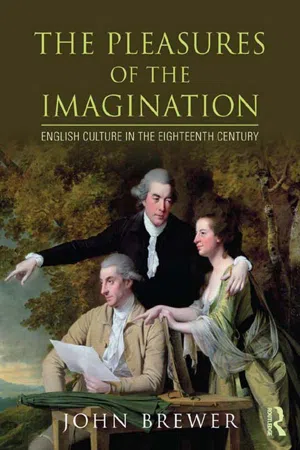
The Pleasures of the Imagination examines the birth and development of English "high culture" in the eighteenth century. It charts the growth of a literary and artistic world fostered by publishers, theatrical and musical impresarios, picture dealers and auctioneers, and presented to th public in coffee-houses, concert halls, libraries, theatres and pleasure gardens. In 1660, there were few professional authors, musicians and painters, no public concert series, galleries, newspaper critics or reviews. By the dawn of the nineteenth century they were all aprt of the cultural life of the nation.
John Brewer's enthralling book explains how this happened and recreates the world in which the great works of English eighteenth-century art were made. Its purpose is to show how literature, painting, music and the theatre were communicated to a public increasingly avid for them. It explores the alleys and garrets of Grub Street, rummages the shelves of bookshops and libraries, peers through printsellers' shop windows and into artists' studios, and slips behind the scenes at Drury Lane and Covent Garden. It takes us out of Gay and Boswell's London to visit the debating clubs, poetry circles, ballrooms, concert halls, music festivals, theatres and assemblies that made the culture of English provincial towns, and shows us how the national landscape became one of Britain's greatest cultural treasures. It reveals to us a picture of English artistic and literary life in the eighteenth century less familiar, but more suprising, more various and more convincing than any we have seen before.
High culture is less a set of discrete works of art than a phenomenon shaped by circles of conversation and criticism formed by its creators, distributors and consumers. In the sixteenth and seventeenth centuries in England such communities were largely confined to the royal court or, if found outside the ruler's palace, looked to the monarch and his entourage as leaders of taste. The court was the centre of high culture, its superiority expressed in its magnificent buildings, ornate tapestries, lavish decoration and exquisite collections of paintings, all of which created a glittering stage on which the drama of monarchy was enacted.
But in the late seventeenth century high culture moved out of the narrow confines of the court and into diverse spaces in London. It slipped out of palaces and into coffee houses, reading societies, debating clubs, assembly rooms, galleries and concert halls; ceasing to be the handmaiden of royal politics, it became the partner of commerce. Between the restoration of Charles II in 1660 and the accession of George III one hundred years later art, literature, music and the theatre were transformed into thriving commercial enterprises. These looked not to the court but to coffee houses, key places in creating new cultural communities, and to the clubs and associations which were among London's leading cultural patrons.
People at the time were much struck by this remarkable change. Whether they greeted it with enthusiasm or complained at the loss of a better age, the cultural life of London and its new institutions gripped them. Just as artists had once devoted themselves to depicting the court and its values, so London was now repeatedly represented on the stage, in prose and verse, in painting and engraved image. The city had become not only the centre of culture but one of its key subjects.
How did this change come about? To answer this question we have to look back to the court culture of the Tudors and early Stuarts and to the political circumstances that fatally undermined the credibility of the monarch and his entourage.
The English court of the sixteenth and seventeenth centuries, especially during the reigns of Henry VIII (1509–47), Elizabeth I (1558–1603) and Charles I (1625–49), followed the pattern of many monarchies throughout Europe. Royal courts were centres of national power, arenas where the struggles and alliances between monarchs and nobility were played out. Increasingly, as kings tried to reduce the military might of their most powerful subjects and as nobles came to accept humanist ideas that valued learning and taste as much as martial prowess, courts became centres of culture and refinement. Modelling themselves on the Italian courts at Florence, Urbino and Ferrara, the English monarchs and their courtiers created communities in which good conversation, taste and learning were cherished.
These values were embodied in the courtier, in his manners and elegant comportment -the gesture of a hand, the subtlety of a bow, a witty remark – but also in the objects with which he surrounded himself. From the Thames to the Danube princes urged their courtiers on a headlong pursuit of tasteful magnificence, the collection and display of everything rare, beautiful and wonderful. The Italian humanist Giovanni Pontano described these objects as ‘statues, pictures, tapestries, divans, chairs of ivory, cloth interwoven with gems, many-coloured boxes and coffers in the Arabian style, crystal vases and other things of this kind … [whose] sight … is pleasing and brings prestige to the owner of the house’. They all spoke to the wealth, taste and virtu of their owner. Rulers were in the forefront of this fashion, wrapping themselves in visual splendour and using their palaces, pictures, libraries and collections of curiosities to display both their exquisite taste and their divinely ordained authority.
For the monarch's courtiers cultural pursuits were a means to an end. Dancing, drawing, literary composition and the playing of musical instruments – those skills that the Italian Renaissance courts and their chief propagandist, Baldassare Castiglione, had made the essence of the noble courtier – were used as weapons in wars of personal intrigue and seduction designed to enhance the status of their possessor and win the monarch's favour. The monarch, at the apex of court power and centre of its ritual, and the greatest patron of the arts, was the cynosure of this culture, standing (or, more usually, sitting) at the centre of a system of artistic practice intended to represent his or her sacred omnipotence and monopoly of power.
At first sight the English court was not a prepossessing place in which to display such royal magnificence, for it consisted of a hotchpotch of asymmetric late-medieval buildings. It was intimate, local and particular, the personal territory of the ruler. In the chief palace, at Whitehall, the king's private servants and officials lived crammed together in close proximity to the monarch. Quite unlike the grand palaces of other European monarchs, it was a warren of ill-proportioned rooms and temporary structures erected for special occasions. Canvas banqueting halls put up to entertain foreign dignitaries were jumbled up with gardens, bowling alleys, a theatre and tennis court, as well as the monarch's private chambers and public receiving rooms. Repairs and alterations were constantly under way.
Yet, for all its architectural incoherence and its importance as a place of intrigue, the monarch and his followers thought of the court as a microcosm of how the kingdom ought to be, the harmonious expression of a social order centred on the monarch. Though its members were quarrelsome and contentious, in its literature, ceremony and theatre it represented itself as orderly, coherent and hierarchical. Within its narrow confines the court and its elaborate patterns of distinction were believed to reproduce the patterns of the knowable world. It was not necessary to represent anything else, because all things could be represented through the court.
Charles I's court represented the English apotheosis of this Renaissance ideal of kingship. The patron of Peter Paul Rubens, Van Dyck and Inigo Jones, Charles owned some of the finest pictures in Europe, including works by Leonardo, Correggio, Caravaggio, Mantegna, Raphael, Bronzino, Titian, Rembrandt and Dürer. ‘When it comes to fine pictures,’ said Rubens on his visit to London in 1629–30, ‘I have never seen such a large number in one place as in the royal palace.’
Ritual and ceremony complemented art, reaching their apogee in the court masque, a mixture of theatre, music, tableau and ritual, shaped by classical myths and Renaissance iconography, and performed by courtiers – sometimes including the king and queen themselves – before an audience of courtiers. The object of the masque was, in the words of the poet BenJonson, ‘the studie of magnificence’; it praised the mysteries of kingship, the organic unity of an obedient polity and the virtues of the monarch. The masque's extravagant costume and complex machinery were elaborately coordinated into a harmonious whole representing both court and nation. They revealed a natural order centred on the king: as Sir John Davenant put it in the masque Britannia Triumphans, performed in 1638, ‘Move then in such a noble order here/As if you each his governed planet were,/And he moved first, to move you in each sphere.’ Inigo Jones's scenery and the extravagant lyrics of the masque, like Charles's exquisite collection of paintings, were intended to create a world of beauty and harmony, a royal realm of moral and political virtue.
Yet, as Charles I was to discover to his cost, the illusion of a unitary, hierarchical, moral and orderly court – and with it a unitary polity – was exceptionally difficult to sustain. While Britannia Triumphans opened with a scene in which rebellious citizens of past reigns are dispelled by Heroic Virtue, faction, disorder and rebellion were much harder to deal with in British society. Within a decade of Davenant's eulogy to the king, its plot was reversed: Charles I had lost two civil wars and was the prisoner of his rebellious subjects. On 30 January 1649 he was led by his captors through the Banqueting Hall in Whitehall, where frequent court masques had celebrated divine kingship and whose ceiling, painted at his behest by Rubens, depicted the apotheosis of his father, James I (Figure 1.1). On a scaffold outside he was summarily decapitated. The culture of the courtly prince in England was killed by the same stroke. No British monarch was ever to match Charles I either as a patron of the arts or as the fabricator of such an astonishingly rich and complex representation of royal power.
Between 1649 and 1653 Charles I's magnificent collection of paintings was sold, and in the ensuing years the King's Musick, employing eighty-eight musicians, was radically reduced. Beyond the confines of the court the Puritans removed organs from places of worship (so that in 1660 there were more in taverns than in churches) and closed the playhouses. More than 100 years later Horace Walpole, the aristocratic author of Anecdotes of Painting in England (who, like a good eighteenth-century Whig, slept with a copy of Charles I's death warrant above his bed), commented that ‘the arts were, in a manner, expelled with the royal family from Britain’.
The Puritan regimes of Oliver Cromwell and his followers (1649–60), which replaced the house of Stuart, were those of the written and spoken word. They loved Scripture, enjoyed sermons, and produced a torrent of polemical print, but they despised and feared ritual and images as the symbols of worldliness, popery and arbitrary power. (Unsurprisingly, though the Puritans planned to transform the royal collection of books into a public library, they never contemplated housing Charles's pictures in a public museum.) Nevertheless there was some respite towards the end of the Protectorate in what was otherwise a bleak era for the arts. Oliver Cromwell, though not a prince, acquired a court, albeit a rather sober one. A great lover of music as long as it was not in church, he permitted private performances and secular court festivities; a few paintings and tapestries appeared at his residence at Hampton Court – Mantegna's enormous cartoons of The Triumph of Caesar were hung in the Long Gallery; Cromwell's bedroom was decorated with paintings of Vulcan, Mars and (less probably) Venus; antique marbles of nude men and women were displayed in the Privy Garden, much to the horror of the stricter supporters of the regime. Officially sanctioned theatre returned in the guise of opera, with the performance of William D'Avenant's The Cruelty of the Spaniards in Peru, held at the Cockpit in Drury Lane in 1658. But Cromwell's court was never a significant social or cultural centre, nor did artists make any serious attempt at an iconographical representation of the Puritan regime. Only in the field of literature, in the works of John Milton and Andrew Marvell, did the Cromwellian regime make any contribution to English culture.
Figure1.1The Apotheosis of James I by Peter Paul Rubens, c. 1635. Crown Copyright: Historical Royal Palaces.
After the restoration of the crown in 1660, first Charles II (1660–85) and then his brother James II (1685–88) aspired to recreate the monarchy of their father and even to emulate the lavish embodiment of royal authority epitomized by Louis XIV's Versailles. But this was no easy task. If the restored monarchy was to be more than a pale imitation of its predecessors and a weak copy of the extravagant absolutist regime across the Channel, it needed to build a palace that was a worthy home, symbol and stage for a powerful monarch, to have a fit setting for the artistic expression and performance of ideals of kingship.
Shortly before the outbreak of civil war Charles I had been working with Inigo Jones on a plan to erect a huge new palace at Whitehall. The king was still examining schemes for the building shortly before his execution. Charles II began where his father had left off, starting to construct two new palaces, one at Greenwich, the other at Winchester. Neither was ever completed. The palace at Winchester was to have been Charles's Versailles (Figure 1.2). Designed by Christopher Wren on land purported to be the meeting place of King Arthur's knights of the Round Table, it was to have been linked to the cathedral by a street of fine town houses to accommodate court servants and nobility. Like Versailles, it would have drawn the aristocracy away from the capital and into the monarch's exclusive orbit. Work began in 1683, at a time when the restored monarchy, having recently vanquished its Whig foes, was at the height of its power and prosperity. But Charles died two years later, and his successor James neglected the building, letting it fall into disrepair. Only an outer shell, the thinnest façade of monarchy, was ever completed. So the palace remained until it was burned down at the end of the nineteenth century. Its magnificent marble pillars, a gift to Charles from the Duke of Tuscany, were given away by the Hanoverians to the Duke of Bolton; the remnant of Wren's vision served as an enduring reminder of the unfulfilled aspirations of the ‘merry monarch’ and, more prosaically, as a prisoner-of-war camp and a local gaol.
No new palace was completed for the British monarchy until the nineteenth century. Its greatest achievements after the Restoration were, in the tradition of the modern middle classes, a succession of remodellings. Charles II spent lavishly on Windsor Castle, creating a splendid series of state apartments, notably St George's Hall. Here the full panoply of baroque symbolism and allegory, notably in Antonio Verrio's ceilings, celebrated monarchical power and virtue. James II made comparable improvements in the great rambling medieval palace at Whitehall. Apartments were designed by Wren, decorated by Grinling Gibbons and Verrio, hung with the last important set of tapestries to be ordered by a British monarch, and filled with paintings by such artists as Godfrey Kneller. Charles and James may have wanted to emulate the Sun King but...
Table of contents
Cover Page
Half Title Page
Title Page
Copyright Page
Table of Contents
Acknowledgements
Note to the Routledge edition
Preface
Introduction
Part I Contexts
Part II Print
Part III Paint
Part IV Performance
Part V Making a national heritage
Part VI Province and Nation
Part VII Britain
Conclusion
Bibliography
Index
Trusted by 375,005 students
Access to over 1.5 million titles for a fair monthly price.
Study more efficiently using our study tools.
Frequently asked questions
Yes, you can cancel anytime from the Subscription tab in your account settings on the Perlego website. Your subscription will stay active until the end of your current billing period. Learn how to cancel your subscription
No, books cannot be downloaded as external files, such as PDFs, for use outside of Perlego. However, you can download books within the Perlego app for offline reading on mobile or tablet. Learn how to download books offline
Perlego offers two plans: Essential and Complete
Essential is ideal for learners and professionals who enjoy exploring a wide range of subjects. Access the Essential Library with 800,000+ trusted titles and best-sellers across business, personal growth, and the humanities. Includes unlimited reading time and Standard Read Aloud voice.
Complete: Perfect for advanced learners and researchers needing full, unrestricted access. Unlock 1.5M+ books across hundreds of subjects, including academic and specialized titles. The Complete Plan also includes advanced features like Premium Read Aloud and Research Assistant.
Both plans are available with monthly, semester, or annual billing cycles.
We are an online textbook subscription service, where you can get access to an entire online library for less than the price of a single book per month. With over 1.5 million books across 990+ topics, we’ve got you covered! Learn about our mission
Look out for the read-aloud symbol on your next book to see if you can listen to it. The read-aloud tool reads text aloud for you, highlighting the text as it is being read. You can pause it, speed it up and slow it down. Learn more about Read Aloud
Yes! You can use the Perlego app on both iOS and Android devices to read anytime, anywhere — even offline. Perfect for commutes or when you’re on the go. Please note we cannot support devices running on iOS 13 and Android 7 or earlier. Learn more about using the app
Yes, you can access The Pleasures of the Imagination by John Brewer in PDF and/or ePUB format, as well as other popular books in History & History of Art. We have over 1.5 million books available in our catalogue for you to explore.