- 347 pages
- English
- ePUB (mobile friendly)
- Available on iOS & Android
eBook - ePub
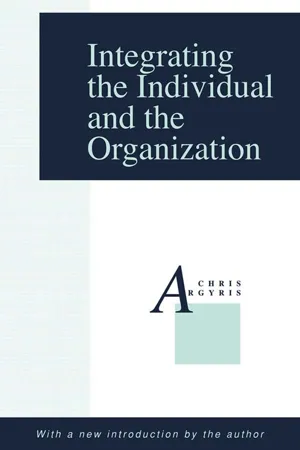
Integrating the Individual and the Organization
About this book
The emphasis on organizational change in the corporate life of recent years-including job redesign, autonomous groups, high performance work systems, and the redesign of control systems-owes a great deal to the pioneering work of Chris Argyris. This book examines how individuals in organizations can become more effective, in turn making organizations more effective. It explores the conventional pyramidal structure of organizations, in which there is top-down control by managers over workers, and examines their negative consequences. These include organizational injustice and eventually irrational decision-making. Argyris also discusses the characteristic learning system of the modern organization, which he describes as -single-loop- in character. This system, he argues, is only adequeate enough to permit the organization to implement existing policies. It does not permit the more difficult and comprehensive task of questioning underlying goals and assumptions, which he terms -doubt loop- learning. In this kind of learning, the organization is able to confront the more difficult problems that affect organizations in a time of transition. In his new introduction, Argyris reviews the strengths and limitations of the argument advanced in Integrating the Individual and the Organization. He describes why the pyramidal structure endures, and why creating a self-learning organization is an even more challenging task than he has imagined. The book will be of interest to professionals with a long-standing interest in organizational development as well as those just entering the field, managers confronting the challenge of organization change, and researchers in organizational behavior and theory.
PART I
Chapter 1
Introduction to Individual and Organizational Effectiveness
One of the main themes of this book is that the problem of integrating the individual and the organization is one in which both have to “give a little” to profit from each other. One of the major issues is how much should each “give”? Is it possible to maximize these relationships? I doubt it. Nor does an optimal integration seem likely in the near future. Borrowing from March and Simon,1 it is suggested that the best that can be offered in this book are some suggestions as to how to “satisfice” the relationships between the individual and the organization. Unlike optimizing, where a set of criteria exists that permits all alternatives to be compared and the alternative in question is preferred by these criteria, a “satisfactory” solution occurs when a set of criteria exists that describes minimally satisfactory alternatives, and the alternatives meet or exceed all these criteria.
Our objective is to do better than minimally satisfice, but we expect to be far short of optimizing. Some of the reasons for suggesting that this level of aspiration may be realistic follow.
The notion of effectiveness at any level of analysis is an extremely elusive concept. For some time the measure of business organization effectiveness could be discussed in one word, profit. During the last decade, it has almost become a fad to discuss the multi-objective business firm. Recently many organizational theorists have pointed out that measures of effectiveness should take into consideration numerous intervening variables such as personality, traditions, cognitive orientations, and others.
The moment one speaks of organizations that take the individual more into account, images are evoked ranging from organizations striving to make people happy, reduce work, treat them with kid gloves, to organizations that skillfully and covertly manipulate individuals so that they think they are happy when “we’ve got them all the time.”
We are interested in developing neither an overpowering manipulative organization nor organizations that will “keep people happy.” Happiness, morale, and satisfaction are not going to be highly relevant guides in our discussion. Individual competence, commitment, self-responsibility, fully functioning individuals, and active, viable, vital organizations will be the kinds of criteria that we will keep foremost in our minds. As we shall see, the former can be “painful” to the individual and the latter “painful” to the organization. But if these “pains” are necessary for increasing individual and organizational effectiveness, they will be included in our considerations.
In all fairness it should be pointed out that this trend away from “keeping people happy” has a long but, until recently, not carefully examined history. According to Erikson, even Freud emphasized, in addition to love, the importance of work in being a healthy person.2 Experimental evidence has been presented by Barker, Dembo, and Lewin showing that a certain amount of tension and frustration actually increases creativity in some children.3 Goldstein suggested that happiness can be akin to psychological death.4 Allport questioned the theory that the only basic need of man was to reduce tension. He pointed out that tension enhancement can be characteristic of healthy individuals.5 Lewin et al!6 showed experimentally that man has the capacity to develop realistic levels of aspiration which lead to a life of continually increasing (realistically) challenges. Maslow7 emphasized the importance of self-actualization; Rogers,8 the importance of striving to function fully; Allport,9 the importance of, and responsibilities involved in, “becoming”; White,10 the basic need to be competent and deal with one’s world effectively; Bruner,11 the intrinsic value of growth strivings. Fromm12 has suggested that modern man’s concept of freedom is one of being free from responsibilities. He argues that this concept must be changed to freedom to be more responsible.
Interestingly, some of the most eloquent and cogent arguments for the new emphasis have recently come from psychiatrists and others who lived through the horror of the German concentration camps. Bettelheim,13 for example, raises some serious questions concerning the value of psychoanalysis under extreme conditions and for developing effective “normal” relationships. Frankl further suggests that without responsibility to something outside of himself man is not able to be free. Responsibility is the criterion of freedom.14 In a more recent statement, Frankl writes:15
To be sure, man’s search for meaning and values may arouse inner tension rather than inner equilibrium. However, this is precisely that which is an indispensable prerequisite of mental health. There is nothing in the world, I venture to say, that would so effectively help one to survive even the worst conditions, as the knowledge that there is a meaning in his life. There is much wisdom in the words of Nietzsche: “He who has a why to live for can bear almost any how.” I see in these words a motto which holds true for any psychotherapy. In the concentration camps one could witness what was later confirmed by American psychiatrists both in Japan and Korea, that those who knew that there was a task waiting for them to fulfill were most apt to survive.
Thus, it can be seen that mental health is based on a certain degree of tension, the tension between what one has already achieved and what he still ought to accomplish, or the gap between what he is and what he should become. Such a tension is inherent in the human being and therefore is indispensable to mental well being. We should not, then, be hesitant about challenging man with meaning potentialities for him to actualize, thus evoking his will to meaning out of its latency. I consider it a dangerous misconception of mental hygiene to assume that what man needs in the first place, is equilibrium or, as it is called in biology, “homeostasis,” i.e., a tension-less state. What man actually needs is not a tension-less state but rather the striving and struggling for some goal worthy of him. What he needs is not the discharge of tension at any cost, but the call of a potential meaning waiting to be fulfilled by him.
Recently Wolf has asked that we consider if we are not making our society “too full” of security and too prevalent with dependence.16 Szasz has even gone so far as to hypothesize that our society encourages mental illness by overprotecting the individual who, because he behaves as if he is ill, is assumed to be ill.17
Leighton18 has suggested that social psychiatry’s primary responsibility is to society or a subgroup within a society. He cites examples in combat, at court, and within organizations where the group’s need must be kept in mind even though it may appear to be done at the expense of the individual: Leighton is careful to emphasize that this point of view does not relegate the individual to the background. It places greater emphasis on the individual’s contribution to society as well as the society’s capacity to provide a milieu in which psychologically healthy individuals can be developed. In short, it is the study of relatively healthy individuals that resulted in the new emphasis on man’s responsibilities and commitments.
Turning closer to organizations, Herzberg19 has suggested, and Schwartz, Jenusaitis, and Stark20 have confirmed, that the healthy individuals look for responsibility, develop commitments, and establish challenges. Vroom also found that workers who were highly involved in their jobs tended to obtain satisfactions from opportunities for self-expression.21 Haire22 has asked why man’s responsibilities and authority must be equal, noting that responsibilities assigned to people seem to be much greater than the authority given to them. Perhaps the attempt to balance them may lead to increased costs for the organization and the individual. Henry23 has recently suggested that the more competent executives were, the more they were in conflict and preoccupied. Cartwright,24 in a cogent inquiry into Whyte’s Organization Man, suggests that there is “productive conformity.”
It is in keeping, therefore, with a long and fine tradition to attempt to create a world in which man focuses on challenges that test and develop his self. It is our hypothesis that the incongruence between the individual and the organization can provide the basis for a continued challenge which, as it is fulfilled, will tend to help man to enhance his own growth and to develop organizations that will tend to be viable and effective. The incongruence between the individual and the organization can be the foundation for increasing the degree of effectiveness of both.
Historical Perspective
The problem of integrating the individual and the organization is not a new one. Scholars beginning with the ancient Greeks have made references to the impact of the organization on the individual. Apparently, Henri Saint-Simon was one of the first sociologically oriented thinkers to note the rise of modem organizational patterns. He predicted that organizations would play an increasingly important role in society. Comte, on the other hand, tended to suppress the positive aspects of formal organization. Comte was convinced that “spontaneous organization” was superior to planned organization.25 Weber, like Comte, feared that organizations could begin to destroy individual personality and subject it to a “dehumanizing regimentation.”26 The alarm concerning the impact on the individual of the formal industrial organization and its unilateral authority system was further reinforced by the work of Mayo and Roethlisberger. They and others disagreed with the apparent deemphasis of the human side of organization on the part of the “molecular approach” of men lik...
Table of contents
- Cover
- Half Title
- Title Page
- Copyright Page
- Dedication
- Table of Contents
- Introduction to the Transaction Edition
- Part One
- Part Two
- Part Three
- Part Four
- Appendix A Note on Essentiality, Interdependence of Parts, and Organizational Growth
- Name Index
- Subject Index
Trusted by 375,005 students
Access to over 1.5 million titles for a fair monthly price.
Study more efficiently using our study tools.
Frequently asked questions
Yes, you can cancel anytime from the Subscription tab in your account settings on the Perlego website. Your subscription will stay active until the end of your current billing period. Learn how to cancel your subscription
No, books cannot be downloaded as external files, such as PDFs, for use outside of Perlego. However, you can download books within the Perlego app for offline reading on mobile or tablet. Learn how to download books offline
Perlego offers two plans: Essential and Complete
- Essential is ideal for learners and professionals who enjoy exploring a wide range of subjects. Access the Essential Library with 800,000+ trusted titles and best-sellers across business, personal growth, and the humanities. Includes unlimited reading time and Standard Read Aloud voice.
- Complete: Perfect for advanced learners and researchers needing full, unrestricted access. Unlock 1.5M+ books across hundreds of subjects, including academic and specialized titles. The Complete Plan also includes advanced features like Premium Read Aloud and Research Assistant.
We are an online textbook subscription service, where you can get access to an entire online library for less than the price of a single book per month. With over 1.5 million books across 990+ topics, we’ve got you covered! Learn about our mission
Look out for the read-aloud symbol on your next book to see if you can listen to it. The read-aloud tool reads text aloud for you, highlighting the text as it is being read. You can pause it, speed it up and slow it down. Learn more about Read Aloud
Yes! You can use the Perlego app on both iOS and Android devices to read anytime, anywhere — even offline. Perfect for commutes or when you’re on the go.
Please note we cannot support devices running on iOS 13 and Android 7 or earlier. Learn more about using the app
Please note we cannot support devices running on iOS 13 and Android 7 or earlier. Learn more about using the app
Yes, you can access Integrating the Individual and the Organization by Chris Argyris in PDF and/or ePUB format, as well as other popular books in Business & Business General. We have over 1.5 million books available in our catalogue for you to explore.