- 424 pages
- English
- ePUB (mobile friendly)
- Available on iOS & Android
eBook - ePub
About this book
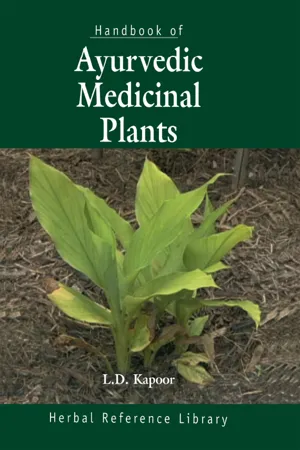
This handbook is filled with over 50 illustrations and descriptions of approximately 250 plants which are used for herbal medicine. It includes information on medicinal plants ranging from Abies spectabilis to Zizyphus vulgaris. The purpose of this handbook is to make available a reference for easy, accurate identification of these herbs. Derived from India, ""Ayurveda"" is the foundation stone of their ancient medical science. Approximately 80 percent of the population of India and other countries in the East continue to utilize this system of medicinal treatment. It is believed that the key to successful medication is the use of the correct herb. This is an indispensable resource for all physicians, pharmacists, drug collectors, and those interested in the healing arts.
Information
ABIES SPECTABILIS (D. Don) G. Don (Syn. A. WEBBIANA Lindl.) | Family: CONIFERAE |
Vernacular names — Sanskrit, Talisapatram; Hindi, Talispatra; English, Himalayan silver fir; Bengali, Talispatra;Nepalese, Tulsi; Sinhalese, Talispaturu; Japanese, Himaraymoni; French, Sapin; Unani, Tulsi; Arabian, Shahasfarm; Persian, Rayhan; Tibetan, Ba-iu; German, Edeltanne.
Habitat — This is a lofty tree growing on the higher ranges of the Himalayas.
Parts used — Leaves.
Morphological characteristics — A tall tree, mostly evergreen. Leaves are spirally arranged, very variable in length, flat, about 2 mm broad; petiole very short. Flowers monoecious, perianth 0. Male flowers in deciduous catkins with scale-like stamens bearing 2 to 5 one-celled pollen sacs on the lower surface. Female flowers in cones consisting of scale-like open carpels which are flat and bear 1 to 2 naked ovules. Fruit usually a woody cone. Seeds often winged, testa thin, albumen fleshy.28
Ayurvedic description — Rasa—tikta; Guna — laghu, teekshna; veerya — ushna; vipak — madhura.
Action and uses — Kafa vat samak, badana nasak, rochan, dipan, swashar, jawrahar, mutrajanak, bal bardhak.
Chemical constituents — it contains a crystalline alkaloid Known as taxin.
Pharmacological action — Leaves are carminative, stomachic, tonic, astringent, antispasmodic, and expectorant.3
Medicinal properties and uses — Decoctions or tinctures in doses of 2 to 4 ml or infusions in doses of 16 to 48 ml of the dried leaves are useful in cases of cough, phthisis, asthma, chronic bronchitis, and catarrh of the bladder, and other pulmonary affections. It is also given in enlarged spleen along with musk.1
Doses — Powder — 0.5 to 1 g; infusion — 16 to 48 ml; tincture — 2 to 4 ml.
ABROMA AUGUSTA (Linn.) L. f. | Family: STERCULIACEAE |
Vernacular names — Sanskrit, Pinchaskarpas; Hindi, Olat kambal; English, Devil’s cotton; Bengali, Olatkambal; Nepalese, Mhashukapay; Sanukpasi, Sinhalese, Peevary; Japanese, Aogiri; Chinese, Taimeo; German, Abrome; Unani, Ulat kambal.
Habitat — A. augusta grows wild throughout the hotter parts of India, from Utter Pradesh to Sikkim, Khasia Hills, and Assam. It is also cultivated for its showy, deep-scarlet flowers.
Parts used — Root, root bark, stem, and leaves.
Pharmacognostical characteristics — Root is brownish in color; fractures fibrously; and has indistinct odor. Root bark has a dull brown outer surface which is longitudinally wrinkled along with small lenticels. The inner surface is smooth, dark brown, and longitudinally striated. Bark is not brittle and can be easily separated. Mitra and Prasad13 studied detailed microscopic characters of young and mature root and root bark as well as the young stem and stem bark and its mature bark. Mucilaginous cavities, starch grains, and rosette crystals of calcium oxalate have been reported in root and stem, as well as the other normal tissues.
Ayurvedic description — Rasa — katu, tikta; Guna — laghu, rooksha, teekshna, snigdh; Veerya — ushna; Vipaaka — katu.
Action and uses — Kafa vat samak, garvasaya balya, artaw janan, badanasthapan, mutral, snahan.
Chemical constituents — The roots of the plant were reported to contain an alkaloid abromine, C16H13NO, mp 283 to 285°C, friedelin, and abromasterol A, mp 125.5°C. Later on isolation of taraxeryl acetate, taraxerol, β-sitosterol, and low-melting neutral compound from the petroleum ether extract of the leaves was reported.14, 16The identity of abromine was confirmed as betaine. Besides, β-sitosterol and stigmasterol were also isolated from the nonsaponifiable fraction of the petroleum ether extract of root.17
Pharmacological action — Leaves and stem are demulcent, root bark is an emmenagogue. It is reported as oxytocic and liable to produce dermatitis.3
Medicinal properties and uses — Infusion in cold water of fresh leaves and stem is very efficacious in gonorrhea. Fresh juice of the root bark is more efficacious and is given in dysmenorrhea. A single administration during the menses will regulate the menstrual flow; also acts as a uterine tonic and to facilitate conception in young married women.1
Doses — Root bark — 1 to 2 g; decoction of root — 14 to 56 ml; leaf infusion — 15 to 25 ml.
ABRUS PRECATORIUS Linn. | Family: LEGUMINOSAE |
Vernacular names — Sanskrit, Gunja; Hindi, Gunja; English, Jequirity; Bengali, Kunch; Nepalese, Ratigedi; Sinhalese, Olinda; Japanese, Toazuki; German, Paternostererbsen; Unani, Ghongchi; Arabian, Ain-ud-dik; Persian, Chashm-e-Kharoos; Burmese, Gyingwe; Malaysian, Akar be limbing; Tamil, Kunri.
Habitat — Throughout India from the Himalayas down to southern India and Sri Lanka.
Morphological characteristics — It is a beautiful woody climber, flowers in August to September, and pods ripen by the end of the cold season. The seeds are slightly smaller than ordinary peas. They are usually of bright scarlet color with a black spot at one end. White seeds are also present. The root is woody, tortuous, and much branched. The seeds are reported to be a hot, dry tonic and an aphrodisiac. The seeds are poisonous when ground into a paste and made into needles which are inserted under the skin of animals to kill them. The seeds are also reported to be abortifacient, antiseptic, antitubercular, and antidysenteric.1, 3
Parts used — Roots, leaves, and seeds.
Ayurvedic description — Rasa — tikta, kashaaya; Guna — laghu, rooksha, teekshna; Veerya — ushna; Vipaaka — katu.
Action and uses — Tridoshahar, khustaghan bran ropan, kesya, bajikaran, grvonirodhak, jwaraghan, gravapatak.
Chemical constituents — Hemagglutinating principle of A. precatorius was found to be a heat-labile protein located in the cotyledon. Two new alkaloids, the methyl ester of N, N-dimethyl tryptophan methocation and picatorine, were isolated from the seeds. In addition, abrine, hypaphorine, choline, and trigonelline were also isolated from seeds. Root and leaves contain about 10% of glycyrrihizin and abrin and acid resin.18 Abrasine, precasine, and hypaphosrine alkaloids have been reported from roots and seeds.10
Pharmalogical action — Seeds are purgative, emetic, tonic, antiphlogistic, and aphrodisiac.
Medicinal properties — The leaves are demulcent; their juice is given for the cure of sore throat and dry cough. It is also a good blood purifier. A paste of the leaves made with some bland oil is applied over swellings and in rheumatism. The seeds are strongly purgative and emetic. Seed paste is used as rubefacient in sciatica, stiff shoulders, paralysis, and other nervous diseases. It is also useful for skin diseases, ulcers, and inflammations. A 3.0% infusion of the decorticated seeds is a useful lotion for eye diseases, such as granular eyelids and corneal opacity.
Doses — Leave decoction — 56 to 112 ml; root powder — 0.5 to 1 g; seed powder — 1 to 3 gr.
ACACIA CATECHU (Linn. f.) Willd. | Family: MIMOSACEAE |
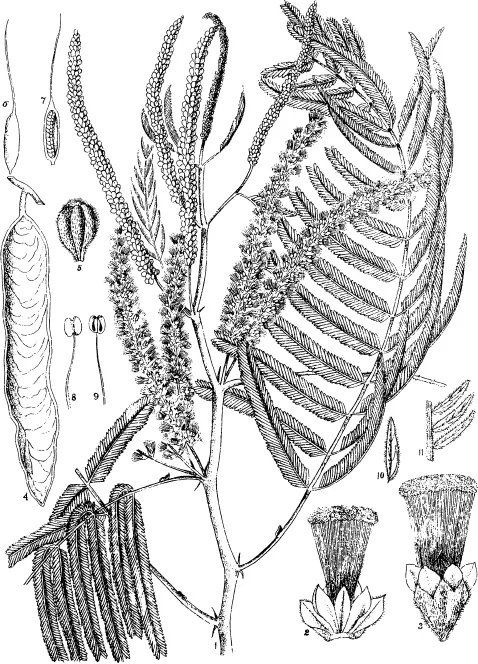
Vernacular names — Sanskrit, Khadira; Hindi, Katha; English, Catechu; Begali, Khayer; Nepalese, Khaya; Sinhalese, Ratkihiri; Japanese, Penguasenyaku; German, Katechubaum; French, Cachoutier; Unani, Katha; Arabian, Kaat; Persian, Kaat;Tibetan, Sen loen; Burmese, Sha; Malaysian, Khadiram; Tamil, Karugali.
Habitat — The tree is widely distributed in India from the Indus eastward to Assam and throughout the peninsula. It is also common in the dry plains and lower hill forests of upper and lower Burma.
Parts used — Extract, bark, wood, flowering tops, and gum.
Pharmacognostical characteristics — A. catechu is a moderate-sized tree. Its dark grayishbrown bark is nearly ½, in. in thickness, exfoliating in long, narrow strips, brown or red inside. The most important products obtained from A. catechu is catechu. This is obtained by boiling the heartwood with water. As sold in the market, katha is found in irregular pieces or small square blocks of grayish color, which after breaking show crystalline fracture.
Ayurvedic description — Rasa — tikta, kasaya; Guna — lagu, rooksha; Veerya—sheeta; Vipak — katu.
Action and uses — Kafpit samak, raktsodhak, kustaghan, soth har, asthamban, krimighan.
Chemical constituents — The main constituents of the heartwood are catechin and catechutannic acid; the catechin content varies from 4 to 7%. The catechin of A. catechu, also called acacatechin, is a colorless crystalline material insoluble in cold water but soluble in hot water. Wood contains α,β,γ- catechin19 and l-epicatechin.2...
Table of contents
- Cover
- Title Page
- Copyright Page
- Table of Contents
- Introduction
- Ayurvedic Medicinal Plants
- Appendices
- Glossary
- References
- List of Figures and Credits
- Index
Trusted by 375,005 students
Access to over 1.5 million titles for a fair monthly price.
Study more efficiently using our study tools.
Frequently asked questions
Yes, you can cancel anytime from the Subscription tab in your account settings on the Perlego website. Your subscription will stay active until the end of your current billing period. Learn how to cancel your subscription
No, books cannot be downloaded as external files, such as PDFs, for use outside of Perlego. However, you can download books within the Perlego app for offline reading on mobile or tablet. Learn how to download books offline
Perlego offers two plans: Essential and Complete
- Essential is ideal for learners and professionals who enjoy exploring a wide range of subjects. Access the Essential Library with 800,000+ trusted titles and best-sellers across business, personal growth, and the humanities. Includes unlimited reading time and Standard Read Aloud voice.
- Complete: Perfect for advanced learners and researchers needing full, unrestricted access. Unlock 1.5M+ books across hundreds of subjects, including academic and specialized titles. The Complete Plan also includes advanced features like Premium Read Aloud and Research Assistant.
We are an online textbook subscription service, where you can get access to an entire online library for less than the price of a single book per month. With over 1.5 million books across 990+ topics, we’ve got you covered! Learn about our mission
Look out for the read-aloud symbol on your next book to see if you can listen to it. The read-aloud tool reads text aloud for you, highlighting the text as it is being read. You can pause it, speed it up and slow it down. Learn more about Read Aloud
Yes! You can use the Perlego app on both iOS and Android devices to read anytime, anywhere — even offline. Perfect for commutes or when you’re on the go.
Please note we cannot support devices running on iOS 13 and Android 7 or earlier. Learn more about using the app
Please note we cannot support devices running on iOS 13 and Android 7 or earlier. Learn more about using the app
Yes, you can access Handbook of Ayurvedic Medicinal Plants by L.D. Kapoor,L. D. Kapoor in PDF and/or ePUB format, as well as other popular books in Medicine & Alternative & Complementary Medicine. We have over 1.5 million books available in our catalogue for you to explore.