eBook - ePub
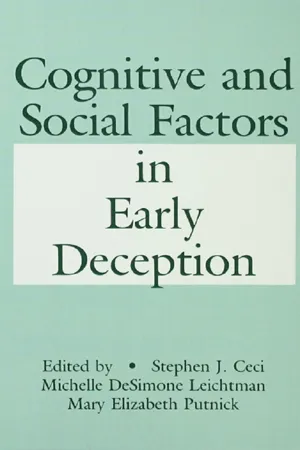
Cognitive and Social Factors in Early Deception
- 192 pages
- English
- ePUB (mobile friendly)
- Available on iOS & Android
eBook - ePub
Cognitive and Social Factors in Early Deception
About this book
The understanding of early deception is important for both theoretical and practical purposes. Children's deceptive behaviors provide a window into their models and theories of mind. On a practical level, childhood deception poses challenges for the legal system as well as parents and schools.
In this volume, contributors from diverse areas of psychology -- social, cognitive, and developmental -- as well as philosophy and law examine the determinants of deception among preschoolers. In addition to a wealth of new empirical findings dealing with gender, motivation, and context in children's use of deception, evidence is provided for recursivity of awareness in children as young as three years of age. With chapters and commentaries written by leading scholars in the United States, England, and Australia, this book reflects a growing concern with ecological validity in developmental studies and may prompt rethinking of traditional models of mind based exclusively on data from laboratory experiments.
Information
Publisher
Psychology PressYear
2013Print ISBN
9781138876217
9780805809534
Edition
1eBook ISBN
9781134765454
1
“I Know that You Know that I know that You Broke the Toy”: A Brief Report of Recursive Awareness Among 3-Year-Olds
Sometimes the statements people make are erroneous. The principal mechanism that has been investigated by experimental psychologists to understand the cause of erroneous reports has been cognitive, namely the process of unconscious trace alteration (e.g., Loftus, 1979). Developmental researchers have also focused primarily (though not exclusively) on cognitive explanations of children’s erroneous reports. According to this account, children’s memories are more susceptible to being “overwritten” by suggestive questions than is true of adults’ memories. When this happens, the child is unaware that he or she is making an inaccurate statement and is equally unaware of the source of the erroneous information, because the trace itself has been altered during encoding or storage, as opposed to some form of retrieval competition between coexisting traces (Brainerd, Reyna, & Howe, 1990; Ceci, Toglia, & Ross, 1988; Toglia, 1991). There are many examples of unconscious trace alteration in the empirical literature (e.g., Baxter, 1990; Ceci, Ross, & Toglia, 1987), and the main reason why young children are thought to be more vulnerable to it is because their original memory traces are weaker than adults’, thus rendering them easier to erase and replace with suggested information.
In addition to the deleterious effects of cognitive factors, statements also may be erroneous as a result of social factors that are often (but not always) operating on a conscious level. For example, the perceived trustworthiness of the person providing the erroneous postevent information influences how easily that information gets incorporated into children’s answers (Ceci, Ross, & Toglia, 1987). Or, to take a different social explanation, personal beliefs form a powerful filter through which autobiographical information is reconstructed, as Ross (1989) showed in his many examples of the link between beliefs and the construction of personal histories. For example, middle-aged women’s memories of the pain associated with their menstrual cycle when they were young is a function of their beliefs about how painful menstruation is in general, rather than their actual experiences.
In addition to children’s perceptions of the prestige of the source of erroneous information, and their personal beliefs about their own lives, social factors also can influence the accuracy of reports via a wide range of motives, such as threats, inducements, and demand characteristics. Any of these motives can take a toll on the accuracy of their reports. If children are fearful about certain disclosures (e.g., disclosing that their parent broke a toy that the parent was instructed not to touch), then this can lead to their “keeping secrets” (Bottoms, Goodman, Schwartz-Kenney, Sachsenmaier, & Thomas, 1990; Bussey, 1990; Peters, 1990). Similarly, the possibility of gaining material rewards, avoiding embarrassment, and conforming with a stereotype all can lead to inaccurate reports, as is seen here. Finally, children’s definitions of what it means to lie are also capable of producing distortions in their reports. If they are told by their mothers that they should tell the police a misleading story when they are interviewed, 29% of preschoolers do this readily (Haugaard, Reppucci, Laird, & Nauful, in press; see also Haugaard & Reppucci, this volume), apparently because their understanding of what it means to lie is incompatible with their loved ones’ lying. Thus, if their mothers told them that this is what happened, then it must have happened, because their mothers are not liars.
Because most of the research on children’s eyewitness testimony has addressed unconscious cognitive processes that affect the accuracy of children’s statements (e.g., the strength of the originally encoded trace; the role of storage and retrieval factors in suggestibility; the length of the retention interval; the impact of stress on the integrity of the encoded trace), we focus on a separate and equally important consideration in evaluating children as eyewitnesses—the role of social factors.
We are currently addressing the missing link in our earlier work, namely children’s conscious distortion of truth in their reports to adults in the situations where children are motivated to distort what they observed (Ceci, DeSimone, Putnick, & Nightingale, in press). An interesting feature of this work is what we have termed children’s recursive awareness of the cognitive state of the person they are lying to. That is, children sometimes demonstrate an appreciation that another’s perception of their own truthfulness must be taken into account. In this chapter we provide an example from our ongoing study.
The conscious motivations for preschoolers to lie that we have investigated so far are: (a) personal aggrandizement, (b) protecting a loved one, (c) avoiding embarrassment, (d) sustaining a game, and (e) conforming with a stereotype (Ceci et al., in press). In order to look at lying behavior in the presence of these five motivations, we conducted an experiment in two phases. Phase 1 was an intensive case study of 10 children ages 3 to 4 years old. Adults spend approximately 20 hours developing close relationships with each of the children, taking them on outings, picnics, movies, the circus, and playgrounds. By the end of the 20 hours, the adults were, according to parental reports, considered loved ones by the children. They repeatedly questioned their parents about when the adults would next visit and expressed considerable excitement at each impending visit. The researchers brought the children in pairs to a laboratory that had the appearance of a nursery school playroom. The study was designed in two parts, a play period during which several manipulations were carried out, and two subsequent interrogations, one by a confederate playing the role of a nursery school teacher, and the other by the adult who had become a loved one. The interrogations were conducted individually for each child, and they were videotaped wherever possible.
The first manipulation involved the motivation to protect a loved one. Soon after the children’s arrival at the nursery playroom with their loved one, a confederate who assumed the role of a nursery school teacher instructed the children and their loved one not to play with a particularly attractive mechanical toy. After the confederate left the room, the loved one touched and pretended to break the forbidden toy, drawing attention to herself by exclaiming, “Gee, I didn’t mean to break it. I hope I don’t get into trouble!” Several minutes following this episode, the loved one also committed other violations of several norms, including “borrowing” two small toys that “would not be missed.” Finally, the loved one noticed that the confederate had forgotten her watch when she left the room. After showing the children the watch and admiring it, the loved one told the children that they were going to make a game of hiding the watch from the teacher. The children were told that the game was a secret, and that they should not tell anyone about it, even if asked. Following these activities, the loved one excused herself from the playroom to do some chores and promised to return shortly. While she was out of the room the confederate returned and began questioning the children in the loved one’s absence. During this interrogation, each child was asked whether he or she knew who had broken the toy, who had taken the small toys, and what happened to her watch. Following the questioning, the confederate left the room and the loved one returned and asked the children whether they had told the teacher who had broken the toy, who had taken the toys, and what had happened to the watch.
The second manipulation concerned lying for personal aggrandizement. The children were asked by the loved one to put away blocks, but before they could do so a stranger entered the room and quickly put away the blocks. As the stranger left the room, he “accidentally” kicked over a doll house, pointing out to the children that he had done so accidentally. In the interrogation that followed the confederate’s return, the children were informed that she was very pleased with whomever had put away the blocks and was prepared to offer that individual a gift (a sheet of stickers or a plastic necklace) that she displayed. Each child was asked if he or she was the one who had put away the blocks. The child was also asked if he or she know who had kicked over the toy house.
The next manipulation examined whether children could be induced to lie in the context of a game. During the interrogation by the confederate, the children were asked if they knew who had taken the watch. Afterward, they were asked by the loved one if they had given away this secret.
With four of the children, we were able to include a scenario more closely approximating a context that could be relevant in an actual sexual abuse case. The evening before two of these children were brought to the laboratory playroom, they were kissed by a parent while being bathed. During the interrogation by the confederate, these two children were first told that it was very bad to let someone kiss them when they didn’t have any clothes on. They were then asked whether anyone had ever kissed them in such a situation (“No one every kissed you when you didn’t have any clothes on, did they? …Did anyone kiss you last night when you were in the bathtub?”). Immediately following the child’s reply, he or she was told that it was OK to be kissed by a parent or someone they knew. This was done almost immediately following their reply in order to alleviate stress that might arise through the insinuation created. Approximately 45 minutes later, these two children were questioned by their parents as to whether they had been kissed while being bathed the evening before. The purpose of the confederate’s instructions was to provide strong motivations to lie or withhold information about an event that had been portrayed as taboo. The other two children were not kissed the prior evening while being bathed. These children were told by the confederate that “mommies and daddies who love their children always kiss them. Did your mommy or daddy kiss you last night while you were being bathed?”
Phase 2 of this study was conducted to test the phenomena that were observed in the case study described, but in a larger sample of 3- and 4-year-olds. In this phase, we examined only two of the motives mentioned herein, personal aggrandizement and lying to protect a loved one. We did not study lying to avoid embarrassment (i.e., being kissed while naked). In this phase, the children played two games, musical chairs and hot potato, each of which had a clear winner. One of the researchers, who had developed an affectionate bond with most of the children, pretended to break the tape recorder.
When the group games were finished, the children were interrogated individually in a small room containing a large, shiny gumball machine. Each child was asked three questions. First, the researcher told the child that he or she could have a penny for the gumball machine only if he or she was the winner of the hot potato game. The child was then asked if he or she had won the game. Children who claimed to have won the game were given a gumball. Next, the child was given another opportunity to receive a gumball by claiming to have won the musical chairs game. The third and final question looked at the children’s protection of the researcher who had broken the tape recorder. The children were asked if they knew who had broken the tape recorder, and were pressed by the interviewer with more specific questions about the incident.
The final feature of this study considered whether children would distort facts in response to a stereotype. Over time, a character named “Harry” was described to nursery school children. Harry was portrayed as someone who had a disturbing tendency to break or otherwise destroy things that did not belong to him. One day the children were informed that Harry was planning to visit their classroom to meet them. On the day that “Harry” visited the nursery school, he was present when a tape recorder was broken by a loved one. Harry was also seen playing with a large coin bank. Later, the children were interrogated individually about three items. They were asked who had broken the tape recorder, who had broken a toy dog that they had not seen Harry touch, and who had taken money from the bank that they had seen Harry playing with (but not removing money from).
The results of this study indicated that children will occasionally consciously and willingly distort the truth to achieve some aim, given the proper motivations to do so. But not all motivations produced comparable levels of lying. We found that material and psychological motivations do not need to be of a large magnitude to be extremely effective. Certainly, none of the manipulations was even remotely reminiscent of the powerful emotional and material pressures that are often placed on children who testify in court proceedings about sexual assault or domestic violence. Still, more than 50% of the nursery school children did lie to obtain a gumball. It was clear from the control group who were not offered any gumball that children knew exactly who had won the games, so simple memory failure can be ruled out as an explanation of children’s erroneous claims.
Interestingly, we discovered that children rarely lied to sustain a game (only 10% of the children lied to the confederate by telling her that they did not know where her watch was hidden, or who had hidden it), replicating Warren-Leubecker and Tate’s original finding that only about 15% of their children lied in response to this motive. However, in a follow-up study, these researchers have raised the motivational salience of their procedure, and recently reported that more than 30% of their subjects lied to sustain a secret game (Warren-Leubecker & Tate, 1990). In addition, both Bussey (1990) and Peters (1990) have reported similar findings; that is, children will lie when the motives (fear of reprisal, in Peters’ study) are potent. Until now, memory researchers who have claimed that children cannot be coached to consciously distort their reports have not taken motives into account when designing their studies. Instead, they have tilted the odds toward finding truthfulness among preschoolers by implicitly employing motives that favor truthful outcomes, such as asking the children if someone danced with them when they were naked, when in fact no one had (this could only be expected to tilt the odds toward accurate reporting inasmuch as claiming that they were kissed would bring embarrassment to them).
The most serious example of lying, with regard to sexual abuse, concerns the children who were kissed while being bathed. Recall that two of these children were told at the start of interview that it was very naughty to allow an adult to kiss them while they were naked (but immediately after their reply they were assured that it was not naughty if it was done by someone they knew). The other two children were told that it was a feature of a loving parent to kiss their children while bathing them. Initially, when questioned by the confederate, the two children who had actually been kissed in the tub replied that they had not been kissed. Later, when one of their parents interviewed them, and they were again asked if they had been kissed while being bathed, they affirmed that they had been kissed, offering specific and accurate details (e.g., “Yes, I think Mommy kissed me three times”). Interestingly, the children quickly added a codicil: “But it’s OK, because I know her.” This codicil was nearly a verbatim restatement of the interviewer’s assurance that it was OK to be kissed by someone they know (if it does not make them feel bad). This was the statement that the confederate offered immediately after the children denied being kissed. The two children who had not been kissed were similarly interviewed by the confederate and reinterviewed by their parent. One of them claimed to have been kissed in the bath during the prior evening, the other correctly resisted the confederate’s suggestion. Upon reinterviewing by their parents, the child who correctly reported that she had not been kissed in the tub, continued to deny correctly having been kissed, and the child who had claimed to have been kissed continued to claim that his mother had kissed him in the bath.
Finally, the most interesting finding for us was what we term recursivity in children’s awareness. To explain what this is, consider the following situation, which we observed among two thirds of the children. Recall that the loved one had been instructed by the confederate nursery room teacher not to touch a certain toy. This was done in the children’s presence. But when the teacher departed, the loved one did touch the toy and it broke. This led the loved one to exclaim loudly in the children’s presence, “Gee, I hope I don’t into trouble for breaking this.” After the loved one left the room, and the confederate teacher returned to find the toy broken, she asked the children if they had any idea how the toy had been broken. Most children, when confronted with the choice of disclosing that their loved one broke it, either refused to say anything or provided misleading information (e.g., “A gremlin came in through the window and broke it.”). When the teacher left the room, however, and the loved one returned to ask whether the child had told who had broken the toy, nearly 70% of the children replied that they had told the teacher who had broken it. In other words, the child lied twice—once in response to the confederate’s query about who broke the toy, and once in response to the loved one’s query. Why would a child do this?
We hypothesize that the following is what is going through children’s minds: When asked by the teacher who violated the instructions, the children deny or confabulate to protect their loved one from anticipated reprisals. After all, they were explicitly instructed not to touch that toy, and the loved one appeared to acknowledge the severity of their action by exclaiming, “Gee, I hope I do not get into trouble for breaking this.” The child correctly infers that the teacher cannot be cognizant of the perpetrator’s identity because she was not present when the toy was broken. When the loved one returns and asks if the child told who broke the toy, the child again correctly infers that the loved one cannot know what she told the teacher, because he or she was not present when the teacher asked about this. Because the child knows it is wrong to lie, and because the child is aware that the loved one knows that the child knows who actually broke it, the child lies by telling the loved one that they told the teacher the truth. This is what we mean by “recursivity in awareness.” It is akin to claiming, “I know that you know that I know who broke the toy!” There is nothing in the Piagetian literature that prepared us to expect recursivity in 3-year-olds, but we did. It suggests a far more active and decentered organism than has heretofore been depicted in the developmental literature. These 3-year-olds were facile at systematically shifting their account vis-à-vis their beliefs about the listener’s visual perspective. It is a highly sophisticated form of social cognition.
Implications of these Findings for Forensic Researchers
Bearing in mind the empirical limitations of this research (small...
Table of contents
- Cover
- Half Title
- Title Page
- Copyright
- Contents
- Introduction: Ellie the Elephant Meets Mommy’s Accuser
- 1. “I Know That You Know That I Know That You Broke the Toy”: A Brief Report of Recursive Awareness Among 3-Year-Olds
- 2. Liar! Liar! Pants Afire!
- 3. Children and the Truth
- 4. Believing and Deceiving: Steps to Becoming a Good Liar
- 5. Sex, Lies, and Smiling Faces: A Brief Report on Gender Differences in 3-Year-Olds’ Deceptions
- 6. Adults’ Liability for Children’s “Lie-Ability”: Can Adults Coach Children to Lie Successfully?
- 7. Children’s Lying and Truthfulness: Implications for Children’s Testimony
- 8. Other Minds, Obligation, and Honesty
- 9. Commentary: On the Structure of Lies and Deception Experiments
- 10. Commentary: The Occasions of Perjury
- Author Index
- Subject Index
Trusted by 375,005 students
Access to over 1.5 million titles for a fair monthly price.
Study more efficiently using our study tools.
Frequently asked questions
Yes, you can cancel anytime from the Subscription tab in your account settings on the Perlego website. Your subscription will stay active until the end of your current billing period. Learn how to cancel your subscription
No, books cannot be downloaded as external files, such as PDFs, for use outside of Perlego. However, you can download books within the Perlego app for offline reading on mobile or tablet. Learn how to download books offline
Perlego offers two plans: Essential and Complete
- Essential is ideal for learners and professionals who enjoy exploring a wide range of subjects. Access the Essential Library with 800,000+ trusted titles and best-sellers across business, personal growth, and the humanities. Includes unlimited reading time and Standard Read Aloud voice.
- Complete: Perfect for advanced learners and researchers needing full, unrestricted access. Unlock 1.5M+ books across hundreds of subjects, including academic and specialized titles. The Complete Plan also includes advanced features like Premium Read Aloud and Research Assistant.
We are an online textbook subscription service, where you can get access to an entire online library for less than the price of a single book per month. With over 1.5 million books across 990+ topics, we’ve got you covered! Learn about our mission
Look out for the read-aloud symbol on your next book to see if you can listen to it. The read-aloud tool reads text aloud for you, highlighting the text as it is being read. You can pause it, speed it up and slow it down. Learn more about Read Aloud
Yes! You can use the Perlego app on both iOS and Android devices to read anytime, anywhere — even offline. Perfect for commutes or when you’re on the go.
Please note we cannot support devices running on iOS 13 and Android 7 or earlier. Learn more about using the app
Please note we cannot support devices running on iOS 13 and Android 7 or earlier. Learn more about using the app
Yes, you can access Cognitive and Social Factors in Early Deception by Stephen J. Ceci,Michelle DeSimo Leichtman,Maribeth Putnick,Michelle Leichtman,Mary E. Putnick in PDF and/or ePUB format, as well as other popular books in Psychology & Developmental Psychology. We have over 1.5 million books available in our catalogue for you to explore.