eBook - ePub
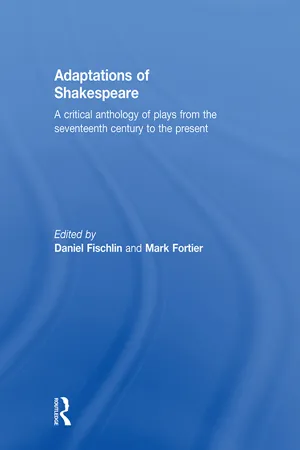
Adaptations of Shakespeare
An Anthology of Plays from the 17th Century to the Present
- 328 pages
- English
- ePUB (mobile friendly)
- Available on iOS & Android
eBook - ePub
Adaptations of Shakespeare
An Anthology of Plays from the 17th Century to the Present
About this book
Shakespeare's plays have been adapted or rewritten in various, often surprising, ways since the seventeenth century. This groundbreaking anthology brings together twelve theatrical adaptations of Shakespeares work from around the world and across the centuries. The plays include
The Woman's Prize or the Tamer Tamed John Fletcher
The History of King Lear Nahum Tate
King Stephen: A Fragment of a Tragedy John Keats
The Public (El P(blico) Federico Garcia Lorca
The Resistible Rise of Arturo Ui Bertolt Brecht
uMabatha Welcome Msomi
Measure for Measure Charles Marowitz
Hamletmachine Heiner Müller
Lears Daughters The Womens Theatre Group & Elaine Feinstein
Desdemona: A Play About a Handkerchief Paula Vogel
This Islands Mine Philip Osment
Harlem Duet Djanet Sears
Each play is introduced by a concise, informative introduction with suggestions for further reading. The collection is prefaced by a detailed General Introduction, which offers an invaluable examination of issues related to
Information
The Woman’s Prize; or the Tamer Tamed
Introduction
John Fletcher was born in Sussex in 1579. His father was the future bishop of London, and Fletcher was educated at Cambridge starting in 1591. Around 1606 he began to work in the theatre in London, most famously in collaboration with Francis Beaumont on such plays as The Maid’s Tragedy and the tragicomedy Philaster. Fletcher also collaborated with other dramatists, such as Philip Massinger, and wrote plays on his own. The Woman’s Prize is Fletcher’s work alone and most likely dates from 1611. Around 1612 Fletcher began collaborating with Shakespeare, who was near the end of his career: on the lost play Cardenio, on The Two Noble Kinsmen, and probably on Henry VIII. After Shakespeare’s retirement, Fletcher succeeded him as the principal playwright for the King’s Men, the foremost theatre company of the period. Fletcher has the distinction, therefore, of being Shakespeare’s adapter, collaborator, and successor. The complexities of influence and exchange between the two men are discussed at length by Christopher Leech (144–168), who concludes: ‘Our image of Shakespeare will be truer if we do not put out of our minds the closeness of his relationship with Fletcher in the last years of his working life.’ Fletcher died in 1625.
The Woman’s Prize is a sequel to Shakespeare’s The Taming of the Shrew – Charles Squier calls it a ‘spinoff’ (120). Petruchio and Katherine’s marriage was stormy and she is now dead. Petruchio marries Maria, a young woman who sets out to avoid the patriarchal domination and cruelty for which Petruchio has become famous. Fletcher’s play concerns her successful struggle to tame Petruchio and his ongoing exasperation at her actions. The Woman’s Prize is set not in Padua but in London, and other than a few familiar names there is little direct detail or circumstance taken from Shakespeare. Molly Easo Smith, however, writes of ‘Fletcher’s pervasive commentary on Shakespeare’ and asserts, ‘characters and situations in The Woman’s Prize seem closely modelled on The Shrew, and Fletcher’s calculated intertextual glance comments [on], rewrites, and undermines the ideological assumptions in Shakespeare’s play’ (39). One of the revampings that has been noted is Fletcher’s borrowing of female solidarity from Aristophanes’ Lysistrata (Ferguson: 12–13): in The Woman’s Prize, too, women band together in refusing sexual relations with men in order to make the men submit to their agenda. The women in The Taming of the Shrew – especially Katherine – are much more isolated from each other than they are in Fletcher’s sequel. In obvious ways, therefore, Fletcher’s play presents itself in relation to Shakespeare’s as its reversal or opposite, with the triumph of its women over its men.
The Taming of the Shrew and The Woman’s Prize were presented together in remountings before the court of Charles I in 1633. At this time, The Woman’s Prize initially ran afoul of the Master of the Revels, in his capacity as censor, for its ‘oaths, prophaness, and ribaldrye’ (Ferguson: 22); at court, however,...
Table of contents
- Cover
- Half Title
- Title Page
- Copyright Page
- Table of Contents
- Acknowledgements
- General Introduction
- The Woman’s Prize; or The Tamer Tamed
- The History of King Lear
- King Stephen: A Dramatic Fragment
- The Public (El público)
- The Resistible Rise of Arturo Ui
- uMabatha
- Measure for Measure
- Hamletmachine
- Lear’s Daughters
- Desdemona: A Play About a Handkerchief
- This Island’s Mine
- Harlem Duet
- Further Adaptations
Trusted by 375,005 students
Access to over 1.5 million titles for a fair monthly price.
Study more efficiently using our study tools.
Frequently asked questions
Yes, you can cancel anytime from the Subscription tab in your account settings on the Perlego website. Your subscription will stay active until the end of your current billing period. Learn how to cancel your subscription
No, books cannot be downloaded as external files, such as PDFs, for use outside of Perlego. However, you can download books within the Perlego app for offline reading on mobile or tablet. Learn how to download books offline
Perlego offers two plans: Essential and Complete
- Essential is ideal for learners and professionals who enjoy exploring a wide range of subjects. Access the Essential Library with 800,000+ trusted titles and best-sellers across business, personal growth, and the humanities. Includes unlimited reading time and Standard Read Aloud voice.
- Complete: Perfect for advanced learners and researchers needing full, unrestricted access. Unlock 1.5M+ books across hundreds of subjects, including academic and specialized titles. The Complete Plan also includes advanced features like Premium Read Aloud and Research Assistant.
We are an online textbook subscription service, where you can get access to an entire online library for less than the price of a single book per month. With over 1.5 million books across 990+ topics, we’ve got you covered! Learn about our mission
Look out for the read-aloud symbol on your next book to see if you can listen to it. The read-aloud tool reads text aloud for you, highlighting the text as it is being read. You can pause it, speed it up and slow it down. Learn more about Read Aloud
Yes! You can use the Perlego app on both iOS and Android devices to read anytime, anywhere — even offline. Perfect for commutes or when you’re on the go.
Please note we cannot support devices running on iOS 13 and Android 7 or earlier. Learn more about using the app
Please note we cannot support devices running on iOS 13 and Android 7 or earlier. Learn more about using the app
Yes, you can access Adaptations of Shakespeare by Daniel Fischlin, Mark Fortier, Daniel Fischlin,Mark Fortier in PDF and/or ePUB format, as well as other popular books in Media & Performing Arts & Drama. We have over 1.5 million books available in our catalogue for you to explore.