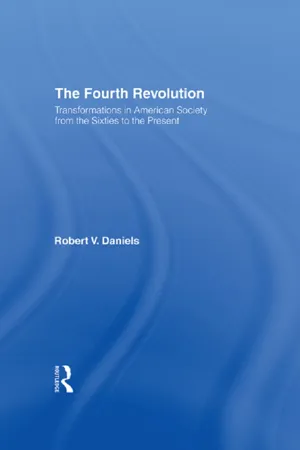
eBook - ePub
The Fourth Revolution
Transformations in American Society from the Sixties to the Present
- 296 pages
- English
- ePUB (mobile friendly)
- Available on iOS & Android
eBook - ePub
The Fourth Revolution
Transformations in American Society from the Sixties to the Present
About this book
The USA has been going through a new kind of revolution, which though it did not literally overthrow the government, transformed racial, gender, and other social relationships, and bequeathed the deep divisions now felt in the nation's politics and culture.
CHAPTER 1
The Terms of Revolutionary Debate
For decades the Western world and above all the United States of America have been in the throes of a new revolution, not a massively violent and bloody one, to be sure, but a revolution nonetheless. It has not been a revolution of the kind familiar in history, where crowds mount the barricades, troops seize government buildings, and royal heads roll; it has not changed the physical face of life or destroyed public institutions. Nevertheless, this Revolution of the Sixties, as it is often identified, was a real one, more so than many Americans realized who saw it only as juvenile wrong-headedness or negativistic exhibitionism. The revolution touched many parts of the world, but few areas—save the violence-ridden Far East—so deeply and none so permanently as the United States. In the phrase of Washington Post writer E. J. Dionne, it set off a “cultural civil war” that is still going on.1
This revolution was not the kind that history normally depicts, of coups and terror and dictatorship. Nor was it a revolution in the tradition of the past three centuries, a movement to depose the ruling classes in the name of constitutional government or collective economy. Instead, it has proceeded, not always quietly but without any general insurrection, as a sea change in the prevailing way of life and thought. While it stayed within narrow confines politically, the Revolution of the Sixties struck deep in the dimensions of human relations and psychology. It has been a revolution of values, the kind of revolution religious reformers have always called for, though not necessarily what they expected—a revolution in the human heart.
This new revolution was not permitted to run smoothly ahead; instead, it suffered intervals of counterrevolutionary rollback. Just as in the classical revolutions of history, aftershocks of disillusion and reaction that shook American political and intellectual life. Yet the new revolution has not relented in principle, and its expressions—above all, the “culture wars”—have continued and even revived right down to the present. The question remains open as to its potential advance onward into the future.
But for all the turmoil and soul-searching that this revolutionary tide has provoked, it has won very little understanding in depth, either in the United States or overseas. The University of Virginia sociologist James Hunter attributed the trouble to “hostility rooted in different systems of moral understanding” and bemoaned “the absence of conceptual categories or analytical tools for understanding cultural conflict.”2 Millions of people who came to maturity during the 1960s can testify that they “didn't know what hit us,” all the while that the Western world thought it was successfully standing off revolution in the guise of the Communist Bloc and the ideology of Marxism-Leninism. The West simply lacked any mental categories by which it could comprehend the new revolution that it was experiencing internally, or even clearly describe and debate it.
This dimness marks the United States above all, though it is the country most shaken in the present era by the struggle of revolution and counterrevolution. Americans do not think with a sense of historical process but view the world more in terms that are moral and emotional, and at the same time simplistic, encapsulated in slogans and analogies. Though presidential campaigns, ought theoretically to highlight public concerns and remedies, the level of insight they achieve has been dropping ever downward. History, for the disputants, is a series of reassuring guideposts, often mythologized, as a substitute for defining their real principles.
Revolutionary Cycles in America
While Europe has had more familiarity with revolution in recent times, the American tradition is that of one “good” revolution, the Revolution of 1776, that was long supposed to have put the nation's values and institutions in place for all time. This tradition has made it even harder for many Americans to recognize the new revolution for what it is, as a profound internal transformation and not some diabolical subversion instigated from who knows where. Nor has this revolution been the first great social crisis experienced by the nation since its independence. The Civil War era was both revolutionary and counterrevolutionary, and it was marked by one of the worst ordeals of internal violence ever experienced by any country. The New Deal era, following the crisis of the Great Depression, was another time of struggle over basic principles, though like the revolution of the 1960s and after, it did not descend into systemic as opposed to episodic violence.
Distinct cycles of reform and reaction have run regularly through American history in the past century and a half, as Arthur Schlesinger pointed out in his well-known essay on this theme.3 They have tended to peak about every thirty years, in other words once in a generation, as potential leaders nourished on reform in one era come into positions of influence after an interval of retrenchment and turn the country toward change again, for a while. In recent decades, presidential campaigns focused the ups and downs of the cycle precisely into a thirty-two-year period, with high points of reform and protest in 1936 and 1968, and troughs of nostalgia in 1952 and 1984.
These cycles in American politics do not just repeat the same old debates, however. New issues have been infused into them, while the country has grown and changed and experienced new stresses and new problems. What distinguished the reformist peak of the 1930s (and the Progressive Era thirty years before) from previous turns of the political revolving door was the surge in controversy over economic issues and competing class interests. Struggles of this sort were secondary in America's eighteenth-century revolution, though the familiar thesis of the Progressive historian Charles A. Beard would hold that the years of constitution-making were a time of postrevolutionary reaction aiming to make sure that the economic interests of the elite would not be put in jeopardy by a runaway democracy.4
Since the late nineteenth century, economic issues have reared up with each repeat of the political cycle. In the 1960s, however, debate took a new turn, as a new set of political principles, reflecting the new revolution we are trying to define, became the driving force in national change. Toward the millennium, the sentiments of the new revolution still loomed large as the cycle seemed to rise again.
The unique feature of the present epoch in American life is the overlapping presence of two unfinished revolutionary agendas, both likely to recur with the political cycle, sometimes reinforcing each other and sometimes competing. The older, economic agenda, having lost much of its constituency and excitement, remains far from complete, while the newer, social agenda presses on aggressively but also with the sense that it is still distant from full realization. Much of the public, confused and frustrated, turns away from politics except when an unconventional personality like H. Ross Perot declares war on the whole system.
Liberalisms and Conservatisms
People in the United States today no longer understand what they are arguing about. Debate still proceeds along the political spectrum—liberal and conservative, Left and Right—but the old terms no longer show through meaningfully in the haze of new problems and new challenges that are but dimly grasped even by the activists who represent them. The commentator Mickey Kaus found American liberalism hopelessly confused about the goals of politics: “The house of liberalism needs more than repairing, remodeling, or even thorough renovation. We need to rip the house down and build it anew on a more secure foundation.”5 E.J. Dionne extended the indictment to both of “the dominant ideologies of American politics. … Liberalism and conservatism prevent the nation from settling the questions that most trouble it.”6 As the cultural historian Christopher Lasch observed, “Old political ideologies have exhausted their capacity either to explain events or to inspire men and women to constructive action.”7
Despite this evidence of confusion, polemics still wax violent over the heresies that each side presumes are festering under the banners of the other camp. The words liberal and conservative remain active in our language, and if they are not analyzed for all their diverse implications they will continue to be used for purposes of political obfuscation. So the first requirement for understanding the revolutionary world of our time is to look to the forms of language that shape political responses to this world and cleanse them of the contradictions and misunderstandings that events have piled up in contemporary thinking.
The familiar terms of liberalism and conservatism together convey several sets of meanings that are not often distinguished. Their most general meaning is relational: Where does one stand on the political spectrum in relation to innovation and tradition? The liberal advocates whatever form of change in public life is being debated in a given epoch, and the conservative resists it, while the radical would forge ahead violently and the reactionary wants to turn the clock back, perhaps also by force. In this sense, people are liberal or conservative not by virtue of the particular view they hold but depending on whether those views are ahead of the times or behind them.
Beyond these basic meanings, there is a series of historical pairings of liberalism and conservatism that express support or opposition to particular programs of change in particular epochs. As people who have experienced America's transition from the 1950s to the 1970s will immediately understand, a viewpoint that is radical in one era can reduce to merely liberal in the next, and ultimately conservative, as it is incorporated into the status quo and defended by opponents of further change against new generations of liberals and radicals. Looking back over two centuries of American history, with a parallel glance at Europe, one can see the progression of political and social thought through three distinct sets of liberal-conservative polarities. These are, roughly speaking, the political, the economic, and the social.
The distinction between the political and economic meanings of liberalism and conservatism has been developed at great length by a host of writers, to contrast the classical political liberalism of the nineteenth century and with the Progressive-New Deal economic liberalism of the twentieth. In this vein, the conservative philosopher Robert Heineman distinguished “classical liberalism” and the newer “reform liberalism.”8 The liberal J.G. Merquior recognized the same distinction as “classical liberalism” and “social liberalism.”9
Political liberalism, based on constitutional government, individual rights, the separation of church and state, laissez-faire economics, and the independence of subject nations, emerged in the eighteenth century in the wake of the English Revolution and under the beneficent glow of the Age of Enlightenment. This was the classical liberalism anchored in the thought of Thomas Jefferson, Tom Paine, and Adam Smith, that, as Louis Hartz showed in his classic work,10 permeated the American psyche. The new United States inherited almost nothing of the old European conservatism of absolute monarchy, legal class privilege, state churches, and mercantilist regulation of the economy. This was the America that so impressed de Tocqueville. “The immigrants who fixed themselves on the shores of America in the beginning of the seventeenth century,” he wrote in Democracy in America, “severed the democratic principle from all the principles which repressed it in the old communities of Europe.”11
Eliminating what remained of the old conservatism, the American Revolution affirmed classical liberalism as the context for all subsequent political life and debate. In Britain too, by the time the old Whig and Tory parties took on the names Liberal and Conservative, respectively, in the middle of the nineteenth century, parliamentary government and capitalist enterprise were firmly established, and politics revolved around classical liberalism; party differences were to be found mainly in nuances such as free trade and extension of the suffrage. On the European Continent, by contrast, classical liberalism had to fight its way through one revolutionary battle after another against monarchism and the survivals of feudalism, from 1789 until the last third of the nineteenth century, before liberal principles more or less prevailed west of the Russian border.
This victory of liberalism in continental Europe was not general, secure, or permanent. In the past century, everywhere in Central and Eastern Europe, classical liberalism fell back in the face of twin onslaughts of by the radical Left of Communism and the radical Right of Fascism and Nazism. The term liberal survives today in Western Europe only as the designation of those political movements, usually small, that resist both the controlled economy of the socialists and the clericalism of the Christian Democrats. Only the British Conservative Party, notwithstanding its name, is a significant embodiment of the classical liberal philosophy. The British Liberals, reduced to minor party status by the rise of socialism and the Labour Party, endure today merely as one element (along with Labour's former right wing) in the watered-down reformism of the Liberal-Democratic Party.
Marxists used to describe classical liberalism as the ideology of the bourgeoisie as it waged class war against feudal landowners and absolute monarchies in the name of economic freedom and the legal equality of individuals. There is much truth in this characterization, considering that Marx formulated his theory of class struggle and the ideological “superstructure” justifying the interests of the ruling class just when the business class was coming into its own in Europe. But in America, the Revolution of 1776 bequeathed classical liberalism as the frame of reference shared by practically everyone. This liberalism was not a class ideology but a national faith.
The second liberal-conservative polarity, of much more recent vintage, revolves around economic rather than political issues. It took shape during the nineteenth century in reaction to problems generated by industrial capitalism that had never been addressed by classical liberalism. In Europe the quest for economic reform found its embodiment in the Social-Democratic or Labor parties, along with more radical elements who rallied to the cause of Soviet-style Communism after the Russian Revolution. In America, challenges to the economic order of classical liberalism emerged mainly within the existing two-party structure of politics, in the form of Progressivism at the turn of the century and New Deal liberalism in the 1930s.
Liberalism in this new sense was directed toward structural economic change, to remedy the perceived evils of the competitive capitalist struggle and, as President Franklin Roosevelt said, to put human rights ahead of property rights. The new liberalism embraced the Welfare State, supported trade unionism, attacked the power of corporate monopoly (by nationalization in Europe, by trust-busting and regulation in America), addressed income inequalities by progressive taxation, and endeavored to stabilize the economy by recourse to the Keynesian fiscal balance wheel.
The conservative term in this new debate was a defense of the nineteenth-century system of free-market economics and limited government, letting the devil take the hindmost according to the justice of Social Darwinism. In other words, the new conservatives in the economic sense were the old classical liberals. In America, there was no other philosophical position for defenders of the economic status quo to fall back on, although in Europe between the wars economic conservatism all too often degenerated into the Fascist and Nazi backlash against political liberalism as well. Meanwhile, economic liberalism was often upstaged by the radicalism of the Communist International.
Neither New Deal liberalism nor European Social Democracy can be as neatly analyzed in class terms as was classical liberalism in Europe. To be sure, enlisting the bulk of the industrial working class (that is, in countries where the workers were not captured by the Communists), these parallel movements of reform did partake of the class struggle of the proletariat against the capitalists. But for New Deal liberalism or Social Democracy to gain the opportunity to rule, they had to win over substantial numbers of farmers and middle-class elements in some sort of populist coalition against the power of concentrated wealth. The historian Alonzo Hamby has asserted, perhaps a bit overconfidently, “The New Deal made collectivist democratic liberalism the norm in American politics,” a norm that “won gradual, reluctant acceptance from a conservative opposition forced toward it by the imperatives of acquiring and keeping political power.”12 A broadly perceived commonality of economic interest in collective bargaining, full employment, stabilizing of markets and competition, social insurance, and consumer protection was the foundation for the political success of liberalism in the economic sense.
This economic liberalism of the New Deal era in America was never fully implemented, diverted and frustrated as it was first by the...
Table of contents
- Cover
- Half Title
- Full Title
- Copyright
- Contents
- Introduction: A New Kind of Revolution
- 1 The Terms of Revolutionary Debate
- 2 A Revolutionary World
- 3 Three Revolutions in America
- 4 The Great Society and the Trajectory of the Fourth Revolution
- 5 The Racial Revolution
- 6 The Revolution of Youth
- 7 The Gender Revolution
- 8 Revolution and Reaction
- 9 Deepening of the Revolution
- 10 Extensions of the Revolution
- 11 The Fourth Revolution at the Millennium
- 12 A Fifth Revolution?
- Notes
- Index
Trusted by 375,005 students
Access to over 1.5 million titles for a fair monthly price.
Study more efficiently using our study tools.
Frequently asked questions
Yes, you can cancel anytime from the Subscription tab in your account settings on the Perlego website. Your subscription will stay active until the end of your current billing period. Learn how to cancel your subscription
No, books cannot be downloaded as external files, such as PDFs, for use outside of Perlego. However, you can download books within the Perlego app for offline reading on mobile or tablet. Learn how to download books offline
Perlego offers two plans: Essential and Complete
- Essential is ideal for learners and professionals who enjoy exploring a wide range of subjects. Access the Essential Library with 800,000+ trusted titles and best-sellers across business, personal growth, and the humanities. Includes unlimited reading time and Standard Read Aloud voice.
- Complete: Perfect for advanced learners and researchers needing full, unrestricted access. Unlock 1.5M+ books across hundreds of subjects, including academic and specialized titles. The Complete Plan also includes advanced features like Premium Read Aloud and Research Assistant.
We are an online textbook subscription service, where you can get access to an entire online library for less than the price of a single book per month. With over 1.5 million books across 990+ topics, we’ve got you covered! Learn about our mission
Look out for the read-aloud symbol on your next book to see if you can listen to it. The read-aloud tool reads text aloud for you, highlighting the text as it is being read. You can pause it, speed it up and slow it down. Learn more about Read Aloud
Yes! You can use the Perlego app on both iOS and Android devices to read anytime, anywhere — even offline. Perfect for commutes or when you’re on the go.
Please note we cannot support devices running on iOS 13 and Android 7 or earlier. Learn more about using the app
Please note we cannot support devices running on iOS 13 and Android 7 or earlier. Learn more about using the app
Yes, you can access The Fourth Revolution by Robert V. Daniels in PDF and/or ePUB format, as well as other popular books in History & Social History. We have over 1.5 million books available in our catalogue for you to explore.