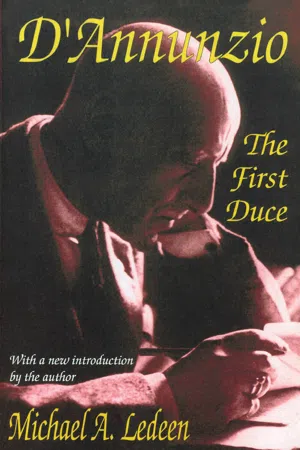
Gabriele D'Annunzio was one of the most flamboyant figures in the political history of modern Europe. A poet in the Byronic style and a popular hero of the First World War, D'Annunzio passionately believed that the sacrifices of war should prelude a new social order. His capture of the city of Fiume in 1919, which had been claimed by Italy as part of the settlement before the Versailles Peace Conference, has been popularized and romanticized ever since. Ledeen uses information gathered from Italian and American archives and from personal interviews to examine the sixteen months of D'Annunzio's personal rule in Fiume, seeing it as a harbinger of successful mass movements of the twentieth century.
The connection between D'Annunzio and Fascism is central to Ledeen's narrative. Virtually the entire ritual of Fascist politics made familiar by Mussolini-the balcony address, the Roman salute, the dramatic dialogues with the crowd, the use of religious symbols in a new secular setting-was influenced by D'Annunzio at Fiume. Both were masters of a political style based on personal charisma. Each spoke for a "new" Italy and, eventually, for a new world. Each attempted to transform his countrymen into more heroic types by an ethic of violence and grandeur. But Ledeen brings sharply into focus profound differences between D'Annunzio's vision of a new world and that offered by Fascism. Significantly, D'Annunzio enlisted support from the most diverse elements of society-politicians and businessmen in addition to representatives of radical trade unions, anarchist groups, and the armed forces.
Often sensationalized as a precursor of a sixties-style "dolce vita," D'Annunzio's Fiume presented many of the phenomena considered novel or unsettling today: sexual promiscuity, widespread experimentation with drugs, clergymen wanting to marry, women demanding equal rights, youth calling for the elimination of the old, soldiers insisting on a democratic army, poets yearning for a beautiful world instead of a purely utilitarian one, minorities clamoring for their fair share of political power. From the dispassionate distance of half a century, Ledeen views Fiume as a microcosm of the larger chaos of our contemporary scene. Although he was removed from Fiume after a pitched battle on land and sea, D'Annunzio remained an influential figure in Italian politics. Ledeen presents him as "one of the great innovators and watersheds of the modern world." This book will be of interest to historians, political scientists, and those interested in Post World War I Italy.
An authority on Italian fascism and contemporary Europe, Michael A. Ledeen is Resident Scholar at the American Enterprise Institute in Washington. In addition to being a frequent contributor to The New Republic, The American Spectator, and 11 Giornale (Milan), he is the author of 15 books on contemporary history and politics.
- 235 pages
- English
- ePUB (mobile friendly)
- Available on iOS & Android
eBook - ePub
About this book
Information
1
The Star
On the ninth of August 1918 the citizens of Vienna were subjected to a unique aerial bombardment. The skies were filled with pieces of colored paper, which were tinted red, white, and green, the colors of the Italian flag. They were propaganda leaflets, and the text began in a spectacular manner: “Viennese! We could now be dropping bombs on you! Instead we drop only a salute.” This masterpiece of wartime propaganda reads like a contemporary document. “We Italians do not make war on women and children,” the Viennese read, “we are making war on your government, which is the enemy of your national liberty.” This distinction, suggesting that the government was unworthy of the people it purported to lead, has become a commonplace in attempts to provoke mass public dissatisfaction. At the time, however, it was something of an innovation, as was the final flourish of the text. “You have turned the world against you. If you wish to continue the War-continue it! You will thereby commit suicide. What have you to gain? The decisive victory promised you by the Prussian generals? Their decisive victory is like Ukrainian bread. You will starve waiting for it. . . .”1
The pilots who dropped this message on Vienna had risked their lives (the flight itself was exceedingly dangerous in that early period of air travel, quite aside from the menace of Austrian planes and antiaircraft) in order to make what was, after all, simply a glorious gesture. This enterprise stood in stark contrast to most of the actions of the “Great War,” which was notoriously a war without heroes, a faceless trench battle in which masses of soldiers slaughtered one another for territorial advantage. To be sure, there was no lack of genuine heroism on the battlefields of Europe, but the image of the war that has come down to us is one of a plodding and methodical war of tactics and attrition. In the literature of the war there is relatively little reference to the exploits of individuals, and although the figure of the Prussian “Red Baron” has recently been elevated from relative obscurity to the level of camp hero, there were few such figures. One of the most revealing comments about the Great War is to be found in the movies about it, for, unlike other conflicts, movies about this war have virtually no heroes. The great classic All Quiet on the Western Front is typical; the film stressed the almost mechanical nature of the struggle, portraying the war as an alternating slaughter of French and German troops, moving back and forth between lines of trenches. In America, the most famous hero in the films of the war was Sergeant York, a boring country boy whose only distinguishing quality was his remarkable accuracy with the weaponry of the period. But York was an obedient soldier who followed orders and did his duty, not an enterprising individual.
Gabriele D’Annunzio, author of the pamphlet that fell on Vienna on August ninth and leader of the squadron that risked death to fare la bella figura (“cut an elegant figure”), was one figure who towered over this scene of trench warfare. While there, were other groups of soldiers noted for their heroic enterprises (such as the various storm troopers), it would be hard to find anyone to match D’Annunzio for sheer bravado and color. His field of activity was not limited to the air; he left his mark in sea battles and land actions as well. Whether it was bombing Trieste from the air twice in one day (first with pamphlets, then with bombs), charging Austrian trenches in the middle of the night with pistols and knives, dressed in a flowing cape, or sailing torpedo boats into the middle of the Austrian fleet at anchor and blowing up a torpedo-boat in the Bay of Buccari, D’Annunzio achieved a reputation as the great poet-warrior of the war. All this was accomplished by a man who was fifty-two years old when he enlisted and who lost an eye during the course of hostilities. Furthermore, D’Annunzio had not had much experience in military activities before the outbreak of fighting (with the exception of a few duels), but was noted in the fields of romance and literature. His reputation had been that of a flamboyant and decadent poet, playwright, and novelist and, above all, one of the great lovers of his day.
It is rare for a poet to achieve such stature during wartime. The only other literary figure who comes to mind in this connection is not a real man, but a fictional one—Cyrano de Bergerac, and Cyrano is a rather farcical character. Yet many of the social upheavals of the early twentieth century involved the active participation of poets (the most famous case is Kurt Eisner’s leadership of the revolutionary socialist republic of Bavaria in 1919), and it is in this context that D’Annunzio’s dramatic role in twentieth-century politics must be viewed.
The Poet as World-Shaper
We do not commonly think of poets as world-shapers, despite their influence over the world in which we live. Yet the men and women who dictate style and taste possess enormous power. Given the high degree of organization of all means of communication today, we are more likely to find powerful poets working for an advertising agency or a political party than living in a loft on the fringes of a city, yet the role remains the same: whoever defines the language of politics wields great power. D’Annunzio gained control over the political rhetoric of Italy at a moment of chaos and crisis, and he mastered the emotions of those who filled Italy’s piazzas to listen to his speeches. His heroism during the war made it possible for D’Annunzio to bridge the chasm between intellectuals and the masses, for he had demonstrated that his bravado was more than a verbal facade. People believed D’Annunzio when he spoke of reviving the glory of Italy’s Roman days and of leading a civilizing mission through the Western world. Few others were so credible in the political arena of postwar Italy.
D’Annunzio was born on the Italian Adriatic coast in the town of Pescara on 12 March 1863. His own personality was foreshadowed by that of his father, a one-time mayor of the city, who was noted for his lechery and his fiscal profligacy. Gabriele was a true D’Annunzio in both his frenetic search for new women to conquer and his constant flirtation with bankruptcy. His education was good, acquired at the famous Cicognini college in Prato, and his verbal flair developed at an early age. When only thirteen, D’Annunzio composed an intensely chauvinistic poem celebrating a visit by King Umberto to Pescara.
His literary career began in the period when Rome started to become a European center; D’Annunzio moved there in 1881, about the time that the city’s first publisher was setting up business. D’Annunzio soon became the Father Knickerbocker of Rome, filling the pages of the Fanfulla with exotic and erotic tales of high society, beautiful women, and dramatic exploits. He was perhaps the first figure of a type that later became celebrated in La Dolce Vita. Many of his columns for the Fanfulla were quite transparently autobiographical, and often downright obscene, but in the turbulent atmosphere of Rome at the end of the century, this licentiousness served to enhance his reputation, his charisma, and his appeal to Roman women. His tastes were similar to those of other decadent artists of the period in other European capitals. Like so many other figures of the fin de siècle, D’Annunzio found himself torn between two desires: one for a “pure spirit,” the other for material acquisitions. “My aesthete’s feeling draws me inevitably toward the acquisition of fine things. I could have eaten quite well in a modest home, sat on a simple wooden chair, eaten off common plates, walked about on carpets made in Italy. . .. Instead, fatally, I have desired divans, Persian carpets, precious materials and stuffs, Japanese plates, all those beautiful and useless things which I love with a deep and ruinous love.”2
Much of D’Annunzio’s writing was exaggerated, especially when the subject was the poet himself, but this particular passage is an understatement. If one visits his last home, the famous Vittoriale in the hills overlooking Lake Garda (where his apartment has been meticulously conserved as it was when the poet lived there), one finds ample evidence of D’Annunzio’s “deep and ruinous love” for the artifacts of the world. His taste was thoroughly eclectic, for the rooms of the Vittoriale are filled with paintings, wall-hangings, masks, bric-a-brac, sculptures, figurines, vases, rugs, china, medals, bells, musical instruments, and books thrown together in a chaotic mixture of styles and cultures. The ceilings are either draped with chamois hangings or inscribed with various slogans, epithets, or erotic phrases. The walls are covered with dark tapestries and paintings of every imaginable description. It is, in short, quite in keeping with the mentality of its poet-in-residence. D’Annunzio was never a great admirer of the sun, living at a time when a pallid complexion was considered more beautiful than a sun tan, and most of his work was done during the night. Hardly a sunbeam enters the Vittoriale, and its heavy, oppressive atmosphere conjures up images of an opium den, even on a sunny day. In his later years, the poet did most of his writing between ten o’clock at night and four or five o’clock in the morning, and within the Vittoriale this nocturnal atmosphere is constantly maintained.3
The style of life that D’Annunzio led, as symbolized by his home, set him apart from his countrymen. In his often frantic search for uniqueness, and for a life-style totally removed from “normality,” D’Annunzio reflected a widespread conviction that artistic creativity could not take place within the confines of bourgeois society. Modern society was viewed as stultifying, artificial, and boring, capable of producing enormous quantities of machines and consumer goods but unable to generate the creative spark that characterizes great artists. Thus, for D’Annunzio and many other creative figures, a spiritual transformation of the world was absolutely necessary, in order that modern man might reestablish contact with the sources of his own natural creativity.
D’Annunzio recognized that his fatal attraction to material things was proof positive of the corrupting influence of modern society, for one could hardly be a true creator if one dissipated one’s energies in the pursuit of baubles and trinkets. Thus, at the same time that he was confessing his weakness for imported rugs, D’Annunzio was calling on his fellow Italians to rebel against the superficiality and the artificiality of the modern world and to express their “Latin creativity” in acts of violence. In one of his most famous novels, The Virgins of the Rocks (1894-95), D’Annunzio described his spiritual ancestors as “an ancient and noble race of warriors,” and he hailed their acts of savagery in the past, “their victories, the beautiful women they raped, their drunkennesses, their magnificence.” He was an Italian Nietzschean, viewing modern civilization as a thin veneer that barely covered up the savage and violent human instincts. D’Annunzio wanted to uncover these instincts so that his fellow Italians could become “natural,” “whole” beings.
This search for “the man within” (or the “new man,” as it was often stated) was typical of the fin de siècle, and D’Annunzio was one in a long list of writers who became obsessed with discovering the essence of human nature and human originality at a time when the entire direction of civilization seemed destined to submerge such originality in a sea of conformity and “massification.” The late nineteenth century was, after all, the moment of the great triumph of the industrial revolution and all its accompanying dislocation. For the artists of the period, the most painful change was in their economic base. Instead of being supported by elegant patrons, they became increasingly subject to the whims of a literary marketplace. Intellectuals rebelled against this change, for they often despised “the public,” preferring to be judged by their own peers. As their own concepts of style and creativity were increasingly relegated to a secondary position and the worth of an artist increasingly judged by his “marketability,” artists became alienated from the process of modern culture, preferring to think of themselves as men apart. For some, this separation was a purely intellectual act, while for others it took a more total form. For an Italian, however, separation from his society is one of the crudest of all fates, and for someone as convivial as D’Annunzio, isolation from the world was unthinkable (although he did experience extended periods of intense depression, when he cut himself off from most human contact). D’Annunzio needed an audience and was unwilling to be alone. Like a true dramatist, he surrounded himself with highly diverse types so that he could be sure of finding the response he desired. Instead of “opting out” of modern society, D’Annunzio eventually undertook to change it.
The notion of transforming the masses of the modern world from the “great unwashed” into a cultured body of men and women of good taste has long fascinated intellectuals. One of the most appealing aspects of this dream is that the intellectuals themselves would clearly be the ones to effect the transformation, and D’Annunzio was not one to shrink from such a task. In this way, the problem of the artist’s relationship to society became transformed into that of the salvation of society itself, for the artist was to be the ultimate arbiter of society’s ills. D’Annunzio put this into typically fiery prose when he spoke of his own mission to his countrymen (long before he conceived of a specifically political role for himself): “I want to write a volume of poetic prose which will be a war-cry for the Latin people,”4 he wrote. D’Annunzio hoped to inspire his countrymen by the force of his prose and the drama of his example. He believed that Italians had become soft, and he wanted to awaken a spirit of aggressiveness in them. Thus, he became an advocate of colonial adventures in Africa (coining the term mare nostrum for the Mediterranean) in order to stress what he felt was Italy’s properly paternalistic and dominating attitude toward the other countries on the shores of the ocean. Ironically, he suffered for years from severe seasickness and was unable to make a grand tour of the Mediterranean. Nonetheless, he overcame this disease to carry out one of his most famous feats, the Beffa di Buccari, at sea during the First World War.
Like virtually all members of the European literary elite at the turn of the century, D’Annunzio was at first anything but a democrat. He felt that decisions should be made by the chosen few who could alone elevate the tastes and lives of the multitudes. A state based on universal suffrage, he said, was an ignoble institution, since a truly great state would favor “the gradual elevation of a privileged class toward its ideal form of existence.”5 In order to advance his own elevation, D’Annunzio entered Parliament in the last year of the century, sitting on the right side of the chamber. But shortly thereafter (on March 27th) the poet announced that he had undergone a political conversion. Henceforth, he proclaimed, he was a man of the Left, having moved “from death to life, from Right to Left.”6 In actuality these terms were virtually meaningless to D’Annunzio, for he was no more allied with the traditional Italian Right than with the Socialists. His thought rarely focused on traditional political ideas like taxation, governmental institutions, or class conflict. Instead, D’Annunzio’s “political” thought was concerned with national greatness, the aesthetics of Italian cities, the creativity of the Italian people, and the virility of Italian men. His notion of “politics” was an essentially spiritual one, and this was quite in keeping with the temper of the age. Many agreed with D’Annunzio that parliamentary politics were banal or ignoble. Many sought, with him, some form of political activity that could restore excitement to government and that would enlist the passions of the people in the enterprises of their nation. By the early twentieth century, such groups as the Futurists were calling for a massive war to cleanse the world of the rotten elements that were destroying it. War, in their view, was the only “hygiene” capable of restoring Western civilization to a state of health.7 The First World War, probably the most ruinous event in modern European history, was welcomed with open arms by such people.
It is unlikely that D’Annunzio conceived of the Great War solely in such terms, at least at the beginning of the struggle. For the poet, war was both an outlet for his own unique abilities and an experience that would purify the Italian people. Further, D’Annunzio hardly believed that war was the only way to achieve greatness, and for most of his life he preferred love to battle. His great notoriety as a lover was achieved through a succession of passionate affairs with some of the most beautiful and fascinating women of the day. The most famous of these was his extended romance with the great Italian actress Eleonora Duse, the only real challenger to Sarah Bernhardt for the title of First Lady of the European stage. D’Annunzio and Duse were together from 1897 to 1904, living in rural splendor, wearing outlandish clothes, staging wild parties, and capturing the imaginations of thousands of jealous onlookers. Rumors of their joint activities could fill volumes. One of the most innocent, but telling, rumors was that each evening at sunset D’Annunzio swam naked in the Mediterranean and that Duse waited for him at the shore with a purple robe to throw over his shoulders as he emerged from the waves.
This was the period during which D’Annunzio raised his own eccentricities to the level of an art form, cultivating his own habits in order to set himself completely apart from the humdrum world of bourgeois Europe. Others were enchanted with modern technology; D’Annunzio always wrote with a quill pen. Others were fascinated by the progress of science; D’Annunzio became a mystic, “reading” the cards in the evening, spending hours on end with witches and soothsayers, studying the secret meanings of numbers, learning the “wisdom of the Orient.”
D’Annunzio was, further, a totally captivating personality, one of the few characters whose charm and charisma extended to both men and women. His success with women is legendary, but he also achieved great fame as a leader of men. It has been suggested that his romantic attraction was not limited to females and that he was, in fact, bisexual.8 If true, it would be remarkable, for he had very few male friends and seems not to have been deeply involved even with his closest associates. The most important aspect of his relationship with men was his ability to convince them to follow him, an ability that was almost hypnotic. He cultivated conversation, always seeming to know the right words to win over an opponent or reinforce a wavering will. He had a prodigious memory for the most insignificant details and was able to remember an encounter years before with someone whom he had not seen in the interim. In his contacts with other men, D’Annunzio had a rare ability to convince his acquaintances that he was immensely concerned with their problems, fascinated by their stories, and involved in their lives. In reality, his egotism was so great that his real feeling was invariably almost total indifference to other people.
If direct contact with D’Annunzio was hypnotic, what can be said about his powerful influence as an orator? D’Annunzio was one of the ...
Table of contents
- Cover Page
- Title Page
- Copyright Page
- Dedication
- Contents
- Introduction to the Transaction Edition
- Preface
- 1 The Star
- 2 The Stage
- 3 Setting the Stage
- 4 The Sacred Entrance
- 5 Searching for Definition
- 6 Behind the Stage Door
- 7 The Definition of the Adventure
- 8 The D’Annunzian World
- 9 The March toward the Future
- 10 The End of the Fiuman Adventure
- Note on Archival Sources
- Notes
- Index
Trusted by 375,005 students
Access to over 1.5 million titles for a fair monthly price.
Study more efficiently using our study tools.
Frequently asked questions
Yes, you can cancel anytime from the Subscription tab in your account settings on the Perlego website. Your subscription will stay active until the end of your current billing period. Learn how to cancel your subscription
No, books cannot be downloaded as external files, such as PDFs, for use outside of Perlego. However, you can download books within the Perlego app for offline reading on mobile or tablet. Learn how to download books offline
Perlego offers two plans: Essential and Complete
- Essential is ideal for learners and professionals who enjoy exploring a wide range of subjects. Access the Essential Library with 800,000+ trusted titles and best-sellers across business, personal growth, and the humanities. Includes unlimited reading time and Standard Read Aloud voice.
- Complete: Perfect for advanced learners and researchers needing full, unrestricted access. Unlock 1.5M+ books across hundreds of subjects, including academic and specialized titles. The Complete Plan also includes advanced features like Premium Read Aloud and Research Assistant.
We are an online textbook subscription service, where you can get access to an entire online library for less than the price of a single book per month. With over 1.5 million books across 990+ topics, we’ve got you covered! Learn about our mission
Look out for the read-aloud symbol on your next book to see if you can listen to it. The read-aloud tool reads text aloud for you, highlighting the text as it is being read. You can pause it, speed it up and slow it down. Learn more about Read Aloud
Yes! You can use the Perlego app on both iOS and Android devices to read anytime, anywhere — even offline. Perfect for commutes or when you’re on the go.
Please note we cannot support devices running on iOS 13 and Android 7 or earlier. Learn more about using the app
Please note we cannot support devices running on iOS 13 and Android 7 or earlier. Learn more about using the app
Yes, you can access D'Annunzio by Michael Ledeen in PDF and/or ePUB format, as well as other popular books in Politics & International Relations & Political Biographies. We have over 1.5 million books available in our catalogue for you to explore.