- 296 pages
- English
- ePUB (mobile friendly)
- Available on iOS & Android
eBook - ePub
About this book
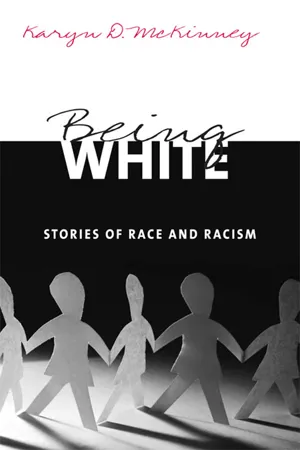
Karyn McKinney uses written autobiographies solicited from young white people to empirically analyze the contours of the white experience in U.S. society. This text offers a unique view of whiteness based on the rich data provided by whites themselves, writing about what it means to be white.
Information
Chapter 1
“I Could Tell My Life Story
Without Mentioning My Race”:
Exploring Everyday Whiteness
In my everyday normal life I don't even think about being white. It has no value or gives me no feeling of superiority.... Being white means fitting in, I will never be ashamed of the fact that I am white. I do find it hard to talk about whiteness without mentioning any other races. I do feel I could tell my life story without mentioning my race.
I was nineteen before I ever thought about what it means to be white. When I was a sophomore in college, as we were studying one night, a close African American friend asked me, “Are you proud to he white?” My mind went blank, and then frantically spun, looking for an answer. I realized that not only did I not know if I was “proud” to be white, I didn't even know what it was to be white—how it felt, what it meant—anything. The question was unanswerable in that the term “white,” for me, was empty of any meaning. If anything, “white” seemed to me boring and bland. I have relatives who have pursued our Scottish heritage. Is reclaiming ethnicity a way to fill in the emptiness of whiteness? Perhaps we as white people long to be “different,” envying the quality dominant culture teaches us to abhor.
When I wrote these words, like my respondents (who were asked to write about how race entered their life stories), I had rarely thought about my racial identity. My recognition that I had something in common with my respondents is important. Accepting that white people do have things in common begins to break down the misconception that there is no “white culture,” that white people never act as a group. At the same time, this understanding guides my approach as a researcher—I am not a passive, objective observer, but occupy a more complex insider/outsider position in this study.2
This book is based on autobiographies of young white people, collected in one Northern and three Southern universities between 1998 and 2003.3 All of the authors were asked to write a “racial and/or ethnic autobiography” that would take the reader through their lives from their earliest memories of thinking about or noticing race to the present. These autobiographies were in a sense “accounts” of race. Accounts are usually asked for and given as explanations for unusual phenomena. As Lyman and Scott note,
By an account, then, we mean a statement made by a social actor to explain unanticipated or untoward behavior.... An account is not called for when people engage in routine, common-sense behavior in a cultural environment that recognizes that behavior as such.... These questions are not asked because they have been settled in advance in our culture.... When such taken-for-granted phenomena are called into question, the inquirer (if a member of the same culture group) is regarded as ‘just fooling around,’ or perhaps as being ‘sick.’4
Initially, my white respondents thought it inane to talk about something so obvious. They thought whiteness was self-evident and did not require an explanation. In this book, I show how most whites do not think about being white unless they are asked to do so. As such, whiteness could be said to be a prompted identity, one that becomes a topic of interest when respondents are directly asked to talk about it.
Recent public opinion research paints a rosy picture of the attitudes of young Americans toward racial and ethnic diversity. A recent Gallup Poll reports that 91% of the young people (aged 13–17) surveyed agree with interracial marriages between whites and blacks and more than eight out of ten teens say that they do not mind whether their college roommate is black, white, Hispanic or Asian.5 The author of the report concludes that race is virtually a “non-issue” for young people. Of course, another more detailed report about the same poll reveals that eight percent of whites would not like a black roommate and twelve percent would not like a Hispanic roommate.6 Thus, at least some young whites still reported discomfort with roommates of another racial background. In terms of religious tolerance, in all the racial groups combined, twenty-nine percent stated they would not like a Muslim roommate. Given the political climate in the post-September 11 United States, this finding likely reveals not only religious but also ethnic bias. Still, not only these two Gallup Polls but also others reach the conclusion that young people have moved beyond the issue of race, and racial prejudices are nonexistent in this generation. For example, in two other Gallup Polls the conclusion is reached that about two-thirds of U.S. young people have “at least a few friends” of other races and ethnic backgrounds.7 These findings differed by geographical region, with teens in the Northeast reporting some of the lowest levels of integration. Still, most young people stated that there was a negligible amount of racial segregation in their lives and schools.
Although not based on a nationally representative sample, my qualitative research reveals a contrasting picture of young whites’ perceptions and attitudes. The data was gathered in two regions of the country. Allowed to write about their own lives in detail, these respondents discuss many lingering discomforts, fears, and struggles with racial issues. Most still discuss a sense of distance from people of color not revealed in the public opinion surveys. Although roommate situations can lead to turning points in their racial identities, most of these young whites were at first quite apprehensive about sharing their domestic space with a person of a different racial or ethnic background. Most importantly, this research will show how the majority of young whites construct whiteness as a liability, while some recognize it as an undeserved privilege when prompted to discuss their racial identities. This research is an exploration of the white self as presented in written autobiographical accounts.8 The next section describes the analytical framework of this book.
Exploring Everyday Whiteness
My project is an effort to avert the critical gaze from the racial object to the racial subject; from the described and imagined to the describers and imaginers; from the serving to the served.
In describing her literary project in Playing in the Dark: Whiteness and the Literary Imagination, Toni Morrison mirrors my sociological interest. Before reading her words, I had not yet found anyone else using the metaphor I had envisioned for my research. I wanted my study to turn the critical gaze away from the racialized Other, onto racialized whites. In this sense, my research consists of “othering” whiteness—treating it as exotic. One of the privileges of whiteness is to be able to remain racially invisible, unnamed.10 As in a child's “peek-a-boo” game, as white people we are able to cover our eyes to consciousness of “race”11 and, in doing so, fool ourselves into thinking that, because we do not “see” race, we will not be seen as racialized beings. In this state of pseudo-invisibility, whites have more often consumed the stories of racialized others, while their own lives remain unexplored.12
My data reveals that many young whites are themselves convinced of this invisibility of white culture, and until we have first outlined the contours of whiteness in everyday experience, we will not be able to make whiteness visible. Just as there is no one “blackness” (i.e., blacks belong to diverse socioeconomic, religious, and political backgrounds), there is no essential whiteness—white people are divided by ethnic, regional, religious, class, and gender differences, among others. Not every white person experiences whiteness the same way. For example, as George Lipsitz points out, all whites do not benefit equally from their whiteness. However, the “possessive investment” in whiteness does affect every white person's life opportunities.13 Because of this, a “white life” is more likely to include certain elements than the life of a person of color does in the United States.
Aside from the substantive content of group experiences (slavery vs. freedom, oppression vs. advantage), the major difference between whiteness and blackness is that whiteness has not been held accountable to the extent that blackness has. I use the word “accountable” here in two ways; both in the non-academic, ethical/moral sense, and in the academic/theoretical sense. Even after those in academia began to treat racism as a white and not a black problem, whites have very rarely been held equally accountable for helping to end racism.14 Most whites, unless they are overtly racist, in the sense of involvement in white supremacist activity or the expression of old-style prejudice, feel absolved of implication in “racism.”
Second, blackness, in popular and academic discourse, is considered more account-worthy in that it is the non-normative or “marked” position, while whiteness, being normative, or “unmarked,” usually is not, literally, accountable. So as much as scholars of race and ethnicity may believe that racism is a white, and not a black problem, most empirical studies of racism still focus on people of color, as the victims of racism, and not on whites, its perpetrators. Thus in both the literary and the moral sense, African Americans and other people of color are held more “accountable” than whites, both in popular culture and in the academy. Rather than taking whiteness for granted as invisible and self-evident, this study holds it accountable. That is, using student racial autobiographies, this book questions the way whiteness is talked about in popular and academic discourse. At the same time, my research is intended to draw direct connections between how whites see themselves and the larger problem of modern racism.
Until relatively recently, research on whites has focused on “heroes” and “villains,” that is, antiracist white activists and members of white supremacist groups. Only the two extremes of those who directly challenge white privilege and those who struggle to maintain it received attention from researchers. Presumably, most “average” whites would not align themselves with either group. Yet it is these average whites who are involved in everyday racism.15 This is the type of racism that routinely affects the lives of people of color, and its root causes depend on average whites’ support of the racist status quo, or lack of recognition of or resistance to structural discrimination.
Some have called for more research on what whites think about being white. For example, Feagin and Vera write:
Most research on whites’ racial attitudes is focused on how whites see the ‘others.’ The question of how whites see themselves as they participate in a racist society has been neglected.... While we do not underestimate the value of learning about others, we believe that one way to begin to address white racism in this society is to reorient social science research to a thorough investigation of whites’ own self-definitions and self-concepts.16
The primary goal of this research is to examine what average whites believe it means today to be white. In the next section I describe how I went about doing my research from this perspective.
Collecting and Making Sense of Autobiographical Data
The personal is political.
We are always coming up with the emphatic facts of history in our private experience and verifying them here. All history becomes subjective; in other words, there is properly no history, only biography. Every mind must know the whole lesson for itself—must go over the whole ground. What it does not see, what is does not live, it will not know.... In like manner, all public facts are to be individualized, all private facts are to be generalized. Then at once History becomes fluid and true, and Biography deep and sublime.
Examining life stories holds promise for deciphering whiteness and the way white people interact with people of color, as noted here by the authors of Storied Lives:
To the sociologically oriented investigator, studying narratives is additionally useful for what they reveal about social life—culture ‘speaks itself through an individual's story. It is possible to examine gender inequality, racial oppression and other practices of power that may be taken for granted by individual speakers. Narrators speak in terms that seem natural, but we can analyze how culturally and historically contingent these terms are.18
In individual white people's life stories lies a rich source of information about white culture, even though that culture is often invisible to the storytellers themselves.
Some researchers assert that change is the operative metaphor in autobiographical discourse.19 As such, autobiography is particularly suited for a study of whiteness at the millennium, because the racial and ethnic makeup of the population is shifting. Written autobiography has not often been used as sociological data, although it seems particularly able to make “the personal political” by exploring the relationship between the experiences of individuals and larger social patterns.20 Robert Blauner, in his introduction to Black Lives, White Lives, reminds us that the great sociologist C. Wright Mills believed “investigating the relation between public issues and private troubles is sociology's special mandate.”21 Thus Blauner chose a life story approach to study how white and African American adults make sense of race in their lives.
While many sociologists have used oral life history narratives as research data, few have examined written autobiographies. When written autobiographies are used, it is usually popular autobiographies, or autob...
Table of contents
- Front Cover
- Half Title
- Title page
- Copyright
- Dedication
- Contents
- Acknowledgments
- Foreword
- Preface “A White Woman from the South”
- Chapter 1 “I Could Tell My Life Story Without Mentioning My Race”: Exploring Everyday Whiteness
- Chapter 2 “I Began to See How Important Race Could Be”: Turning Points in Whiteness
- Chapter 3 “Being Born in the U.S. to White Parents is Almost Boring”: Whiteness as a Meaningless Identity
- Chapter 4 “I Feel ‘Whiteness’ When I Hear People Blaming Whites”: Whiteness As Cultural Stigmatization
- Chapter 5 “I Was the Loser in this Rat Race”: Whiteness as Economic Disadvantage
- Chapter 6 “Being White is Like Being Free”: Whiteness and the Potential for Antiracism
- Appendix A Sample Validity
- Appendix B Sample Differences: North/South or Rural/Urban?
- Appendix C Autobiography Guide
- Endnotes
- Index
Trusted by 375,005 students
Access to over 1.5 million titles for a fair monthly price.
Study more efficiently using our study tools.
Frequently asked questions
Yes, you can cancel anytime from the Subscription tab in your account settings on the Perlego website. Your subscription will stay active until the end of your current billing period. Learn how to cancel your subscription
No, books cannot be downloaded as external files, such as PDFs, for use outside of Perlego. However, you can download books within the Perlego app for offline reading on mobile or tablet. Learn how to download books offline
Perlego offers two plans: Essential and Complete
- Essential is ideal for learners and professionals who enjoy exploring a wide range of subjects. Access the Essential Library with 800,000+ trusted titles and best-sellers across business, personal growth, and the humanities. Includes unlimited reading time and Standard Read Aloud voice.
- Complete: Perfect for advanced learners and researchers needing full, unrestricted access. Unlock 1.5M+ books across hundreds of subjects, including academic and specialized titles. The Complete Plan also includes advanced features like Premium Read Aloud and Research Assistant.
We are an online textbook subscription service, where you can get access to an entire online library for less than the price of a single book per month. With over 1.5 million books across 990+ topics, we’ve got you covered! Learn about our mission
Look out for the read-aloud symbol on your next book to see if you can listen to it. The read-aloud tool reads text aloud for you, highlighting the text as it is being read. You can pause it, speed it up and slow it down. Learn more about Read Aloud
Yes! You can use the Perlego app on both iOS and Android devices to read anytime, anywhere — even offline. Perfect for commutes or when you’re on the go.
Please note we cannot support devices running on iOS 13 and Android 7 or earlier. Learn more about using the app
Please note we cannot support devices running on iOS 13 and Android 7 or earlier. Learn more about using the app
Yes, you can access Being White by Karyn D. McKinney in PDF and/or ePUB format, as well as other popular books in Ciencias sociales & Discriminación y relaciones raciales. We have over 1.5 million books available in our catalogue for you to explore.