- 224 pages
- English
- ePUB (mobile friendly)
- Available on iOS & Android
eBook - ePub
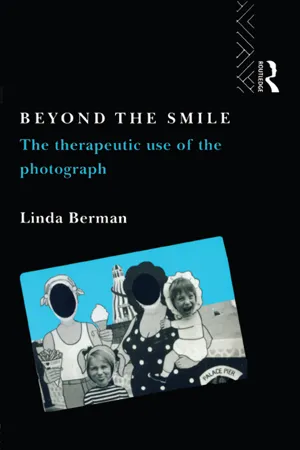
Beyond the Smile: The Therapeutic Use of the Photograph
About this book
Linda Berman explores the importance of photographs in our lives, highlighting the hidden messages behind the images. She describes different ways of using photographs in therapy and shows how by triggering memory and emotion and revealing family patterns they can be used to help the patient. Detailed case studies, with appropriate illustrations, show how photographs can be used with individuals, couples and groups, and demonstrate how useful photographs can be in many different therapeutic settings.
Information
Chapter 1
Photographs in everyday life
‘One for the Album’
Who will recall
That the red dog had fleas this summer
And stank of the barn?
That one child broke his brother’s nose
In August
And the farm roof leaked?
Those apples on the ground
Hummed full of bees
And smelled of rot.
The camera never lies.
It earmarks truth more ruthlessly than brush
Making us climb forever there
Over the white fence
Under the apple tree
Into the sunlit field.
(Margaret Newlin, Day of Sirens)
Why do we like looking at photographs? Why do we often take such care with them, storing them and cherishing them, like treasures?
Before we take a more detailed look at the therapeutic use of photographs, it is necessary to understand their wider significance in our lives. Therapy is set against the backdrop of the world; it is important, therefore, to appreciate the wide range of cultural, social and popular attitudes to the camera and photographs and to consider the uses that we make of these in our day-to-day living. Therapists must develop and foster within themselves a keen awareness of these wider issues before beginning to contemplate the use of photographs in therapy. For photographs are not brought into therapy out of a void; they are taken out of life, and as such carry with them a whole set of issues and implications.
Let us take the time, therefore, to consider these broader themes in relation to photographs, thinking around them and beyond them. For it appears that, despite much careful preservation, the images on the whole tend to be viewed quite superficially, without thought for their deeper significance and meaning. With more profound examination, the pictures pose a multitude of questions.
THE PSYCHOLOGICAL SIGNIFICANCE OF PHOTOGRAPHS
Importance and appeal
The Sun newspaper once asked its readers: ‘What would you grab first if the fire alarm went off?’ One woman replied:
After the family were safe, I’d grab my photographs.I can replace possessions, but not a lifetime of memories.
The appeal of the photograph is not restricted to any social class; its attraction is universal. The royal family obviously treasures its photographs as much as any family would. These, however, have an additional function; they simultaneously document the history of a family and that of a nation’s monarchy.
Photographs perform useful practical functions in countless areas of life. They have for example, become an indispensable asset to the police, as identification, evidence and proof. They record events in newspapers and books, illustrating historical facts and giving information. They allow us to see the famous – and the infamous – at close quarters, giving pleasure to countless teenagers in the form of ‘pop’ posters – and bringing their heart-throbs right into the bedroom.
The fact that photographs ‘have become an integral part of our lives’ is confirmed by the results of a survey on photography conducted in June 1990 by a large photographic company. This nationwide survey revealed that:
We use photos to record those special moments and to underline our personal values.96% of adults in the country love to keep photographs which capture their happy memories.Eight out of ten of us hate to throw photographs away and almost half of us put them in albums.There is a camera in 80% of British households.1
Thanks to the camera, it is relatively easy to express aspects of ourselves in pictures and to visually record selected features of our lives. The facility of photography is available to us all. Daguerre himself, who invented the first practicable photographic process in 1838, emphasised this point:
By this process, without any idea of drawing, without any knowledge of chemistry and physics, it will be possible to take in a few minutes the most detailed views, the most picturesque scenery, for the manipulation is simple and does not demand any special knowledge, only care and a little practice is needed to succeed perfectly. … This important discovery, capable of innumerable applications, will not only be of great interest to science, but it will also give a new impulse to the arts, and far from damaging those who practise them, it will prove a great boon to them. The leisured class will find it a most attractive occupation, and although the result is obtained by chemical means, the little work it entails will greatly please ladies.(Trachtenberg 1980:12–13)
Having been able to take a picture with such ease, we most often look forward to seeing the results of our photographic efforts. When photographs are collected from the processors, many people feel a sense of excitement at the prospect of seeing themselves, their families and friends, through the camera’s eye.
The inhibited among us may wait for a private moment for perusal and possible censorship. The young and more open element often find it hard to keep the newly developed photographs in their envelope until they arrive home; they are excitedly opened on the spot.
For, in general, children love photographs. This love appears to relate to the delight in seeing themselves reflected. Catching a surprise glimpse of themselves in a mirror, a puddle – or a snapshot – is sure to produce squeals of joy. Children have a fascination with their own image, gazing enquiringly. They are also enthralled at the recognition of other family members on film. The reflection is confirming – of themselves and their identity. For children, the image can be a sign of the security of their place within the family and their world. From very early in life, this need to have oneself reflected is crucial to the development of the self:
Every child has a legitimate narcissistic need to be noticed, understood, taken seriously, and respected by his mother. In the first weeks and months of life he needs to have his mother at his disposal, must be able to use her and be mirrored by her. This is beautifully illustrated in one of Winnicott’s images; the mother gazes at the baby in her arms, and the baby gazes at his mother’s face and finds himself therein … provided that the mother is really looking at the unique, small, helpless being and not projecting her own introjects on to the child, nor her own expectations, fears and plans for the child. In that case, the child would not find himself in his mother’s face but rather the mother’s own predicaments. This child would remain without a mirror, and for the rest of his life would be seeking a mirror in vain.(Miller 1987: 49)
Children need to be recognised as the unique and interesting small human beings that they are; not to be seen, to be ignored, or ‘looked right through’ is a most distressing experience for children and adults alike.
Reflected in the eyes of another, children can learn about themselves and their own identity. Thus, the sharing and recognition of their photographic image provides an exciting added bonus for children in the quest for identity and recognition; it validates them and their individuality, confirming both their separateness in the world and their relatedness to others. To be seen and admired in a photograph gives children a strengthening experience as they communicate the message ‘This is me.’
The photograph provides us all, young and old, with an extra way of seeing and being seen; it helps us get ourselves noticed. As we select our photographs, we often show ourselves in the ways that we want to be seen, ways that match our desired internal image of ourselves. In showing the photograph, sharing it with others, we tend to watch their faces as they react to our image, checking out our impact on the other people, seeking their reflected acknowledgement and appreciation.
The effective therapist will be aware of this universal human need to have the self reflected, and will ensure that she helps the patient to have an experience in therapy of being heard, seen and understood in the eyes of the other.
Issues of control and rebellion
We want to keep our memories for all time; the very having of our photographs gives us a feeling that we have some control. This may be illusory, a denial, yet we cling tenaciously to our pictures. A recent television advertisement has as its theme song ‘They can’t take that away from me.’ The film depicts a woman treasuring the photographic memory of a lost relationship.
We take such care of photographs because we know they connect us with our past; they are precious confirmation that we have existed, experienced, that we have been. They literally help us picture ourselves at different stages in our lives. The photographed moment, stretching out to infinity, lends us the time to absorb details at our leisure; we can control it in a way that gives us a feeling of power.
We may use photographs in any way we choose, employing fantasy and imagination. We can adore them, hate them, stick pins in them, display them, hide them, destroy or censor them. We can use them to deny or to confirm reality, to laugh or weep over, to preserve our desired image and maintain our fantasies.
The issue of control is often also present whilst the photographs are being taken. We can use the camera itself as a shield to avoid having to relate to people, or to intrude on their conversations. Photographing people gives the photographer the licence to control others by infantilising them and issuing orders:
Right, everyone, smile for the camera … Mabel, smile love, it may never happen. Elsie … please … stand still and move a little nearer to George. … Watch the birdie everybody!
We often react in a child-like way to these infantilising orders. Our behaviour whilst being photographed may be silly or absurd, as if we act out repressed urges. To some degree, this may be a reaction to feelings of self-consciousness and embarrassment, but the camera does also give some amongst us a freedom to relax our inhibitions and ‘grab the limelight’.
Teenagers, especially, seize the opportunity to behave in a zany manner when faced with a camera. It is often a way of using their power to rebel against adults who want to control them into posing for a ‘good’ picture.
There are, however, people who hate being photographed. Perhaps they have unpleasant memories of being forced to pose as children, and now are using their adult choice to refuse such an experience. If they are ‘captured’ without permission, they may cover their face, turn away, protesting that they are ‘camera shy’. A refusal to be photographed may also reflect a low self-image, a fear of seeing and being seen in a way that feels ultimately inescapable.
We can also use photographs to control others, especially through subjecting them to ‘compulsory’ looking. It is very difficult to decline an enthusiastic invitation to view someone’s proudly proffered holiday snaps, for it would feel as though we were rejecting a part of them. There is a need in most of us to show our photographs to people who matter to us. It is good to have them admired and accepted, to have the approval of others and an unspoken confirmation that we are worth looking at.
Sometimes it is quite easy to appreciate another’s photographs – they look interesting and one feels free enough with that person to browse through the snaps in an unconstrained way, without pressure. However, at other times, the showing of such holiday snaps is accompanied by a controlling, detailed and tedious narrative. Photographs reflect the person in more than one sense – the manner of presentation tells us much about their owner.
For the most part, other people’s holiday snaps are just not as interesting as our own. Unless the presenter of the pictures is sensitive to this fact, the often reluctant onlookers are faced with a rather boring, repetitive set of holiday images – and one set looks very much like another.
But our own photographs are different – we have the memories; we can recollect the evocative smells, the warmth, the music, taste the food, reminisce over the new-found friends and reflect on the excitement of holiday romances. The pictures are treasured both as souvenirs and an important way of preserving our reminiscences.
Children on display
Often, photographs can become very special gifts, especially within the family. They may be presented in the form of cards, sent on special occasions, often expressly designed with a slot for the picture. School photographs are frequently sent to grandparents, who proudly exhibit their framed collections on pianos, mantelpieces and window-sills, delighting in their ever-increasing numbers. Perhaps the pictures stand as symbols of what they themselves have achieved and assurances that the family line will continue long after they have gone.
Furthermore, there is a curious truth in the fact that the photographs come to express their own reality, a larger than life quality, a sense of other-worldliness. They develop a value all of their own, an extra dimension. This point can be humorously illustrated by the following well-known Jewish joke:
Mrs Levine, her face wreathed in proud smiles, was taking her infant daughter on her first outing. On the way, she encountered a neighbour who gushed over the baby.‘What a beautiful child!’ the neighbour cried.Mrs Levine smiled delightedly. ‘This is nothing,’ she boasted. ‘You should see her pictures!’(Spalding 1969: 378)
Photographic mistakes and their relation to the unconscious
Not all photographs turn out as ‘well’ as Mrs Levine’s. The family’s camera is brought out to record all kinds of life events, and there are millions of photographs developed every year – with varying results.
For the seasoned amateur, it is sometimes difficult really to see what is framed by the camera’s lens; often there is an anxiety to take the photograph quickly so we can carry on with life, for taking the posed picture momentarily stops everything. Photographer and subjects are stilled. In our haste to come back to life, to resume movement and action, we perhaps are not consciously aware of all we are seeing in one brief moment through the tiny viewfinder, with its capacity for instant time-seizure.
At times, maybe we try too ha...
Table of contents
- Cover
- Title Page
- Dedication
- Copyright Page
- Table of Contents
- Preface
- Acknowledgements
- 1 Photographs in everyday life
- 2 ‘I am here, I am there’: paradoxes, contradictions and ambiguities within the photograph
- 3 Using photographs in therapy: some general principles
- 4 A clinical example: Jane
- 5 A closer look at the family album: searching for clues to the past
- 6 The search continues: exploring images of interaction
- 7 Who can benefit?
- 8 ‘Can it really be me?’ Photographs and the self
- Conclusion
- Notes
- Bibliography
- Further reading
- Name index
- Subject index
Trusted by 375,005 students
Access to over 1.5 million titles for a fair monthly price.
Study more efficiently using our study tools.
Frequently asked questions
Yes, you can cancel anytime from the Subscription tab in your account settings on the Perlego website. Your subscription will stay active until the end of your current billing period. Learn how to cancel your subscription
No, books cannot be downloaded as external files, such as PDFs, for use outside of Perlego. However, you can download books within the Perlego app for offline reading on mobile or tablet. Learn how to download books offline
Perlego offers two plans: Essential and Complete
- Essential is ideal for learners and professionals who enjoy exploring a wide range of subjects. Access the Essential Library with 800,000+ trusted titles and best-sellers across business, personal growth, and the humanities. Includes unlimited reading time and Standard Read Aloud voice.
- Complete: Perfect for advanced learners and researchers needing full, unrestricted access. Unlock 1.5M+ books across hundreds of subjects, including academic and specialized titles. The Complete Plan also includes advanced features like Premium Read Aloud and Research Assistant.
We are an online textbook subscription service, where you can get access to an entire online library for less than the price of a single book per month. With over 1.5 million books across 990+ topics, we’ve got you covered! Learn about our mission
Look out for the read-aloud symbol on your next book to see if you can listen to it. The read-aloud tool reads text aloud for you, highlighting the text as it is being read. You can pause it, speed it up and slow it down. Learn more about Read Aloud
Yes! You can use the Perlego app on both iOS and Android devices to read anytime, anywhere — even offline. Perfect for commutes or when you’re on the go.
Please note we cannot support devices running on iOS 13 and Android 7 or earlier. Learn more about using the app
Please note we cannot support devices running on iOS 13 and Android 7 or earlier. Learn more about using the app
Yes, you can access Beyond the Smile: The Therapeutic Use of the Photograph by Linda Berman in PDF and/or ePUB format, as well as other popular books in Psychology & Photography. We have over 1.5 million books available in our catalogue for you to explore.