- 356 pages
- English
- ePUB (mobile friendly)
- Available on iOS & Android
eBook - ePub
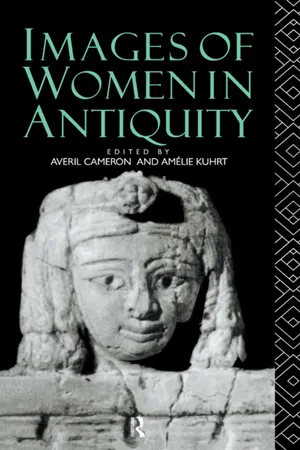
Images of Women in Antiquity
About this book
The agenda and significance of women in antiquity has gained considerable attention in recent years. In this book diverse roles for and attitudes to women in ancient societies are explored: women as witches, as courtesans, as mothers, as priestesses, as nuns, as heiresses and typically as eranged. The shifting focus is variously economic, social, biological, religious and artistic. The studies cover a wide geographic and chronological range, from the ancient Hittite kingdom to the Byzantine Empires.
This book has been brought thoroughly up to date with the addition of a new introduction and addenda to individual chapters.
PART ONEPERCEIVING WOMEN
The conditioning of a society's thinking and writing about women by
unchallenged preconceptions about their nature and function
unchallenged preconceptions about their nature and function
1 WOMEN: MODEL FOR POSSESSION BY GREEK DAEMONS1
My starting-point is such patterns of male fantasies about women, and of male strategies for controlling women in social life and cult, as we can conceivably attribute to fifth-century BC Athenians. Behind these patterns, I shall suggest, is a sense that women contain an inner space and inner darkness, which together interact with, and provide one model for, traditional popular thinking about that inner space belonging to all normal, i.e. male, human beings, in which the Greeks located the organs of what we call the mind. That relationship of metaphorical interaction is part of the background to Greek notions of daemonic possession, especially to the image of possession as erotic entry.
Evidence for male systems of controlling women in real life is thin and ambiguous; evidence for male patterns of thinking or fantasising about women is more plentiful but far more ambiguous (Gould, 1980, pp. 38-42), being mainly literary, and so liable to the distortion by convention and literary tradition which such evidence always creates. Statements about Greek societies, especially about what a genre reflects of its immediate environment, should always be prefaced with an enormous ‘perhaps’.
My evidence and my interests, nonetheless, are chiefly literary, and they centre on fifth-century Athenian tragedy. I end by speculating that fifth-century patterns of fantasy about women may have been a significant element in the formation of male Athenian literary structures such as tragedy. In these patterns of fantasy, the feeling that women are especially open to daemonic possession has an important part.
Society and Cult: Male Control and Enclosure
Greek systems of fantasy and family generally reflect, amid the usual ambivalence in male perceptions of women, a view that women can threaten male order, male life and sanity. Most Greek daemons, especially two classes, those which hunt human victims in groups (like Erinyes, ‘Furies’) and those which persecute the mind (again the Erinyes, or single daemons such as Lyssa, ‘Madness’), are female. They are also chthonic (born from chthon, ‘earth’) and are sometimes described in phrases like ‘daughters of Night’. Their femaleness is linked with their earth-born status, their attack on the mind and their habitation in darkness. Fears of the carnivorousness in female sexuality, underlying some of this material, are reflected in popular names for prostitutes like ‘The Lioness’, ‘The Panther’.2
Patterns of economic and social control presumably express the male sense that the threat posed by what is female should be contained. Such patterns varied across Greek societies, and there is little dense evidence for any society except Athens, where control seems to have been especially energetic (Schaps, 1979, p. 198). Women had no control over their own marriages, either as daughters or as widows. They were central to the social system as transmitters of property but had no control over that property themselves (Lefkowitz and Fant, 1982, pp. 33-40). Legal protection of their inheritance-rights depended effectively on defining them as incapable of a self-determining act (Gould, 1980, pp. 43-56). ‘A sympathetic wife is the greatest ktema’ (‘possession’, a neuter word).3
At Athens, therefore, women were themselves possessions. Athenian speculation about women’s activity at Sparta, furthermore, is the filter through which the Spartan material reaches us. Athenians are shocked to think that Spartan women live more publicly than at Athens, where even the names of respectable women are concealed in public discourse.4
A high degree of enclosure for their women, therefore, underpinned the prevailing self-image for fifth-century Athenian males. So did other forms of rule over people. The period during which Athenian tragedy flourished was the period of Athens’ imperial control over other Greek states. Thucydides, the fifth-century Athenian historian, attributes a critique of the Athenian character to a Corinthian, who is encouraging the Spartans to stand up to Athenian imperialism: Athenians, he says, are energetic, reckless, ‘most adventurous abroad, while you stay at home’. They have a lust to possess: the verb ktasthai, ‘to gain possession of’, figures largely in these paragraphs. Athenians never allow themselves to ‘have’ peace of mind, nor allow other people to do so: repose is the one possession, he implies, they do not want. These attributes make them extremely dangerous to other people. Thucydides fabricates an Athenian reply: the Athenians accepted ‘rule’ when it was offered; moreover, it is an eternal law that the stronger should rule the weaker.5 He suggests a picture of an Athenian (male) self-image orientated round the need to control what is allotrion, the word for ‘foreign’, ‘abroad’, which is also often used for ‘other’ as opposed to ‘self’. The application of such activity to male-female relationships is simple; and helps, perhaps, to explain Athenian attitudes to Spartan women. Men who do not ‘go out to control’ other people, as the Athenians do, are naturally perceived as weaker, and less controlling, than their women.
The Greek city-state, developing from the archaic into the classical age, was defined imaginatively by the character of its tutelary deity (Snodgrass, 1977) and also, I suggest, by the kinds of relationship which that deity traditionally made with human beings. The Athene of classical Athens was essentially kourotrophic: her prime function, in her central state cult, was to guard the mythical Athenian princeling Erichthonios (Hooker, 1963) as, in Homeric narratives, Athene protects central male figures like Diomedes, Achilles or Odysseus.6 As Aeschylus makes her say (Eumenides, 736), she has no mother. Her identity turns on her exclusive relation to the male. A male Athenian, identifying with his city’s role as a controller of others, might well feel supported in this activity by a sense of his relation with the city’s armed and kourotrophic guardian.
Greek societies, male-ordered, generally assigned to women ritual presidency over the transitional experiences, dying and birth, which are perceived as passages into and out of darkness. Dying is ‘going into the dark’, being born is ‘coming into the light’,7 an image often doing double service for the body’s emergence from the womb and passage into the grave, and for the soul’s passage into whatever obscurity is imagined to precede life, and into Hades. In the archaic age death was perceived and feared with increasing sharpness (Sourvinou-Inwood, 1981) and a sharper sense of death’s contaminating power collected around the very rites of burial and mourning which were traditionally assigned to women. In male perception, a supposed female aptitude for monitoring passage out of or into darkness is linked with a supposed female aptitude for making contact with what is polluting. In Greek as in some other cultures, concepts of the sacred are interwoven with concepts of pollution: hagnos or hagios, ‘sacred’, is cognate with agos, ‘pollution’. In Greek as in some other cultures, aspects of female biology are also perceived as polluting to men. There are taboos on touching women during menstruation or after childbirth, or on entering a temple after intercourse with a woman; as, in the society for which ancient Tamil poetry was written, any female excreta, the touch of nursing milk on a masculine chest, for example, pollutes the male, though at the same time women function as a focus of sanctity (Hart, 1973), or as in some periods of medieval European culture women’s supposed aptness for handling the more polluting and ‘darker’ aspects of divinity is interdependent on their biological and cultural associations with what comes into and what comes out of darkness, whether the darkness be that of the underworld or of the female body.8
Some of the roles assigned to women in Greek cult likewise reflect feelings about their biological functions. Women are usually confined in the cult buildings or cult procedure, as they are confined in domestic homes (Walker, this volume). They sometimes guard sacred objects, which are normally hidden or secret and are only revealed under strict ritual conditions, like the arrheta, ‘unspeakable things’, in the Panathenaic festival at Athens. They can reveal and bring forth, but only under male control; as the male priests at Delphi patterned into hexameters the sounds that came from the mouth of the priestess, the Pythia (according to one Delphic tradition, Parke and Wormell, 1965, vol. i, p. 34).
One can interpret female involvement with darker, ‘black’ cults, in Greece or in medieval Europe,9 in two ways: as chosen by the women themselves, or as assigned to them by men. It has been argued that women, disqualified from political participation, turn to ritual and cult activity in some ways ‘alternative’ to state-controlled, which often in Greek contexts means Olympian, cult (Vernant, 1980, p. 108). However, against this interpretation is the fact that in Greek societies women were given central functions in some state cults, as the guardianship of the arrheta in the central Athenian festival (Gould, 1980, p. 51). Since it was men who controlled women’s role in state cults, and who avoided direct contact with what was polluting and threatening by women’s involvement in chthonic cults, it seems more likely that in Greece, at least, where men perceived women’s physical functions as polluting to themselves, and also regarded contact with chthonic divinities as dangerous, women’s role in chthonic and state cult alike was assigned to them by men. Women’s propensity for being perceived as having an affinity with darkness may be used differently, and have a different relation to the imagination, in different cultures. In Greece, I suggest, men used, and carefully controlled, the kinship they felt women had with the darker, polluting side of divinity, and assigned them guardianship and activity by which the women would make contact, on their behalf, with potentially contaminating objects and forces.
Maenadism, part of the Bacchic cult, supposedly allowed women escape from the confinement which characterised male control of them in domestic or ritual life. However, evidence for the nature, status and even existence of maenadism in classical (as opposed to post-classical) Athens, is disablingly thin (Heinrichs, 1978). Euripides’ Bacchae, which inspires our ideas of it, may well be only a literary construct made from elements of myth and imagination, and no true reflection of any contemporary cult known to the Athenians. As such, however, the Bacchae provides magnificent if ambiguous evidence for the ways in which male Athenian fantasies might respond to women escaping from confinement into the wilds. The play combines a picture of women who are ‘out of their minds’ with a picture of women out of their proper place within the home and city; and it links both to the tearing apart of an individual king (Dodds, 1951, pp. 271-6), the collapse of a royal palace, and the exile and fragmentation of the founding royal family (Bacchae, 633, 1350-63). It establishes women’s potentially peaceful physical relation with savage nature through their reproductive functions – the maenads suckle the young of wild animals – but shows male order, and an individual male, destroyed through this relationship, and through the women’s relationship with a god who ‘drives them out of the house in madness’ (Bacchae, 33). Other, earlier, poems and plays had brought these motifs together already. Aeschylus showed the maenads tearing apart Orpheus, who is, in a sense, the archetypal author of order (in that music, in the Greek tradition, was an image of balance and order) and wielder of the human power to tame animal nature: women here tear to pieces a man who makes, as Pentheus attempts to maintain, an image of order. Several earlier poets had used the story of the daughters of Proteus, who were maddened by a goddess, and ran wild on the mountains, desiring men but disgusting them by their own physical condition.10 The ritual parallel, perhaps, to some of these elements in such myths, might be the Athenian festival known as the Thesmophoria, in which women were allowed out of the house, and sexual relations were upset (Gould, 1980, p. 51).
However male society may confine women, and control male contact with what comes out of them, it does crudely depend on their function of bringing things to light, of letting something emerge from themselves. Assigning women the ritual revelation of hidden sacred things, organising a festival in which women themselves ‘come out’, and elaborating in myth and poetry narratives in which women do escape from the city into the mountains, is a way of expressing, I suggest, and also of containing, women’s closer connection with animal nature, through their capacity for childbirth, which Greek medical writers also express in describing the womb’s mobile and aggressive nature (Lefkowitz, 1982, p. 225; King, this volume). As it is men who control the Pythia’s ravings, so it is men who create and use the myths depicting women ‘out of their mind’, whose mental and physical displacement from the norm destroys society; and a male-ordered calendar contains the Thesmophoria. Male society controls, monitors, and also, one might say, exploits, the animal nature in women (as men perceive them), which requires emergence, but which is perceived as destructive to society if not controlled by it.
Inner Space and Inner Darkness: Metaphors for the Interior
The interior space, sacred or domestic, which encloses women in cult or home, is emblematic of the female interior itself, as perceived by men. The muchos, the ‘women’s quarter’, was the inmost part of the inward-looking Athenian home (Walker, this volume). In a sense, fifth-century Athenian life, for the social classes for which we have evidence, must have been functionally divided between two roles, defined by the spaces inhabited (Gould, 1980, p. 48, n. 72), as if between two races: one at ease among marble buildings and public spaces like the agora, gymnasium and assembly, free of the city and of the lands beyond, the other confined to the inmost part of the mudbrick domestic house, with only limited exit even from the private home. As in H.G. Wells’s fantasy The Time Machine, the race living in the light feared that which inhabited comparative darkness.
Most Greek buildings had a sacred centre which, in the domestic house was the hearth, whose presiding deity was Hestia: the divine embodiment of the sanctity at the centre of the home was female (Vernant, 1965). Inside a temple there was the inner shrine, called abaton or adyton, ‘untreadable’, ‘unenterable’. Greek structuring of space, both domestic and sacred, made the centre dark (like the muchos in a house, and like the abaton in a temple, which had to be lit by torches), unenterable except to those properly consecrated, and, in a domestic context, female. Perhaps there was an unconscious parallel in male consciousness between a sacred centre or sacred precinct and the female interior.
Such a parallel, I suggest, underlies the response of the chorus to Oedipus in Sophocles’ Oedipus at Colonus. At the start of the play Oedipus walks into a grove which Antigone at once recognises as sacred (16). The Stranger, not knowing Oedipus’s identity, says he has walked on to ‘a place not holy to tread … untouchable, not to be inhabited’ (37-9). The chorus call him ektopios, ‘out of place’. When they find him in the grove they exclaim ‘terrible to see, terrible to hear’ (118-41). Sophocles balances their horrified responses here with their response when they learn who he is (since all the Greek world knows that ‘Oedipus’ has killed his father and lain with his mother). They are terrified when he tells them that he is Oedipus (222-3) even though he characterises himself as one who did not act knowingly (539, 548), just as he ‘ignorantly came where I came’ (273). His unwitting entry into the goddesses’ sacred grove has become, Sophocles lightly suggests, also a symbolic ech...
Table of contents
- Cover
- Half Title
- Full Title
- Copyright
- CONTENTS
- List of Figures
- List of Plates
- Introduction
- Introduction to the Revised Edition
- Part One Perceiving Women
- Part Two Women and Power
- Part Three Women at Home
- Part Four The Biology of Women
- Part Five Discovering Women
- Part Six The Economic Role of Women
- Part Seven Women in Religion and Cult
- Abbreviations
- Appendices, Addenda and Corrigenda
- Bibliography
- Index of Proper Names
- Subject Index
Trusted by 375,005 students
Access to over 1.5 million titles for a fair monthly price.
Study more efficiently using our study tools.
Frequently asked questions
Yes, you can cancel anytime from the Subscription tab in your account settings on the Perlego website. Your subscription will stay active until the end of your current billing period. Learn how to cancel your subscription
No, books cannot be downloaded as external files, such as PDFs, for use outside of Perlego. However, you can download books within the Perlego app for offline reading on mobile or tablet. Learn how to download books offline
Perlego offers two plans: Essential and Complete
- Essential is ideal for learners and professionals who enjoy exploring a wide range of subjects. Access the Essential Library with 800,000+ trusted titles and best-sellers across business, personal growth, and the humanities. Includes unlimited reading time and Standard Read Aloud voice.
- Complete: Perfect for advanced learners and researchers needing full, unrestricted access. Unlock 1.5M+ books across hundreds of subjects, including academic and specialized titles. The Complete Plan also includes advanced features like Premium Read Aloud and Research Assistant.
We are an online textbook subscription service, where you can get access to an entire online library for less than the price of a single book per month. With over 1.5 million books across 990+ topics, we’ve got you covered! Learn about our mission
Look out for the read-aloud symbol on your next book to see if you can listen to it. The read-aloud tool reads text aloud for you, highlighting the text as it is being read. You can pause it, speed it up and slow it down. Learn more about Read Aloud
Yes! You can use the Perlego app on both iOS and Android devices to read anytime, anywhere — even offline. Perfect for commutes or when you’re on the go.
Please note we cannot support devices running on iOS 13 and Android 7 or earlier. Learn more about using the app
Please note we cannot support devices running on iOS 13 and Android 7 or earlier. Learn more about using the app
Yes, you can access Images of Women in Antiquity by Averil Cameron, Amélie Kuhrt, Averil Cameron,Amélie Kuhrt in PDF and/or ePUB format, as well as other popular books in History & Ancient History. We have over 1.5 million books available in our catalogue for you to explore.