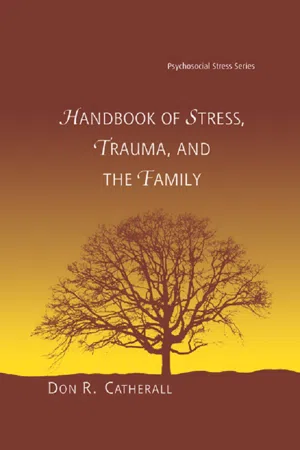
The Handbook of Stress, Trauma, and the Family is broken down into three sections, compiling research, theory and practice. The first section focuses on how traumatic stress affects intimate others, what familial characteristics affect individual susceptibility to trauma, as well as evaluation of the effectiveness of various interventions. The section on theory explores concepts of stress and intrapsychic processes underlying the intergenerational transmission of trauma, addressesing how families can buffer or enhance anxiety. The final section, entitled practice, covers assessment (presenting both the Circumplex Model and Bowenian family theory models), treatment models and treatment formats for specific populations. The major family treatment models applicable to stress and trauma are discussed, including contextual, object relations, emotionally focused and critical interaction therapy.
- 588 pages
- English
- ePUB (mobile friendly)
- Available on iOS & Android
eBook - ePub
Handbook of Stress, Trauma, and the Family
About this book
Information
Part I Theory
DOI: 10.4324/9780203644157-2
1 Trauma and Its Impact on Families
DOI: 10.4324/9780203644157-3
In Greek, trauma means wounding. Life-threatening events—whether they be fires or floods, sexual assaults, or terrorist attacks—wound the mind, the body, and the soul. Assumptions about personal invulnerability are shattered (Janoff-Bulman & Wortman, 1977). Cherished spiritual beliefs are challenged. Under conditions of prolonged or otherwise severe trauma, the person’s biochemistry (Friedman, 1991; Kolb, 1987; McDonagh-Coyle et al., 2001; Murberg, 1996; van der Kolk, 1988, 1996) may be permanently altered, as is the ability to give and receive love (Herman, 1992; Jordan et al., 1992; Matsakis, 1994a, 1996a, 1996b, 1998b). (See also chapters 3, 4, and 11 in this volume.) Just as in novels and the movies, trauma seldom affects the individual alone.
Based on Freud’s emphasis on liebe (love) and arbeit (work), a simple working definition of mental health is the ability to love, work, and play. Yet when a traumatized individual develops more than a 30-day acute stress reaction and goes on to acquire a longer term and more devastating traumatic reaction (such as posttraumatic stress or a dissociative, depressive, or somatic disorder), that person’s ability to pursue meaningful work and to develop and maintain safe and loving relationships is severely impaired (Kates, 1999; Sheehan, 1994; Spasojevic, Heffer, & Snyder, 2000; Williams & Williams, 1987; Matsakis, 1994a, 1994b). Unfortunately, at the very time survivors need people the most, their symptoms can lead to alienation, hostilities, and a host of misunderstandings for all involved including coworkers, neighbors, grandparents, and other members of the extended family.
Although not all survivors develop posttraumatic stress disorder (PTSD), the interpersonal repercussions of PTSD are the focus of this chapter. However, due to the overlap between the symptoms of PTSD and those of other possible reactions, such as a dissociative, somatic, or depressive disorder (Cascardi & O’Leary, 1992; Feeny, Zoeller, & Foa, 2000; Tampke and Irwin, 1999; van der Kolk & Fisler, 1995; Zoellner, Fitzgibbons, & Foa, 2000), many of the observations made regarding PTSD may also apply to instances where survivors develop a different traumatic reaction. Exceptions include those interpersonal problems that stem directly from the unique feature of PTSD: the PTSD cycle—states of hyperarousal alternating with states of numbing. Either state can result in mental and emotional disorganization, leaving survivors feeling out-of-control, even terrified, unless they have ways of managing them.
Extreme states of numbing or hyperarousal can be dangerous. When intrusive thoughts, flashbacks, panic attacks, or other forms of hyperarousal occur while driving, cooking, or working with children or machinery, accidents can result. In addition, the feelings of helplessness and confusion engendered by being unable to modulate the PTSD cycle are reminiscent of the powerlessness and disorientation experienced during the original trauma. Hence the symptoms of PTSD are retraumatizing in themselves (Matsakis, 1994a, 1996a). Under such circumstances, survivors have difficulty in being present to others. In response, others can feel angered, rejected, or helpless and can easily decide that the survivor is “impossible,” “antisocial,” or “crazy.”
A common way survivors try to circumvent the PTSD cycle is by avoiding interpersonal and other situations that might stimulate it. Abraham Kardiner, who worked with shell-shocked World War I veterans, wrote that traumatization (what we now call PTSD) is similar to schizophrenia in that the person withdraws from the world (Kardiner & Spiegel,1947). Since the ego can not handle the anxiety generated by the trauma in addition to the anxieties of normal life, a diminished interest in the world and a decline in personal functioning can follow (Matsakis, 1994a, 1996b). Indeed, it is more often the avoidant symptoms of PTSD, rather than the survivor’s reminiscences, that create negative marital and family dynamics.
Survivors frequently report that they seek relief from the PTSD cycle (and the clinical depression that frequently attends those with severe or chronic PTSD) through addiction. Alcohol, excess food, and certain street drugs can have a suppressant effect on the nightmares, night terrors, and panic attacks of hyperarousal as well as mitigating effects on depressive and numbing symptoms. Survivors are at high risk for developing clinical depression or substance abuse problems or both (or for exacerbating preexisting ones); this has been found in numerous populations, from combat veterans to victims of family violence and sexual assault (Courtois,1998; Herman, 1992; Kates, 1999; Jelinek & Williams, 1984; Keane, Caddell, Martin, Zimering, & Fairbank, 1983; Lacoursiere, Godfrey, & Ruby, 1980; Matsakis, 1994a; McLeod et al., 2001; van der Kolk, 1988,1996).
For example, in a national sample, Hankin et al. (1999) found that symptoms of depression were three times higher, and rates of alcohol abuse were two times higher among women Veterans Administration (VA) outpatients who reported sexual assault while in the military. Hence, any discussion of the interpersonal effects of trauma must take into account the fact that a substantial number of families have a loved one with more than one diagnosis. When substance abuse exists, it, alone, can ravage a family’s emotional and financial stability.
The “consequence of PTSD” hypothesis views substance abuse as a form of self-medication for the symptoms of PTSD and depression; however, there are at least two other hypotheses regarding the frequency of the dual diagnoses of alcohol abuse and PTSD (McLeod et al., 2001). The “shared stressor” hypothesis holds that addiction and PTSD are the results of a shared stressor, while the “shared vulnerability” hypothesis suggests that environmental or genetic factors or both create vulnerability to both PTSD and alcohol.
As researchers and clinicians have observed, strong marital or family ties and community support can serve as a buffer, if not a life-saver, for trauma survivors (van der Kolk, 1996; Herman, 1992; Matsakis, 1998a, 1998b). One of the most critical factors in determining whether a traumatized person will develop a long-term traumatic reaction (as opposed to a short-term stress reaction) is the quality of the individual’s attachment system—his or her ability to derive comfort and hope from others. This requires that there are persons who are able to provide such assistance and that, furthermore, the traumatized individual is able and willing to receive it.
Impact on Significant others
Despite the observed buffering effects of supportive others, there is no lack of evidence for the negative impact of trauma on family and intimate relationships. Separation, divorce, marital dissatisfaction, and emotional instability in children are common (Carroll, Foy, Cannon, & Zwier, 1991; Herman, 1992; Kates, 1999; Kulka et al., 1990; Matsakis, 1996b; Matsakis, 2001; Scaturo & Hayman, 1991; Sheehan, 1994; Vogel & Marshall, 2001; Williams & Williams, 1987).
Some survivors may function well at work or when focused on specific projects. However, at home, their mood swings, irritability, depression, memory problems, emotional numbing, and difficulties with conflict-resolution and life-span transitions eventually manifest themselves and affect the entire family, even toddlers (Daniele, 1994; Scaturo & Hayman, 1991; Taft, King, King, Leskin, & Riggs, 1999; Vogel & Marshall, 2001). Family members describe having to “walk on eggshells” so as not to increase the suffering of a loved one who is already distressed. They may also fear irritating an already irritable person and risk becoming the object of that person’s rage reactions or rejections.
The Threat of Suicide
It is well established that persons with PTSD and depression, especially if comorbid with substance abuse, are high suicide risks, especially during anniversaries of the trauma or in response to major losses, such as the death of a child or loss of a job (Hendlin & Haas, 1984; Kates, 1999; Matsakis, 1994a, 1996b). Family members who are aware of this suicide potential, or whose survivor has threatened or attempted suicide in the past, may be especially cautious in their interactions. “I edit everything I say to him so as not to upset him. I don’t want him going off on me or, worse, going into a slump because of something I said or did,” explains the wife of a firefighter. “He’s threatened suicide a few times. If he does it, I know it won’t be my fault. But I don’t want to be the one who pushes him over the edge.”
The author has worked with dozens of spouses and young adult children of survivors who refrained from leaving their unhappy home because they feared the survivor might act on a suicide threat. In many instances, it was as hard for the clinician as for the family member to determine whether the threat was manipulative or sincere. In the author’s experience, sometimes the departure of a disgruntled family member did precipitate a suicide attempt or parasuicidal behavior, such as driving while intoxicated, having sexual relationships with HIV-infected persons, or not taking needed medications. There were cases of completed suicides and parasuicidal behaviors which were ultimately lethal. According to Kates (1999), more police officers die as the result of PTSD than in the line of duty.
Fulfillment of Family Roles
Partners frequently describe their trauma survivor as either a “part-time” lover or as a controlling or suffocating one, as either a nonexistent parent or as an overly protective or inconsistent one (Courtois, 1988; Matsakis, 1994b, 2000). Parents with combat histories or histories of child abuse may have difficulties disciplining children. Some employ the harsh methods of discipline inflicted upon them in the past. Others are so fearful of repeating their past, they avoid disciplining their children altogether. Adult survivors of child abuse who were severely punished, then later indulged, by their abuser may repeat this pattern as parents (Courtois, 1988). Any of these disciplinary methods can lead to conflicts with the other parent and deleterious effects on the children.
When the trauma survivor’s symptoms do not permit, or they severely limit, the ability to sustain gainful employment, others in the family must shoulder the economic burden. In instances observed by the author, this can create resentments and possible guilt about harboring such resentments. The husband of a car accident survivor explains, “Of course I mind having to work overtime to make ends meet. Who wouldn’t? What I can’t stand is when she damns me and anyone else who isn’t in constant pain like she is. Yet when I remember that her tantrums are not her fault and see her bravely trying to go on, I feel guilty for blaming her and sometimes even hating her for ruining my life.”
Intergenerational Effects
The effects of trauma can ripple down to future generations (Barocas & Barocas, 1973; Epstein, 1979; Figley, 1995; Freyberg, 1980; Rosenheck & Fontana, 1998). “Will I ever be able to love again?” were the first words uttered by the son of a combat veteran as he barged into my office. “I don’t care about my nightmares and panic attacks, but will I be able to feel again? To love others and to let them love me?”
This young man had internalized his father’s traumas to the point of reenacting them in highly dissociative states. Although he was the sole object of his father’s adoration, in the name of “initiating” his son into manhood, the father treated him harshly. After the young man married, his attachment to his father continued to dominate his life. He felt he had to tolerate his father’s ongoing emotional abuse and intrusions into his marriage so as not to see his father psychologically disintegrate. As Kerr and Bowen (1988) would have predicted, just as the young man began to make therapeutic progress, the father insisted that he terminate therapy—and he did.
Parentification of Children
The multigenerational impacts of trauma are diverse. Studies of the children of...
Table of contents
- Cover Page
- Title Page
- Copyright Page
- Table of Contents
- About the Editor
- Contributors
- Series Editor's Foreword
- Preface
- Introduction
- Part I: Theory
- Part II: Research
- Part III: practice
- Index
Trusted by 375,005 students
Access to over 1.5 million titles for a fair monthly price.
Study more efficiently using our study tools.
Frequently asked questions
Yes, you can cancel anytime from the Subscription tab in your account settings on the Perlego website. Your subscription will stay active until the end of your current billing period. Learn how to cancel your subscription
No, books cannot be downloaded as external files, such as PDFs, for use outside of Perlego. However, you can download books within the Perlego app for offline reading on mobile or tablet. Learn how to download books offline
Perlego offers two plans: Essential and Complete
- Essential is ideal for learners and professionals who enjoy exploring a wide range of subjects. Access the Essential Library with 800,000+ trusted titles and best-sellers across business, personal growth, and the humanities. Includes unlimited reading time and Standard Read Aloud voice.
- Complete: Perfect for advanced learners and researchers needing full, unrestricted access. Unlock 1.5M+ books across hundreds of subjects, including academic and specialized titles. The Complete Plan also includes advanced features like Premium Read Aloud and Research Assistant.
We are an online textbook subscription service, where you can get access to an entire online library for less than the price of a single book per month. With over 1.5 million books across 990+ topics, we’ve got you covered! Learn about our mission
Look out for the read-aloud symbol on your next book to see if you can listen to it. The read-aloud tool reads text aloud for you, highlighting the text as it is being read. You can pause it, speed it up and slow it down. Learn more about Read Aloud
Yes! You can use the Perlego app on both iOS and Android devices to read anytime, anywhere — even offline. Perfect for commutes or when you’re on the go.
Please note we cannot support devices running on iOS 13 and Android 7 or earlier. Learn more about using the app
Please note we cannot support devices running on iOS 13 and Android 7 or earlier. Learn more about using the app
Yes, you can access Handbook of Stress, Trauma, and the Family by Don. R. Catherall in PDF and/or ePUB format, as well as other popular books in Medicine & History & Theory in Psychology. We have over 1.5 million books available in our catalogue for you to explore.