This book provides the latest information about the development of intersensory perception -- a topic which has recently begun to receive a great deal of attention from researchers studying the general problem of perceptual development. This interest was inspired after the realization that unimodal perception of sensory information is only the first stage of perceptual processing. Under normal conditions, an organism is faced with multiple, multisensory sources of information and its task is to either select a single relevant source of information or select several sources of information and integrate them. In general, perception and action on the basis of multiple sources of information is more efficient and effective. Before greater efficiency and effectiveness can be achieved, however, the organism must be able to integrate the multiple sources of information. By doing so, the organism can then achieve a coherent and unified percept of the world.
The various chapters in this book examine the developmental origins of intersensory perceptual capacities by presenting the latest research on the development of intersensory perceptual skills in a variety of different species. By adopting a comparative approach to this problem, this volume as a whole helps uncover similarities as well as differences in the mechanisms underlying the development of intersensory integration. In addition, it shows that there is no longer any doubt that intersensory interactions occur right from the beginning of the developmental process, that the nature of these intersensory interactions changes as development progresses, and that early experience contributes in important ways to these changes.
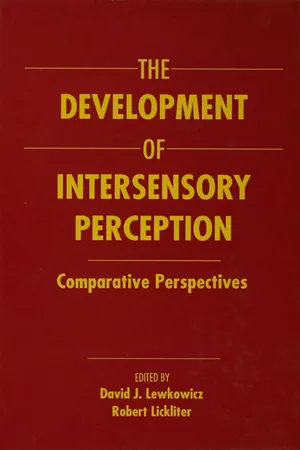
eBook - ePub
The Development of Intersensory Perception
Comparative Perspectives
- 454 pages
- English
- ePUB (mobile friendly)
- Available on iOS & Android
eBook - ePub
The Development of Intersensory Perception
Comparative Perspectives
About this book
Information
Publisher
Psychology PressYear
2013Print ISBN
9781138989054
9780805812176
Edition
1eBook ISBN
9781134773572
Part One
Conceptual Issues
Chapter One
Sources of Order for Intersensory Functioning
Intersensory functioning has frequently been referred to as if it were a process, when in fact it is an outcome. That is, intersensory functioning is involved whenever there are joint influences of stimulation in more than one modality. However, different instances of intersensory functioning need not have any mechanisms in common. It can therefore be likened to other functional classes of behavior such as feeding or social behavior, where similarity of outcome has no implications with regard to the mechanisms whereby the outcome is accomplished. For example, although both amoebas and humans feed and the amoeba’s extension of a pseudopod and Oliver Twist’s extension of his porridge bowl can both be seen as related to feeding, any similarity in the mechanisms underlying the two “feeding responses” is at best trivial. The task is to determine how a similar outcome (e.g., feeding or intersensory function) is accomplished by different organisms in different contexts.
This analytic task is particularly meaningful with regard to developmental processes as mechanisms utilized, developed, or sharpened within one domain or phase of development are available for incorporation into new organizations in new domains at later periods in development. In addition, because intersensory functioning enhances adaptive responding, it is likely to be involved at most stages of development. The mechanisms involved in such functions may, however, change during ontogeny. The transitions in the mechanisms underlying a particular phenomenon are likely to have important implications for the overall functions of an organism. Consequently, it is important to delineate the mechanisms involved in intersensory functions at different stages of development. In this chapter I discuss three aspects of intersensory development:
- The different types of intersensory functioning and the mechanisms underlying them.
- Some of the determinants of these mechanisms.
- Aspects of development that lead to changes in the configuration in which these mechanisms operate.
I pay particular attention to the way in which heterochronaxial development (i.e., different times of onset and rates of development) of the sense systems can influence the relationships between the sensory modalities. In particular, I examine how the nature of intersensory relationships can contribute to shaping functional organization in fundamental ways.
Types of Intersensory Function
A number of different types of intersensory functioning have been previously identified (Boutck & Turkewitz, 1990; Mendelson & Haith, 1976; Turkewitz & McGuire, 1978). These include:
- Independent functioning, in which stimulation in one modality has no effect on responsiveness to stimuli in other modalities.
- Intersensory facilitation or inhibition, in which stimulation in one modality either enhances or reduces responsiveness to stimuli in other modalities.
- Association of polymodal characteristics.
- Abstraction of common information. Abstraction of common information involves equivalence between modalities with regard to what have been termed amodal properties such as location, extent, texture, movement, duration, number and form.
In this chapter I am primarily concerned with the way in which independent functioning and developmental changes in the separation between the senses influence the other modes of intersensory functioning, particularly the abstraction of common information.
Independent Functioning
In their listing of possible types of auditory–visual relationships, Mendelson and Haith (1976) included no relation, although they believed the possibility “was dispelled by existing data.” Although that is undoubtedly true with regard to auditory–visual relationships following birth, it is not at all the case that no relationship between particular sense systems represents a null set when a more extended perspective on development is assumed. Thus, given the sequential onset of functioning of the various sense systems, which has been documented by Alberts (1984) and Gottlieb (1971), it is a virtual certainty that at some time in embryogenesis there is independence of functioning between functional and nonfunctional systems. Although this particular mechanism (i.e., the nonfunctional state of one or more sense systems) for achieving independence between systems seems so obvious as to not bear mentioning, it should be noted that such independence is not a design requirement for the development of a multimodally responsive organism. It is easy to conceive of organisms in which all sense systems began to develop simultaneously and continue to develop at equivalent rates so that there is never any effective isolation of developing systems. Despite the relative simplicity of differential time of onset as a mechanism, consequences deriving from its operation are far from trivial. As has been previously suggested (Turkewitz & Kenny, 1982), the absence of input from an as yet nonfunctional modality could reduce competition between sense systems and could reduce the amount of information to be dealt with. This would simplify processing requirements and make it easier for developing organisms to create a structure for dealing with the available input. The information and structure gained from the operation of the earlier developing system would be available for utilization in the organization of later developing systems. In reviewing the literature on compensatory function in relation to time of onset of impairment, Burnstine, Greenough, and Tees (1984) concluded that overall the findings fit well with Turkewitz and Kenny’s view that information in one modality is used in the organization of another.
According to Turkewitz and Kenny (1982), the timing of the onset of relationships between systems plays a crucial role not only in determining the nature of the relationships between the systems but also in shaping the nature of functioning within a modality. By far, the greatest number of studies examining factors contributing to the development of sensory and perceptual development have focused on the influence of experience, or lack of it, on functioning within the exposed or deprived modality. A few studies, however, have examined the effects of deprivation in one modality on functioning in another modality. Finally, several recent studies have examined the effects of unusually early stimulation in one modality on functioning in other modalities. The latter two types of studies are obviously relevant to issues concerning the timing of shifts from conditions when two systems are unrelated to a condition when they are related.
Though obvious, it should be noted that the absence of functioning within a modality is not the only possible basis for independence of functioning between modalities. Birch and Lefford (1963) used as an example of independence Abbott’s demonstration:
… that the frog was incapable of modifying a visually determined response on the basis of information obtained through pain sensation. Thus, a frog who was permitted to strike at a live fly impaled on a central post which was surrounded by a sharp palisade of stakes continued to strike at the moving fly despite the fact that every outthrust of its tongue resulted in its being impaled upon the sharp points of the palisade…. In contrast, in the same organism, the visually determined striking response is capable of being modified by information received through gustatory avenues of stimulation. Thus, as Schaeffer (28) has pointed out, a frog in very few trials will learn to inhibit its visually determined striking response to a bitter hairy caterpillar. (Birch & Lefford, 1963, p. 3)
The frog’s failure to relate the visual and tactile stimulation represents a clear instance of independence of functioning between two functioning systems where the independence is determined by the absence of any common final pathway between the two modalities. Another form of independent functioning between functional systems is exhibited in the prey-finding behavior of pit vipers, which exhibit a serial use of different sense systems in different phases of the hunting sequence, with chemical cues guiding tracking and thermal cues guiding striking. Similar examples of the sequential use of different sense systems in the guidance of complex sequences of behavior are not rare in the study of animal behavior but have not been suggested nor looked for in humans. Although such serial switching of control by different modalities is unlikely in adults, it may well exist during early stages of development. Thus, it is possible that the sequential nature of children’s exploratory behavior of the type documented by Ruff (1976; Ruff, Saltarelli, Capozzoli, & Dubiner, 1992) is governed by a hierarchical set of relationships between sense systems with successive habituation of different modalities. So, for example, reported transitions from looking at to mouthing of an object could stem from an initially dominant response to the visual aspects of an object becoming habituated so that the infant then responds to the tactile properties of the object. It should be noted that this proposition entails a functional isolation between systems, based on sensory dominance. This idea of dominance is somewhat different from the usual one. Discussions of dominance have usually implied an age or stagelike character to dominance, with a particular system being dominant at one age or stage of development (Birch & Lefford, 1963; Lewkowicz, 1988a, 1988b). The current proposition, although not precluding such age or stagelike dominance, would make it a somewhat more dynamic phenomenon with the dominant sense system changing during the course of a sequence of behavior. This processing-dependent dominance is consistent with Lewkowicz’s (1992) recent finding of differences in dominance in response to moving as opposed to static figures in infants during the first year of life. In addition to the kind of dominance thus far discussed, which is essentially a process resulting in independence between systems, there is another sense that does not involve independence of systems nor even reduced attention to one or more systems. Therefore, it should be differentiated from the other. This second type of dominance is one in which input in one modality is assimilated to that in another modality. A particularly striking example is the phenomenon of visual capture when, for instance, the sounds from speakers located at the sides of a movie theater are localized as coming from the front of the theater where the visual image from which the sound is putatively emanating is located. Although this type of dominance is clearly relevant to intersensory functioning, it is not relevant to independent functioning between modalities and therefore is not further pursued in this chapter.
Some of the developmental implications and consequences of initial independence between sense systems are captured in an analysis of the homing behavior of kittens (Rosenblatt, Turkewitz, & Schneirla, 1969). When reared in the laboratory, kittens spend almost all of the time during their first 3 weeks of life together with littermates and mother in one corner of their living cage. There is clear evidence that the kittens become attached to this area of their living space and develop a pattern of returning to it when displaced from the “home corner.” When the mother and other kittens are removed from the cage and kittens are tested one at a time by being placed in various areas of the cage, they show an increasing tendency to return to the home corner during a 3-min test period. This pattern is first evidenced at 5–7 days of age, when almost 75% of tests begun by placing a kitten in a corner adjacent to the home corner are concluded with the kitten in the home corner. It is not until they are almost 2 weeks old that kittens exhibit homing reliably when started in the corner diagonally opposite the home corner. It should be noted that homing from the adjacent corner begins at a time when the kittens’ eyes, which open between the seventh and ninth day of age, are still closed. There is evidence that the earliest phase of homing is under olfactory and thermal control (Freeman & Rosenblatt, 1978), with a gradual transition to joint visual and olfactory control, ending with primarily visual control (Rosenblatt, Turkewitz, & Schneirla, 1969). Turkewitz and Kenny (1982, 1985) suggested that this pattern was in part shaped by the initial absence of intersensory competition followed by its gradual development. Thus, they suggested that the development of homing from the adjacent corner, which took place in the absence of patterned visual input, was facilitated by the absence of competition from vision. It should be noted that this suggestion received some indirect support from a study with rats in which it was found that rat pups that had their eyes surgically opened at an earlier than normal age, thereby providing abnormally early intersensory competition, failed to discriminate home cage shavings from fresh shavings at an age when littermate controls clearly preferred the home cage shavings (Celenza, Kenny, & Turkewitz, 1984).
The transition to joint olfactory and visual control does not occur at the time of eye opening but several days later. In this connection it is important to note that eye opening in the kitten is generally a gradual process occurring over a 2- to 3-day period, with separation between the lids gradually increasing over this period. From my perspective, the gradual increase in visual input is important because it does not produce the kind of disruption in functioning that would be expected from a sudden increase in input in a modality. In fact, in the rat pup, in which eye opening occurs considerably later (usually during the third week of life; Altman & Dittmer, 1972) and somewhat less gradually than in the kitten, there is evidence that eye opening is associated with a disruption in homing (Johanson, Turkewitz, & Hamburgh, 1980; Kenny & Turkewitz, 1986). It is possible that it is the gradual increase in visual input in the kitten that is responsible for the failure to find any evidence of the use of vision for several days after the eyes have opened, despite the fact that there is evidence that elements of the visual system are functional well before the age of eye opening (Hubel & Wiesel, 1963). In other words, when patterned visual information first becomes available, the kitten may not utilize it in directing its behavior and may merely continue to behave in accordance with the pattern it had developed in the absence of vision. This, however, provides an opportunity for visual information to be mapped onto the already organized olfactory based pattern and might be the basis for the development of joint, multimodal control. Once vision begins to be used for guiding behavior, the increased information can result in a reorganization of the entire pattern so that the earlier types of behaviors such as homing disappear.
I have explored this example at some length because it illustrates some of the complexities that result from the heterochronic development of sense systems. The heterochronic development normally enables one modality to function unperturbed by stimulation from another, and ontogenetic relaxation of that separation can shape and modify behavior. Thus, the onset of later developing systems can have different consequences for the organization of behavior depending on the state of organization of the earlier developing systems, as well as on the manner of onset of the latter system. For example, the onset of functioning of a newly developed system can result in no immediate change in ongoing behavior, as appears to be the case when the kitten’s eyes open, or can result in disruption of an ongoing pattern, as appears to be the case for the rat. The disruption seen in the rat may have a somewhat unanticipated source. Unlike the cat, the rat does not appear to be a highly visual animal, as is apparent when its behavior on a visual cliff is examined. When placed on a visual cliff apparatus, cats routinely descend on the shallow side (Turkewitz, Gilbert, & Birch, 1974). In contrast, rats are as likely to descend on the deep as on the shallow side unless their whiskers are clipped prior to testing (Schiffman, Lore, Passafiume, & Neeb, 1970). These data indicate that when tested under comparable circumstances in which tactile and visual cues are in conflict, cats respond to visual cues whereas rats essentially ignore the visual differences on the two sides of the cliff and respond instead to their tactile similarity. When examined developmentally, further differences, which may in part be due to differences in the manner of eye opening, are exhibited by kittens and rats. As has previously been noted, adult cats respond differently to the two sides of the visual cliff even wit...
Table of contents
- Cover
- Half Title
- Title Page
- Copyright
- Contents
- Foreword
- Part I: Conceptual Issues
- Part II: Effects of Early Experience and Neural Mechanisms in Animals
- Part III: Intersensory Interactions in Human Development
- Part IV: Future Directions
- Author Index
- Subject Index
Trusted by 375,005 students
Access to over 1.5 million titles for a fair monthly price.
Study more efficiently using our study tools.
Frequently asked questions
Yes, you can cancel anytime from the Subscription tab in your account settings on the Perlego website. Your subscription will stay active until the end of your current billing period. Learn how to cancel your subscription
No, books cannot be downloaded as external files, such as PDFs, for use outside of Perlego. However, you can download books within the Perlego app for offline reading on mobile or tablet. Learn how to download books offline
Perlego offers two plans: Essential and Complete
- Essential is ideal for learners and professionals who enjoy exploring a wide range of subjects. Access the Essential Library with 800,000+ trusted titles and best-sellers across business, personal growth, and the humanities. Includes unlimited reading time and Standard Read Aloud voice.
- Complete: Perfect for advanced learners and researchers needing full, unrestricted access. Unlock 1.5M+ books across hundreds of subjects, including academic and specialized titles. The Complete Plan also includes advanced features like Premium Read Aloud and Research Assistant.
We are an online textbook subscription service, where you can get access to an entire online library for less than the price of a single book per month. With over 1.5 million books across 990+ topics, we’ve got you covered! Learn about our mission
Look out for the read-aloud symbol on your next book to see if you can listen to it. The read-aloud tool reads text aloud for you, highlighting the text as it is being read. You can pause it, speed it up and slow it down. Learn more about Read Aloud
Yes! You can use the Perlego app on both iOS and Android devices to read anytime, anywhere — even offline. Perfect for commutes or when you’re on the go.
Please note we cannot support devices running on iOS 13 and Android 7 or earlier. Learn more about using the app
Please note we cannot support devices running on iOS 13 and Android 7 or earlier. Learn more about using the app
Yes, you can access The Development of Intersensory Perception by David J. Lewkowicz,Robert Lickliter in PDF and/or ePUB format, as well as other popular books in Psychology & Developmental Psychology. We have over 1.5 million books available in our catalogue for you to explore.