![]()
CHAPTER 1
Healthy eating and the under 5s
AT A GLANCE
• What are children made of…?
• Summary of healthy eating principles
• Vegetarian diets
• Vitamin supplements
• Dental hygiene
• Foods to eat in moderation
Introduction
Food provides the nutrients necessary to sustain normal growth and development in the early years. The weight of babies has normally tripled by the time of their first birthday and their height will have almost doubled. This rate of development slows in the second year of life but remains comparatively rapid. From the age of about two, height increases about 6 cm annually through childhood and adolescence. In the first five years of life a child's brain will have grown to about 90 per cent of its final size. Associated with height and weight is the development of hair and teeth and, unseen, internal organs such as the heart and lungs. Normal growth and development are dependent on many factors, one of the most important being the quality of diet.
At birth, a baby's diet is totally dependent on breast or formula milk. Most experts recommend breast milk because it contains all the nutrients needed in the correct proportions. In addition, evidence suggests that breastfeeding reduces the risk of infection and diseases, in both the short and long term. The Department of Health recommends that exclusive breastfeeding should continue until six months when weaning – the gradual introduction of solid food into the diet – can begin. At six months, breast milk may not be providing all the nutrients that a baby needs and the introduction of other foods enables the provision of a balanced diet. In particular, babies may become deficient in iron and the introduction of puréed meat or pulses is a good idea. Weaning should not normally begin before a baby reaches 20 weeks. If weaning does start before six months, there are a number of foods that should be avoided, particularly those than contain: wheat, gluten (a protein found in wheat), eggs, fish, shellfish, liver, citrus fruits, nuts, soft and unpasteurised cheeses.
Weaning enables nutrients from a greater variety of foods to be eaten and develops other skills in infants such as biting and chewing. When children are first weaned the solid food should be smooth and puréed, gradually changing to a thicker consistency with some ‘lumps’. By the time children are about one year old food will be the same as for the rest of the family but mashed and chopped into small manageable pieces. Once weaning has started children are no longer dependent only on breast milk and provision of a healthy balanced diet starts to take on importance. It is essential, therefore, that family food provides a healthy diet for the benefit of young and old alike.
A healthy balanced diet provides all the nutrients that children need, in the correct amounts. These days, general concerns about children's diets are twofold. The first is that children are eating too much food – more than they need to meet their energy requirements. When this happens the excess is converted into body fat which increases the risk of becoming overweight or obese. The second concern is that there are insufficient nutrients in children's diets to maintain normal growth and to undertake their daily activities. It is quite possible for a child to eat too much food and become overweight whilst, at the same time, be undernourished because her or his diet lacks sufficient of the essential nutrients. The effects of a poor childhood diet may only become apparent in later life.
Children should enjoy food; it is one of the pleasures of life. It is best to avoid thinking about ‘good’ or ‘bad’ foods – the key point is that children should eat a healthy balanced diet. This chapter discusses some of the core issues that relate to eating a healthy diet. It starts by looking at the principles on which a healthy diet is based and considering how these may be applied to young children. There are a number of foods that, if eaten to excess, can lead to long or short term health problems and guidance is given on some foods that should be avoided or limited.
What are children made of… ?
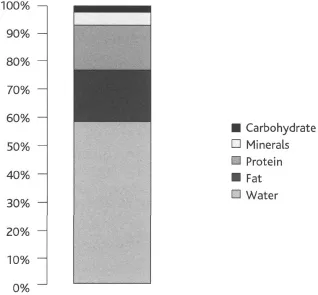
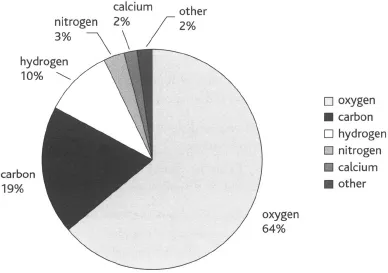
Children's bodies are made up of cells. No one really knows how many cells they have – it increases as they grow and by the time they reach adulthood it is likely to be in the order of 10 to 100 trillion (a trillion is a million million or 1,000,000,000,000). Children (like adults) have tissues – groups of cells with similar structure and function – muscle or nervous tissues are examples, which increase in size and number as they grow. Organs comprise two or more types of tissue that together perform a particular function – the heart and brain are examples of organs. Finally, organ systems are a group of organs working together to achieve a particular function. For example the heart, blood and blood vessels combine to form the circulatory system. They work together to transport nutrients and oxygen throughout the body and remove waste products. Figures 1.1 and 1.2 illustrate the typical composition of a child's body.
Cells consist mainly of water but they contain also many substances that are essential for life. The food that children eat provides nutrients for cells, which are essential for normal metabolism. The nutrients are needed for energy and for growth – the development of new cells – that enable the enlargement of tissues and organs. Cells are constantly changing – new substances are being produced and waste material is being excreted. It is amazingly complex – there are thousands of chemical reactions, all interlinked and controlled by enzymes, going on all the time. A healthy balanced diet ensures that the cells receive the nutrients they need to enable a child's body to function effectively, and maintain health and wellbeing.
The largest constituent of a child's body is water – nearly two-thirds. The amount of fat is highly variable between individuals as well as variations due to age and gender. Most of the minerals are found in bones and teeth although iron is an important constituent of blood. Many minerals are present in cells in minute quantities but play a vital role in metabolism. Carbohydrates are present mainly as blood sugar and as glycogen which is stored in the liver. Although essential, vitamins only occur in very small amounts – too small to register on this chart.
Figure 1.1 Approximate composition of a child's body
Oxygen is the most abundant element found. It is a constituent of water (H2O), fats, proteins and carbohydrates. Carbon and hydrogen are major constituents of fats, proteins and carbohydrates. Nitrogen is found in protein (and other important substances such as DNA and RNA). Calcium is present in significant quantities in bones and teeth. ‘Other’ includes minerals such as phosphorous, sodium, potassium and iron plus various trace elements.
Figure 1.2 Approximate percentages of elements in a child's body
Healthy eating
Food is defined as any solid or liquid that contains nutrients. Children need nutrients for:
• Energy – normal, active children depend on food to provide sufficient energy.
• Growth and repair – children need food to enable normal growth and development, and to repair and replace tissues that wear out or become damaged.
• Regulating their body functions – energy production and growth are not random events and children have substances such as enzymes and hormones to control the activities of their bodies.
Healthy eating guidelines for under 5s are similar to those recommended for adults but there are some differences. When planning meals and snacks for under 5s it is important to bear in mind that:
• Children have relatively high energy and nutrient needs relative to their size; this is needed for normal growth and development.
• They have small stomachs and immature digestive systems and may find it difficult to cope with large meals – small regular meals and snacks are preferable.
• Their appetites are not consistent and the amount they want to eat will vary; they may go through phases where they seem to eat relatively little or are insatiable.
In theory, providing the correct balance of foods to ensure a healthy diet is relatively straightforward. A healthy balanced diet should consist of:
• Starchy foods and fruits and vegetables – they should form the major part of the diet and be provided at all mealtimes.
• Meat, pulses, milk and dairy foods are protein rich, contain a variety of additional nutrients and should be provided on a regular basis.
In practice it can be difficult to be sure about the quantity of nutrients children are eating. In most instances it is not necessary – if a child is eating a balanced healthy diet the chances are that she or he will be getting all the necessary nutrients in the correct amounts. Considerable research has been carried out over the years to determine nutrient needs of children and adults alike. Box 1.1 explains the current position.
Starchy foods
Starchy foods provide children with energy, vitamins, minerals and fibre. Staple foods such as bread, other cereal based foods (rice, pasta and breakfast cereals), and tubers such as potatoes, yams and sweet potatoes, are all good examples of starchy foods. Whole grain cereal products tend to contain more fibre, vitamins and minerals.
Box 1.1 Nutritional requirements explained
The amount of nutrients we need – our nutritional requirements – vary according to age and gender as well as individual differences. It is difficult to be precise. In the UK the Committee on the Medical Aspects of Food and Nutrition Policy (COMA)*, estimated the nutrient requirements of different sectors of the population – Dietary Reference Values (DRVs). There are four DRVs:
• Estimated average requirement (EAR) – this is the average amount of energy or nutrient needed; by definition about 50% of children will be above or below the average.
• Reference nutrient intake (RNI) – this is the intake that will ensure almost all (97.5%) children will receive sufficient amounts; this means that many children will require less than this value.
• Lower reference nutrient intake (LRNI) – this is sufficient for only a minority of children (2.5%); it will not be enough for the vast majority of children.
• Safe intake – in some instances there is insufficient evidence to set levels of EAR, RNI or LRNI and levels are set where there is considered that deficiency will not occur, nor is there a risk of consuming too much.
DRVs have been set for various groups of children (and adults): 0–3 months; 4–6 months; 7–9 months; 10–12 months; 1–3 years and 4–6 years.
*Now superseded by the Scientific Advisory Committee on Nutrition (SANC).
Fruit and vegetables
Fruit and vegetables contain vitamins and minerals as well as being another useful source of fibre. Fruit and vegetables tend to be high in water and low in energy (even though many fruits contain sugar). It is recommended that children eat at least five portions a day (two to four portions of fruit and three to five portions of vegetables provides a good balance). A portion for an under 5 is smaller than an adult portion. It is difficult to be precise but typical examples might be:
• Fruit – a small banana, half an orange or a whole satsuma, half a medium sized apple (sliced)
• Juice – approximately 25 ml diluted with water
• Vegetables – approximately 40 g (11/2 oz) peas, carrots, sweetcorn, broccoli, etc. or a combination
Pr...