- 287 pages
- English
- ePUB (mobile friendly)
- Available on iOS & Android
eBook - ePub
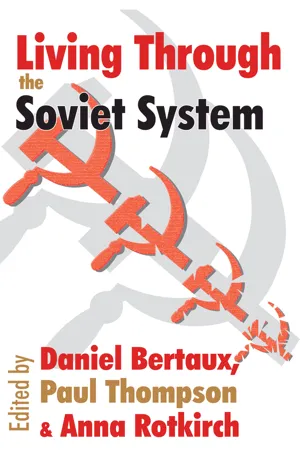
Living Through the Soviet System
About this book
For a period of over seventy years after the 1917 revolutions in Russia, talking about the past, either political or personal, became dangerous. The situation changed dramatically with the new policy of glasnost at the end of the 1980s. The result was a flood of reminiscence, almost nightly on television, and more formally collected by new Russian oral history groups and also by Western researchers. Daniel Bertaux and Paul Thompson both began collecting life story and family history interview material in the early 1990s, and this book is the outcome of their initiative. Living Through the Soviet System analyzes, through personal accounts, how Russian society operated on a day-to-day level. It contrasts the integration of different social groups: the descendents of the pre-revolutionary upper classes, the new industrial working class, or the ethnically marginalized Russian Jews. It examines in turn the implications of family relationships, working mothers, absent fathers and caretaking grandmothers; patterns of eating together, and of housing; the secrecy of sex; the suppression of religion; and the small freedoms of growing vegetables on weekends on a dacha plot. Because of its basis in direct testimonies, the book reveals in a highly readable and direct style the meaning for ordinary men and women of living through those seven dark decades of a great European nation. Because of the centrality of Soviet Russia to the history of the twentieth-century world, this book will be of interest to a wide range of readers. It will be of importance to students, researchers and teachers of history and sociology, as well as specialists in East European and other communist societies.
1
Introduction
For a period of over seventy years after the October 1917 Revolution in Russia, talking about the past, either political or personal, became extremely dangerous for many. In a society dominated by a giant system of internal espionage, talking about yourself could always leave perilous clues, hostages to fortune. Who could know which neighbours or friends were informers to the authorities? And to reveal that any relative or close connection had ever been in political trouble, or fought on the wrong side in the Civil War, or was descended from aristocrats or well-to-do peasants (kulaki) or even shopkeepers, could put anyone at risk of unemployment or banishment to the political prison camps in Siberia and elsewhere. In such a context, there was no chance of successful interview-based research, either by Russians or by outsiders, and understanding of what was really going on in Russia was thus generally left, in terms of politics, to 'Kremlinologists' whose prime skill was reading between the lines of Pravda and other official newspapers or, for economy and society, to a painstaking wringing-out of perspectives from published statistics, policy documents and literature.1
The situation changed dramatically with the new policy of glasnost at the end of the 1980s. In parallel, Soviet society began to re-examine its own pasts, while Russian family members began opening up their own family secrets. The result was a flood of reminiscence, almost nightly on television, and more formally collected by new Russian oral history groups and also by Western researchers. Daniel Bertaux and Paul Thompson both began collecting in-depth life-story and family-history interview material in the early 1990s, working with two overlapping Russian groups of interviewers. The two projects – which we detail in the Epilogue – shared an intergenerational perspective, and gathered altogether fifty family case-history interviews (from the Bertaux project) and forty-seven life-history interviews from a further twenty-five families (from the Thompson project). The most important immediate outcome was a book in Russian published by the Bertaux team, which has proved widely read and influential.2 This new book builds on those initial findings, and at the same time brings the two earlier projects together with other more recent work based on different kinds of autobiographical material.
Thus the first four chapters of On Living through Soviet Russia, written by Daniel Bertaux, Victoria Semenova and Ekaterina Foteeva, are based directly on the Bertaux project, while a further chapter, by Semenova and Thompson, draws on both the Bertaux and the Thompson interviews. To these we have added two more chapters by other current researchers who have been using life-story interviews (Naomi Roslyn Galtz and Irina Korovushkina Paert), and four others (one each by Nanci Adler, Marianne Liljeström and two by Anna Rotkirch) by authors who have been analysing Russian written autobiographies. This is by definition a unique book, not only because no similar material was collected earlier, but also because, newly released from earlier suppression, memory of the Soviet era was exceptionally full and vivid in the glasnost era. Indeed Russia, then in a moment of free flux, has since moved to another kind of fearful society, with its own new barriers to free talking.
The coherence of the book is based on the use throughout of autobiographical material, and this has necessitated some discussion of issues of memory in a formerly totalitarian society. However, while this book does raise important questions of method for future researchers, our aim here is not primarily methodological. It is rather to analyse, through personal accounts, how Russian society operated at a day-to-day level, and also how people coped with these operating mechanisms – topics on which there was scarcely any serious work up to the end of the 1980s.3 This volume contrasts the different social integration of different social groups, from the descendants of the pre-revolutionary upper class to the new industrial working class. It examines in turn the implications of family relationships, working mothers, absent fathers and caretaking grandmothers; patterns of eating together, communal living, and of housing; the secrecy of sex; the suppression of religion; and the small – but, in the context, so relevant – freedoms of growing vegetables at weekends on a dachi plot. Because of its basis in direct testimonies, On Living through Soviet Russia reveals in a highly readable and direct style the meaning for ordinary men and women of living through those seven turbulent, decades of a great European nation.
Understanding Soviet Social Structures
Of all the deliberate social experiments which have taken place in human history, Soviet society was one of the largest ever undertaken, and it was sustained over a vast part of the world's surface for as long as seventy years.4 It claimed to offer an alternative to capitalism, providing full employment for its citizens, cheap housing for all, free health care and free education. Although we now know that it was a never-achieved utopia which cost millions of lives, for most of the twentieth society it provided a crucial worldwide symbol that there was a viable alternative to capitalism, that the logic of industrial capitalism need not invariably prevail, and that resistance to class oppression could be progressive, on the side of the future. Indeed, without Soviet society, it seems unlikely that Western Europe would have achieved, between Communism and the pure capitalist market society, compromises in the form of welfare capitalism and the social market – compromises which have more recently become much more difficult to defend. Once represented as pragmatic reforms, they are now criticised as if impossible utopias. Soviet Russia's claims for economic and social success were taken very seriously for decades, both by Russians and by Westerners, and even in the 1960s, it looked briefly as if Russian scientists would succeed in leading the Americans in the race to conquer outer space. The cracks in the Soviet system only began to be widely recognised in the 1970s under the extreme pressure of the armaments race, and its final demise took place with a rapidity which scarcely anybody – either in Russia or in the West – had dared to imagine.
Many older Russian men and women in the early 1990s had memories encompassing the entire Soviet era. They had experienced the drama of its twisting evolution. There was, first of all, the collapse of the old social hierarchies of the Tsar's Empire through its defeat in the First World War and the twin 1917 Revolutions; then a period of chaos, followed until 1920 by Civil War, which cost two million lives. For a while the New Economic Policy of the early 1920s allowed some slow reconstruction, but soon, with Stalin's takeover, much more radical changes set the whole society rocking again.
From the late 1920s Stalin began a series of drastic initiatives for the creation of the new socialist state. The class of medium peasants – branded as kulaki, a derogatory word – was eliminated from the countryside and the land turned over almost entirely to collective farming. Small entrepreneurs were also eliminated from the towns, and a massive programme of industrialisation and urbanisation launched. Under the first two five-year plans, from 1928 until 1938, the urban population of Russia doubled. Still more dramatically, Stalin used forced labour from his growing network of prison camps in an attempt to colonise the bleak Russian north, constructing canals and railways through the frozen wilderness and forcing colonists to create new outposts of Soviet society there. (From many such regions, with the collapse of Soviet industry, over half the population has fled back to western Russia since 1990.) Stalin also even set up an autonomous Jewish state in 1928 in Siberia's far east, Yiddish-speaking Birobidzhan, although this eccentric colonisation project proved an early victim, struck by Stalin's own Great Terror in 1936–7.5
At the same time, family relationships were thoroughly transformed and the power structures between generations and sexes dramatically altered through the abolition of larger private property, the partial spread of communal forms of housing for the urban working class, and also – at a time when, in Western societies, married women were largely excluded from professional work – a requirement for both men and women to undertake paid work. The numbers of women rose from 24 per cent to 39 per cent of the whole Soviet workforce between 1928 and 1940. In total contrast to the gender conventions of Western culture, Stalin even set up three regiments composed entirely of women fighter pilots, who fought at Stalingrad and in every battle involving the Red Army up to the defeat of the Nazis in 1945.6 More typically, Russian women could be found in a whole range of occupations, from manual jobs in agriculture and industry to skilled and professional work from engineering to medicine.
The third phase was the return of chaos and slaughter with the Great Patriotic War, in which much of western Russia was occupied by Germany, and some 27 million more Russian soldiers and citizens died at the battlefront, in prison camps, or as the result of starvation, massacre and illness. Finally, after 1945 there was a much more ordered phase in the history of Soviet society, beginning with post-war reconstruction, and then from the late 1950s more serious attempts by the Communist elite to raise the ordinary standard of living, produce enough food, get goods into the shops, build family housing, and create a renewed society which really worked. By the 1980s that, too, had failed, and the whole Soviet infrastructure was running down, with food and industrial production in decline and the credibility of the Soviet leadership evaporating. With Gorbachev's arrival in 1985, the final gamble was made: perestroika (restructuring), and glasnost (the end of secrecy). But the tensions, now released into the open, destroyed the system.
While from the late 1920s, millions of Russians suffered from Stalin's radical strategies to create a new Soviet society, many losing their homes and their jobs, many of them 'repressed' by being kept permanently workless, or made to migrate or serve for years as prison labour (around 11 million exiled or executed), it is equally important to remember how many Russians believed they were indeed helping to create a new world. 'People had real spirit here', one Siberian pioneer remembers.7 Even where the changes brought mortal famine to the countryside, which we now know was deliberately imposed by Stalin on groups such as the Cossacks whom he regarded as potential opposition, the victims were simply bewildered, unable to imagine the source of their destructive fate. Ordinary Russians were more likely to pray to Stalin than to imagine him as a source of their sufferings. The relentless propaganda made its impact: the heroic celebratory booklets like Building the White Sea Canal, which never mentioned that most of the workforce was convict labour, or the mid-1930s film Seekers of Happiness, depicting the journey of an American Jewish family who moved to Siberia to escape the unemployment of the Great Depression. Everywhere, Soviet children were taught through their membership of socialist youth movements the ideals of communism – solidarity, equality, justice, peace, brotherhood, the supremacy of the collective. Equally they learned to disapprove of their opposites – individualism and divisive or 'anti-social' behaviour. We can assume that almost all Soviet citizens to some extent internalised these anti-capitalist and pro-socialist values. Among the strongest believers were the teachers. The Bertaux team collected stories of idealistic young teachers who, even in the 1960s, wanted to bring their educational practices closer to Communism, and moved then to Siberia in order to have the freedom to set up new, more ideal schools. They found other young teachers there with similar attitudes. But, paradoxically, even such efforts to realise the ideals of Soviet society regularly ended in suppression, and sometimes the repression of their initiators, for changing local institutions without the approval of the relevant Communist Party authorities.
Soviet society was thus not only utopian, but also perplexingly contradictory, and hence difficult for most contemporaries to interpret. Because, it fell far short of what it claimed to be, the actual rules of Soviet society had to remain hidden from view – hidden not only to foreigners, but to Soviet citizens too. It was a 'secret' society, whose official public pronouncements had to be minutely checked before their release. These pronouncements and the controlled official press and radio became the staple material of Western Sovietologists, who thereby created whole libraries of critical studies of Soviet society without ever being able to gain much understanding of the real lives of Soviet citizens. The only Russians they could freely interview during the whole Soviet period were those who had escaped to the West, and it was never possible to know how far their experiences had been typical.8
It is unlikely; in any case, that ordinary Russian citizens could have explained the fundamental workings of Soviet society, precisely because these were deliberately hidden from them. Even in the democratic West, only a minority of specialised professionals fully understand the workings of the capitalist market and its full power – not only because of its complexity but also because its workings also are partly deliberately hidden – although the market is fundamental to the social exchanges and inequalities of Western societies. In Soviet Russia it could be argued that, from the 1950s, the workings of the system and the rules of the game did become increasingly well understood by Russians themselves, and that was one of the reasons for the system's downfall.
Soviet society was structured around power rather than possessions. Money –despite popular pride in the possession of a stable and reliable national currency – was much less relevant in everyday Soviet life than in the West, because there were severe restrictions on what it could buy: there was no market in housing, few goods for sale in the shops. Many of the key things came free, like health care and education, or very cheap, like bread, housing and electricity. But since supply seldom never enough, access to them was either through the black market – flourishing from the late 1930s, where dealings could be either in cash or in barter – or through accessing a mixture of formal rights and informal network connections. Hence, getting what you wanted depended to a high degree on your networks, your social capital. You could not simply reserve a table for a meal in a restaurant: you had to use your connections to get the table, because otherwise you would be told it was booked, when in fact the food intended for the restaurant might have been bartered by the work team for something more useful to them, say a group holiday in Yalta. It seems that it was connections as means to favours, the informal deals expressed in the rhetoric of friendship which Russians called blat, which were the basic currency of Soviet life, the equivalent to money in the West.9 But how such connections were built, social capital accumulated, is much less clear. We explore in the chapters which follow how social capital took different forms in different contexts: information networks for migrants, getting jobs or housing through work contacts, the pull of old family connections, or the transmission across generations of intellectual skills or approaches to dealing with crisis. Family relationships gained a new importance in this economy of exchange, paradoxically precisely at the same moment as the influence of family was being deliberately undermined by government policies in housing and schooling, and at the old elite level family connections had to be hidden for fear of persecution. Connections were therefore perhaps as often made through neighbours and workmates, through specially close friendships (druzhba), through politics, and also through religious or political dissidence.
From this followed the Soviet class structure. Again, secrecy made this hard to study, because social classes had officially been abolished. Perhaps this is one reason why there has been considerable contention on the issue, with the views of historians and socialists ranging from those who see the Soviet system as being in reality not significantly different from that of the West, to those who interpret it either as a survival from the past – for example, with 'Estates' rather than classes –or as a new and wholly different system.10 But, for the research projects on which this book is based, we have assumed that there was in practice a hierarchy along the following broad lines. First, at the top there was an upper class of those with access to political power, headed by the nomenklatura, with the middle- and lower-level party cadres in their wake. Next there were the two major blocks of the working population at all occupational levels: the urban population, from professionals to unskilled, and well below them the peasantry. However, within these blocks some professions, such as the intelligentsia, or at a lower level, hairdressers or shop assistants, evidently could gain more access to useful connections, yet there has not been enough information to make any systematic distinctions among them. Lastly and much more obviously, there was the large group of marginalised or repressed citizens, the more fortunate of the latter released and 'assigned' to the least popular parts of the country such as Siberian outposts, the worst off still prisoners working their sentences in the network of Stalin's lager system. This social structure seems clear enough in retrospect, but it is important to understand that not only is its nature still a matter of debate, but also, more importantly for our purposes, not at all of it was obvious to most of those who were living through Soviet Russia.
The oral and written autobiographies on which ...
Table of contents
- Cover
- Half Title
- Title
- Copyright
- CONTENTS
- Notes on contributors
- 1 Introduction
- PART I Creating Soviet Society
- PART II Personal and Family Life
- PART III The Marginal and the Successful
- Bibliography
- Index
Trusted by 375,005 students
Access to over 1.5 million titles for a fair monthly price.
Study more efficiently using our study tools.
Frequently asked questions
Yes, you can cancel anytime from the Subscription tab in your account settings on the Perlego website. Your subscription will stay active until the end of your current billing period. Learn how to cancel your subscription
No, books cannot be downloaded as external files, such as PDFs, for use outside of Perlego. However, you can download books within the Perlego app for offline reading on mobile or tablet. Learn how to download books offline
Perlego offers two plans: Essential and Complete
- Essential is ideal for learners and professionals who enjoy exploring a wide range of subjects. Access the Essential Library with 800,000+ trusted titles and best-sellers across business, personal growth, and the humanities. Includes unlimited reading time and Standard Read Aloud voice.
- Complete: Perfect for advanced learners and researchers needing full, unrestricted access. Unlock 1.5M+ books across hundreds of subjects, including academic and specialized titles. The Complete Plan also includes advanced features like Premium Read Aloud and Research Assistant.
We are an online textbook subscription service, where you can get access to an entire online library for less than the price of a single book per month. With over 1.5 million books across 990+ topics, we’ve got you covered! Learn about our mission
Look out for the read-aloud symbol on your next book to see if you can listen to it. The read-aloud tool reads text aloud for you, highlighting the text as it is being read. You can pause it, speed it up and slow it down. Learn more about Read Aloud
Yes! You can use the Perlego app on both iOS and Android devices to read anytime, anywhere — even offline. Perfect for commutes or when you’re on the go.
Please note we cannot support devices running on iOS 13 and Android 7 or earlier. Learn more about using the app
Please note we cannot support devices running on iOS 13 and Android 7 or earlier. Learn more about using the app
Yes, you can access Living Through the Soviet System by Leo Lowenthal,Paul Thompson in PDF and/or ePUB format, as well as other popular books in History & European History. We have over 1.5 million books available in our catalogue for you to explore.