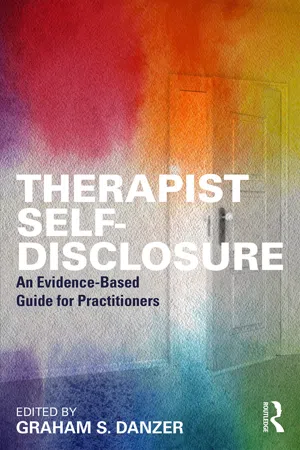
Therapist Self-Disclosure gives clinicians professional and practical guidance on how and when to self-disclose in therapy. Chapters weave together theory, research, case studies, and applications to examine types of self-disclosure, timing, factors and dynamics of the therapeutic relationship, ethics in practice, and cultural, demographic, and vulnerability factors. Chapter authors then examine self-disclosure with specific client populations, including clients who are LGBTQ, Christian, multicultural, suffering from eating disorders or trauma, in forensic settings, at risk for suicide, with an intellectual disability, or are in recovery for substance abuse.This book will very helpful to graduate students, early career practitioners, and more seasoned professionals who have wrestled with decisions about whether to self-disclose under various clinical circumstances.
- 270 pages
- English
- ePUB (mobile friendly)
- Available on iOS & Android
eBook - ePub
About this book
Information
Part I
Overview
CHAPTER 1
Introduction
Graham S. Danzer, PsyD
Therapist self-disclosure (TSD) has long frequented the counseling and psychotherapy literature (LaPorte, Sweifach, & Linzer, 2010). Over the past decade, the topic has received increased attention in theoretical debates (Audet & Everall, 2003), empirical research (Bitar, Kimball, Bermúdez, & Drew, 2014; Kelly & Rodriguez, 2007), and across many mental health disciplines (D’Aniello & Nguyen, 2017). There has been an expansion of ideas about what makes a TSD ethically appropriate (Audet, 2011) and how relevant ethical principles should guide therapist decisions to or not to disclose in different clinical scenarios (Bottrill, Pistrang, Barker, & Worrell, 2010; LaPorte et al., 2010).
Controversy about what TSD is and is not has complicated theoretical conceptualization, research efforts, and clinical discussions on the topic (Farber, 2006). Depending on the extent to which it is discouraged or encouraged, disclosure has been regarded in the literature as a therapist behavior (Bottrill et al., 2010), boundary crossing or violation (Audet, 2011), or as an intervention, clinical skill, and/or an expression of authenticity and genuineness (Bitar et al., 2014). A therapist’s general position on TSD is informative about his or her sense of role, profession, and personal preferences for the nature and intensity of interpersonal interactions (Bottrill et al., 2010). While a therapist may no longer be able to remain a truly anonymous professional, there may also be a fine line between one who reveals too little and one who reveals too much (LaPorte et al., 2010; Rasmussen & Mishna, 2008; Thomas, 2008). Whereas disclosing too much may raise client questions about boundaries, disclosing too little may lead clients to perceive the therapist as an aloof and distant professional (Thomas, 2008).
The first step in a process of more deeply exploring this issue is to first acknowledge the reality that therapists generally do disclose. Moreover, TSD happens more frequently than a researcher or therapist might assume. Research suggests at least some extent of intentional self-disclosure is relatively common among most clinical practitioners (Aron, 1991; Audet, 2011; Greenberg, 1995). Across multiple studies, 65–90% of surveyed therapists acknowledged intentionally disclosing to clients at least some of the time (Audet, 2011; Audet & Everall, 2003; Henretty & Levitt, 2010; Kelly & Rodriguez, 2007; LaPorte et al., 2010). Offering further specification, surveyed therapists in other studies reported disclosures made up between 1–13% of all of their interventions, with an average of 3.5% (Henretty & Levitt, 2010; Kelly & Rodriguez, 2007).
Therapeutic relationship factors offer at least a partial explanation for what may seem to be a relatively high level of disclosure. Commonly, TSD becomes more implicit and conversational as therapeutic relationships grow stronger (Russell, 2006). In research studies, therapists who had been in personal therapy with a disclosing therapist and reflected on the TSD as being positive were more likely to disclose with their own clients (Simon, 1990; Simone, McCarthy, & Skay, 1998). It is also likely that most of the aforementioned disclosures were/are not of the higher intimacy, historical content nature that raises Cain among conservative ethicists and practitioners.
From the research it is inferred that TSD not only does happen, but that it may be a preferred alternative to full neutrality and non-disclosure in many circumstances. The seemingly one-sided nature of clients necessarily disclosing far more than the therapist is a unique interpersonal pattern that deviates from established social norms and may therefore be difficult for clients in need of human connection to tolerate (D’Aniello & Nguyen, 2017). Thus, clients may perceive non-disclosing therapists as inaccessible (Goldstein, 1994) or even hostile (Henretty & Levitt, 2010). Surveyed clients have described therapists perceived as erring on the side of non-disclosure as overly formal, rigid, and authoritative (Audet, 2011). In response to non-disclosure, clients may become reluctant to disclose (Henretty & Levitt, 2010) and therapeutic impasses may occur (Wachtel, 1993). Whereas perfect neutrality intends to encourage and not interfere with client introspection and processing, the prior positions suggest that non-disclosure can have the opposite effect.
Even under strict ethical frameworks, TSD may still be appropriate. Conservative ethicists may support disclosure in cases where a therapist’s undisclosed personal circumstances might otherwise negatively affect the course of treatment (Audet, 2011). The American Psychological Association’s (APA) Code of Ethics offers no clear and explicit guidance, though several of its codes apply and suggest that therapists can no longer choose non-disclosure without having first considered both sides of the issue carefully (Henretty & Levitt, 2010). Going a step further, an APA task force included TSD under the category of “promising and probably effective” therapeutic interventions (Ackerman et al., 2001, p. 495).
From this review of literature it is inferred that the ethics of self-disclosure have moved at least incrementally in a progressive direction reminiscent of what is increasingly recognized as a two-person therapeutic relationship with a neutral, reserved, and professional component, as well as what is described by Gelso and Carter (1994) as an authentic and non-transferential component. Further scholarly discussion on this subject matter is necessary because the disclosing therapist invites an uncharted level of intimacy into a professional relationship historically built upon secrecy and subtlety (Bottrill et al., 2010).
Overview and Outline of the Text
Given recent advances in theory and research, the larger purpose of this text will be to go beyond the more conservative subject of whether or not to disclose, into a more critical discussion of what can or even should be disclosed to which clients by which therapists under what clinical and vulnerability circumstances and contexts. Although such decision-making is necessarily clinical and cannot be fully prescriptive, reflections upon the research are likely to be informative and, at times, reconciling. Scenarios in which self-disclosure may be a possibility are often of a higher intensity nature that can end up being the most clinically fruitful and/or hazardous. Conceptualizing such a scenario, in part, through the relevant scholarly literature may help practicing therapists to maintain an optimal balance between individualized and empirical care. In so doing, complex clinical decisions may be made with maximal likelihood of both helping clients and reducing likelihood of harm.
Outline of This Text
Parts I and II contain essential TSD background information as well as reviews of general research, theoretical, clinical, and ethical considerations. Part III will include summaries of scholarly writings and research on different populations or clinical contexts mentioned frequently in the literature. This will include different forms of trauma, as well as LGBTQ identity, physical illness, mortality, eating disorders, serious mental illness, religion and spirituality, forensic settings, and children and adolescents.
Whereas the vulnerability chapters flowed directly from the literature, the next set of ‘responding to direct client inquiry’ and ‘clinical challenge’ chapters in Parts IV and V will cover areas of practice that have been less researched, relatively under-attended to in clinical discussions, and/or expanded from the vulnerability chapters to cover some of the major nuances in practice. These chapters are written by invited guest researcher-practitioners with considerable expertise in their areas of authorship. They will offer a professional commentary on TSD within their area of current focus and identify some of the ways in which their perspectives align with or are informed by the research. Thus, this text contains not only a comprehensive and compartmentalized review of TSD research for ease of reading and referencing, but also expands from the literature based on clinical perspectives of a more consultative nature and with attention to elusive concepts and considerations unlikely to be fully captured through research methodology.
The final four discussant and concluding chapters in Part VI will consolidate prior positions and suggest to the reader the main take-aways from the TSD research, with advised applications to practice. More specifically, concluding chapters are intended to inform the reader about what key points should be at least momentarily considered before, during, and/or after scenarios wherein self-disclosure felt/feels like a possibility. As mentioned, these scenarios are among the most controversial and difficult to navigate even for seasoned and highly competent practitioners. In such circumstances, it is often helpful to reflect upon the scholarly research as a source of guidance or point of reference for clinical thinking and decision-making.
Rationale and Approach of the Text
Throughout the text, qualitative and quantitative research studies on client and therapist perspectives will be reviewed and compared. Whereas qualitative disclosure research informs an understanding of client and therapist experiences, quantitative research helps to explore objective differences in quantifiable outcomes (D’Aniello & Nguyen, 2017). Qualitative studies are difficult to generalize given typically small sample sizes, broad and diverse research questions, and interpretations necessarily being subjective and inferential (Harris, 2015). In turn, quantitative studies may be difficult to apply unilaterally to individual cases, because as noted by Rahman (2017), they offer more of a snap shot representation of a particular phenomenon, without as thorough and complete of a representation of individual perspectives and experiences. In addition, a limitation of all research is the perspective of the researcher may impact their results, as well as interpretation and presentation of those results (Moore & Jenkins, 2012).
The current text will attempt to compensate for each of these limitations by including all relevant and scholarly sources, organizing them in chapter subjects that flowed from the research, and noting where qualitative and quantitative research findings converge and diverge. Areas of consistency and difference will suggest to the reader how clients and therapists generally experience or perceive important aspects of TSD similarly or differently, with equal attention to each of the recurring perspectives on major clinical and contextual factors. In addition, areas of consistency and difference in the literature will be among the major points of discussion within the concluding section of chapters. Major, recurring, opposing, and unconventional positions will be presented. Doing so is intended to present to the research-informed practitioner a maximally thorough, organized, diverse, and reliable summary of findings. Flowing from areas of convergence and divergence in the literature, implications for practice will be presented throughout the text and highlighted in relevant concluding sections.
Recent research studies will be emphasized and prioritized in accordance with the contemporary research focus of this text, changing clinical and practice trends on the whole, and specific indications that TSD has only more recently grown in its general acceptability. With changing clinical trends in mind (including but not limited to TSD), unpublished and recent dissertations will be included in this text, in an effort to better incorporate the perspective of the next generation of practitioners and researchers. Key points in the first two sections of chapters will have multiple citations in order to show recurrent support in the literature. Key points will then be referenced in the vulnerability, clinical challenge, direct client inquiry, and implications for practice chapters in order to demonstrate applicability in other contexts.
Implications and recommendations will be general and advisory. Greater specificity would risk suggesting a more scripted and formulaic approach to TSD. In turn, this would risk de-prioritizing the client’s individual needs and the therapist’s intuitive understanding of those needs. For this reason, the need to individualize treatment and base conceptualizations in part through a reflection on the scholarly literature will be emphasized and referenced repeatedly. Thus, the following presentation is intended to inform though not dictate the research-informed practitioner’s clinical thinking.
References
Ackerman, S., Benjamin, L., Beutler, L., Gelso, C., Goldfried, M., & Hill, C. (2001). Empirically supported therapy relationships: Conclusions and recommendations of the Division 29 Task Force. Psychotherapy: Theory, Research, Practice, Training, 38, 495–7.
Aron, L. (1991). The patient’s experience of the analyst’s subjectivity. Psychoanalytic Dialogues, 1(1), 29–51.
Audet, C. (2011). Client perspectives of therapist self-disclosure: Violating boundaries or removing boundaries? Counselling Psychology Quarterly, 24(2), 85–100.
Audet, C., & Everall, R. (2003). Counsellor self-disclosure: Client-informed implications for practice. Counselling and Psychotherapy Research, 3(3), 223–31.
Bitar, G., Kimball, T., Bermúdez, J., & Drew, C. (2014). Therapist self-disclosure and culturally competent case with Mexican-American court mandated clients: A phenomenological study. Contemporary Family Therapy, 36(3), 417–25.
Bottrill, S., Pistrang, N., Barker, C., & Worrell, M. (2010). The use of therapist self-disclosure: Clinical psychology trainees’ experiences. Psychotherapy Research, 20(2), 165–80.
D’Aniello, C., & Nguyen, H. (2017). Considerations for intentional use of self-disclosure for family therapists. Journal of Family Psychotherapy, 28(1), 23–37.
Farber, B. (2006). Self-disclosure in psychotherapy. New York: Guilford Press.
Gelso, C., & Carter, J. (1994). Components of the psychotherapy relationship: Their interaction and unfolding during treatment. Journal of Counseling Psychology, 41(3), 296–306.
Goldstein, E. (1994). Self-disclosure in treatment: What therapists do and don’t talk about. Clinical Social Work Journal, 22(4), 417–33.
Greenberg, J. (1995). Self-disclosure: Is it psychoanalytic? Contemporary Psychoanalysis, 31(2), 193–205.
Harris, A. (2015). To disclose or not to disclose? The LGBT therapist’s question (Doctoral dissertation). Retrieved from ProQuest Dissertations and Theses database (No UMI No.).
Henretty, J., & Levitt, H. (2010). The role of therapist self-disclosure in psychotherapy: A qualitative review. Clinical Psychology Review, 30(1), 63–77.
Kelly, A., & Rodriguez, R. (2007). Do therapists self-disclose more to clients with greater symptomo...
Table of contents
- Cover Page
- Therapist Self-Disclosure
- Title
- Copyright
- Contents
- List of Contributors
- Part I: Overview
- Part II: Clinical Factors
- Part III: Vulnerability Factors
- Part IV: Responding to Direct Client Inquiries
- Part V: Clinical Challenges
- Part VI: Major Implication for Practitioners
- Index
Trusted by 375,005 students
Access to over 1.5 million titles for a fair monthly price.
Study more efficiently using our study tools.
Frequently asked questions
Yes, you can cancel anytime from the Subscription tab in your account settings on the Perlego website. Your subscription will stay active until the end of your current billing period. Learn how to cancel your subscription
No, books cannot be downloaded as external files, such as PDFs, for use outside of Perlego. However, you can download books within the Perlego app for offline reading on mobile or tablet. Learn how to download books offline
Perlego offers two plans: Essential and Complete
- Essential is ideal for learners and professionals who enjoy exploring a wide range of subjects. Access the Essential Library with 800,000+ trusted titles and best-sellers across business, personal growth, and the humanities. Includes unlimited reading time and Standard Read Aloud voice.
- Complete: Perfect for advanced learners and researchers needing full, unrestricted access. Unlock 1.5M+ books across hundreds of subjects, including academic and specialized titles. The Complete Plan also includes advanced features like Premium Read Aloud and Research Assistant.
We are an online textbook subscription service, where you can get access to an entire online library for less than the price of a single book per month. With over 1.5 million books across 990+ topics, we’ve got you covered! Learn about our mission
Look out for the read-aloud symbol on your next book to see if you can listen to it. The read-aloud tool reads text aloud for you, highlighting the text as it is being read. You can pause it, speed it up and slow it down. Learn more about Read Aloud
Yes! You can use the Perlego app on both iOS and Android devices to read anytime, anywhere — even offline. Perfect for commutes or when you’re on the go.
Please note we cannot support devices running on iOS 13 and Android 7 or earlier. Learn more about using the app
Please note we cannot support devices running on iOS 13 and Android 7 or earlier. Learn more about using the app
Yes, you can access Therapist Self-Disclosure by Graham S. Danzer in PDF and/or ePUB format, as well as other popular books in Psychology & Education in Psychology. We have over 1.5 million books available in our catalogue for you to explore.