eBook - ePub
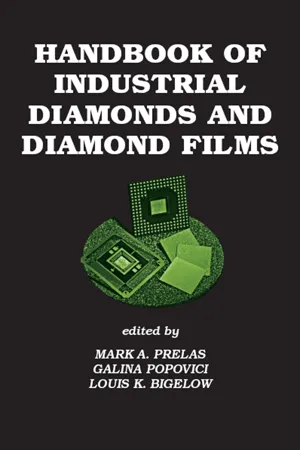
Handbook of Industrial Diamonds and Diamond Films
- 1,232 pages
- English
- ePUB (mobile friendly)
- Available on iOS & Android
eBook - ePub
Handbook of Industrial Diamonds and Diamond Films
About this book
Examines both mined and synthetic diamonds and diamond films. The text offers coverage on the use of diamond as an engineering material, integrating original research on the science, technology and applications of diamond. It discusses the use of chemical vapour deposition grown diamonds in electronics, cutting tools, wear resistant coatings, thermal management, optics and acoustics, as well as in new products.
Chapter 5
HEAT CAPACITY, CONDUCTIVITY, AND THE THERMAL COEFFICIENT OF EXPANSION
Almazy Rossii-Sakha Co., Ltd., Almazny Center, 14 Ul. 1812 Goda 121170, Moscow, Russia
Contents
1. Heat Capacity
2. Thermal Expansion
3. Thermal Conductivity
3.1 SCATTERING PROCESSES
3.2 TYPE IIa AND TYPE IIb DIAMONDS
3.3 TYPE Ib DIAMONDS
3.4 THERMAL CONDUCTIVITY IN DIAMONDS WITH VARIABLE ISOTOPE CONTENT
3.5 HYDRODYNAMIC BEHAVIOR OF PHONONS (POISEUILLE FLOW, THE SECOND SOUND)
3.6 THE THERMAL CONDUCTIVITY OF DIAMOND FILMS
3.7 MATERIALS SINTERED FROM DIAMOND POWDERS
3.8 TWO-COMPONENT DIAMOND COMPOSITES
4. References
1. Heat Capacity
Heat capacity is given by the ratio of heat amount δθ absorbed (given back) by the body to the deviation of its temperature, when the last is negligible:
Heat capacity depends not only on the initial and final states (in particular, the body temperature), but also on the path of the transition between them. One distinguishes the heat capacity at a constant volume (Cv) and the heat capacity at a constant pressure (Cp), if in the process of heating, the volume of a body or the pressure remains constant. In dielectric crystals, the heat capacity is determined by the heat capacity of the crystal lattice. At a constant volume, heat is spent only on the change of vibrational energy of the crystal lattice, and the body heat capacity Cv coincides with the phonon heat capacity. If one imagines the crystal lattice as a multitude of independent harmonic oscillators with frequencies corresponding to the normal vibrations of the lattice, then it is possible to calculate the energy of the system using the methods of quantum statistics.
Differentiation of the energy with respect to the temperature gives an expression for heat capacity of a monoatomic crystal lattice:
(1) |
where n0 is the number of atoms per unit volume, ω is the frequency of normal vibrations of the crystal lattice (i.e. phonons), D(ω) is the spectral density of lattice vibrations, and k and ħ are the Boltzman and Plank constants respectively.
Since heat capacity is an integral quantity, the exact form of the function D(ω) is not of great importance and Debye theory [1] gives suitable results. According to this theorone takes into account only the acoustic vibrations of the lattice. At the same time, one assumes that independently of the polarization, the phonons are characterized by the same speed of spreading s (the velocity of sound) and by the linear dispersion dependence, ωq=sq, where q is the wave number. This condition is actually fulfilled only at low temperatures. In addition, in Brillouin zones, where there are allowed values of the vector q, a Debye sphere of the same volume is substituted in inverted space. From these condition, one can imagine that there is a maximum wave number, qD, and a corresponding maximum frequency of normal vibrations (phonons), ωD, which is called the Debye frequency.
If one uses cyclic boundary conditions and takes into account that the full number of normal vibrations is equal to the number of atoms in the volume, corresponding to the chosen boundary conditions, then
The spectral density according to the Debye approximation is given by
Then from equation (1)
(2) |
Here x = ħω/kT, θ = ħωD/k, the Debye temperature. At low temperatures (T≪θ) one gets from (2) with good accuracy
That is, the heat capacity is proportional to T3 (Debye relation of T3 dependence). At high temperatures (T≪θ)
That is, the heat capacity does not depend on temperature (the law of Dulong and Pti). In practice, heat capacity temperature dependence is expressed by equation (2) with a single parameter θ for all temperatures, only in general outline which is related to the above mentioned assumptions of Debye theory. The effective Debye temperature θef(T) is the value at which divergence with Debye theory occurs. θef(T) equals the value of θ in equation (2) at which equation (2) agrees with the experimentally determined heat capacity Cv at the given ...
Table of contents
- Cover
- Half Title
- Title Page
- Copyright Page
- Table of Contents
- Preface
- Contributors
- Properties
- Thermal Properties
- Characterization
- Mined Diamond
- Theory
- Modeling and Diagnostics of Plasma Reactors
- Methods of Chemical Vapor Deposition Growth
- Structural Modification of Diamond
- Applications of Industrial Diamonds
- Economics
- Index
Trusted by 375,005 students
Access to over 1.5 million titles for a fair monthly price.
Study more efficiently using our study tools.
Frequently asked questions
Yes, you can cancel anytime from the Subscription tab in your account settings on the Perlego website. Your subscription will stay active until the end of your current billing period. Learn how to cancel your subscription
No, books cannot be downloaded as external files, such as PDFs, for use outside of Perlego. However, you can download books within the Perlego app for offline reading on mobile or tablet. Learn how to download books offline
Perlego offers two plans: Essential and Complete
- Essential is ideal for learners and professionals who enjoy exploring a wide range of subjects. Access the Essential Library with 800,000+ trusted titles and best-sellers across business, personal growth, and the humanities. Includes unlimited reading time and Standard Read Aloud voice.
- Complete: Perfect for advanced learners and researchers needing full, unrestricted access. Unlock 1.5M+ books across hundreds of subjects, including academic and specialized titles. The Complete Plan also includes advanced features like Premium Read Aloud and Research Assistant.
We are an online textbook subscription service, where you can get access to an entire online library for less than the price of a single book per month. With over 1.5 million books across 990+ topics, we’ve got you covered! Learn about our mission
Look out for the read-aloud symbol on your next book to see if you can listen to it. The read-aloud tool reads text aloud for you, highlighting the text as it is being read. You can pause it, speed it up and slow it down. Learn more about Read Aloud
Yes! You can use the Perlego app on both iOS and Android devices to read anytime, anywhere — even offline. Perfect for commutes or when you’re on the go.
Please note we cannot support devices running on iOS 13 and Android 7 or earlier. Learn more about using the app
Please note we cannot support devices running on iOS 13 and Android 7 or earlier. Learn more about using the app
Yes, you can access Handbook of Industrial Diamonds and Diamond Films by Mark A. Prelas, Galina Popovici, Louis K. Bigelow, Mark A. Prelas,Galina Popovici,Louis K. Bigelow in PDF and/or ePUB format, as well as other popular books in Technology & Engineering & Chemistry. We have over 1.5 million books available in our catalogue for you to explore.