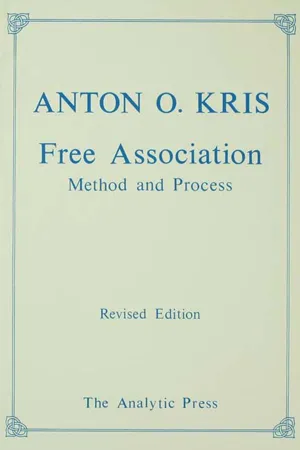
- 144 pages
- English
- ePUB (mobile friendly)
- Available on iOS & Android
eBook - ePub
About this book
In this expanded edition of a classic text, Anton Kris reexamines the method of free association, one of the foundational components of psychoanalysis. Tracing the history of the concept from its original pride of place among early analysts through its more recent downgrading, Kris reformulates the multifaceted illumination that free association provides, thereby assigning it a central place in contemporary thinking about psychoanalytic technique.
Information
CHAPTER ONE
Formulation from the viewpoint of free association
Psychoanalysts regularly emphasize the interaction of theory and technique. The way we formulate, the way we make abstractions from observation, and the way we relate evidence and inference reflects and influences what we do in analysing. Psychoanalytic theories of the mind, which have proven their usefulness in a number of contexts, have left considerable room for improvement as the basis for understanding the conduct and process of psychoanalytic treatment. Many questions remain unanswered in regard to the application of psychoanalytic theories in the clinical context. This book provides one possible answer, by focusing on initial formulations of the analytic process relatively free of theories of the mind. In placing a central emphasis on the method of free association and on observation of free associations, it temporarily bypasses, though it does not obviate, the need for a theory of the mind. Its governing principle is more closely connected with the distinction between experience-near and experience-distant psychoanalytic formulation (Waelder, 1962) than with the distinction between clinical and metapsychological theories.
Characteristically, psychoanalytic theories focus upon the patient's behaviour or the patient's mind, from a variety of points of view. The statement of these theories, however, regularly omits consideration of differences among the analysts who are to apply them.1 While theoretical formulations in general may be employed more explicitly by some analysts, more implicitly by others, it is not hard to demonstrate that psychoanalysts differ in predilection for particular kinds of theoretical formulation. What is figure for one may well be background for another. Therefore, correct application of theory is determined not only by observations of the patient's behaviour and state of mind but by the way the analyst uses theoretical formulation to organize his understanding and his interventions. Selection of theoretical perspective is one element in the analyst's participation in the analytic process.
While the subject of differences among analysts in regard to their use of theory is an important topic, to which I return throughout this book, my aims at present are more limited. I shall describe here the general approach that I have adopted in applying psychoanalytic theory to psychoanalytic technique. In this approach the free association method is the central point of reference. Initial formulation of clinical events from the viewpoint of the free association method provides a useful articulation with the multi-dimensional propositions of psychoanalytic theory. It emphasizes the interpretation of the observational data in terms of the method used to obtain them. While this is generally the way all analysts do their work, I believe that I make use of the free association method in a more operational fashion than is commonly expressed in psychoanalytic writings. This approach offers a means for conceptualizing both the patient's and the analyst's participation in the psychoanalytic process. In regard to the latter it highlights the influence of the analyst's formulations on his interventions and, consequently, on the patient's free associations.
To make use of the free association method in this way of formulating clinical events, one must be able to state diagnostic assessments in similar terms and to have a corresponding conception of the nature of psychoanalytic treatment. For example, concerning treatment, I am apt to show my patients that their associations come to an unsatisfying halt, or that they miscarry, or that ordinary language breaks off and symptoms continue the expression of the patient's associations. Completion of one's associations, including thought, feeling, wish, image, sensation, and memory, leads to a sense of satisfaction, while interruption or diversion leads to a sense of dissatisfaction. Various forms of dissatisfaction result from interference with the expression of the associations, and a variety of interferences and diversions can be described. It follows that psychoanalytic treatment should aid the patient in completing the expression of his associations by helping him recognize and master the interferences and diversions. This is one way I characterize psychoanalysis to my patients.
I find it useful to define the free association method, the principal method of psychoanalysis, as a joint venture in which the patient attempts to express whatever comes to mind, that is, the free associations, and the analyst, guided by his own associations and formulations, contributes only with the goal of enhancing the expression of the patient's free associations, expanding, the patient's freedom of association. The complex and extraordinary consequence of this mutual activity is the free association process.
This definition of the free association method may at first seem restrictive or simplistic, for analysts generally regard free association as only one of several sources of “material” for the work of producing analytic understanding (e.g., Freud, 1940a [1938], p. 177). My aim in this book is to demonstrate the merits of viewing other sources of understanding, such as the transference reactions, as the consequence of using the free association method. For purposes of exposition I shall refer to “the analyst”, to his functions, and to his responsibilities. I shall not always repeat my firm belief that this is one way rather than the way to practice psychoanalysis. I am always interested, however, to know why and how each analyst finds particular approaches to his taste.
The definition deliberately describes the analyst's goal in the use of the free association method as the enhancement of the patient's free associations and not as the production of insight, nor as the development of a regressive transference neurosis and its resolution, nor as the reduction of symptoms or suffering. Naturally, the free association method itself is undertaken with the therapeutic aim of reducing a broad range of symptoms and suffering, but within the method, so to speak, the analyst's goal is to further the process that results from using the method. The production of insight and the development and resolution of the regressive transference neurosis are essential components of that process, but, within the method, insight and the vicissitudes of the transference neurosis are subsidiary to enhancement of the patient's free associations. In making interpretations the analyst aims to facilitate the free association process, which is in turn expected to have an effect upon symptoms and suffering.
To view the analyst's task in such a perspective does not contradict an alternative view that interpretations produce insight, which in turn exerts an influence upon symptoms. It is probably more accurate to say that the free association method leads concomitantly to insight, resolution of symptoms, and other aspects of the free association process. These three terms refer to overlapping descriptions of behaviour and experience. For the practical purpose of outlining a formulation of psychoanalytic technique in general, I find it sufficient to recognize that they are parallel consequences of the free association method.
Similarly, it is essential to be able to formulate symptoms in terms of the free associations and the free association process for such a point of view of the analyst's function to be meaningful. I do not intend to imply that psychopathology should be equated with a disorder of free association. But I do want to emphasize: psychoanalysis has demonstrated that the components of psycho-pathology invariably include significant limitations in freedom of association. In this sense, Freud spoke of Fraulein Elisabeth von R.’s knowing and not knowing her loving feelings for her brother-in-law, which “were cut off from any free associative connection of thought with the rest of the ideational content of her mind” (Freud, 1895d, p. 165). The psychoanalytic treatment method offers a substantial approach to the resolution of psychopathology by focusing upon the limitations and disorders of free association. Its therapeutic aim is to increase the patient's freedom of association. In this book I consider the relationship between psychopathology and free association from several directions, in order to clarify the approach I am describing.
Like any other approach to formulating psychoanalytic experience, the one I have been outlining could enslave the human discourse of psychoanalysis in rigid codification. For me, it is a useful tool that helps me understand and influence my patients without interfering. It is fundamental that the associations belong to the patient. They are derivatively a part of himself, especially of his body, as they come to express feelings, needs, and desires, and as they represent his self-image, symbolically. The analyst must take care not to dispossess the patient of them. They reflect not only the patient's investment in his body but his detachment from it as well. Where the patient can be helped to possess his associations more, by understanding more of his own meaning, he regains lost connections with his body and between constituent elements of his mind.
Allusive statements such as these are, of course, relatively easy to make with any of a number of approaches to understanding patients. What appeals to me about the approach I am describing is that it permits convincing attention to clinical detail as it generates experience-near hypotheses (Waelder, 1962) about the associations. These hypotheses can then, in turn, be viewed in the perspective of one or another of the frames of reference of psychoanalytic theory at a number of levels of abstraction.
This brings me back, for a moment, to the role of theory and the differences among analysts in the use of theory. What may be crucially important in formulating the analytic process for one analyst may seem relatively unimportant to another. Furthermore, each may be different with different patients. On the other hand, I believe that a central interest in the free associations and their meaning to the patient is characteristic of all psychoanalytic treatment, of psychoanalysis proper, and of its derivative therapies. Differences among analysts come into play as the selection process begins. Which elements of the associations does one put together, and how does one express the combination? Surely there is more than anyone can grasp. Valid differences in observation and selection, based on styles and interests of the analysts, not on their relative acuity or obtuseness or on their pathology, contribute to differences of theoretical emphasis. Affinity for a particular aspect of theory exerts a corresponding influence on observation and selection of free associations for clarification and interpretation. From the wide range of psychoanalytic statements and propositions, the analyst selects one or several suitable to the occasion. An individual is bound by his own predilections, however, trainable for breadth but not unlimited in scope.
Not all theoretical differences represent equally valid alternatives, nor are all selections from the free associations equally correct (where “correct” is defined as enhancing the free association process). Nor am I suggesting that theoretically or clinically “anything goes” just because some aspect of the free associations can be shown to relate to it. In a world of proliferating psychological highways many roads, but certainly not all of them, will lead to Rome. This book will not concern itself with theoretical differences of that sort.
The kind of valid differences I mean may be illustrated by an example. A patient in analysis is critical of my silence. His associations falter. A familiar pattern of his impatience and demand for attention is before us. A comment on the possible sources of his impatience or a reminder of many past situations of similar impatience that have been mentioned in recent sessions might well assist his further free associations. I notice, however, that his criticism of my technique has not only an impatient but a didactic sound. Two days ago he gave me advice on another, entirely different matter, and his embarrassment about doing so was prominent in the hour between. I draw his attention to this line of continuity.
The psychoanalytic method is geared, first of all, to identifying continuities. As a method of observation it is radically different from other methods of observation that tend to record and emphasize discontinuities. These continuities are, in the first place, those of thought, wish, feeling, sensation, image, and memory as they appear in the free associations, but they extend in many dimensions. In the example that I have just given, I have suggested two alternative lines of continuity. In the first, the continuity of impatience and demand is highlighted; in the second, didactic criticism is emphasized. In the first, one might formulate a wish for the analyst to do something to or for the patient, while in the second one is more apt to see that the patient wants to do something to the analyst. In an entirely different line, neither contradictory nor requisite to the other two, one may approach the present in terms of a distant-past connection, or one may be drawn to events in the two most recent sessions, with or without an understanding of connections to the distant past. On still another plane, one may choose to emphasize, in either line, that the patient's criticism is the expression of a transference, the reactivation of a past relationship; or one may tend to emphasize the inherent elements of style and wish, without reference to particular relationships in which they may have been important. No one would argue against the proposition that elements of interpretation and clarification such as these would generally be suitable, individually or in combination, depending upon the circumstances of the clinical event, here presented only in the barest outline. The point that I should like to emphasize, however, is that the continuities chosen by the analyst for intervention and the perspectives in which he sees them, the formulations that guide his interventions, depend not only upon the patient but upon the analyst as well.
I make such a point of the differences among analysts in order to highlight those features of the psychoanalytic process that we hold in common. For me, the central point in psychoanalysis is the commitment to the free association method, as I have already indicated. I intend, now, to examine some features of the method and of the process that results from its use. In doing so I shall attempt to create a composite picture by selecting for discussion a series of individual clinical matters and their relationship to free association.
1 Today, the emphasis on recognizing and using countertransference provides at least one means to provide for individual differences among analysts. [A.O.K., 1996]
CHAPTER TWO
Varieties of free association
It may be clear already that I use the term free association in a number of different ways. It is, first of all, a sequence of thoughts, feelings, wishes, sensations, and images, present or remembered, expressed from a variety of perspectives. The sequential quality, relatively unencumbered by consciously directed, purposeful organization, characterizes free association in this sense. Such sequences of mental activity are the ordinary stuff of everyday life (Lewin, 1955, pp. 274–281). Here is a brief example.
One day, when the question of whether to become an analyst was still before me, as I was headed out to do some spring gardening, I found myself wondering about psychoanalysis and what could possibly be the good of a treatment that only uses words. I did not take the question particularly seriously and, so I thought, forgot it entirely. Some time later, perhaps fifteen minutes, I found myself recalling these familiar lines from “Daffodils”:
For oft when on my couch I lie,
In vacant or in pensive mood,
They flash upon that inward eye,
Which is the bliss of solitude;
I became aware that I had returned to my original topic, more or less. I was pleased to see that in the poet's name, Wordsworth, I found my original question, and I took the whole sequence as something of a positive answer.
The sequence of thoughts, feelings, images, and memories I think of as “the free associations”, or “the associations”. In this example, the associations include not only the explicit elements but also the form in which I expressed doubt and affirmation, wanting and not wanting to pay attention to the question on my mind. The activity that produces the sequence is “free association”. (It is merely a matter of linguistic preference that I omit the participle of an imaginary verb, “to free associate”.) The “method of free association”, involving two people, attempts to employ this activity in the analytic situation. Extended use of the method leads to the “free association process”.
In all these terms, the word “free” connotes the absence of conscious direction. In speaking of “freedom of association” or “freedom of free association”, however, I refer to the absence of unconscious restrictions (resistances). For example, I am apt to assess freedom of association as an important measure of clinical condition, especially as a measure of progress in treatment.
Intimately connected with these terms is the implicit assumption of unconscious or preconscious determinants as organizing principles of the associations that contribute a significant aspect of meaning. For me, the process of free association yields a necessary enrichment of conscious meaning for the patient. This is one aspect of insight.
When I speak of varieties of free association, it is as a psychoanalytic clinician, referring to differences of form, quality, or function of the associations, in the free association process. This chapter will focus mainly on form, style, and modality of expression, while the next one will be devoted more to functions of free association. I shall begin with two examples in which the free association is influenced by a single major determinant.
There is a common and important kind of analytic session that can be characterized by the mutual conclusion of patient and analyst: “Now we understand what happened yesterday.” Sometimes the patient may know at the start that there was a problem in some event of the previous day. Often there is only vague uneasiness that focuses on a particular matter in the course of the hour. The substance of the hour leads to the formulation of the source of this uneasiness in the experience of the day before. For instance, in the analysis of a young man, the associations, including a dream, clearly referred to a masturbatory experiment of the day before. I inferred that the patient must have been afraid that he had injured his penis. When I asked, he recalled such a fear and experienced relief of uneasiness.
Another instance of a similar kind of hour reached a little deeper. A man was furious with his wife for having bought tickets for a baseball game for the wrong day. His associations led us back to a time when he was a boy of 10, ill and confined to bed. Radio broadcasts of baseball games had given him an essential avenue for hope that he might grow up to be a man. The associations brought together for him a number of valuable connections: from observation of excessive anger; to memory of the particular importance of baseball; to an awareness that his fury at his wife was a response to revived past hel...
Table of contents
- Front Cover
- Half Title
- Title Page
- Copyright
- Contents
- PREFACE TO THE REVISED EDITION
- PREFACE
- ACKNOWLEDGEMENTS
- 1 Formulation from the viewpoint of free association
- 2 Varieties of free association
- 3 Functions of free association
- 4 The method of free association
- 5 Reluctance, resistance, and negative attitudes
- 6 The dynamics of free association
- 7 Satisfaction in free association
- 8 Free association in two kinds of conflict
- 9 Transference and free association
- 10 Countertransference and free association
- 11 Illustrations of the free association process
- 12 Development and free association
- 13 Free association in psychotherapy
- 14 Prospects for education and research
- BIBLIOGRAPHY
- INDEX
Trusted by 375,005 students
Access to over 1.5 million titles for a fair monthly price.
Study more efficiently using our study tools.
Frequently asked questions
Yes, you can cancel anytime from the Subscription tab in your account settings on the Perlego website. Your subscription will stay active until the end of your current billing period. Learn how to cancel your subscription
No, books cannot be downloaded as external files, such as PDFs, for use outside of Perlego. However, you can download books within the Perlego app for offline reading on mobile or tablet. Learn how to download books offline
Perlego offers two plans: Essential and Complete
- Essential is ideal for learners and professionals who enjoy exploring a wide range of subjects. Access the Essential Library with 800,000+ trusted titles and best-sellers across business, personal growth, and the humanities. Includes unlimited reading time and Standard Read Aloud voice.
- Complete: Perfect for advanced learners and researchers needing full, unrestricted access. Unlock 1.5M+ books across hundreds of subjects, including academic and specialized titles. The Complete Plan also includes advanced features like Premium Read Aloud and Research Assistant.
We are an online textbook subscription service, where you can get access to an entire online library for less than the price of a single book per month. With over 1.5 million books across 990+ topics, we’ve got you covered! Learn about our mission
Look out for the read-aloud symbol on your next book to see if you can listen to it. The read-aloud tool reads text aloud for you, highlighting the text as it is being read. You can pause it, speed it up and slow it down. Learn more about Read Aloud
Yes! You can use the Perlego app on both iOS and Android devices to read anytime, anywhere — even offline. Perfect for commutes or when you’re on the go.
Please note we cannot support devices running on iOS 13 and Android 7 or earlier. Learn more about using the app
Please note we cannot support devices running on iOS 13 and Android 7 or earlier. Learn more about using the app
Yes, you can access Free Association by Anton O. Kris in PDF and/or ePUB format, as well as other popular books in Psychology & Applied Psychology. We have over 1.5 million books available in our catalogue for you to explore.