Traditionally, developmental psychology has its focus on individuals. Developmentalists aim to describe regularities in individuals' change and development across time, to explain the processes and mechanisms that are involved in producing change and regularity, and eventually, to design strategies for optimization and modification of developmental pathways. Although the role of contexts has always been of central concern for these purposes, it is nevertheless quite surprising to note that compared to the effort devoted to individuals, relatively little attention has been paid to the study of the nature and organization of their contexts.
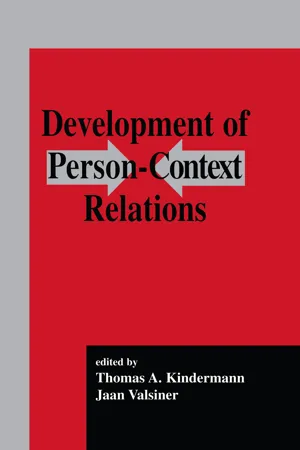
This volume is an exploration of the idea that how we describe and explain human development will be closely tied to our understanding of what contexts are, how individuals and contexts become influential for one another, what contexts do to and with individuals, and how contexts and their influences change themselves across time. A major theme is whether the traditional dichotomy between individuals and their contexts may be artificial, perhaps culturally biased, and after psychologists have adhered to it for about a century, may have become an impediment to increasing our understanding of developmental processes.
With this volume, the editors contribute a serious consideration of development and systematic change to emerging models of person-context relations, and provide suggestions about how it may be possible to incorporate these notions in developmental research and theorizing.
- 272 pages
- English
- ePUB (mobile friendly)
- Available on iOS & Android
eBook - ePub
Development of Person-context Relations
About this book
Information
Publisher
Psychology PressYear
2013Print ISBN
9781138876491
9780805815689
Edition
1eBook ISBN
9781134786732
PART ONE
TOWARD A FRAMEWORK FOR THE STUDY OF DEVELOPING PERSON–CONTEXT RELATIONS: PRAGMATIC, THEORETICAL, AND METHODOLOGICAL ISSUES
CHAPTER ONE
Developing Individuals Within Changing Contexts: Implications of Developmental Contextualism for Human Development Research, Policy, and Programs
Richard M. Lerner
Michigan State University
Interest in the context of human development has a long history in philosophy and social science (for reviews see Dixon & Nesselroade, 1983; Kaplan, 1983). However, contextual philosophy (e.g., Pepper, 1942) began to attract increasing interest from psychologists during the late 1960s (e.g., see Bandura, 1978; Bronfenbrenner, 1979; Jenkins, 1974; Kuo, 1967; Rosnow & Georgoudi, 1986; Sarbin, 1977). There were at least two reasons for this burgeoning interest. They pertain to metatheoretical issues about models of human development and to empirical findings about relations between individual development and social or historical change.
In this chapter, I discuss a specific instance of this interest in contextualism—developmental contextualism—as a framework for studying development in general and children, youth, and families in particular. Two sources are noted for the increased interest in developmental contextualism—the growth in the importance accorded metatheories of human development and a burgeoning of the number of studies of organism-context relations. The concept of integrative levels in development is presented as a means to introduce the features of developmental contextualism and to discuss general characteristics of models of dynamic, person-context relations. Finally, I indicate the implications of developmental contextualism for understanding the basic process of development, that is, for understanding changing person-context relations; in turn, I explain how this view of the basic process of human development has implications for methods of research in human development and for the links between research, policies, and programs designed to enhance the course of life.
METATHEORIES OF HUMAN DEVELOPMENT
Attention to contextualism derived from altered conceptual emphases among scholars in the area of human development. In the early decades of the 20th century, and continuing through at least the beginning of the 1940s, much of developmental psychology was descriptive and normative in orientation (Bronfenbrenner, 1963; Looft, 1972). Change in this orientation was in part prodded by the infusion of European psychologists (such as Kohler, Lewin, and Wertheimer), who came to the United States in the years surrounding World War II (Dixon & Lerner, 1988). These scholars infused American psychology with ideas that provided contrasting accounts of the bases of norms of development. As a consequence, the middle decades of the century saw increasing discussions of the explanations of development.
For instance, in an early review of the history of developmental science, Bronfenbrenner (1963) noted that from the 1930s to the early 1960s there was a continuing shift away from studies involving the mere collection of data, and a shift toward research concerned with abstract processes and constructs. Some books and essays published during this period epitomized this trend by calling for the study of developmental processes and mechanisms (e.g., Harris, 1957; Spiker & McCandless, 1954). Accordingly, describing the status of the field in 1963, Bronfenbrenner (1963) wrote that “first and foremost, the gathering of data for data’s sake seems to have lost favor. The major concern in today’s developmental research is clearly with inferred processes and constructs” (p. 527). In a review almost a decade later, Looft (1972) noted continuation of the trends documented by Bronfenbrenner. Looft’s review, like Bronfenbrenner’s, was based on an analysis of major handbooks of developmental psychology published from the 1930s to 1972. Looft suggested that a shift toward more general, integrative concerns occurred by 1945 (after World War II), and that the trend continued through 1963 (Bronfenbrenner, 1963) to 1972.
Since the early 1970s, this trend toward attending to both the description and explanation of developmental processes has continued in a number of ways. Considerable interest has come to be focused on a variety of theories, on explanations, and on processes of development. Such emphases have led to the recognition that there are multiple adequate ways (theories) of accounting for the facts (descriptions) of development. This pluralistic perspective implies that theoretical concerns guide the collection and interpretation of data, and that theory and data should be evaluated in terms of each other. A second aspect of this trend toward explanation may be seen in an examination of the most recent compilations of research and theory. For example, in the fourth edition of the Handbook of Child Psychology, the first volume (Mussen & Kessen, 1983) is devoted to historical, theoretical, and methodological issues—topics not integrated within a single section of previous editions.
Indeed, the interest in conceptual and methodological issues has itself generated considerable scholarship. In particular, the theoretical and metatheoretical bases upon which individual development is studied and interpreted has become a focus of investigation (e.g., Overton, 1984; Reese & Overton, 1970). Following the work of such philosophers as Pepper (1942) and Kuhn (1970), Reese and Overton (1970) identified two major philosophical models that provided the basis for many extant assumptions about human development. These models provide a set of assumptions, or metatheoretical ideas, about human nature and thereby influenced lower order theoretical and methodological statements.
The two models discussed by Reese and Overton (1970) were termed organicism and mechanism. The organismic position stresses the qualitative features of developmental change and the active contribution of the organism’s processes in these changes. The theories of Piaget (e.g., 1950) and to some extent of Freud (e.g., 1954) are examples of such organismically oriented approaches. In contrast, the mechanistic position stresses quantitative change and the active contribution of processes outside the primary control of the organism (e.g., in the external stimulus environment) as the major source of development. The behavioral analysis approach of Bijou (1976) and of Bijou and Baer (1961) is a major example of such mechanistically oriented approaches.
The discussions prompted by the work of Reese and Overton (1970) involved, as well, consideration of the “family of theories” associated with each model. For instance, as I previously noted, there are at least two types of organismically oriented theories, that of Freud and that of Piaget. Although there are differences among family members (Freud emphasized social and personality development and Piaget emphasized cognitive development), there is greater similarity among the theories within a family (e.g., the common stress on the qualitative, stage-like nature of development) than there is between theories associated with different families (e.g., mechanistically oriented theories would deny the importance, indeed the reality, of qualitatively different stages in development).
Due to the philosophically based differences between families of theories derived from the organismic and the mechanistic models, the period since the early 1970s has included several discussions about the different stances regarding an array of key conceptual issues of development, which are associated with the different metatheories of development. Examples are the nature and nurture bases of development (Lehrman, 1970; Lerner, 1978; Overton, 1973); the quality, openness, and continuity of change (Brim & Kagan, 1980; Looft, 1973); appropriate methods for studying development (Baltes, Reese, & Nesselroade, 1977); and ultimately, the alternative truth criteria for establishing the “facts” of development (Dixon & Nesselroade, 1983; Reese & Overton, 1970).
This awareness of the philosophical bases of developmental theory, method, and data contributed to the consideration of additional models appropriate to the study of psychological development. In part, this consideration developed as a consequence of interest in integrating assumptions associated with theories derived from organismic and mechanistic models (Looft, 1973). For instance, Riegel (e.g., 1975, 1976) attempted to apply an historical model of development that seemed to include some features of organicism (e.g., the active organism) and some features of mechanism (e.g., the active environment). In turn, Riegel’s interest in continual, reciprocal relations between an active organism and its active context (and not in either element per se), and the concern with these relations as they exist on all phenomenal levels of analysis, formed a basis for his proposing a dialectical model of human development (Riegel, 1975, 1976). Indeed, other developmentalists, focusing too on the implications for theory of viewing distinct levels of analysis as reciprocally interactive, proposed related models, ones termed transactional (Sameroff, 1975), relational (Looft, 1973), or developmental contextual (Lerner, 1978, 1984, 1986). This philosophically driven interest in bidirectional organism-context relations led several theorists to explore the application of a change-oriented contextual model to the collection and interpretation of developmental (and other psychological) data (see especially the volume on contextualism edited by Rosnow & Georgoudi, 1986). This last feature of the recent history of the field of human development is linked as well to the second basis for the growing interest in the context of human development.
THE EMPIRICAL STUDY OF ORGANISM-CONTEXT RELATIONS
A second basis of the interest in contextualism that grew through the 1970s derived from the nature of empirical findings generated during this period. These findings were quite problematic to interpret when viewed from extant organismic- or mechanistic-derived theories. As a consequence, scholars sought to evaluate the use of a new philosophical, or metatheoretical, frame for their work because of the growing empirical literature that suggested that it was necessary to forego an exclusively psychological analysis of individual development; this literature pointed instead to explanations that emphasized the multilevel bases of human functioning and the connections among levels (e.g., Baltes, 1987; R. Lerner, 1984; Lerner & Busch-Rossnagel, 1981; Magnusson & Allen, 1983; Tobach & Greenberg, 1984).
For example, in 1980 Brim and Kagan edited a book (Constancy and Change in Human Development) that reviewed evidence from several disciplines about whether early experience provides a virtually immutable shaper of the entire life course—in other words, about whether events in early life necessarily constrain later development. Studies were reviewed that indicated that features of the person’s historical setting often shape personality, social, and intellectual functioning to a much greater extent than maturational- or age-associated changes (Elder, 1974; Nesselroade & Baltes, 1974; Schaie, 1979). General historical events such as wars, economic privations, or political upheavals, as well as personal events such as marriage, divorce, illness, death, or career change, are seen often to provide potent shapers of the quantity of life changes and of the quality of the life course (e.g., Elder, 1974, 1980). These studies also indicate that there are multiple paths through life. As people age they become increasingly different from each other, and these different life paths are again linked to general historical or personal events (Baltes, Reese, & Lipsitt, 1980; Brim & Ryff, 1980).
To illustrate the kind of findings reviewed in the Brim and Kagan (1980) volume, I point to the research of Schaie (1979). He reported that the direction of age changes in intellectual aging is related to variables associated with birth cohort membership. Members of one birth cohort might show negatively accelerated changes in levels of cognitive abilities during their aged years; another cohort might show stability in these abilities during this period; and still another cohort might show continued growth in abilities during their aged years. The particular pattern depended on educational and pedagogical variables present in the context of a given cohort during the particular time in history when its members were educated.
Not only may contextual variables exist that differentiate people born at given times in history and thereby influence the particular direction...
Table of contents
- Cover Page
- Half Title page
- Title Page
- Copyright Page
- Contents
- Contributors
- Acknowledgments
- Original Half Title page
- Introduction: Individual Development, Changing Contexts, and the Co-Construction of Person—Context Relations in Human Development
- PART ONE Toward a Framework for the Study of Developing Person–Context Relations Pragmatic, Theoretical, and Methodological Issues
- CHAPTER ONE Developing Individuals Within Changing Contexts Implications of Developmental Contextualism for Human Development Research, Policy, and Programs
- CHAPTER TWO Accounting for Person–Context Relations and Their Development
- CHAPTER THREE Processes of Development, and Search for Their Logic An Introduction to Herbst's Co-Genetic Logic
- CHAPTER FOUR What Happens When We Make a Distinction An Elementary Introduction to Co-Genetic Logic
- PART TWO Empirical Approaches to the Study of Developing Person–Context Relations
- CHAPTER FIVE Understanding the Economic Framework Children's and Adolescents' Conceptions of Economic Inequality
- CHAPTER SIX Person—Context Relations as Developmental Conditions for Empathy and Prosocial Action A Cross-Cultural Analysis
- CHAPTER SEVEN Life Events' Spacing and Order in Individual Development
- CHAPTER EIGHT Adolescents' Adaptation to Structural Changes in Family Relationships With Parental Divorce A Combinatorial Model
- CHAPTER NINE Distinguishing “Buddies” From “Bystanders” The Study of Children's Development Within Natural Peer Contexts
- Epilogue: Directions for the Study of Developing Person–Context Relations
- Author Index
- Subject Index
Trusted by 375,005 students
Access to over 1.5 million titles for a fair monthly price.
Study more efficiently using our study tools.
Frequently asked questions
Yes, you can cancel anytime from the Subscription tab in your account settings on the Perlego website. Your subscription will stay active until the end of your current billing period. Learn how to cancel your subscription
No, books cannot be downloaded as external files, such as PDFs, for use outside of Perlego. However, you can download books within the Perlego app for offline reading on mobile or tablet. Learn how to download books offline
Perlego offers two plans: Essential and Complete
- Essential is ideal for learners and professionals who enjoy exploring a wide range of subjects. Access the Essential Library with 800,000+ trusted titles and best-sellers across business, personal growth, and the humanities. Includes unlimited reading time and Standard Read Aloud voice.
- Complete: Perfect for advanced learners and researchers needing full, unrestricted access. Unlock 1.5M+ books across hundreds of subjects, including academic and specialized titles. The Complete Plan also includes advanced features like Premium Read Aloud and Research Assistant.
We are an online textbook subscription service, where you can get access to an entire online library for less than the price of a single book per month. With over 1.5 million books across 990+ topics, we’ve got you covered! Learn about our mission
Look out for the read-aloud symbol on your next book to see if you can listen to it. The read-aloud tool reads text aloud for you, highlighting the text as it is being read. You can pause it, speed it up and slow it down. Learn more about Read Aloud
Yes! You can use the Perlego app on both iOS and Android devices to read anytime, anywhere — even offline. Perfect for commutes or when you’re on the go.
Please note we cannot support devices running on iOS 13 and Android 7 or earlier. Learn more about using the app
Please note we cannot support devices running on iOS 13 and Android 7 or earlier. Learn more about using the app
Yes, you can access Development of Person-context Relations by Thomas A. Kindermann,Jaan Valsiner in PDF and/or ePUB format, as well as other popular books in Psychology & Developmental Psychology. We have over 1.5 million books available in our catalogue for you to explore.