- 324 pages
- English
- ePUB (mobile friendly)
- Available on iOS & Android
eBook - ePub
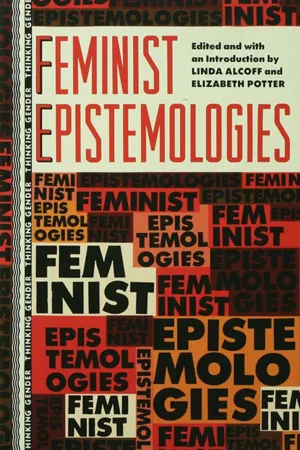
Feminist Epistemologies
About this book
This is the first collection by influential feminist theorists to focus on the heart of traditional epistemology, dealing with such issues as the nature of knowledge and objectivity from a gender perspective.
Information
1
Introduction: When Feminisms Intersect Epistemology
Linda Alcoff and Elizabeth Potter
Yesterday, “feminist epistemology” was an oxymoron; today, it has name recognition, but its referent is not yet clear. Our title, Feminist Epistemologies, is meant to indicate that the term does not have a single referent and, for reasons that we will explore later, it may never. Feminist theorists have used the term variously to refer to women's “ways of knowing,” “women's experience,” or simply “women's knowledge,” all of which are alien to professional philosophers and to epistemology “proper”—that is, alien to a theory of knowledge in general. But this latter conception of proper epistemology leaves unchallenged the premise that a general account of knowledge, one that uncovers justificatory standards a priori, is possible. This is precisely the premise that feminist epistemologists have called into question. Feminist analyses in philosophy, as in other disciplines, have insisted on the significance and particularity of the context of theory. This has led many feminist epistemologists to skepticism about the possibility of a general or universal account of the nature and limits of knowledge, an account that ignores the social context and status of knowers. Is it likely that epistemological accounts of dominant knowledges, that is, knowledge produced and authorized by people in dominant political, social, and economic positions, can apply to subaltern knowledges as well?
“Feminist epistemology,” as we use the term, marks the uneasy alliance of feminism and philosophy, an alliance made uneasy by this contradictory pull between the concrete and the universal. The authors included in this text are concerned with many of the problems that have vexed traditional epistemology, among them the nature of knowledge itself, epistemic agency, justification, objectivity, and whether and how epistemology should be naturalized. But their essays are also informed by feminism and so treat these issues in new ways and introduce new problems including the politics of knowledge and the impact of the social status as well as the sexed body of the knower upon the production of knowledge.
Still, those working in feminist epistemology are engaged in a dialogue with one or more traditions in the history of epistemology. And the feminist orientation toward these mainstream views is varied; it involves appropriation and respect as well as criticism and rejection, and when the mainstream epistemology is already naturalistic, recognizing, for example, the contextual nature of justificatory standards, the feminist orientation reveals the progressive political possibilities of that epistemology. We view this dialogue as healthy and disagree with those who argue that any use of or engagement with the traditional problematics of epistemology leads to our co-optation. On the other hand, the essays in this volume demonstrate that a conservative approach that preserves traditional assumptions and strategies is not a virtue in feminist work. The history of feminist epistemology itself is the history of the clash between the feminist commitment to the struggles of women to have their understandings of the world legitimated and the commitment of traditional philosophy to various accounts of knowledge—positivist, postpositivist, and others—that have consistently undermined women's claims to know.
Feminism made its first incursions into philosophy in a movement from the margins to the center. Applied fields, most notably applied ethics, were the first areas in which feminist work was published. Not coincidentally, these areas were and are viewed by most professional philosophers as “on the periphery” of central philosophical work, where the virtue of centrality is accorded to work with a greater degree of abstraction from concrete material reality and with pretensions to universality. Feminist philosophers began work in the applied areas because feminism is, first and last, a political movement concerned with practical issues, and feminist philosophers understood their intellectual work to be a contribution to the public debate on crucial practical issues. At first, the more abstract areas of philosophy seemed distant from these concrete concerns. But from the applied areas we moved into more central ones as we began to see the problems produced by androcentrism in aesthetics, ethics, philosophy of science, and, finally and fairly recently, in the “core” areas of epistemology and metaphysics.1
Feminist work in epistemology, as in all other areas, began as a critique of the tradition (including a critique of the dominant narratives about just what that tradition is). Although this critique continues, constructive and reconstructive work in the theory of knowledge is emerging today. The essays in this volume reveal the contours of a new research program in epistemology, a research program moving beyond critique to reframe the problematic of knowledge. Our title, Feminist Epistemologies, should alert readers that this new research program is internally heterogeneous and irreducible to any uniform set of theses. The feminisms that make up this new problematic are diverse, often having in common only their commitment to unearth the politics of epistemology. But this recognition of the political commitments and effects implicit in every philosophical position has sparked a determination to reconstruct epistemology on newer, more self-conscious ground. This reconstruction also promises to reconfigure the borders between epistemology, political philosophy, ethics, and other areas of philosophy as we come to see the interrelationships and inseparability of heretofore disparate issues. Moreover, the distinctions between margin and center or periphery and core within the domain of philosophy itself give way. Once we recognize that values, politics, and knowledge are intrinsically connected, the hierarchies and divisions within philosophy will be replaced by more holistic and coherentist models. This volume demonstrates that the work of feminist philosophers is in the process of producing a new configuration of the scope, contours, and problematics of philosophy in its entirety.
Readers may be tempted to assume that because this anthology bears the word “feminist” in its title, the issues treated in it are limited or reduced to gender issues. Not so. Growing awareness of the many ways in which political relationships (that is, disparate power relations) are implicated in theories of knowledge has led to the conclusion that gender hierarchies are not the only ones that influence the production of knowledge. Cognitive authority is usually associated with a cluster of markings that involve not only gender but also race, class, sexuality, culture, and age. Moreover, developments in feminist theory have demonstrated that gender as a category of analysis cannot be abstracted from a particular context while other factors are held stable; gender can never be observed as a “pure” or solitary influence. Gender identity cannot be adequately understood—or even perceived—except as a component of complex interrelationships with other systems of identification and hierarchy. Thus, because gender as an abstract universal is not a useful analytical category and because research has revealed a plethora of oppressions at work in productions of knowledge, feminist epistemology is emerging as a research program with multiple dimensions. And feminist epistemology should not be taken as involving a commitment to gender as the primary axis of oppression, in any sense of “primary,” or positing that gender is a theoretical variable separable from other axes of oppression and susceptible to a unique analysis.
Why, then, retain the adjective “feminist”? We decided to retain Feminist Epistemologies as the title of this collection because it serves to identify work about which there is considerable curiosity; thus, its title distinguishes this book as an appropriate resource for anyone who seeks acquaintance with that body of work. As well, the term “feminist” correctly identifies the history of this work. The articles collected here under the rubric “feminist epistemologies” represent the latest development of a good fifteen years of work that did in fact begin (among those who identified with mainstream academic feminism) as work on gender issues in the theory of knowledge. The term allows us to identify the historical trajectory of current work and to see where we are coming from.
We find a strong consensus among feminists today that both the term and the project of feminism itself must be more inclusive than a focus on gender alone permits. If feminism is to liberate women, it must address virtually all forms of domination because women fill the ranks of every category of oppressed people. Indeed, the ontological status of woman and even of women has shifted for academic feminists in light of influential arguments showing that women, per se, do not exist. There exist upper-caste Indian little girls; older, heterosexual Latinas; and white, working-class lesbians. Each lives at a different node in the web of oppressions. Thus, to refer to a liberatory project as “feminist” cannot mean that it is only for or about “women,” but that it is informed by or consistent with feminism. It seeks, in current feminist parlance, to unmake the web of oppressions and reweave the web of life.
If the concept “woman” has lost its analytical credibility, the concept of a universal human nature is even less credible. Yet it is the latter concept that allows mainstream epistemologists to ignore the specificity of the knowing subject. Lorraine Code, in “Taking Subjectivity into Account,” argues that this inattention to the subjective elements involved in knowing and the illusion that knowing is universal and perspectiveless are easy to maintain when the paradigm of knowledge is taken to be the observation of everyday simple objects, such as sticks, apples, and patches of colors. In this type of knowing—“perception at a distance”—the particular person who fills the role of the knowing subject will make no difference. Any person would be likely to see the object in the same way, and epistemologists have concluded therefore that there is no point in “taking subjectivity into account.” The key epistemic attributes of knowers are then argued to be “universal.”
Code suggests that there is no justifiable reason to take “perception at a distance” as the paradigm case of knowing and the model for analyzing epistemic practices. Knowing others, which is arguably a more crucial practice in human knowledge acquisition given that most of our knowledge is interactive and dependent on others, would yield a very different “geography of the epistemic terrain” if taken as the paradigm case. However, Code does not want simply to replace one hegemonic paradigm of knowing with another but to show why the strategies for identifying necessary and sufficient conditions for “S knows that p” in the mainstream literature can never be successful until they pay as much attention to S as they pay to p.
Code also argues that mainstream epistemology creates the illusion of a universal subject through the excision of “unacceptable” points of view. She shows how Richard Foley's attempt to ground his account of knowledge on a first-person subjective foundationalism can only erect its “we subject” through the exclusion of “crazy,” “bizarre,” and “abnormal” others. It is toward the goal of overturning such “perspectival hierarchies” that some feminist epistemologists have developed what they call standpoint epistemologies, which seek to epistemically valorize some of the most discredited perspectives of knowledge. Sandra Harding is one of the best-known proponents of such a view.
In “Rethinking Standpoint Epistemology,” Harding defends the feminist version of standpoint epistemology from some of the major criticisms it has received since it was first developed a decade ago. In particular, she establishes that standpoint epistemology is not in contradiction with the goal of achieving objective knowledge. If we dispense with the notion that the process of knowing is universal and we accept the idea that all knowing will substantively involve the standpoint or social and historical context of particular knowers, it may seem that we must give up on objectivity and embrace relativism. Harding argues here not only that this is not the case but also that standpoint epistemology will increase and strengthen our ability to achieve objectivity.
Harding's argument consists of two parts. First, she argues that even if researchers were to follow the most rigorous rules of traditional methods of research, they would not be able to achieve strong objectivity. This is because these methods leave unexamined the context of discovery, which is considered nonrational and therefore exempt from analysis, and because these methods neglect to identify the social desires, interests, and values that have shaped the sciences. Science presents itself as subjectless: the disembodied report of value-free, context-independent facts. But Harding argues that science does have a subject, which in our community is a group of dominant males, and that this subject has a standpoint, that is, a perspective involving assumptions and values based on the kinds of activities this group engages in. Traditional science leaves this standpoint unexamined and thus impoverishes the objectivity that science could achieve.
Harding further argues that the standpoint of this dominant group is epistemically limited with respect to the standpoint of various marginalized groups. When the dominant group is homogeneous, its shared assumptions stand little chance of identification, and when this group benefits from maintaining these assumptions, there is even less chance that the assumptions will be critically interrogated. As a remedy, Harding advocates a methodology that involves “starting thought from the lives of marginalized peoples.” She argues that this will reveal more of the unexamined assumptions influencing science and will generate more critical questions, thus producing less partial and distorted accounts. And she urges that research done in this way can be—and needs to be—undertaken by everyone, not just by the marginalized themselves.
Bat-Ami Bar On is skeptical that the attribution of epistemic privilege to socially marginalized subjects can be sustained. Bar On's paper, “Marginality and Epistemic Privilege,” provides a useful analysis of the contrast between feminist claims about epistemic privilege and Marx's claim that the standpoint of the proletariat is epistemically superior to that of the bourgeoisie. Feminist standpoint theory has differed from Marx in two crucial ways. First, Marx's argument for epistemic privilege was based on the idea that workers are both marginal and central in bourgeois society: marginal in relation to political and cultural power but central to the process of production. Their marginality means that they have less vested interest in maintaining bourgeois ideology, whereas their centrality gives them a privileged view of the real nature of capitalist production; it is these two elements in combination that confer on the working class an epistemic superiority. Feminist arguments, on the other hand, have argued from and established only the marginality of women. A second difference lies in the level of complexity by which oppression is understood. Where Marx basically theorized a single axis of oppression that revolved around class, feminists have theorized multiple axes. The result of this more complicated social grid is that the notion of a single center becomes displaced, which then problematizes the use of a margin/center ontology and raises new questions about the relationships between the multiple oppressed groupings.
Bar On also argues provocatively that feminist claims for women's epistemic privilege are based on a neo-Romantic conception of the subject that is emotional and nondualistic between mind and body or reason and passion. Further, she points out that feminist claims have emerged as a counterpoint to the Enlightenment strategies for claiming authority. As such, the feminist arguments have been framed within the Enlightenment's terms of discourse and replicate its repressive mechanisms for claiming the authority and privilege to silence others. Bar On argues that feminists must repudiate such strategies of domination. Besides, such arguments only succeed in actuality within the oppressed group itself, because claiming authority when one lacks the social power on which to base it “cannot yield the same results as the self-authorizing claims of the dominant group and are, therefore, merely normative, compelling only for those who are … usually members of the socially marginalized group who find them empowering.”
On different grounds Helen Longino also takes issue with standpoint accounts. In “Subjects, Power and Knowledge: Description and Prescription in Feminist Philosophies of Science,” Longino argues that most feminist philosophies of science, including standpoint epistemologies, those derived from feminist object relations theory, and traditional feminist empiricism, have very strong descriptive elements but are insufficiently normative. This is particularly worrisome because, although recognizing that mainstream accounts of natural processes have been developed from particular locations and reflect particular affective orientations, these feminist epistemologies argue only that certain locations and orientations are superior to others without providing norms by which we can decide among their conflicting claims about natural processes. This is because they do not provide norms for deciding which standpoint or orientation is epistemically superior. Longino offers normative criteria for indirectly evaluating competing theories, viz. whether they are produced by scientific communities socially structured to facilitate transformative criticism. Longino's position recognizes that cognitive needs can vary among communities and that this variation creates cognitive diversity, but she rejects relativism for socially constituted objectivity; however, socially constituted objectivity presents the paradox that knowledge requires consensus but consensus is reached only by quieting oppositional positions.
Longino solves the paradox by rejecting consensus in favor of multiple, sometimes incompatible theories that satisfy local standards. This solution is a strong one when supported, inter alia, by a modeltheoretic theory of theories according to which two different models are incompatible only if both are taken to describe a single underlying reality rather than to pick out objects and events under different descriptions and to pick out different sets of relations among objects and events.
It is important to note that Longino's paradox arises from her commitment to the social nature of knowledge production. For many feminists, the entire endeavor to analyze epistemic agency in terms of a single knower, whatever her or his social position, is wrongheaded. In “Epistemological Communities,” Lynn Hankinson Nelson argues that communities are the primary epistemic agents, not the isolated individual subject posited by traditional epistemology and not the socially situated though still isolated individual subject of a possible feminist epistemology. Communities, not individuals, are “the primary generators, repositories, holders, and acquirers” of knowledge. Nelson also rejects recent postmodern claims that there is no subject or agent of knowledge. These postmodern arguments set two dilemmas for feminist epistemology; the first is that either agents or knowledge are abstract Cartesian selves or they are “subjects in process” constituted by “the discourses and practices of their culture” and so cannot be the agents of knowledge. This dichotomy is related to a second one about evidence; either there is a foundation of knowledge or there are no standards for judging knowledge claims. Nelson argues that neither dichotomy is exhaustive, and the burden of her essay is to present an alternative view of the agents of knowledge as communities and of the evidence underpinning knowledge as communal, historical, and contingent.
The discovery of a bit of scientific knowledge, for example, is only possible within a system of theories and practices including metaphysical commitments, methods, and standards of evidence that emerged concomitantly with the process of coming to know that bit of knowledge—when that system is adopted by a community. That is, Nelson argues that this adoption is itself only possible “within a context of social arrangements and practices, puzzles, pressures, conflicts, and undertakings.”
We find, then, that what counts as evidence depends in turn on the same communal system; on the metaphysical commitments and methods incorporated in current scientific practices; on theories and practices in other, related fields; and ultimately on “common-sense” knowledge and experience of macroscopic objects and events—all adopted by a community with certain social arrangements, practices, and so on. We should note that Nelson also holds experience to be fundamentally social, not something fundamentally ascribed to individuals. Thus, the sensory experiences that provide partial evidence for scientific claims depend on public theories and practices that allow individuals “to organize our sensory experiences into coherent and recoverable accounts.”
Nelson uses the dispute between man-the-hunter theories of h...
Table of contents
- Front Cover
- Half Title
- Title Page
- Copyright
- Contents
- Acknowledgments
- 1. Introduction: When Feminisms Intersect Epistemology
- 2. Taking Subjectivity into Account
- 3. Rethinking Standpoint Epistemology: “What Is Strong Objectivity”?
- 4. Marginality and Epistemic Privilege
- 5. Subjects, Power and Knowledge: Description and Prescription in Feminist Philosophies of Science
- 6. Epistemological Communities
- 7. Gender and Epistemic Negotiation
- 8. Bodies and Knowledges: Feminism and the Crisis of Reason
- 9. Are “Old Wives’ Tales” Justified?
- 10. Feminism and Objective Interests: The Role of Transformation Experiences in Rational Deliberation
- 11. Knower/Doers and Their Moral Problems
- Bibliography of Feminist Epistemologies
- Index
- Notes on Contributors
Trusted by 375,005 students
Access to over 1.5 million titles for a fair monthly price.
Study more efficiently using our study tools.
Frequently asked questions
Yes, you can cancel anytime from the Subscription tab in your account settings on the Perlego website. Your subscription will stay active until the end of your current billing period. Learn how to cancel your subscription
No, books cannot be downloaded as external files, such as PDFs, for use outside of Perlego. However, you can download books within the Perlego app for offline reading on mobile or tablet. Learn how to download books offline
Perlego offers two plans: Essential and Complete
- Essential is ideal for learners and professionals who enjoy exploring a wide range of subjects. Access the Essential Library with 800,000+ trusted titles and best-sellers across business, personal growth, and the humanities. Includes unlimited reading time and Standard Read Aloud voice.
- Complete: Perfect for advanced learners and researchers needing full, unrestricted access. Unlock 1.5M+ books across hundreds of subjects, including academic and specialized titles. The Complete Plan also includes advanced features like Premium Read Aloud and Research Assistant.
We are an online textbook subscription service, where you can get access to an entire online library for less than the price of a single book per month. With over 1.5 million books across 990+ topics, we’ve got you covered! Learn about our mission
Look out for the read-aloud symbol on your next book to see if you can listen to it. The read-aloud tool reads text aloud for you, highlighting the text as it is being read. You can pause it, speed it up and slow it down. Learn more about Read Aloud
Yes! You can use the Perlego app on both iOS and Android devices to read anytime, anywhere — even offline. Perfect for commutes or when you’re on the go.
Please note we cannot support devices running on iOS 13 and Android 7 or earlier. Learn more about using the app
Please note we cannot support devices running on iOS 13 and Android 7 or earlier. Learn more about using the app
Yes, you can access Feminist Epistemologies by Linda Alcoff, Elizabeth Potter, Linda Alcoff,Elizabeth Potter in PDF and/or ePUB format, as well as other popular books in Philosophy & Epistemology in Philosophy. We have over 1.5 million books available in our catalogue for you to explore.