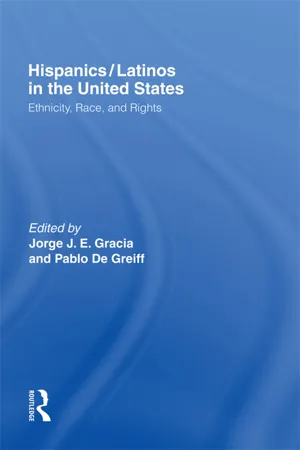
The presence and impact of Hispanics/Latinos in the United States cannot be ignored. Already the largest minority group, by 2050 their numbers will exceed all the other minority groups in the United States combined. The diversity of this population is often understated, but the people differ in terms of their origin, race. language, custom, religion, political affiliation, education and economic status. The heterogeneity of the Hispanic/Latino population raises questions about their identity and their rights: do they really constitute a group? That is, do they have rights as a group, or just as individuals? This volume, addresses these concerns through a varied and interdisciplinary approach.
eBook - ePub
Hispanics/Latinos in the United States
Ethnicity, Race, and Rights
- 288 pages
- English
- ePUB (mobile friendly)
- Available on iOS & Android
eBook - ePub
Hispanics/Latinos in the United States
Ethnicity, Race, and Rights
About this book
Information

IS LATINA/O IDENTITY A RACIAL IDENTITY? | 1 |
Linda Martin Alcoff |
Is Latina/o identity a racial identity? Given the social basis of racializing categories and the dynamic nature of identities, there is no decontextual, final, or essential answer to this question. However, I would describe my concern in this paper as being in the realm of social ontology in the sense that I seek the truth about how Latina/o identity is configured as well as lived in the context of North America today. The question then can be formulated in the following way: What is the best, or most apt, account of Latina/o identity that makes the most sense of the current political and social realities within which we must negotiate our social environment? Although I am interested here in the politics of identity, that is, the political effects of various accounts of identity in and on popular consciousness, both among Latinas/os and among Anglos, my principal concern is at the level of experience, ideology, and meaning rather than the attendant political rights that may be associated with identity.
As will be seen, much of the debates over Latinas/os and race weave together strategic considerations (a concern with political effects) and metaphysical considerations (a concern with the most apt description). It is not clear to me that these concerns can, in fact, be disentangled. There are two reasons for this. One is that strategic proposals for the way a community should represent itself cannot work if there is no connection whatsoever to lived experience or to the common meanings that are prominent in the relevant discourses and practices. Thus, the strategic efficacy of political proposals are dependent on correct assessments of metaphysical realities. But, second, the question of what is the most apt description of those metaphysical realities is not as clear-cut as some philosophers might suppose. And this is because the concepts of “race,” “Latina/o,” and even “identity” admit of different meanings and have complicated histories, such that it is not possible to simply say, “This is the meaning.” Thus, we must make a judgment about meaning, a judgment that will be underdetermined by usage, history, science, or phenomenological description of experience. And in making these judgments, we must look to the future and not just the past. In other words, given that we are participating in the construction of meanings in making such judgments, we must take responsibility for our actions, which will require carefully considering their likely real-world effects.
The question of Latina/o identity's relationship to the conventional categories of race that have been historically dominant in the United States is a particularly vexing one. To put it straightforwardly, we simply don't fit. Racialized identities in the United States have long connoted homogeneity, easily visible identifying features, and biological heredity, but none of these characteristics apply to Latinas/os in the United States, nor even to any one national subset, such as Cuban Americans or Puerto Ricans. We are not homogeneous by “race,” we are often not identifiable by visible features or even by names, and such issues as disease heredity that are often cited as the biologically relevant sign of race are inapplicable to such a heterogeneous group.
Moreover, the corresponding practices of racialization in the United States—such as racial border control, legal sanctions on cross-racial marriage, and the multitudinous demands for racial self-identification on nearly every application form from day care to college admissions—are also relatively unfamiliar south of the border. Angel R. Oquendo recounts that before he could even take the SAT in Puerto Rico he was asked to identify himself racially. “I was caught off guard,” he says. “I had never thought of myself in terms of race.”1 Fortunately, the SAT included “Puerto Rican” among the choices of “race,” and Oquendo was spared what he called a “profound existential dilemma.” Even while many Latinas/os consider color a relevant factor for marriage, and antiblack racism persists in Latin America along with a condescension toward indigenous peoples, the institutional and ideological forms that racism has taken in Latin America are generally not analogous to those in the North. And these differences are why many of us find our identity as well as our social status changing as we step off the plane or cross the river: race suddenly becomes an all-important aspect of our identity, and sometimes our racial identity dramatically changes in ways over which it feels as if we have no control.
In the face of this transcontinental experiential dissonance, there are at least three general options possible as a way of characterizing the relationship between Latina/o identity and race. One option is to refuse a racialized designation and use the concept of “ethnicity” instead. This would avoid the problem of racial diversity within Latina/o communities and yet recognize the cultural links among Latinas/os in the North. The concept of ethnicity builds on cultural practices, customs, language, sometimes religion, and so on. One might also be motivated toward this option as a way of resisting the imposition of a pan-Latina/o ethnicity, in order to insist that the only meaningful identities for Latinas/os are Cuban American, Puerto Rican, Mexican American, and so on.2
A second option would resist the ethnic paradigm on the grounds that, whatever the historical basis of Latina/o identity, living in the context of North America means that we have become a racialized population and need a self-understanding that will accurately assess our portrayal here. A third option, adopted by many neoconservatives, is to attempt to assimilate to the individualist ideology of the United States both in body and in mind, and reject the salience of group identities a priori.
None of these responses seems fully adequate, though some have more problems than others. It is hard to see how the diversity among Latinas/os could be fairly represented in any concept of race. And it is doubtful that many Latinas/os, especially those who are darker-skinned, will be able to succeed in presenting themselves as simply individuals: they will still be seen by many as instantiations of a group whose characteristics are considered both universally shared within the group and largely inferior, even if they do not see themselves this way. On the face of it, the first option—an account of Latina/o identity as an ethnic identity—seems to make the most sense, for a variety of reasons that I will explore in this paper. This option could recognize the salience of social identity, allow for more internal heterogeneity, and resist the racializing that so often mischaracterizes our own sense of self. However, I will ultimately argue that the “ethnic option” is not fully adequate to the contemporary social realities we face, and may inhibit the development of useful political strategies for our diverse communities. My argument in this paper primarily will take the form of a negative: that the ethnic option is not adequate. Developing a fully adequate alternative is beyond my scope or ambitions here, but the very failure of the ethnic option will establish some of the necessary criteria for such an alternative.
My argument will take the following steps. First, I will explain briefly the context of these debates over identity, which will go some way toward refuting the individualist option. Next, I will go over some of the relevant facts about our populations to provide the necessary cultural context. Then I will zero in on the ethnicity argument, assess its advantages and disadvantages, and conclude by posing the outline of an alternative.
Why Care about Identity?
If I may be permitted a gross overgeneralization, European Americans are afraid of strongly felt ethnic and racial identities. Not all, to be sure. The Irish and Italian communities, as well as some other European-American nationalities, have organized cultural events on the basis of their identities at least since the 1960s, with the cooperation of police and city councils across the country. The genealogy of this movement among the Irish and the Italians has been precisely motivated by their discrimination and vilification in U.S. history, a vilification that has sometimes taken racialized forms.
But there is a different attitude among whites in general toward “white ethnic” celebrations of identity and toward those of others, that is, those of nonwhites. And this is, I suspect* because it is one thing to say to the dominant culture, “You have been unfairly prejudiced against me,” as southern European ethnicities might say, and quite another to say, “You have stolen my lands and enslaved my people and through these means created the wealth of your country,” as African Americans, Latinas/os, and Native Americans might say. The latter message is harder to hear; it challenges the basic legitimizing narratives of this country's formation and global status, and it understandably elicits the worry, “What will be the full extent of their demands?” Of course, all of the cultural programs that celebrate African, indigenous, or Latina/o heritage do not make these explicit claims. But in a sense, the claims do not need to be explicit: any reference to slavery, indigenous peoples, or Chicano or Puerto Rican history implies challenges to the legitimizing narrative of the United States, and any expression of solidarity among such groups consciously or unconsciously elicits concern about the political and economic demands such groups may eventually make, even if they are not made now.
This is surely part of what is going on when European Americans express puzzlement about the importance attached to identity by non-European Americans, when young whites complain about African Americans sitting together in the cafeteria, or when both leftist and liberal political theorists, such as Todd Gitlin and Arthur Schlesinger, jump to the conclusion that a strong sense of group solidarity and its resultant “identity politics” among people of color in this country will fracture the body politic and disable our democracy.3
A prominent explanation given for these attachments to identity, attachments that are considered otherwise inexplicable, is that there is opportunism at work, among leaders if not among the rank and file, to secure government handouts and claim special rights. However, the demand for cultural recognition does not entail a demand for special political rights. The assumption in so much of contemporary political philosophy that a politics of recognition—or identity-based political movements—leads automatically to demands for special rights is grounded, I suspect, in the mystification some feel in regard to the politics of cultural identity in the first place. Given this mystification and feeling of amorphous threat, assumptions of opportunism and strategic reasoning become plausible.
Assumptions about the opportunism behind identity politics seem to work on the basis of the following understanding of the recent historical past: in the 1960s, some groups began to clamor for the recognition of their identities, began to resist and critique the cultural assimilationism of liberal politics, and argued that state institutions should give these identities public recognition. Thus, on this scenario, first we had identity politics asserting the political importance of these identities, and then we had (coerced) state recognition of them. But denigrated identity designations, particularly racial ones, have originated with and been enforced by the state in U.S. history, not vice versa. Obviously, it is the U.S. state and U.S. courts that initially insisted on the overwhelming salience of some racial and ethnic identities, to the exclusion of rights to suffrage, education, property, marrying whomever one wanted, and so on. Denigrated groups are trying to reverse this process; they are not the initiators of it. It seems to me that they have two aims: (1) to valorize previously derided identities, and (2) to have their own hand at constructing the representations of identities.
The U.S. pan-Latina/o identity is perhaps the newest and most important identity that has emerged in the recent period. The concept of a pan-Latina/o identity is not new in Latin America: Simon Bolivar called for it nearly two hundred years ago as a strategy for anticolonialism, but also because it provided a name for the “new peoples” that had emerged from the conquest. And influential leaders such as José Martí and Che Guevara also promoted Latin American solidarity. It is important to note that populations “on the ground” have not often resonated with these grand visions, and that national political and economic leaders continue to obstruct regional accords and trade agreements that might enhance solidarity. But the point remains that the invocation of a pan-Latina/o identity does not actually originate in the North.
Only much more recently is it the case that some Latina/o political groups in the North have organized on a pan-Latina/o basis, although most Latina/o politics here has been organized along national lines, for example, as Puerto Ricans or Chicanos. But what is especially new, and what is being largely foisted on us from the outside, is the representation of a pan-Latina/o identity in the dominant North American media, and it is this representation we want to have a hand in shaping. Marketing agencies have discovered/created a marketing niche for the “generic” Latina/o. And Latina/o-owned marketing agencies and advertising agencies are working on the construction of this identity as much as anyone, though of course in ways dominated by strategic interests or what Habermas calls purposive rationality. There are also more and more cultural representations of Latinas/os in the dominant media and in government productions such as the census. Thus, the concern that U.S. Latinas/os have with our identity is not spontaneous or originating entirely or even mostly from within our communities; neither is the ongoing representation of our identity something we can easily just ignore.4
What We Are Depends on Where We Are
Social identities, whether racial or ethnic, are dynamic. In Omi and Winant's study of what they call “racial formations” in the United States between the 1960s and the 1980s, they argued, “Racial categories and the meanings of race...
Table of contents
- Cover Page
- Half Title Page
- Title Page
- Copyright Page
- Contents
- Hispanic/Latino Ethnicity, Race, and Rights
- Part 1: Hispanic/Latiimo Identity, Ethnicity, and Race
- 1. Is Latina/o Identity a Racial Identity?
- 2. The Making of New Peoples
- 3. Negotiating Latina Identities
- 4. Cultural Particularity Versus Universal Humanity
- 5. The Larger Picture
- 6. “It Must Be A Fake!”
- Part 2: Hispanic/Latiimo Identity, Politics, And Rights
- 7. Structure, Difference, and Hispanic/Latino Claims of Justice
- 8. Universalism, Particularism, and Group Rights
- 9. Accommodation Rights for Hispanics in the United States
- 10. Affirmative Action For Hispanics? Yes and No
- 11. Latino Identity and Affirmative Action
- 12. Deliberation and Hispanic Representation
- Bibliography
- Contributors
- Subject Index
- Name Index
Trusted by 375,005 students
Access to over 1.5 million titles for a fair monthly price.
Study more efficiently using our study tools.
Frequently asked questions
Yes, you can cancel anytime from the Subscription tab in your account settings on the Perlego website. Your subscription will stay active until the end of your current billing period. Learn how to cancel your subscription
No, books cannot be downloaded as external files, such as PDFs, for use outside of Perlego. However, you can download books within the Perlego app for offline reading on mobile or tablet. Learn how to download books offline
Perlego offers two plans: Essential and Complete
- Essential is ideal for learners and professionals who enjoy exploring a wide range of subjects. Access the Essential Library with 800,000+ trusted titles and best-sellers across business, personal growth, and the humanities. Includes unlimited reading time and Standard Read Aloud voice.
- Complete: Perfect for advanced learners and researchers needing full, unrestricted access. Unlock 1.5M+ books across hundreds of subjects, including academic and specialized titles. The Complete Plan also includes advanced features like Premium Read Aloud and Research Assistant.
We are an online textbook subscription service, where you can get access to an entire online library for less than the price of a single book per month. With over 1.5 million books across 990+ topics, we’ve got you covered! Learn about our mission
Look out for the read-aloud symbol on your next book to see if you can listen to it. The read-aloud tool reads text aloud for you, highlighting the text as it is being read. You can pause it, speed it up and slow it down. Learn more about Read Aloud
Yes! You can use the Perlego app on both iOS and Android devices to read anytime, anywhere — even offline. Perfect for commutes or when you’re on the go.
Please note we cannot support devices running on iOS 13 and Android 7 or earlier. Learn more about using the app
Please note we cannot support devices running on iOS 13 and Android 7 or earlier. Learn more about using the app
Yes, you can access Hispanics/Latinos in the United States by Jorge J.E. Gracia, Pablo De Greiff, Jorge J.E. Gracia,Pablo De Greiff in PDF and/or ePUB format, as well as other popular books in Social Sciences & Civil Rights in Politics. We have over 1.5 million books available in our catalogue for you to explore.