Alcohol misuse presents a major risk for health and well-being throughout the life-span, but youth have a special vulnerability. Alcohol is the most widely used drug by adolescents. For some, this may be one or two isolated occasions of youthful experimentation; for others, the use becomes excessive, placing them in danger of immediate adverse consequences such as accidental injury and alcohol poisoning, or encouraging other high-risk behavior patterns including unprotected sex. Moreover, a pattern of heavy drinking established in adolescence and young adulthood may continue into an adult pattern of alcohol abuse.
Concerned communities and institutions across the nation are tackling the problem of alcohol use and abuse by young people. Research-based knowledge is urgently needed to inform these efforts and to ensure that limited prevention resources are used as effectively as possible. The origins of youthful alcohol use and abuse are found within the complex interplay of individual characteristics, family and peer influences, the larger societal context for alcohol use, environmental conditions, and maturational processes that accompany adolescence.
This volume, which began as a special issue of the Journal of Research on Adolescence, contains all of the material from the journal issue plus additional chapters. It helps researchers to meet the tremendous challenge of disentangling the key determinants of risk, and developing effective interventions. Primary sources of influence on youthful alcohol use are described, ranging from individual expectancies about alcohol effects and cognitive decision processes to parenting practices, peer influences, social environments, and economic factors; and a corresponding range of prevention interventions is discussed. This book will serve as a primer to those with an interest in developing and improving effective programs and activities to reduce alcohol-related problems among young people. For those engaged in prevention research, the text will provide useful reviews and current findings that should aid in directing future research activities.
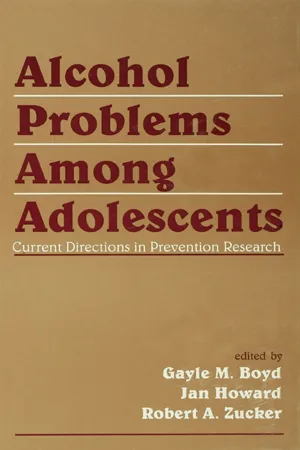
eBook - ePub
Alcohol Problems Among Adolescents
Current Directions in Prevention Research
- 272 pages
- English
- ePUB (mobile friendly)
- Available on iOS & Android
eBook - ePub
Alcohol Problems Among Adolescents
Current Directions in Prevention Research
About this book
Information
1
An Overview of Issues
National Institute on
Alcohol Abuse and Alcoholism
Alcohol Abuse and Alcoholism
Michigan State University
Although the minimum legal drinking age in all 50 states is 21 years, alcohol use and attendant problems are commonplace among American adolescents. Recent surveys indicate that by the eighth grade, 70% of students have tried alcohol, 25% have used it during the preceding 30 days, and 13% report consuming five or more drinks on a single occasion during the previous 2 weeks (Johnston, O’Malley, & Bachman, 1992a). These figures increase with age: In 1991, 30% of high-school seniors and 43% of college students indicated that they had engaged in binge drinking within the past 2 weeks (Johnston, O’Malley, & Bachman, 1992b).
Alcohol use and abuse among adolescents are associated with a broad range of high-risk behaviors that can have profound health, economic, and social consequences. These behaviors include drinking and driving, participation in deviant peer groups, abuse of other drugs, unprotected sexual intercourse, interpersonal violence, destruction of private property, and poor school performance.
Trend data suggest that most measures of alcohol consumption by youth and young adults have decreased during the past decade (Johnston et al., 1992a, 1992b). Current rates of consumption and alcohol-related problems still remain alarmingly high, however. For example, recent data from the Fatal Accident Reporting System (FARS) indicate that 33% of fatally injured drivers 16 to 20 years of age had a blood alcohol concentration (BAC) level of 0.10 or higher (National Transportation Safety Board [NTSB], 1993). In 1990, drivers 15 to 20 years accounted for only 7.1% of all licensed drivers, but they were involved in 14.9% of all driver fatalities (NTSB, 1993). Research suggests that younger drivers are more susceptible to impairment from alcohol at moderate BAC levels than are older drivers. Although younger drivers have higher relative risks of fatal crash involvement than other drivers regardless of their BAC levels, that risk is particularly notable at BAC levels in the .05–.09 range (Zador, 1991).
The consumption of alcoholic beverages is embedded in the social fabric of the nation and, for many youths, learning to drink has become a rite of passage and a signal of emergent independence. For these reasons, studying youth drinking behavior has helped developmentally focused researchers understand the causal matrix of cognitive, emotional, and social development underlying the transition from childhood to adolescence, and thereafter to adulthood (Jessor & Jessor, 1977; Kandel, 1980). At the same time, alcohol researchers have focused very heavily on this developmental period to understand the emergence of drinking-related behaviors, including how patterns of alcohol use are acquired and maintained, how expectancies about drug taking are formed, how social pressures and individual differences shape the development of different drinking patterns, and how environmental factors influence use.
Research on the use of alcohol by adolescents and its prevention is necessarily driven by a public-health concern. Alcohol is implicated in the behavior disorder of greatest prevalence in the U.S. population: alcohol abuse/ dependence (Regier et al., 1990). Because for most individuals, drinking practices are initiated during adolescence and because the prevalence of problem drinking is very high in this age group, the potential gains from intervention activities that target adolescents are also especially great.
The urgency of the problems associated with adolescent use and misuse of alcohol impels lawmakers, educators, parents, and communities to take action. Intervention efforts instituted in response to public demand, however, are often not informed by research, and it is seldom clear whether the interventions are effective. In this environment, researchers are challenged to develop theoretically grounded, well-tested, effective preventive interventions. At the same time, they are frequently asked to provide immediate practical guidance for incipient or ongoing community-driven intervention activities and policy decision making. The ubiquitous presence of alcohol prevention programs and the variety of relevant legal sanctions can expand the prevention-research laboratory to communities, states, and the nation as a whole, and sometimes provide opportunities to “test” interventions that would be too costly to institute for the sake of research alone.
Prevention Strategies
To address alcohol-related problems among youth, a wide range of prevention policies has been adopted and implemented at national, state, and local levels. These strategies include the adoption by all 50 states and the District of Columbia of the minimum legal drinking age of 21 years for the sale of alcohol. All but one state and the District of Columbia also prohibit public possession of alcohol by minors, and all but five states and the District prohibit purchase of alcohol by minors (NTSB, 1993).
A number of states have enacted lower BAC limits for young drivers, ranging from limits of 0.00 to 0.06. Studies have shown such constraints to be effective in reducing alcohol-related crashes, especially when the restrictions are adequately publicized and combined with administrative license revocation (Hingson, 1993; NTSB, 1993; U.S. Department of Transportation, 1992).
The NTSB concluded that several other legislative and policy actions can also be effective in reducing alcohol-related automobile crashes among youth: more vigorously enforcing minimum purchase age laws, enacting laws that establish a provisional license system that is combined with nighttime driving restrictions for young novice drivers, and developing carefully targeted multimedia information and education campaigns directed at youth (NTSB, 1993).
Although drinking and driving by youth is a major concern, prevention efforts are not limited to the area of drunk driving. The Drug-Free Schools and Communities Act and its amendments required institutions of higher education and state and local educational agencies to certify to the Department of Education by October 1,1990 that they had adopted and implemented a program to prevent the illicit use of drugs and the abuse of alcohol by students and employees (Drug-Free Schools and Communities Act Amendment of 1989). At a minimum, the program must include the annual distribution to each student and employee of: standards of conduct that prohibit the unlawful possession, use, or distribution of drugs and alcohol at the institution or its activities; a description of relevant legal sanctions, health risks, and available counseling, treatment, or rehabilitation programs; and a clear statement that the institution will impose described sanctions on students and employees for violations of the standards of conduct, including expulsion or termination of employment and referral for prosecution. Elementary and secondary schools are also required to provide age-appropriate, developmentally based drug and alcohol education and prevention programs for all students and grades. Receipt of federal funds by educational institutions and agencies is contingent on their compliance with the Act.
Throughout the United States, communities as a whole and organized constituencies within them have designed and implemented a variety of interventions for the prevention of alcohol-related problems among youth. In rare instances, these interventions have been developed for the specific purpose of testing their effectiveness. In other instances, “naturally occurring” prevention programs, initiated by public and private organizations, have provided opportunities for researchers to study their effectiveness by conducting “natural experiments.”
The number of prevention strategies worthy of being studied, singly and in combination, taxes the imagination. However, the resources available for research are finite, and their judicious expenditure requires difficult choices. Researchers have therefore suggested various theoretical and pragmatic schemes for classifying the broad array of interventions (Howard, 1993). For example, interventions have been distinguished in terms of whether they target individuals (through processes of socialization) or the larger environment (through mechanisms of social control). Attempts have also been made to structure prevention research in terms of a continuum of systematic research phases.
Phases of Prevention Research
In several fields of health research, models of research phases have been set forth that establish frameworks for the logical progression of research from more basic to more applied studies. The National Cancer Institute uses a five-phase model to guide research on the prevention of cancer and consequent morbidity and mortality. The five-phase sequence includes hypothesis development, methods development, controlled intervention trials, defined population studies, and demonstration and implementation studies (Greenwald, Cullen, & McKenna, 1987). Similarly, the National Heart, Lung, and Blood Institute has a five-phase sequence, but only the last category is specifically concerned with prevention—testing the effectiveness of interventions “designed to promote healthful behaviors and to prevent or ameliorate disease in defined populations” (National Heart, Lung, and Blood Institute, 1987, p. 2).
The most widely known model of research phases is the Food and Drug Administration (FDA) sequence that involves three phases of drug testing in human or clinical populations: safety or toxicity studies, efficacy studies, and more extensive clinical trials that assess drug effectiveness and monitor adverse reactions among larger groups of patients under realistic conditions (Flieger, 1990; Young, 1990).
Staff from the National Institute on Alcohol Abuse and Alcoholism (NIAAA) and a select group of extramural researchers have been considering components of a phases model for alcohol prevention research. The specific dimensions of the model and its accompanying sequence of methods are still being developed. Suffice it to say here that the model recognizes that intervention research (i.e., the testing of strategies believed to have the potential of preventing or reducing alcohol-related problems) must be based on a foundation of more basic preintervention research, generally in the social and behavioral sciences.
Depending on the prevention strategy of interest, preintervention studies might focus on: (a) examining risk and protective factors; (b) identifying appropriate target groups and endpoint or outcome variables; (c) developing feasible intervention approaches aimed at the individual (i.e., host), the agent (i.e., alcohol), and/or the social, economic, political, and cultural environment; (d) identifying potential mechanisms for cost-effective delivery of interventions; and (e) selecting, adapting (or constructing), and pretesting appropriate measuring instruments.
Structure and Themes
This volume is organized in terms of an implicit phases model. It begins with two analyses of risk and protective factors that influence adolescent drinking patterns over time without the intrusion of deliberate intervention. These can be considered preintervention studies. The third chapter also falls into the preintervention category. It examines decision-making processes among adolescents, with particular consideration of choices concerning risky alcohol-related situations. Although the author suggests possible approaches for making health communications more relevant to adolescents and reducing the likelihood of harmful decisions, he has not reached the stage of testing these interventions. Chapter 4 explores the role that alcohol expectancies play in teenage problem drinking; but it goes beyond the boundary of preintervention studies by including laboratory research on the experimental manipulation of expectancies as a means of reducing alcohol abuse.
The next six chapters focus almost entirely on intervention research—studies that test or evaluate intervention strategies in terms of their impact or potential impact on alcohol use and abuse by adolescents. The chapters are organized in terms of a micro/macro environmental perspective, moving from the smaller microcosm of the family through school and university settings, communities, and large governmental jurisdictions. In five of the six chapters, the intervention being discussed was originally initiated and implemented by the investigators for research purposes. However, the final chapter evaluates the effects of taxation policies (natural events) that are beyond the control of the investigator and were implemented for reasons extraneous to research.
Themes and Conclusions
In the first chapter, Barnes and her colleagues examine risk and protective factors influencing the development of drinking patterns among Black and White adolescents in Buffalo, New York. The ongoing longitudinal study includes a large representative sample of adolescents and their parents. Of particular interest is the impact of family influences as predictors of alcohol abuse among adolescents. Regardless of race or other sociodemographic factors, the quality of parenting has proven to be a critically important influence on adolescent drinking behavior. “High levels of parental support and monitoring as well as positive adolescent-parent communication” serve as “key elements in the prevention of alcohol abuse and other deviant behaviors.”
Peterson and her colleagues also examine the effects of several family influences (parent alcohol consumption patterns, family management practices, and parental alcohol norms) on alcohol use among African-American and European-American adolescents. The initial study population consisted of a large sample of fifth-grade students from Seattle and one of their parents, generally the mother. Students were followed over time through the ninth grade. Those from high crime neighborhoods were overrepresented in the sample. Among both ethnic groups, current alcohol use by the adolescents was strongly and inversely associated with proactive family management practices. Moreover, the influence of parent drinking on adolescent alcohol use appeared to be mediated by family management practices and by parental norms regarding alcohol use. According to the authors, these findings have important implications for the design and implementation of preventive interventions.
Fischhoff and Quadrel describe a cognitive framework for decision making theory and show how this theoretical perspective may be applied to adolescents’ decisions about alcohol use. For illustrative purposes, they focus some of their discussion on a single decision: whether to ride with a friend who has been drinking. To indicate how decision theorists would study this type of choice, the authors consider both normative and descriptive approaches to the question. Normative analysis attempts to show how decisions should be made if decision makers are to choose wisely, whereas descriptive analysis attempts to show how people actually make decisions. Using data from their own studies, the authors report similarities between teenagers and adults in perceived vulnerability to alcohol-related risks. Their discussion highlights methodological challenges in applying decision theory to adolescent drinking behavior.
Smith and Goldman provide strong empirical support for their thesis that alcohol expectancies play a causal-mediational role in teenage problem drinking. They argue that these expectancies predict the future onset of problem drinking among teenagers and mediate family influences on such behavior, and that experimental manipulation of alcohol expectancies can significantly reduce heavy drinking among college students. The authors also contend that assessments of expectancies may contribute to the identification of high-risk adolescents before they actually begin to drink. Thus, alcohol expectancies have the potential of being an important index in the early identification of high-risk youth and an object of challenge or manipulation for the purpose of preventing or reducing alcohol abuse.
Maguin and his colleagues describe and evaluate their family-based approach to arresting conduct problems among high-risk preschool children as a means of deterring later onset of alcohol abuse and alcoholism. The intervention combined parent training with a marital issues component, and was focused on families with preschool-aged boys in which the father had been convicted of drunk driving. Compared to their controls, boys in the intervention group showed a sustained increase over time in their prosocial behavior. Significant decreases in overt negative behavior and increases in affectionate behavior were also observed, although these changes may not have been lasting. Evidence suggests that the involvement of both parents in the intervention program was more effective than involving mothers only. These data indicate that moderating effects can be produced with very high-risk families on behaviors believed to be prodromal to later alcohol problems. However, longer term follow-up is essential to demonstrate the efficacy of this family-based approach for moderating later alcohol use.
Teddy Dielman reviews the history and progression of school-based strategies for the prevention of adolescent alcohol use and misuse. He argues that the new generation of school-based prevention research uses promising theoretical approaches that recognize the deterrent value of social norms and social (or refusal) skills. To illustrate his thesis, Dielman summarizes findings from his own research on adolescents. His data establish or confirm that school-based prevention programs can reduce the rate of increase of adolescent alcohol use and misuse; that these effects can endure over time; that intervention is most effective among adolescents who have already started to experiment with alcohol in settings without adult supervision; that there may be an optimal age for intervention; that the degree of adolescent susceptibility to peer pressure is an important mediating variable; and that parental influences are important independent of the effects of peer influences.
Alan Marlatt and his colleagues believe that college students represent a unique population of adolescents and young adults at risk for alcohol problems. And these researchers have been testing a harm-reduction approach to the prevention of alcohol abuse among a sample of heavy-drinking college students. Findings indicate that the intervention program, which involves motivational enhancement, has resulted in meaningful risk reduction among the exposed group compared to randomly selected heavy-drinking controls. The authors also describe a new prevention project targeted at students who belong to fraternities and sororities (the Greek system), because studies show them to be particularly vulnera...
Table of contents
- Cover
- Half Title
- Title Page
- Copyright
- Contents
- Foreword
- Preface
- 1. An Overview of Issues
- 2. Family Influences on Alcohol Abuse and Other Problem Behaviors Among Black and White Adolescents in a General Population Sample
- 3. Disentangling the Effects of Parental Drinking, Family Management, and Parental Alcohol Norms on Current Drinking by Black and White Adolescents
- 4. Adolescent Alcohol Decisions
- 5. Alcohol Expectancy Theory and the Identification of High-Risk Adolescents
- 6. The Path to Alcohol Problems Through Conduct Problems: A Family-Based Approach to Very Early Intervention With Risk
- 7. School-Based Research on the Prevention of Adolescent Alcohol Use and Misuse: Methodological Issues and Advances
- 8. Preventing Alcohol Abuse in College Students: A Harm-Reduction Approach
- 9. Parental Participation in Drug Abuse Prevention: Results from the Midwestern Prevention Project
- 10. Community Strategies for the Reduction of Youth Drinking: Theory and Application
- 11. Effects of Alcohol Price Policy on Youth: A Summary of Economic Research
- Author Index
- Subject Index
Trusted by 375,005 students
Access to over 1.5 million titles for a fair monthly price.
Study more efficiently using our study tools.
Frequently asked questions
Yes, you can cancel anytime from the Subscription tab in your account settings on the Perlego website. Your subscription will stay active until the end of your current billing period. Learn how to cancel your subscription
No, books cannot be downloaded as external files, such as PDFs, for use outside of Perlego. However, you can download books within the Perlego app for offline reading on mobile or tablet. Learn how to download books offline
Perlego offers two plans: Essential and Complete
- Essential is ideal for learners and professionals who enjoy exploring a wide range of subjects. Access the Essential Library with 800,000+ trusted titles and best-sellers across business, personal growth, and the humanities. Includes unlimited reading time and Standard Read Aloud voice.
- Complete: Perfect for advanced learners and researchers needing full, unrestricted access. Unlock 1.5M+ books across hundreds of subjects, including academic and specialized titles. The Complete Plan also includes advanced features like Premium Read Aloud and Research Assistant.
We are an online textbook subscription service, where you can get access to an entire online library for less than the price of a single book per month. With over 1.5 million books across 990+ topics, we’ve got you covered! Learn about our mission
Look out for the read-aloud symbol on your next book to see if you can listen to it. The read-aloud tool reads text aloud for you, highlighting the text as it is being read. You can pause it, speed it up and slow it down. Learn more about Read Aloud
Yes! You can use the Perlego app on both iOS and Android devices to read anytime, anywhere — even offline. Perfect for commutes or when you’re on the go.
Please note we cannot support devices running on iOS 13 and Android 7 or earlier. Learn more about using the app
Please note we cannot support devices running on iOS 13 and Android 7 or earlier. Learn more about using the app
Yes, you can access Alcohol Problems Among Adolescents by Gayle M. Boyd,Jan Howard,Robert A. Zucker in PDF and/or ePUB format, as well as other popular books in Psychology & Developmental Psychology. We have over 1.5 million books available in our catalogue for you to explore.