![]()
PART 1
Dyslexia and you
There are four chapters in Part 1:
• Chapter 1
Finding out about dyslexia and the brain
What we know about dyslexia and the brain
• Chapter 2
Exploring your dyslexia
What dyslexia is, and feelings about being dyslexic
• Chapter 3
How dyslexia affects you
Considering your dyslexia and your needs
• Chapter 4
Support from those close to you
How family and friends can give effective help
Although you don't need to read Part 1 first, you will find something here to get you thinking about how dyslexia affects you. We help you to understand what is happening in your brain and identify your strengths. Armed with this knowledge you can move confidently on to Part 2.
![]()
1
Finding out about dyslexia
and the brain
Understanding something about dyslexia will help you to know what might be going on in your brain.
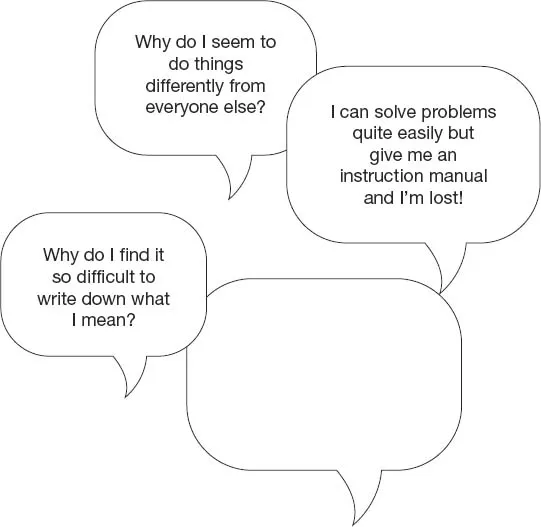
Do any of these ring a bell? You might like to add a comment about yourself.
Dyslexic brains are different. That's official. There is scientific evidence to show that the dyslexic brain processes information differently. For example, with various brain-scanning techniques we can now see what is happening in our brains when we are doing particular tasks; the scanner measures which bits of the brain are active. We can see that dyslexic brains are active in a different way to those of non-dyslexics.
This chapter looks at how we read, write and use the English language, and at some of the scientific evidence for dyslexia.
How we read
Reading makes considerable demands on us that are quite different from speaking. Our brains are programmed for speaking but not for reading. Reading uses different parts of our brain so we have to learn the rules:
•we have to know what sounds the letters represent;
•we have to know how to put the sounds together to make words.
Reading involves two processes:
•processing sound information; and
•processing visual information.
You may not be familiar with the term ‘phonology’ (pronounced: fo-nol-ogy). Phonology is the study of sounds that are found in language. This means the sounds used when you speak, not the sounds made when you scream, laugh or cough.
Put simply, the two skills that the brain is using are:
•linking the letters to sounds – phonology (e.g. the sound that ‘th’ makes); and
•matching the look of the word to what you have seen before – visual.
Your difficulties learning to read
Can you remember learning to read? Can you remember having any of the following difficulties?
•Couldn't remember the different sounds of the vowels: a e i o u.
•Couldn't tell the difference between some letters such as ‘p’ and ‘q’, ‘b’ and ‘d’.
•Had difficulty with pronouncing ‘th’ and ‘f’.
•Couldn't remember the sounds for ‘ough’ in though, through, cough, enough, bough.
•Circle any of these words below that describe how you remember having felt at the time and add any others you think of:
frustrated angry resigned foolish
perplexed tired embarrassed
| These are the skills required for reading. Dyslexic people use these two skills in a different way to most people.If you want to know a bit more about how these work when we read, refer to the additional information:How the brain reads and How we learn to read in the Reading section of our online resource. | |
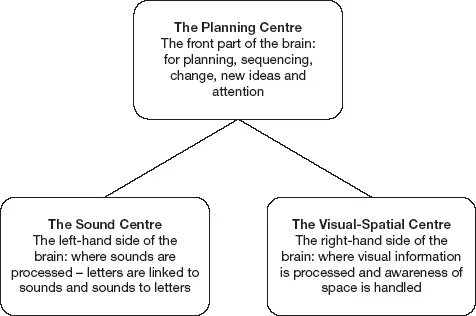
Figure 1.1 shows how the tasks are divided between different parts of the brain. You will sometimes hear reference to the ‘left brain’ (i.e. ‘sound centre’) and the ‘right brain’ (‘visual-spatial centre’) but both sides of the brain are involved in reading.
Figure 1.1 Adapted from the model of Alan Baddeley
(Working Memory, Oxford: Clarendon Press, 1986)
We have oversimplified the real situation. If your phonological processing (the ‘sound centre’) is inefficient then your visual processing (the ‘visual-spatial centre’)will make up for it. However, the visual route is slower. It is also hopelessly unreliable for reading long words and not good for new words. You probably have difficulty reading words you've never encountered before.
Look at the words on this list. Try reading them aloud:
• pathognomonic
• homunculus
• reafference
• diphenylbutyl
We can't check whether you've got them right but we suspect that you would struggle to read them straight off because they are probably unfamiliar to you. Are you beginning to understand how you read?
You may also have experienced muddling words that look very similar. Try these pairs:
• spilt and split
• affect and effect
• though and through
Look back at Figure 1.1. When you are reading, the ‘visual-spatial centre’ may let you down.
As you read through texts your visual-spatial centre:
• cannot recognize a word you've never met before;
• may mistake one word for another.
If your ‘sound centre’ works well, it will deal with these situations by recognizing the letter sounds and putting them together. This is called ‘phonological awareness’. But, in dyslexia, the processing in the ‘sound centre’ is often very inefficient, so you have to rely more on the ‘visual-spatial centre’. Reading, therefore, becomes slower and harder.
In summary:
•Phonology is about the way that speech sounds relate to letters.
•You need phonological as well as visual skills to read efficiently.
•In dyslexia, phonological skills (the sound centre processes) are usually underdeveloped.
•Dyslexics tend to use the slower, less reliable, ‘visual-spatial’ centre of the brain.
The sound centre: phonology and phonological awareness
Your phonological skills should develop before you learn to read. This is why learning nursery rhymes and tongue twisters are so important. There are 3 stages in the development of phonological skills. These are summar...