- 96 pages
- English
- ePUB (mobile friendly)
- Available on iOS & Android
eBook - ePub
Caesar's Gallic Wars 58-50 BC
About this book
Julius Caesar was one of the most ambitious and successful politicians of the late Roman Republic, and his short but bloody conquest of the Celtic tribes led to the establishment of the Roman province of Gaul (modern France). Caesar's commentaries on his Gallic Wars provide us with the most detailed surviving eyewitness account of a campaign from antiquity. In this book, Kate Gilliver makes use of this firsthand account and other surviving evidence to consider the importance of the Gallic Wars in the context of the collapse of the Roman Republic and its slide toward civil war.
The fighting
Invasion, siege and conquest
58 BC The first campaign
In the first year of his governorship, Caesar fought and won two major pitched battles and set himself up to conquer Gaul. The speed and decisiveness with which he operated must have impressed his political rivals in Rome, and terrified the Gauls. Caesar had freed them from the menace of the migrating Helvetii and the German king Ariovistus, but now he threatened their independence himself.
Caesar was still in Rome when news arrived in mid-March that the Helvetii were on the move, heading west towards Geneva and southern Gaul, dangerously close to the Roman province. He immediately headed for Provence, ordering the only legion stationed there to make for Geneva and to destroy the bridge over the Rhône. He levied auxiliary troops in Provence and raised two new legions in northern Italy. Playing for time, he agreed to consider a request that the Helvetii be allowed to pass, but then refused once his troops had built defences that forced the Helvetii away from Roman territory and into central France. He then dashed back to Italy to collect the two new legions and three veteran legions in garrison at Aquileia, marched them through the Alps in early summer and caught up with the Helvetii as they were crossing the Saône. Three-quarters had crossed, but Caesar attacked those remaining. Some escaped into the woods, but his legions slaughtered the rest. The casualty figures are not recorded.
Crossing the Saône in a single day on pontoons, Caesar caught up with the main body of Helvetii and trailed them at a discreet distance, refusing to be drawn into combat except on his terms. The Helvetii were keen to avoid battle and tried to negotiate, but Caesar's demands were too severe, perhaps intentionally since he was probably eager to fight when the tactical situation became favourable. It did a few days later and a force under Labienus took the high ground above the Helvetian camp in preparation for an attack, but a veteran scout panicked and wrongly reported to Caesar that the flashes of arms he had seen on the hill were definitely Gallic, not Roman, so the attack had to be aborted.
Caesar continued to tail the Helvetii, but was finally forced towards Bibracte to collect supplies from his Aeduan allies, his own supply train being stuck on the Saône. Perhaps hoping to cut the Romans off from their supplies, the Helvetii decided to give battle and attacked the Roman rearguard. Caesar deployed on a slope under cover of a cavalry screen.
Battle against the Helvetii
The Roman forces consisted of six legions numbering c. 24,000–30,000 men, as well as unknown numbers of auxiliary infantry and cavalry. Two of the legions were newly recruited and many of the auxiliaries were Gauls. Their fighting capabilities must have been suspect.
There are no figures for the size of the Helvetian army; their allies, the Boii and Tulingi, numbered c. 15, 000, and it is unlikely that the total Gallic army was more than c. 50,000 men.
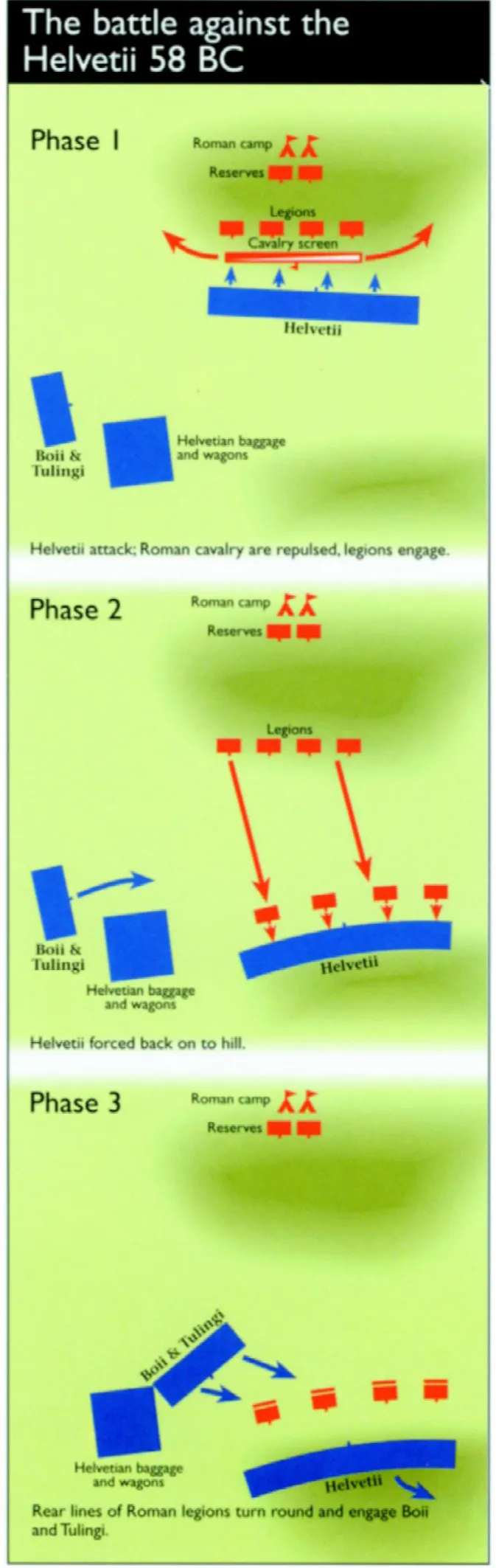
Caesar deployed his two new legions and the auxiliary infantry on the high ground as a reserve and to guard the Roman encampment; the four veteran legions deployed as a triplex acies on ground sloping down towards the Helvetii. (Four cohorts were in the front line, with two further lines of three cohorts each as a reserve force.) The Helvetii formed up in very close order. They gathered their baggage, wagons and families beyond the left wing of their battle line, along with their allies, the Boii and Tulingi.
The first attack of the Helvetii was easily repulsed by the Romans, who had the advantage of the slope and superior weaponry in the form of their pila, which stuck into the enemy's shields, weighing them down and pinning them together. The Helvetii were forced back, but this attack may have been a feint. As the Roman cohorts followed the retreating Helvetii, the Boii and Tulingi outflanked the Roman right. At this point the Helvetii renewed the fight and the Romans were surrounded. Close-quarter infantry combat ensued. The brilliant tactical flexibility of the legion enabled Caesar to order the rear line of cohorts to turn round and the legions fought the battle on two fronts. The Roman reserves on the hill were not even engaged.
The Helvetii fled; the Boii and Tulingi were forced back against the wagons and slaughtered, along with the women and children.
In the aftermath of the battle, Caesar rested for three days to see to his wounded before continuing his pursuit of the Helvetii, who promptly surrendered. Concerned that Germanic tribes might move into the lands vacated by the Helvetii, Caesar ordered the survivors home. Caesar claims that of the 368,000 who set out on the migration, only 110,000 returned.
After dealing with the Helvetii, Caesar turned on the German tribes who occupied land on the left bank of the Rhine under their king Ariovistus. Caesar needed a good reason for attacking a king who was a ‘Friend and Ally of the Roman People’, and claimed that the Germans were raiding allied Aeduan territory and other Gallic tribes had asked for help. Both sides aimed to occupy the strategically important town of Besançon but Caesar got there first. Here panic spread through Caesar's inexperienced troops and even among some of his officers that Ariovistus and his army was going to be a much tougher prospect than the migratory tribes the Romans had so easily slaughtered. Caesar had to restore discipline by threatening to march off with only one of his legions. When he did march, with all his army, the two leaders met to parley but neither was prepared to damage his reputation by backing down and agreeing to the other's demands to vacate Gaul. Pitched battle was inevitable, although Caesar was more eager to force an engagement, perhaps because of his usual difficulties with his supplies. He was dependent for supplies on Gallic tribes whose reliability was sometimes suspect, and the speed with which he liked to operate on campaign only added to the uncertainties of his supply lines. Eventually, the Romans forced Ariovistus to deploy by marching in battle formation right at the German encampment.
The Germans parked their wagons behind their battle line, Caesar says to prevent the warriors escaping, but it may equally have been to prevent an outflanking manoeuvre by the Romans. The engagement began with the Germans charging so quickly that the Romans had no time to throw their pila, and an intense period of hand-to-hand combat ensued. The German left was routed by the Roman right under the personal command of Caesar, but the Roman left was coming under pressure. The officer in command of the cavalry, Publius Crassus, saw this and had the initiative to redeploy the third line of each legion to attack the German right. Again it was the flexibility of legionary tactics that turned the battle and the Germans fled, pursued the full 15 miles to the Rhine. The German losses are reported at 80,000 and the battle was clearly an outright victory for the Romans. In just one year Caesar was able to report to his rivals in Rome that he had defeated two of Rome's traditional and most feared enemies, Gauls and Germans. He wintered his legions near Vesontio and returned to northern Italy to attend to the civil aspects of his governorship.

The engineering skills of the Roman army are best illustrated by the bridge Caesar's soldiers built in 10 days across the Rhine. The bridge was built entirely of wood and required hundreds of timbers to be driven into the river bed from barges built specially for the purpose. Once they were in place, a timber roadway was constructed on top, allowing the Roman army to march across the river into Germany. (Glasgow University Library)
T57 BC Conquest of the east
By early 57 BC, if he had not already resolved to do so the previous year, Caesar had decided to conquer the whole of Gaul.
German cavalry tactics
Although the horses the German cavalrymen used were small and sometimes of poor quality, the cavalry itself was made particularly effective through the addition of a force of light infantry that worked in tandem with the cavalry. This provided the manoeuvrability of cavalry along with the staying power of infantry.
‘With the six thousand cavalry was the same number of infantry, the swiftest and bravest men, each chosen from the whole army by a cavalryman for his own protection; they went into battle together. The cavalry would fall back on them; if the cavalry were in difficulties the infantry ran to help; if a cavalryman had been wounded and fallen from his horse, they surrounded him. They had become so swift through training that on a long advance or a quick retreat they could keep up by running, holding on to the horses' manes.'
Caesar, Gallic War
Some Gallic tribes were persuaded to form alliances with Rome because of the protection and influence such a relationship would bring within Gaul, and they may have felt, probably correctly, that as conquest was inevitable, it was better to be on the winning side. The Aedui in central Gaul were encouraged to remain Caesar's staunchest ally by his willingness to let them expand their influence over defeated Gallic tribes. The Remi in northern Gaul preferred to fight with Rome rather than against her, providing Caesar with intelligence during the campaign. However, the majority of Belgic tribes, feared Rome's growing power in the region and prepared to resist, soliciting help from the Germans. Caesar claims they could muster an army of 200,000 warriors.
Caesar's subordinates
Caesar had under his command a number of officers who were also senators in Rome and whom he could appoint to senior positions. A quaestor was attached to the province of Gaul who had some financial responsibilities, and as a junior senator could also command troops, sometimes independently. Publius Crassus seems to have been a particularly able young man who, in 54 BC, went to join his father on the doomed campaign against the Parthians; he was killed at Carrhae the following year.
Caesar was also allowed to appoint a number of legates, usually more senior senators like Labienus who had held the Praetorship, a senior magistracy in Rome. These men could be placed in command of quite large forces of several legions plus cavalry, and trusted with independent commands. Labienus was left in charge of the entire province of Gaul during the expeditions to Britain. Appointing legates provided an opportunity to pay back political debts or to place others in your debt through patronage, although his debt to Caesar did not prevent Labienus from siding with Pompey in the Civil War.
Caesar raised two more legions, bringing the total to eight (32,000–40,000 men, plus auxiliaries), and at the start of the campaigning season, headed for northern Gaul. His intention was to defeat the powerful Belgic tribes and cut them off from German support to the east. The Belgae caught up with him near Bibrax and tried to capture the oppidum from the occupying Remi who were being assisted by lightly armed missile troops Caesar had sent to help. Unable to capture the town, the Belgae instead ravaged the land and then turned towards Caesar's camp by the river Aisne. Neither side wished for battle at this point, although Caesar had prepared by linking artillery redoubts to the camp by means of trenches to prevent a Belgic outflanking manoeuvre should battle ensue. Skirmishes followed, but still no battle. Eventually each side's supply requirements effected a result of sorts: Caesar attempted to precipitate a general engagement by sending his cavalry and light infantry against the Belgae because he was concerned about being cut off from his supplies. But the Belgae, too, were running short of supplies and because they had no logistical support, simply disbanded their army, to re-form if, or when, Caesar threatened them directly. They may also have recognised that Caesar's prepared battlefield made the terrain too unfavourable for a successful engagement.

A coin depicting the Celtic thunder god, Taranis, who is shown clutching a lightning bolt and standing next to a solar wheel, the symbols of his power His rectangular shield closely resembles those of the Gallic warriors who fought against Caesar's legions (see also illustration on page 24). (Ancient Art and Architecture)
The speed at which Roman armies could move proved an important factor in the success of this year's campaigns. Caesar pounced on the oppidum of the Suessiones at Noviodunum (on the river Aisne), hoping to capture it before the warriors returned after the Belgic army had disbanded. Though the warriors were able to sneak in at night, they quickly surrendered when they saw the siege preparations: clearly they had never experienced anything like Roman siege warfare before. The psychological effects of this surrender were widespread, with the Bellovaci and Ambiones surrendering to the Romans without resistance. The next tribe though, the Nervii, decided to resist, formed an alliance with the neighbouring Atrebates and Viromandui and planned to ambush Caesar's army as it was marching or at its most vulnerable when encamping. Making use of the terrain, the land patched with dense woodland and divided by high hedgerows, the Nervii set an ambush in woods on the far side of the river Sambre. The Romans began fortifying camp on the near side of the river, and their cavalry and light infantry crossed the water to scout and keep the Nervii away while the legionaries completed the encampment. They were easily repulsed by the Nervii, who then charged very fast at the entrenching Roman soldiers. Caesar had failed to deploy a screen of infantry to protect those entrenching, standard procedure when encamping in the presence of the enemy, and his legions were caught dispersed and unprepared. The two rookie legions forming the rearguard had not even arrived at the campsite.
Battle against the Nervii
Caesar employed eight legions, t...
Table of contents
- Cover Page
- Title Page
- Copyright Page
- Introduction
- Chronology
- Background to war
- Outbreak: The migration of the Helvetii
- The fighting: Invasion, siege and conquest
- Portrait of a soldier: Caesar's centurions
- The world around war: The impact of the conflict
- Portrait of a civilian: Roman merchants
- How the war ended: Roman triumphs
- Conclusion and consequences: Pax Romana
- Further reading
Trusted by 375,005 students
Access to over 1.5 million titles for a fair monthly price.
Study more efficiently using our study tools.
Frequently asked questions
Yes, you can cancel anytime from the Subscription tab in your account settings on the Perlego website. Your subscription will stay active until the end of your current billing period. Learn how to cancel your subscription
No, books cannot be downloaded as external files, such as PDFs, for use outside of Perlego. However, you can download books within the Perlego app for offline reading on mobile or tablet. Learn how to download books offline
Perlego offers two plans: Essential and Complete
- Essential is ideal for learners and professionals who enjoy exploring a wide range of subjects. Access the Essential Library with 800,000+ trusted titles and best-sellers across business, personal growth, and the humanities. Includes unlimited reading time and Standard Read Aloud voice.
- Complete: Perfect for advanced learners and researchers needing full, unrestricted access. Unlock 1.5M+ books across hundreds of subjects, including academic and specialized titles. The Complete Plan also includes advanced features like Premium Read Aloud and Research Assistant.
We are an online textbook subscription service, where you can get access to an entire online library for less than the price of a single book per month. With over 1.5 million books across 990+ topics, we’ve got you covered! Learn about our mission
Look out for the read-aloud symbol on your next book to see if you can listen to it. The read-aloud tool reads text aloud for you, highlighting the text as it is being read. You can pause it, speed it up and slow it down. Learn more about Read Aloud
Yes! You can use the Perlego app on both iOS and Android devices to read anytime, anywhere — even offline. Perfect for commutes or when you’re on the go.
Please note we cannot support devices running on iOS 13 and Android 7 or earlier. Learn more about using the app
Please note we cannot support devices running on iOS 13 and Android 7 or earlier. Learn more about using the app
Yes, you can access Caesar's Gallic Wars 58-50 BC by K. M. Gilliver in PDF and/or ePUB format, as well as other popular books in History & Military & Maritime History. We have over 1.5 million books available in our catalogue for you to explore.