eBook - ePub
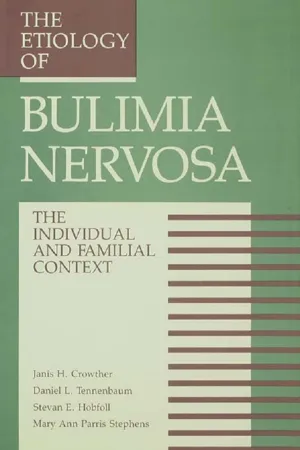
The Etiology Of Bulimia Nervosa
The Individual And Familial Context: Material Arising From The Second Annual Kent Psychology Forum, Kent, October 1990
- 252 pages
- English
- ePUB (mobile friendly)
- Available on iOS & Android
eBook - ePub
The Etiology Of Bulimia Nervosa
The Individual And Familial Context: Material Arising From The Second Annual Kent Psychology Forum, Kent, October 1990
About this book
This work reflects material covered at a psychology forum in 1990, striving to unite a psychopathalogical perspective on bulimia nervosa episodic food binging/purging with research on individual and family characteristics that might be precursors to developing eating disorders.
Information
1
EPIDEMIOLOGY OF BULIMIA NERVOSA
Bulimia nervosa has been the focus of considerable attention in both the scientific and popular literature since 1980 when it was introduced as a diagnostic entity in the third edition of the Diagnostic and Statistical Manual (DSM–III; American Psychiatric Association [APA], 1980). Among the cardinal features of bulimia nervosa are cyclical episodes of bingeing and purging (the latter including self-induced vomiting), laxatives, diuretics, and strict dieting or fasting to counteract the weight gain associated with excessive caloric consumption. Central to this disorder are the feelings of loss of control over eating during a binge and a persistent overconcern with weight and shape (APA, 1987).
Although eating disorders generally are thought to be characteristic of modern society, some evidence has shown that eating-disordered symptomatology existed during ancient and medieval times (Wilson, Hogan, & Mintz, 1983). During ancient times, the Egyptians believed that food was a predominant etiological factor in disease and, thus, deliberately purged on a monthly basis, and the Romans were renowned for their vomitoriums (Bliss & Branch, 1960). During the high Middle Ages, many young women, motivated by religious conviction, engaged in rigorous fasts of some duration, surviving by eating only tiny portions of food with enough nutritional value to sustain life (Brumberg, 1988). Although anorexia nervosa was recognized as a clinical entity during the late 1800s (Gull, 1873; Lasegue, 1873), one of the earliest descriptions of binge eating was offered by Stunkard in 1959. As reports of a syndrome characterized primarily by episodes of uncontrolled eating began emerging in the 1970s, various diagnostic terms were introduced, including compulsive eating (Ondercin, 1979), the dietary chaos syndrome (Palmer, 1979), bulimarexia (Boskind-Lodahl & Sirlin, 1977), bulimia nervosa (Russell, 1979), and bulimia (APA, 1980).
Most researchers agreed that bulimia nervosa is a complex psychological disorder with a multifactorial etiology (e.g., Johnson & Connors, 1987; Mizes, 1985). To understand its cause more clearly, models are needed that not only incorporate individual, familial, and sociocultural factors but also recognize that these factors, individually or in combination, may have differential effects in those young women who subsequently develop bulimia nervosa. By way of introduction, we address the following questions. First, how has the diagnosis of bulimia nervosa evolved? Second, what is the prevalence of bulimia nervosa among various populations? Finally, given that most young women today experience a sociocultural milieu that emphasizes the importance of physical attractiveness and a thin, tubular physique, how can we best begin to understand the roles of developmental, familial, and individual factors in increasing a young woman's vulnerability to this disorder?
BULIMIA NERVOSA: AN EVOLVING DISORDER
In the revision of DSM–III (DSM–III–R; APA, 1987), several changes were made in the diagnostic terminology and criteria for the eating disorders, particularly for bulimia nervosa. First, the diagnostic term bulimia was replaced with the term bulimia nervosa. At least one of the reasons for this change involved the confusion over the use of the term bulimia (Fairburn & Garner, 1986). It had been used interchangeably in the eating-disorder literature to refer both to the symptom of binge eating and the more severe clinical syndrome characterized by a constellation of symptoms including cyclical episodes of bingeing and purging (Fairburn & Garner, 1986). Yet the symptom of bulimia (referring to binge eating) is far more prevalent than the syndrome of bulimia (e.g., Crowther, Post, & Zaynor, 1985; Pyle et al., 1983); it occurs among underweight, normal-weight, and overweight populations (Wolf & Crowther, 1983); and in the absence of purging as an extreme weight-control method, the symptom of bulimia did not necessarily distinguish eating-disordered populations from normal-weight and overweight populations.
Second, although the diagnostic criteria of recurrent binge episodes and a feeling of lack of control over eating during a binge were maintained in DSM–III–R, the remaining DSM–III diagnostic criteria were eliminated. These included the individuals’ awareness that their eating patterns were abnormal, the presence of depression or self-deprecating thoughts after eating binges, and the presence of at least three of the following:
(1) consumption of high-caloric, easily ingested food during a binge; (2) inconspicuous eating during a binge; (3) termination of such eating episodes by abdominal pain, sleep, social interruption, or self-induced vomiting; (4) repeated attempts to lose weight by severely restrictive diets, self-induced vomiting, or the use of cathartics or diuretics; [or](5) frequent weight fluctuations greater than ten pounds due to alternating binges and fasts. (APA, 1980, pp. 70-71)
The original diagnostic criteria were criticized for being overinclusive primarily because of their emphasis on bulimia as a symptom of uncontrolled overeating as opposed to bulimia nervosa as a clinical syndrome (Fairburn & Garner, 1986). These criteria were also criticized for neglecting the extreme concerns about weight and shape and maladaptive weight-control measures including self-induced vomiting, the use of laxatives or diuretics, or rigid dieting or fasting, which are characteristic of clinical samples of bulimic individuals. Interestingly, under the DSM–III diagnostic criteria, an individual could receive a diagnosis of bulimia without ever engaging in repeated weight-control measures or without engaging in binge eating with any prescribed frequency. The current diagnostic criteria for bulimia nervosa have addressed these issues by requiring a minimum frequency of binge episodes, the regular use of extreme methods of weight control, and the presence of overconcern with body shape and weight (APA, 1987).
Currently, the DSM–III–R criteria for bulimia nervosa (APA, 1987) are as follows:
A. Recurrent episodes of binge eating (rapid consumption of a large amount of food in a discrete period of time).
B. A feeling of lack of control over eating behavior during the eating binges.
C. The person regularly engages in either self-induced vomiting, use of laxatives or diuretics, strict dieting or fasting, or vigorous exercise in order to prevent weight gain.
D. A minimum average of two binge eating episodes a week for at least three months.
E. Persistent overconcern with body shape and weight, (pp. 68-69)
A related issue involves the complicated interrelationship between bulimia nervosa and anorexia nervosa. Whereas bulimia nervosa is characterized by episodes of excessive overeating accompanied by a subjective loss of control, anorexia nervosa is an eating disorder whose central feature is the maintenance of extremely low body weight. Accompanying this refusal to maintain a normal weight are severe body-image disturbance, an intense fear of gaining weight, and amenorrhea (APA, 1987). Several lines of research raised questions regarding whether or not anorexia nervosa and bulimia nervosa represent clearly different forms of psychopathology. First, two anorectic subgroups have been identified: restricting anorexics, who exert excessive control over their caloric intake, and bulimic anorexics, who may engage in both bingeing and purging (e.g., Casper, Eckert, Halmi, Goldberg, & Davis, 1980; Garfinkel, Moldofsky, & Garner, 1980). Second, many bulimics report a history of anorexia nervosa (e.g., Vandereycken & Meerman, 1984). Finally, there is reason to believe that there are more similarities between bulimic anorexics and normal-weight bulimics than between restricting and bulimic anorexics (e.g., Wonderlich, this volume, ch. 6). Although distinctions between the two disorders often have been made historically on the basis of weight, research on the epidemiology of bulimia nervosa may need to pay particular attention to the differential diagnosis of these two disorders in the definition of a case.
EPIDEMIOLOGY OF BULIMIA NERVOSA
Methodological Issues
Over the past 10 years, much research has been generated in attempts to establish accurate prevalence rates for bulimia nervosa and associated bulimic behaviors. As Johnson and Connors (1987) noted:
Epidemiological studies are necessary to generate information concerning prevalence rates, variation of these rates in different populations, and identification of risk factors which increase the likelihood of developing the disorder. This information is vital for planning treatment and prevention strategies to meet the needs of the affected or at risk population. However, the information is all predicated on the ability to define what constitutes a “case” of the disorder and to distinguish clearly between “cases” and “normals.” (p. 14)
Unfortunately, epidemiological studies on bulimia have been plagued by problems of case definition. Primarily, two areas of controversy have had impact on case-definition problems in bulimia prevalence research. The first controversy relates to the definition of binge eating. Although most researchers agree that binge eating refers to the consumption of a large amount of food in a relatively short period of time, there is disagreement as to whether the subjective definition of binge eating should be operationalized in terms of the amount of food consumed or the length of time. Moreover, researchers varied in including loss of control over eating as part of the operational definition of binge eating (Pyle & Mitchell, 1986).
The second area of controversy in bulimia research relates to problems in choosing the proper inclusion criteria to define the bulimic syndrome (Pyle & Mitchell, 1986). With the inclusion of bulimia as a psychiatric disorder in the DSM–III (APA, 1980), uniform diagnostic criteria were introduced. However, many researchers viewed the DSM–III criteria as overly broad and used modified DSM–III criteria in their epidemiological research (e.g., Crowther et al., 1985; Pyle, Halvorson, Neuman, & Mitchell, 1986), most commonly including a frequency criterion and the use of extreme weight-control measures as cardinal features of this disorder. Finally, with the publication of DSM–III–R (APA, 1987), the syndrome was renamed bulimia nervosa, and the diagnostic criteria were changed. Thus, one reason for the wide differences in the reported estimates of the prevalence of bulimia may be differences in the criteria used.
In addition to definitional problems, other methodological limitations and inconsistencies have confounded the interpretation of prevalence data. These methodological problems have been grouped into three major categories: sampling issues, method of assessment, and scope of assessment (e.g., Connors & Johnson, 1987; Fairburn, 1984). Prevalence estimates may reflect significant differences among the subjects sampled. Different subject groups have included junior high, high school, and college students; attenders at various clinics; magazine readers; and women interviewed while shopping. In addition, there may be significant differences among apparently homogeneous samples on such variables as age, socioeconomic status, and racial composition. Other factors such as geographical location, size of community or school, and social climate may also create variability among samples (Connors & Johnson, 1987). Additional sampling issues relate to external validity. That most prevalence studies have been conducted on student populations in the United States seriously limits generalizability. Moreover, in some studies, it is open to question whether the samples have been representative of the populations from which they were drawn (Fairburn, 1984). This is particularly a factor in studies with relatively low return rates on questionnaires in which no follow-up was conducted to determine who was noncompliant and why (Connors & Johnson, 1987).
Numerous researchers highlighted problems in methods of assessment. Pyle and Mitchell (1986) noted that although prevalence studies should involve the administration of a standardized, validated questionnaire to a sample representative of the general population, ideally through a structured interview, most prevalence studies have been limited to the use of self-report questionnaires. Self-report questionnaire studies are limited by a number of problems including the fact that researchers must select wording that subjects will understand and that correctly represents the diagnostic criteria. Questionnaires are often limited ...
Table of contents
- Cover Page
- Half Title page
- Series Page
- Title Page
- Copyright Page
- Dedication
- Contents
- Contributors
- Preface
- Acknowledgments
- 1 Epidemiology of Bulimia Nervosa
- Developmental and Familial Factors
- Individual Factors
- Future Directions
- Index
Trusted by 375,005 students
Access to over 1.5 million titles for a fair monthly price.
Study more efficiently using our study tools.
Frequently asked questions
Yes, you can cancel anytime from the Subscription tab in your account settings on the Perlego website. Your subscription will stay active until the end of your current billing period. Learn how to cancel your subscription
No, books cannot be downloaded as external files, such as PDFs, for use outside of Perlego. However, you can download books within the Perlego app for offline reading on mobile or tablet. Learn how to download books offline
Perlego offers two plans: Essential and Complete
- Essential is ideal for learners and professionals who enjoy exploring a wide range of subjects. Access the Essential Library with 800,000+ trusted titles and best-sellers across business, personal growth, and the humanities. Includes unlimited reading time and Standard Read Aloud voice.
- Complete: Perfect for advanced learners and researchers needing full, unrestricted access. Unlock 1.5M+ books across hundreds of subjects, including academic and specialized titles. The Complete Plan also includes advanced features like Premium Read Aloud and Research Assistant.
We are an online textbook subscription service, where you can get access to an entire online library for less than the price of a single book per month. With over 1.5 million books across 990+ topics, we’ve got you covered! Learn about our mission
Look out for the read-aloud symbol on your next book to see if you can listen to it. The read-aloud tool reads text aloud for you, highlighting the text as it is being read. You can pause it, speed it up and slow it down. Learn more about Read Aloud
Yes! You can use the Perlego app on both iOS and Android devices to read anytime, anywhere — even offline. Perfect for commutes or when you’re on the go.
Please note we cannot support devices running on iOS 13 and Android 7 or earlier. Learn more about using the app
Please note we cannot support devices running on iOS 13 and Android 7 or earlier. Learn more about using the app
Yes, you can access The Etiology Of Bulimia Nervosa by Janis H. Crowther, Stevan E. Hobfoll, Mary A. Stephens, Daniel L. Tennenbaum, Janis H. Crowther,Stevan E. Hobfoll,Mary A. Stephens,Daniel L. Tennenbaum in PDF and/or ePUB format, as well as other popular books in Psychologie & Psychopathologie. We have over 1.5 million books available in our catalogue for you to explore.