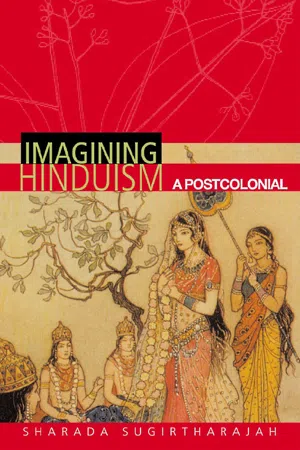
Imagining Hinduism examines how Hinduism has been defined, interpreted and manufactured through Western categorizations, from the foreign interventions of eighteenth and nineteenth-century Orientalists and missionaries, to the present day. Sugirtharajah argues that ever since early Orientalists 'discovered' the ancient Sanskrit texts and the Hindu 'golden age', the West has nurtured a complex and ambivalent fascination with Hinduism, ranging from romantic admiration to ridicule. At the same time, Hindu discourse has drawn upon Orientalist representations in order to redefine Hindu identity.
As the first comprehensive work to bring postcolonial critique to the study of Hinduism, this is essential reading for those seeking a full understanding of Hinduism.
- 192 pages
- English
- ePUB (mobile friendly)
- Available on iOS & Android
eBook - ePub
About this book
Information
Chapter 1
William Jones
Making Hinduism safe
All I need to do is make a few alterations. I can add the right words here and there, and I can cut out the offending ones.(Sijie 2001: 78)
William Jones (1746–94), an exceptionally gifted Welshman of his time, occupies a distinctive place in the study of British orientalism. His oriental pursuits began even before he set foot on Indian soil in 1783. Born in London in 1746, and a product of Harrow and of University College, Oxford, Jones rapidly gained linguistic proficiency in diverse classical languages such as Latin, Greek, Hebrew, Arabic, and Persian. Later he learned Sanskrit in India, mainly for administrative purposes. He is known for a language (Sanskrit) that he was not initially keen to learn but found himself falling in love with. He is best known, however, for his “discovery” of an Indo-European family of languages, drawing attention to the close resemblances between Sanskrit and the classical languages of Europe.1 His published works include the translation of the Persian History of Nader Shah into French (1770) and English (1773), and the Grammar of the Persian Language (1771). Among his translations, two stand out: Kālidāsa’s Sanskrit play Ṥakuntalᾱ (1789),2 which made a profound impact on Europe, and The Institutes of Hindu Law: or, the Ordinances of Menu (or Manu; completed and published after Jones’ death as A Digest of Hindu Law on Contracts and Successions), intended for the use of English judges in India. Jones was more than a linguist – he was a polymath, a man of extraordinary talents and wideranging interests that included music, poetry, philology, religion, botany, astronomy, history, politics, and law.3
Jones turned to the Bar in 1770 in order to make himself financially independent. It was law rather than his quest for the Orient that led him to India. He set off for the subcontinent in 1783 to take up a judgeship in the Calcutta Supreme Court. As with many middle-class gentlemen of his time, Jones went to India to improve his financial prospects with the intention of eventually returning to England with his wife Anna Maria, to a peaceful retired life on a country estate. Sadly, he died in 1794, at the age of 47, before he could realize his dreams.
Jones arrived in Bengal at a time when the colonial grip on India was being strengthened under the governorship of Warren Hastings, himself a scholaradministrator. Although imperialism was not the prevailing ethos at this time, a colonial government was being formed. In the late eighteenth century (between 1772 and 1792), under the governorship of Warren Hastings, Bengal witnessed the production of orientalist knowledge for the needs of the colonial government. Hastings initiated the study and translation of Hindu texts such as The Laws of Manu4 in the belief that an accurate knowledge of India and Hindu manners and customs could be gained from ancient Sanskrit texts. Even before the arrival of “Oriental Jones,” Warren Hastings’ Judicial Plan of 1772 had clear rules regarding the governance of natives, namely that the natives ought to be governed and protected by their own laws which were to be found in their sacred texts rather than in local customs.5 Hindu legal texts thus became the object of study and investigation. Hardly had Jones arrived in India than he was appointed the first President of the Asiatic Society in 1784 in Calcutta, with Warren Hastings as its patron, thus initiating the process of studying, translating, and codifying Hindu texts. With the formal establishment of the Asiatic Society, orientalism was becoming a corporate enterprise. The works of scholar-administrators came to be published in the prestigious journal of the Society, Asiatick Researches, thereby making them available to a wider audience. The orientalist project initiated what came to be known as “oriental renaissance” (Schwab 1984).
Jones was the product of an eighteenth-century England which valued “reason,” yet there was in him a romantic yearning for the “primitive” and “natural” that finds expression in his poetry. As well as being a product of the Enlightenment he was a precursor of the Romantic movement in that his works were a major source of inspiration for romantic orientalism.6 The New Oxford Book of Romantic Period Verse begins with Jones’ prefatory note to “A Hymn to Na’ra’yena,”7 followed by his invocation to the deity, thus emphasizing the significance of his works for Romanticism (McGann 1993: xxi–xxii).
My main concern in this chapter is with the hermeneutical factors at work in Jones’ construction and appropriation of Hinduism in his writings. This chapter draws on Jones’ various “Anniversary” discourses and essays from the 1799 six-volume edition of The Works of Sir William Jones 8 as well as his letters. I discuss Jones’ representation of Hinduism under three headings: Romantic Jones, Biblical Jones and Juridical Jones. These three categories are not mutually exclusive, rather they impinge on one another.
Biblical Jones
“Gods of Indian and European heathens”
In his seminal essay “On the Gods of Greece, Italy and India,” written soon after his arrival in India in 1784, Jones renders the Other in categories familiar to the West. He draws classical analogies between the mythologies and religious practices of the Greco-Roman and the Hindu world. What Jones is trying to demonstrate is that Europeans are not encountering a strange culture but their own culture in its primitive form. In other words, Europeans are rather rediscovering their own pagan past in Hinduism.
Jones’ thesis is that there is a great likeness between the popular worship of Hindus and Europeans; both share similar characteristics, namely polytheism, but the difference is that while Europeans have progressed from idolatry to biblical monotheism, Hindus are stuck in their primitive state. Jones’ theory of common origins allows him to compare and contrast cultures without being intimidated by them, yet at the same time to affirm the primacy of Christianity. He perceives Indians and Europeans as sharing a common ancestry (descendants of the biblical Noah). However, having migrated from a common center (Iran) to different destinations, they had departed from the rational religion or what Jones calls “the rational adoration of the only true God” which is clearly the monotheistic God of the Bible. In his essay “On the Gods of Greece, Italy and India,” Jones remarks:
We cannot justly conclude, by arguments preceding the proof of facts, that one idolatrous people must have borrowed their deities, rites, and tenets from another; since Gods of all shapes and dimensions may be framed by the boundless powers of imagination, or by the frauds and follies of men, in countries never connected; but, when features of resemblance, too strong to have been accidental, or observable in different systems of polytheism, without fancy or prejudice to colour them and improve their likeness, we can scarce help believing, that some connection has immemorially subsisted between several nations, who have adopted them: it is my design in this essay, to point out such a resemblance between the popular worship of the old Greeks and Italians and that of the Hindus; nor can there be room to doubt of a great familiarity between their strange religions and that of Egypt, China, Persia … From all this, if it be satisfactorily proved, we may infer a general union or affinity between the most distinguished inhabitants of the primitive world, at the time when they deviated, as they did too early deviate, from the rational adoration of the only true God.(1799a: 229–30)
Jones is not dismissive of the Hindu pantheon of gods and goddesses but sees them as a sign of a primitive state common to many nations. He uses the term “heathen” both for Hindus and Europeans, to indicate their unrefined state. In fact, he does not see much difference between what he calls the “Gods of the Indian and European heathens.” He states that “in one capacity or another, there exists a striking similitude between the chief objects of worship in ancient Greece or Italy and in the very interesting country, which we now inhabit” (Jones 1799a: 232).9 He draws attention to the resemblances between Gaṇeśa and Janus, Manu and Saturn, Ceres and Lakṣmῑ, Jupiter and Indra, Śiva and Zeus, Durgā and Venus, Pārvatῑ and Juno, Rāma and Dionysus, and so forth. For Jones, both Hindu and Greco-Roman gods and goddesses are the products of imagination rather than of rational thought. Being in their primitive state, both Hindu and European “heathens” are not as yet capable of exercising their rational faculties. The outcome is that the biblical truth has been distorted into fable by imagination (ibid. 230). As Balagangadhara points out:
Generally, the eighteenth-century thinkers argued that the origin of religion – especially the primitive or the heathen ones – had to do with the fact that they, the “others,” hypostatized natural forces into gods with human and semi-divine attributes and embellishments, and thus inventing their pantheon. Being not yet capable of rational and abstract thinking, the early man used the fanciful imagination that he was endowed with. This was at the root of those fantastical creations and absurd stories that constituted his religious world. These mythologies… are the products of “mythical thought,” standing opposed to which is “rational” or “scientific” thought.(1994: 132)
For Jones, Hinduism has more to do with imagination than with reason but this does not lead him to conclude that it is a false religion, although occasionally he refers to Hinduism as an “erroneous religion” (Jones 1799b: 22). He finds in it a less refined version of biblical truth. This does not imply that Hinduism is morally corrupt but only that it is still in a state of infancy. Unlike most missionaries of the time, Jones does not associate Hindu worship of deities with moral depravity. For William Ward, the Hindu god Kṛṣṇa appears a “lascivious character” who is detrimental to the moral health of his worshippers, whereas in his letter to Charles Wilkins (Cannon 1970: 652) Jones speaks of being “charmed with Crishen.”10 Jones’ sympathetic attitude is the outcome of his hypothesis that Hindus are still in a state of of childhood – yet to grow out of their wild imagination and innocence. Therefore it does not make any sense to attribute the worship of images to their moral degeneration. He remarks: “It never seems to have entered the heads of the legislators or people that anything natural could be offensively obscene; a singularity, which pervades all their writings and conversation, but is no proof of the depravity in their morals” (Jones 1799a: 261).11 For Jones, Hindus are like the Israelites who needed rituals and ceremonies because of their childlike- ness. With the full manhood in the form of Jesus, these rituals are made superfluous.
Primitive monotheism to biblical monotheism
As we have seen, Jones identifies in the ancient texts of Hindus a distorted monotheism. Biblical monotheism functions as the one rational and enlightened faith to which all belong but migration to various places resulted in departure from the monotheism of the biblical religion. Jones is concerned to recover the “ancient purity” (Jones 1799a: 23)12 contained in ancient Sanskrit texts, for they alone contain the uncontaminated monotheism. As Balagangadhara points out: “The rediscovery of India and its culture meant a discovery of an ancient culture, which was contemporaneous with the modern one. The ancients were not dead but merely found living in another part of the world. These ancients … represented the childhood of man” (Balagangadhara 1994: 132). In other words, Romantic thinkers who saw Indian culture as representing the infancy of European culture, “did not go beyond or against the Enlightenment tradition – but merely extended it with a fanciful twist” (ibid.: 133). While European civilization had matured, Indian culture was still in its early stages. Its growth had stagnated and thus it became comparable with the dead Greek and Roman cultures. India’s past was important for Europe’s definition of its own identity. If at all there was any trace of purity in Hinduism, it was located in the Veda, and this came to be seen as the true “Hinduism” while the present was seen as a distortion of the past. Placing the Veda within the biblical time scheme, Jones was trying to demonstrate that the Veda was the earliest declaration of undiluted monotheism. As Trautmann points out: “It was specifically within a short biblical time-frame that India and the Veda acquired their heightened significance for Europeans as a window upon the original condition of mankind and of ancient wisdom” (Trautmann 1997: 193). Having securely situated Hindu texts within the biblical time-framework, Jones felt free to interact with them. They were not to be discarded as they revealed the primitive state of Europeans in their bygone days.
Hindu texts made secure
Jones’ discovery of an Indo-European family of languages and shared origins meant that India and Europe were strangers no more. While this discovery disturbed the Western world, it led Jones and other orientalists to explore India and Sanskrit literature with great enthusiasm. It also meant that the antiquity of Hindu sacred literature could now be explained and affirmed without feeling intimidated or being put off by its strangeness. Jones, who subscribed to the biblical scholarship of the time that regarded biblical events as historical facts, saw the Book of Genesis as the definitive record of the history of the world, and regarded Moses as the first historian. This view of Genesis led Jones to place Hindu texts such as the Vedas, the Bhāgavata Purāṇa and Manu’s Dharmaśāstra within the biblical framework (1799a: 245).13 What Jones was implying was that these texts were important not so much for their own merits as for their validation of Christianity. Once he had established the primacy of biblical history, Jones was comfortable with Hindu texts. To put it differently, they were not seen as a threat to Christianity but as endorsing or corroborating biblical truth. Now that Hindu texts were divested of their independent agency, they were not impenetrable; they had been made safe, especially for Christians. For Jones, Hindu texts were not totally corrupt as William Ward (whom we will encounter later) perceived them. Rather, Hindu texts verifed for Jones the truth and primacy of the biblical revelation.
Hindu chronology through a biblical lens
One of the characteristics of colonialism is that it deprives the natives of their own sense of time and reinscribes time in terms of the colonizer’s version of it. Jones divests Hindu chronology of its own lengthy time-sequence by “semitizing” it to suit his own conclusions. Eighteenth-century Western orientalists constructed Hindu notions of time and history largely from selective texts such as the Mahābhārata, Purāṇas and the Dharmaśāstra (Thapar 1996: 1).14 Jones sees the Hindu concept of yugas through a biblical lens, thus reducing vast spans of time in order to show that Hindu chronology before Genesis can have no real significance. Jones does not dismiss the history of Hindus as of no significance. Now, having situated it within the Semitic framework, he believes it is possible to get glimpses of Hindu history, however fragmentary, from the Sanskrit literature which has been uncovered by the West. In the light of such an interpretative framework, anything before Genesis can have only metaphorical importance. Jones considers the biblical Flood, narrated by Moses, as the commencement of Hindu chronology. He compares the story of the flood in the Bhāgavata Purāṇa with the story of the universal flood in the Bible. Manu is warned of an impending flood and was saved by LordViṣṇu in his matsya-avatāra (fish incarnation). Manu and seven sages board a boat which is fastened to a horn on the fish’s head, and are towed safely to the mountain top. When the the flood subsides, new creation begins. For Jones the story of Manu “seems evidently to be that of NOAH disguised by Asiatick fiction” (Jones 1799a: 237).15 Manu is none other than the Noah of the Bible. Jones places the Purāṇic flood narrative within the biblical time-span, thus maintaining the primacy of biblical chronology:
This epitome of the first Indian History, that is now extant, appears to me very curious and very important; for the story, though whimsically dressed up in the form of an allegory, seems to prove a primeval tradition in this country of the universal deluge described by MOSES, and fixes consequently the time, when the genuine Hindu Chronology actually begins.(Jones 1799a: 241–2)16
According to one of the four sources of Hindu mythology outlined by Jones, “Historical, or natural, truth has been perverted into fable by ignorance, imagination, flattery, or stupidity” (ibid.: 230).17 The implication is that while the universal deluge is historical, the flood story in the Purāṇas is a distorted version of the historical truth embedded in the Bible. Jones appropriates the flood story to suit his conclusions, which is that biblical history is the reliable starting point of any meaningful understanding of history. It should not therefore be surprising to find the biblical narrative perverted in the Purāṇas. Attributing the story of creation in Manu’s Dharmaśāstra to Christian sources, Jones compares the opening passage of Genesis with Manu’s account of creation, in order to establish the primacy of the biblical version of creation. Jones remarks:
That water was the primitive element and first work of the Creative Power, is the uniform opinion of the Indian philosophers; but, as they give so particular account of the general deluge and of the Creation, it can never be admitted, that their whole system arose from traditions concerning the flood only, and must appear indubitable, that their doctrine is in part borrowed from the opening of the Birásit or Genesis …(1799a: 250–7)18
In his view, the sublimity of the Genesis account is greatly affected “by the Indian paraphrase of it, with which MENU, the son of BRAHMA, begins his address to the sages who sought to know h...
Table of contents
- Cover Page
- Title Page
- Copyright Page
- Acknowledgements
- Introduction
- Chapter 1 William Jones
- Chapter 2 Max Müller
- Chapter 3 William Ward’s “virtuous Christians, vicious Hindus”
- Chapter 4 Decrowning Farquhar’s Hinduism
- Chapter 5 Courtly text and courting satῑ
- Chapter 6 Conclusion
- Notes
- Bibliography
Trusted by 375,005 students
Access to over 1.5 million titles for a fair monthly price.
Study more efficiently using our study tools.
Frequently asked questions
Yes, you can cancel anytime from the Subscription tab in your account settings on the Perlego website. Your subscription will stay active until the end of your current billing period. Learn how to cancel your subscription
No, books cannot be downloaded as external files, such as PDFs, for use outside of Perlego. However, you can download books within the Perlego app for offline reading on mobile or tablet. Learn how to download books offline
Perlego offers two plans: Essential and Complete
- Essential is ideal for learners and professionals who enjoy exploring a wide range of subjects. Access the Essential Library with 800,000+ trusted titles and best-sellers across business, personal growth, and the humanities. Includes unlimited reading time and Standard Read Aloud voice.
- Complete: Perfect for advanced learners and researchers needing full, unrestricted access. Unlock 1.5M+ books across hundreds of subjects, including academic and specialized titles. The Complete Plan also includes advanced features like Premium Read Aloud and Research Assistant.
We are an online textbook subscription service, where you can get access to an entire online library for less than the price of a single book per month. With over 1.5 million books across 990+ topics, we’ve got you covered! Learn about our mission
Look out for the read-aloud symbol on your next book to see if you can listen to it. The read-aloud tool reads text aloud for you, highlighting the text as it is being read. You can pause it, speed it up and slow it down. Learn more about Read Aloud
Yes! You can use the Perlego app on both iOS and Android devices to read anytime, anywhere — even offline. Perfect for commutes or when you’re on the go.
Please note we cannot support devices running on iOS 13 and Android 7 or earlier. Learn more about using the app
Please note we cannot support devices running on iOS 13 and Android 7 or earlier. Learn more about using the app
Yes, you can access Imagining Hinduism by Sharada Sugirtharajah in PDF and/or ePUB format, as well as other popular books in Théologie et religion & Historiographie. We have over 1.5 million books available in our catalogue for you to explore.