This text was developed as a manual for those employed in the emergency services ESP, those who deal with victims of trauma in the workplace, work in school systems or acute psychiatric settings, provide assistance to ESP, or who are employed in other settings where persons may experience trauma. The book can also be used by mental health workers as they conduct workshops or provide debriefings where trauma has occured.
Visit www.geraldlewis.com for more information.
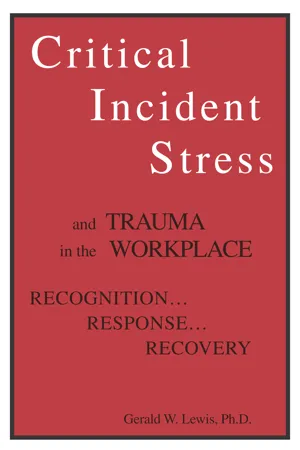
eBook - ePub
Critical Incident Stress And Trauma In The Workplace
Recognition... Response... Recovery
- 144 pages
- English
- ePUB (mobile friendly)
- Available on iOS & Android
eBook - ePub
Critical Incident Stress And Trauma In The Workplace
Recognition... Response... Recovery
About this book
Information
Chapter 1
Understanding Stress and Stress Management
The word “stress” has been around for a long time, but it has certainly become a buzzword since the 1980s. In Webster’s International Dictionary, we find a definition of stress: “A physical, chemical or emotional factor that causes bodily or mental tension and may be a factor in disease causation.” Simply translated: Stress may hurt us, contributing to our becoming physically as well as mentally ill.
General Concepts of Stress
The research that has resulted in stress becoming such a buzzword is veiy extensive as well as conclusive and may be summarized in seven concepts:
- Stress is a by-product of any change.
- Since there are different types of changes that we experience, there are different types of stress; loosely defined as good stress (eustress) and bad stress (distress).
- Not all stress is harmful. We need stress in our lives in order to feel fulfilled, excited, challenged, and ultimately satisfied.
- Different individuals have varying degrees of tolerance for different types of stress and may perceive the same event(s) with differing amounts of stress.
- Long-term distress is damaging to one’s emotional and physical well-being.
- Different professions have more stress than others and therefore may be considered more hazardous.
- We have much control over the impact of stress in our daily lives; however, we generally choose not to exercise this control.
Biological Relationships
Let’s take a brief sojourn into introductory biology. This may seem rather basic to many of you, but please bear with me.
The human body, and all its functions are controlled by two parts of the Central Nervous System (CNS). One part, the parasympathetic nervous system, controls the voluntary, conscious aspects of bodily functioning: moving limbs, speaking words, reading, singing, dancing, etc. The other component, the sympathetic nervous system, controls all of the nonvoluntary, unconscious bodily functions such as heart rate, respiration, blood vessel dilation, hormonal secretion, digestion, etc. This latter system is considered very primitive, dating back to a time when we were still running through the jungles and swinging through the trees. It is the part of the brain that we have in common with the monkeys, apes, dogs, etc. It is an internal mechanism that keeps our bodies functioning at the correct RPMs for whatever task we need to perform. It is the system that promotes the fight or flight response.
For thousands of years, this part of our central nervous system was extremely important and well-utilized as humans found themselves in situations that required that they either fight or flee. This part of the CNS would kick in automatically with very little conscious thought. Since it operates primarily on sensory stimulation, which is connected to the most primitive part of the brain, all it would take is the sight of an enemy or the smell of a large dangerous animal, and the individual’s body instinctively would downshift into overdrive. Likewise, this system also has a braking mechanism in order to slow down the process.
As the human species has become more civilized and domesticated, we are no longer in many situations that allow the expression of the fight of flight response. However, because it is nonvoluntaiy, unconscious, and connected to the primitive part of the brain, the sympathetic nervous system is still functional. We now find ourselves in situations where we have to suppress the response because to allow its expression might result in severe repercussions. Nevertheless, the internal unconscious adjustments and changes continue to go on even though the external action is suppressed. One might say that it is the equivalent to putting your car in drive and depressing the gas pedal while keeping on the emergency brake. All of the previously mentioned functions continue: heart rate, respiration, digestion, hormonal secretion, perspiration, neurotransmitter production, etc.
Let’s look at what happens to an animal that is feeling threatened, about to get into a fight, or needs to flee from an enemy. The following takes place concurrently in a matter of a moment in the form of a reflexive unconscious response. Anyone who has a cat or dog will be familiar with the following scenario.
- Adrenalin gets pumped into the blood system along with a higher level of blood glucose. This acts as a supercharge or turbo boost to the entire physiological system.
- The stomach secretes more digestive juices in order to process any remaining food and transform it into needed energy/fuel. As part of this process, the animals excretory functions increase in order to be rid of excess baggage that may slow it down.
- The heart and lungs start to increase their functioning. Breathing becomes shallow as well as rapid while the heart pumps blood at a more rapid rate.
- Peripheral blood vessels constrict and blood is directed away from the extremities (hands, arms, legs, feet) and into the internal organs. Once again, in the case of a fight, this is an appropriate response because it limits the bleeding that may be caused by cuts or bites to the limbs. It also lessens the pain from such contact because a numbness and coldness develops as a result of constricted blood supply.
- The animal begins to sweat, drool, and secrete bodily fluids which, makes it slippery and difficult to grasp.
- Concentration decreases while attention increases. Colloquially, we tend to use these two terms interchangeably; however, they are actually the opposite of one another. When one is concentrating, there is a sense of being focused on one stimulus: absorbed by one task. There is a limited awareness of extraneous stimuli that may distract from one’s concentration. Attention is a state of hypervigilence: an increase in the sensitivity of the radar system. The animal quickly picks up movements, sounds, smells, etc. The ability to focus on one stimulus is diminished because the animal is attending to a variety of potential warning signals.
- Muscle tone is enhanced; there is a muscle tension and a heightened state of arousal. The animal is poised for action.
You may be wondering why I have gone through this rather graphic scenario. It is an example of what occurs as a function of the fight or flight response as an organism prepares to protect itself. It is also what happens for humans on a regular basis day in and day out. These also are the symptoms of an anxiety attack (see Figure 1).

Figure 1. Symptoms of the fight or flight response.
The preceding symptoms are what lead to ulcers, hypertension, headaches, muscle tension, and fatigue and a variety of other stress-related illness. The following is a quote from Lawrence and Lawrence in Nursing Forum, #2, 1987–88, Vol. 23, pp. 45–51, that describes some of the process in physiological detail:
Initially there is a sympathetic alarm response with intense vaso-constriction due to increased catecholamines. Anger causes a greater increase in norepinephrine than in epinephrine, possibly resulting in palpitations because of increased heart rate and the force of contractions. Vascular headaches may develop as a result of high blood pressure.
There may be an elevated blood sugar as an adaptive response to meet the increased energy needs.
Since stress is primarily psycho-cognitive in origin, the excess blood sugar may not be utilized and may trigger the secretion of an excess amount of insulin which causes stress hypoglycemia. This over time causes fatigue, nervousness, irritability and motor agitation.
Stress in Life
Hans Selye (1978), considered the Pioneer of Stress, has researched and written extensively on the subject. The following is information gathered from his book entitled, The Stress of Life.
Stress is a by-product of change. Stress is caused whenever a demand is placed upon us, be it a physical, emotional or mental event in our lives. Figure 2 is a schematic representation of the impact of stress.

Figure 2. Diagram of stressor, stress, and strain.
A stressor is any event that places a demand upon the human organism. Over time, stress will develop as a result of this demand and will lead to a psychological and physiological response, usually precipitating a fight or flight response. If this stress is not resolved, strain, the wear and tear of unresolved stress, will develop.
Further, any stressor/event may be categorized as one of three types:
FRUSTRATION—The prevention of achieving a goal: one’s needs not being met. This type of stress tends to be experienced as generating from an external source (i.e., a supervisor, spouse, etc.). An example is when an individual wishes to purchase an item, but his/her spouse says that they cannot afford it.
CONFLICT—Tension generated by incompatible inner needs or drives. It is derived from feelings within ourselves when we want to achieve two or more competing goals. This is often referred to as “role conflict.” An example of role conflict would be the individual who would like to work overtime, but feels conflicted because it takes away from time with the family, or the supervisor who wants to be liked by his/her staff but must put pressure on them to work longer hours.
PRESSURE—The necessity or urgency of matters demanding immediate attention and needing to be accomplished rapidly and/or accurately.
Of course what is clear is that most stressors /events provide us with a combination of all three types of stress in varying proportionality.
In my workshops, I often conduct a demonstration in which I ask a man in the audience to volunteer as a subject. When the man approaches the front of the room, I ask his name, where he works, if he is married, has kids, etc. I then tell him to relax. Telling someone to relax while he is standing in front of a large audience not knowing what is to be expected is an example of an emotional stressor: receiving two conflicting and mixed messages. Further, telling someone to relax automatically makes it a command and, therefore, a demand and, hence, a stressor. I then proceed to drape my arm over his shoulders and lean on him with about 30 to 40 pounds of pressure. I have now generated a physical stressor in combination with the emotional stressor(s). I then ask the audience to describe what they witness the individual doing in response to my stressors; they usually report that the individual makes bodily movements in order to accommodate my weight. Often this bodily change is accompanied by a change of facial expression indicating either annoyance, humor, embarrassment, or a variety of other emotions. As an example of strain, I ask the audience to describe what they think would happen if we were to stay like this for about two hours. To further develop the demonstration, I ask them to imagine that I am a woman leaning on the subject. Further, instead of being in front of an audience in a brightly lit auditorium, imagine that we are now in a dimly lit lounge. And further yet, imagine that he is single… or married… or that his wife is across the room.
The purpose of this part of the performance is to demonstrate that what may be stressful to one person may be experienced veiy differently by another individual who has had different life experiences.
Remember, Stress is not Just an Event but More Importantly One’s Perception of and Associations to the Event.
Estimates are that at any given time approximately 15% to 20% of the work force is undergoing enough personal stress in their lives that it may impact upon their job performance. For any individual, the estimate is that once every seven years an accumulation of natural, significant life events may occur that may deeply affect him/her: births, deaths, marriages, marital problems, aging/ill parents, problematic children, work stress, money concerns, health issues. These are just a few of the many items on the stress menu that potentially may impair one’s personal life and/or job performance.
These are all natural life events, most of which cannot be avoided. When we think of our physical and emotional selves, it is similar to buying a car. No matter how shiny and new the car is when it leaves the showroom, there is no way to avoid all the dents, scratches, squeaks, and rust spots that will develop over the course of normal usage.
The general agreement among most health professionals is that stress leads to physical problems. The estimate is that close to 60% of visits to physicians are precipitated by stress-related conditions. This is not to say that “it is all in his/her head”; rather, the physical conditions are legitimate medical problems that have been exacerbated by unresolved stress.
Experts agree that stress is cumulative; an individual may be unaffected for years, but the stress gradually builds until it starts to take its toll in any number of ways. “Diseases of adaptation” are not the direct result of an external agent but rather the consequence of the body’s imperfect attempt to adapt to the wide variety of stressors. All of us come into this world with some component of our body that is more vulnerable than others to the effects of stress. For some it is an organ of the gastrointestinal tract and stress may result in ulcers, colitis, or spastic colon. For others it may be the respiratory system with impairments such as asthma. For still others it may be that the blood vessels in the cranium are arranged in such a way that stress leads to headaches. Some people manifest the effects of stress as emotional difficulties. The stress impacts upon neurotransmitter and hormonal production, leading to anxiety, depression, and anger. It behooves all of us to recognize that all parts of our body/mind are not built with equal quality control and that the human organism...
Table of contents
- Cover
- Title Page
- Copyright
- Contents
- Dedication
- Preface
- List of Figures
- 1. Understanding Stress and Stress Management
- 2. Critical Incident Stress (CIS)
- 3. Description of “At Risk” Occupations
- 4. Post-Traumatic Stress Disorder (PTSD)
- 5. Dynamics and Definitions Involved with Different Types of Crises
- 6. Critical Incident Stress Response (CISR): Strategies and Interventions to Deal with CIS
- 7. Reactions of Others
- 8. Trauma and Crisis in the Workplace
- 9. Guidelines for Conducting Debriefings (and Other Types of Interventions)
- 10. Crises in School Settings
- Bibliography
- Index
- About the Author
- Abbreviations
Trusted by 375,005 students
Access to over 1.5 million titles for a fair monthly price.
Study more efficiently using our study tools.
Frequently asked questions
Yes, you can cancel anytime from the Subscription tab in your account settings on the Perlego website. Your subscription will stay active until the end of your current billing period. Learn how to cancel your subscription
No, books cannot be downloaded as external files, such as PDFs, for use outside of Perlego. However, you can download books within the Perlego app for offline reading on mobile or tablet. Learn how to download books offline
Perlego offers two plans: Essential and Complete
- Essential is ideal for learners and professionals who enjoy exploring a wide range of subjects. Access the Essential Library with 800,000+ trusted titles and best-sellers across business, personal growth, and the humanities. Includes unlimited reading time and Standard Read Aloud voice.
- Complete: Perfect for advanced learners and researchers needing full, unrestricted access. Unlock 1.5M+ books across hundreds of subjects, including academic and specialized titles. The Complete Plan also includes advanced features like Premium Read Aloud and Research Assistant.
We are an online textbook subscription service, where you can get access to an entire online library for less than the price of a single book per month. With over 1.5 million books across 990+ topics, we’ve got you covered! Learn about our mission
Look out for the read-aloud symbol on your next book to see if you can listen to it. The read-aloud tool reads text aloud for you, highlighting the text as it is being read. You can pause it, speed it up and slow it down. Learn more about Read Aloud
Yes! You can use the Perlego app on both iOS and Android devices to read anytime, anywhere — even offline. Perfect for commutes or when you’re on the go.
Please note we cannot support devices running on iOS 13 and Android 7 or earlier. Learn more about using the app
Please note we cannot support devices running on iOS 13 and Android 7 or earlier. Learn more about using the app
Yes, you can access Critical Incident Stress And Trauma In The Workplace by Gerald W. Lewis in PDF and/or ePUB format, as well as other popular books in Social Sciences & History & Theory in Psychology. We have over 1.5 million books available in our catalogue for you to explore.