- 216 pages
- English
- ePUB (mobile friendly)
- Available on iOS & Android
eBook - ePub
About this book
Are you saying one thing whilst your hands reveal another?
Are you influenced by other people's body language without even knowing it?
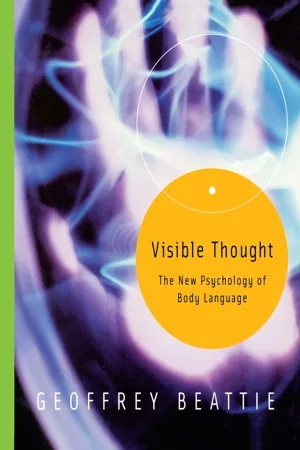
Darting through examples found anywhere from the controlled psychology laboratory to modern advertising and the Big Brother TV phenomenon, official Big Brother psychologist Geoffrey Beattie takes on the issue of what our everyday gestures mean and how they affect our relationships with other people. For a long time psychologists have misunderstood body language as an emotional nonverbal side effect. In this book Geoffrey Beattie ranges across the history of communication from Cicero to Chomsky to demonstrate that by adding to or even contradicting what we say, gestures literally make our true thoughts visible. A unique blend of popular examples and scientific research presented in language that everybody can understand, Visible Thought is an accessible and groundbreaking text that will appeal to those interested in social psychology and anyone who wants to delve beneath the surface of human interaction.
Geoffrey Beattie is the official Big Brother psychologist and Professor at the Department of Psychology, University of Manchester. He is a recipient of the Spearman Medal awarded by the British Psychological Society for 'published psychological work of outstanding merit'.
Information
Subtopic
Social PsychologyIndex
PsychologyIntroduction: Big Brother and other experiments | 1 |
In this book I am going to present a new theory of bodily communication, or at least of an important part of bodily communication, namely the movements of the hands and arms that people make when speaking. I will argue that such movements are not part of some system of communication completely divorced from speech, as many psychologists have assumed, rather they are intimately connected with speaking and with thinking. Indeed these movements of the hands and arms reflect our thinking, like language itself but in a completely different manner. I will argue that such behaviours provide us with a glimpse of our hidden unarticulated thoughts. Movements of the hands and arms act as a window on the human mind; they make thought visible.
This is a new theory in psychology, which owes much to the pioneering work of the American psychologist David McNeill, but as the Big Brother psychologist I have taken this theory and applied it to examples of behaviour from the Big Brother house for millions to see. Many seemed to like the basic idea and agreed that my interpretations of unarticulated thoughts were at least plausible, but what was the scientific value of this new theory? Where did the theory come from? How had it been tested? Were there other possible explanations for the unconscious movements of the hands and arms as people speak? In a television show you are not afforded opportunities to go into these kinds of issues. In this book I will outline the scientific case for this new theory and explain why movements of the hands and arms are a crucial and integral part of thinking and why careful scrutiny of these movements might reveal a great deal about the thinking of the individuals concerned and sometimes much more than they ever intended.
As the Big Brother psychologist my focus has been on bodily communication but now I want to argue that we may not have understood a major component of it.
It might seem odd, by the way, for a reasonably established academic to have a television programme prefixed to his occupation in this way, as in ‘Big Brother psychologist’, it sounds rather like ‘Blue Peter presenter’ or ‘Match of the Day pundit’, but given the enormous success of Big Brother, that's how I am identified outside my university. The Guardian calls me exactly that, and sometimes I am referred to in that way inside my university as well. I sometimes find that a little strange but I am getting used to it (and no doubt one day I will simply be known as the ex-Big Brother psychologist, but that's a different and perhaps an even sadder story). So I now use the title, currently without the ex, perhaps a little self-consciously. Big Brother, after all, has been very useful in interesting the public in the micro-aspects of human behaviour, something that I have been interested in for many years, and it has provided a unique archive of material for psychologists to analyse. This archive has made a significant contribution to our thinking about language and nonverbal communication and how these two systems of communication fit together.
How has this been achieved, you might ask, when all the Big Brother series provide us with are highly selected individuals performing in front of the cameras? Let us not kid ourselves here. We all know how highly selected the housemates are. We have all seen the videos that they forward with their applications in their efforts to be selected for the show. The housemates are selected to achieve balance and ‘interest’ with one thing apparently in common – this desperate craving for fame and maybe even fortune somewhere down the line. To critics they are merely self-publicising extraverts, who know that they are continually being watched, ‘acting’ in front of a battery of cameras which pick up their every movement night and day. Why should such footage be of any interest to psychologists? Because, I would argue, it shows behaviour in sufficient detail in a long enough context so that we can begin to understand the individuals and to get some hint as to why they are doing what they are doing. We can then start to interpret function and motive in their communication and thereby attempt to unravel the complexity of their behaviour operating to achieve such functions in a way that no psychology experiment that I know of has ever allowed before.
Nearly all of the psychological research that has studied bodily communication in the past has been based on mere snapshots of behaviour. Small sets of individuals have been invited into a psychological laboratory, complete with one way mirrors and hidden cameras, for short periods of time (but see the work of Albert Scheflen 1972, 1974, for a possible exception). No psychology experiment, with all of the technology necessary to record the complexity of behaviour, ever had anyone actually living in the laboratory before. But Big Brother, of course, did just that. The housemates knew that they were being watched (and sometimes they acted up to the camera, pretending to freeze so that the cameramen and women might think their equipment was faulty) – but so do all participants in research in the psychological laboratory. There are strict ethical guidelines governing what participants must be told. If you are going to record behaviour with hidden cameras you should inform the participants before hand. Big Brother followed these ethical guidelines.
There is another major advantage to this particular show for the psychologist in that through time in each series the audience become interested in the characters on the screen in front of them, interested in their behaviour and in their moods and their relationships, interested in what will happen to them. People are rarely interested in participants in psychological research in quite the same way. This makes the job of the psychologist that much easier. Abstract descriptions of behaviour – ‘minimal eye gaze’, ‘high levels of self-touching in the initial period’, ‘open posture developing into postural echo’ – became relevant to the action rather than appearing like some irrelevant academic language that misses the point of the whole thing.
Here are some examples from the third series of Big Brother. Kate, Spencer, Jonny, Adele, PJ, Jade, Tim, Alex, Alison, Lee, Sophie, Lyn and Sandy, their relationships and their behaviour were being discussed by the nation in the summer of 2002. One day we will probably look back and wonder why, but in that summer they gripped us. People would stop me in the street and ask, ‘You're the Big Brother psychologist, what do you think is going on between Kate and Spencer?’ I would stand there, not wishing to appear rude, rocking slightly with embarrassment, trying to say something that they had not heard before, trying to notice something for them in those layers of behaviour. I would offer up a comment and watch their reaction. ‘Nah, you're wrong mate,’ they would say. ‘Didn't you see that look Kate gave Spencer when he chatted to Adele?’ We were all psychologists now, or so it seemed.
Here were lives in miniature, for all the psychologists out there to analyse. There was meaning in the action and narratives unfolding across time to be understood and the behaviour of the characters was a clue to what was going on. It was in fact more than a clue, it was a major part of the story itself. If you missed that look, that gesture or that shrug, you didn't get it at all. Every week I travelled down to Bromley-by-Bow and later to the Elstree studios in Borehamwood to sit in front of the ‘quad split’, with four streams of image coming at me simultaneously in a room laden with props for the various challenges. The pressure was on for me to make my observations. The fact that the monitors were all quite small made this sometimes a difficult and painstaking task. ‘Have you found anything yet?’ the producer would ask. ‘No pressure really, but the cameraman is set up and ready.’
The first observation I report here is about Kate, popular from the start and, in fact, the eventual winner of Big Brother 3, but at one point her position in the house looked decidedly shaky. This was my discussion of why that might be the case. I have prefaced each extract with the short title used in the programme itself. These were dreamt up by the producers and usually made me smile.
Kiss me Kate
From the start Kate has been a very popular housemate. She has many of the physical attributes that might suggest that she would be a big hit in the Big Brother house. Kate has formed very close ties with Spencer. Indeed some of the most apparently intimate moments so far in the Big Brother house have been between Spencer and Kate. But what is perhaps most revealing isn't what is present but what is absent. These absences might suggest that this relationship is less about love and emotion and more about protection and power. Notice how she touches his knee, they intertwine their legs and she flirtatiously touches her lips. But also notice what is missing here: although they look in the direction of the other there is actually no eye contact. Eye gaze is used here to monitor the response of the other person rather than to display real affection or any emotion towards the other person. When people are being naturally intimate they often synchronize the timing of small movements, and this is done at a very unconscious level, this is called interactional synchrony. But there is none of this interactional synchrony here.
Kate also displays very similar intimacy behaviours towards Alison. The very close interpersonal distance, sitting on her knee, the arm around her. These are exactly the same kinds of behaviours she displays towards Spencer. This again suggests that Kate might be displaying these intimacy behaviours as a strategic or political tool to build alliances within the house with powerful allies. Or people that she thinks will be powerful allies.
But Kate's got a problem. She might have chosen these allies wrongly. Alison's nomination suggests that she might not be quite as popular as Kate thought. Spencer doesn't seem to be responding to Kate's advances. What's more he refuses to be the protector that Kate wants. Not only is Kate not getting what she needs from her chosen mates, these relationships have been alienating the other housemates. Kate is now realising that her position in the house is not as secure as she'd hoped.
Here we can focus on eye gaze and interactional synchrony, or rather the absence of interactional synchrony, but these are no longer dry academic descriptions of small aspects of behaviour but an essential part of the story itself, significant clues as to what is going on in the action. The public were interested in this relationship on the screen and now they were focusing on these micro-behaviours that might hold the key to how it might develop. These micro-behaviours were slowed down and paused and isolated for them to see some of the essential elements of human social interaction. It seemed to me sometimes that we were now educating a society of people watchers.
Big Brother, of course, has a number of essential components. One is the nomination process, where each housemate nominates two other housemates for eviction and gives the reasons for their nomination; another is the eviction itself where the public vote for the housemate that they would like to see evicted from the set of housemates with the most nominations. The eviction process is a live show, the culmination of the week. Here is how the housemates reacted to the eviction of Spencer, who at the time was another very popular housemate.
Aftershock
The psychological reaction of the housemates on hearing of Spencer's eviction is one of complete surprise and intense shock. It's not dissimilar to the way that close relatives feel when they hear of someone's sudden death. His closest allies were literally shocked into a state of no response and were unable to console or comfort effectively in this initial period. It was eight seconds before anyone responded to the news and that was Tim's cursory touch. It was 20 seconds before PJ touched Spencer's shoulder and 4 minutes before Kate's first tentative touch. She then waited a full 15 minutes before actually hugging Spencer. Kate is unable to conceal the negative emotions that leak out through her facial expressions. These expressions are blends of fear, surprise and sadness. Her unconscious hand-to-head movements, known as self-adaptors, also reveal her need for some self-comfort. Her humming is an attempt to block out the reality of the current situation. It takes one and a half hours for her to let herself go completely with a show of tears.
PJ's shock isn't just at the loss of a loved one but also a shock of the housemates’ changed situation. By repeatedly congratulating Alex he is ingratiating himself with the new leader in the house. The fact that PJ also announces that he is looking for a new father figure underlies that he is not contending for the alpha-male role. He offers this role tentatively to Jonny, Alex and Tim in turn before explicitly directing this offer to Alex who rejects it. Spencer's shock eviction will lead to a period of rapid realignment in the Big Brother house. The housemates are desperate to come to terms with their new feelings of uncertainty. Many of them will now be feeling ‘If Spencer can go any of us can’.
Psychologists had commented in the past on the uses of touch for comfort, but this incident shows us something about another dimension of touch – its timing. It shows that touch is not used immediately. There is a delay before it occurs. The incident also illustrates the use of self-touching as a comfort device. These aspects of behaviour become interesting and relevant because they help us interpret what has happened at a broader level in terms of the relationships in the group.
The Big Brother viewers, through time, become interested in the fortunes of individual housemates. Some of the psychology pieces reflected this interest. In the extract below I attempted to summarize Jonny's situation halfway through the series.
Joker wanted
At the halfway mark the housemate who's been most affected by the Big Brother experience is Jonny. He walked in as the self-proclaimed house joker and entertainer. Through a psychological process called self-verification Jonny invited the other housemates to accept a well-tested image, which formed the basis of his identity. From the beginning Jonny was one of the most visible housemates, but for most of the last four weeks and despite surviving this week's public vote, he's been withdrawn and at times virtually frozen, paralysed by his inability to make an impact on the group. He's become the invisible housemate. After week one Jonny suffered a series of severe blows. First there was Alison's eviction and then he was nominated himself in week two. In week three Sandy dealt the final blow to Jonny's sense of worth.
SANDY: I actually didn't like you.
Six days later Jonny shaved his head, an act of huge symbolic significance as an attempt to shed his old self-image. The result is a man who displays a combination of behaviours sometimes found in depression. He sleeps till after midday, he's up alone at night and obsessively questions his own identity in the house. After being nominated for eviction for the second time Jonny thought he could become someone else.
But Jonny has a problem translating his wish into reality. Jonny's confidential chat with the Big Brother counsellor might have helped him realize even further that he must remain true to himself.
Now with the house changing as the second half of Big Brother gets underway, there is role for an entertainer.
KATE: I can still say that my first week in the house was my best week, because I had such a good one, I'd never ever laughed so much in all my life.
PJ: I just want a bit of fun back into this experience. It's not all doom and gloom, it shouldn't be.
If Jonny can claim back his old identity as house joker he might find himself in a very powerful position. If he fails to see that the role of joker is up for grabs he could condemn himself permanently to the role of invisible man.
Here we have a resumé piece summarizing the position of one character halfway through the experience, alerting the viewer as to what to look out for next, attempting to make sense of his psychological position in the house. The producers of the show encouraged the psychologists to produce psychology pieces that were predictive where possible. The pieces should allow the viewer to anticipate what might happen next if the observations and the interpretation were correct. In the Jonny piece there was a degree of prediction.
Relationships in the Big Brother house are always fascinating to the viewer. They may not be the relationships of great literature – in fact they are often quite ordinary, mundane affairs – but I suppose that is their real attraction. They are relationships like our own, relationships that we can identify with. We watch them build, sometimes very slowly, with this almost 360-degree perspective we have on them. Relationships caught from every angle night and day, in the presence of the other and in the absence of the other, and we try to make sense of the conflicting and difficult signals as best we can.
The odd couple
This year Big Brother has been strewn with budding relationships. Alex and Adele, Kate and Spencer, PJ and Jade, Lee and Sophie. But all came to nothing as they were mostly about power and protection. But there is one relationship in the house that might be genuine and that's Alex and Kate. Since they entered the Big Brother house, Kate and Alex have gone through an intense and at times stormy relationship with a surprising number of twists. The start was really promising, but on week two the situation had turned around completely. Kate and Spencer are playing with oranges. Alex con...
Table of contents
- Front Cover
- Half Title
- Dedication
- Title Page
- Copyright
- Contents
- Acknowledgements
- 1. Introduction: Big Brother and other experiments
- 2. Two separate languages?
- 3. Where the action is
- 4. ‘A remarkable biological miracle’
- 5. Images in the hands, images in the mind
- 6. Different vehicles of meaning
- 7. Gestures and the frustrations of everyday life
- 8. Speech is only half the story
- 9. Who or what the hands portray
- 10. A glimpse of the unguarded mind in action
- 11. Some philosophical and practical implications
- References
- Index
Trusted by 375,005 students
Access to over 1.5 million titles for a fair monthly price.
Study more efficiently using our study tools.
Frequently asked questions
Yes, you can cancel anytime from the Subscription tab in your account settings on the Perlego website. Your subscription will stay active until the end of your current billing period. Learn how to cancel your subscription
No, books cannot be downloaded as external files, such as PDFs, for use outside of Perlego. However, you can download books within the Perlego app for offline reading on mobile or tablet. Learn how to download books offline
Perlego offers two plans: Essential and Complete
- Essential is ideal for learners and professionals who enjoy exploring a wide range of subjects. Access the Essential Library with 800,000+ trusted titles and best-sellers across business, personal growth, and the humanities. Includes unlimited reading time and Standard Read Aloud voice.
- Complete: Perfect for advanced learners and researchers needing full, unrestricted access. Unlock 1.5M+ books across hundreds of subjects, including academic and specialized titles. The Complete Plan also includes advanced features like Premium Read Aloud and Research Assistant.
We are an online textbook subscription service, where you can get access to an entire online library for less than the price of a single book per month. With over 1.5 million books across 990+ topics, we’ve got you covered! Learn about our mission
Look out for the read-aloud symbol on your next book to see if you can listen to it. The read-aloud tool reads text aloud for you, highlighting the text as it is being read. You can pause it, speed it up and slow it down. Learn more about Read Aloud
Yes! You can use the Perlego app on both iOS and Android devices to read anytime, anywhere — even offline. Perfect for commutes or when you’re on the go.
Please note we cannot support devices running on iOS 13 and Android 7 or earlier. Learn more about using the app
Please note we cannot support devices running on iOS 13 and Android 7 or earlier. Learn more about using the app
Yes, you can access Visible Thought by Geoffrey Beattie in PDF and/or ePUB format, as well as other popular books in Psychology & Social Psychology. We have over 1.5 million books available in our catalogue for you to explore.