eBook - ePub
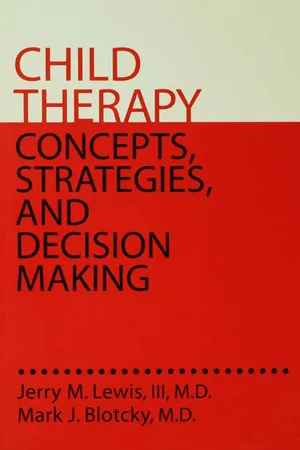
Child Therapy: Concepts, Strategies,And Decision Making
Concepts Strategies & Decision Making
- 224 pages
- English
- ePUB (mobile friendly)
- Available on iOS & Android
eBook - ePub
Child Therapy: Concepts, Strategies,And Decision Making
Concepts Strategies & Decision Making
About this book
Published in 1997, Child Therapy: Concepts, Strategies, And Decision Making is a valuable contribution to the field of Psychotherapy.
Information
Part I
What Is Child Therapy?
1
Evolution
As incomprehensible as it may seem today, infanticide continued to be a frequent measure for dealing with abnormal or problematic children through the Middle Ages, and beyond. While Hippocrates had early on suggested that insanity was “a disease of the brain,” until the nineteenth century its treatment was, for the most part, excluded from the purview of medicine. It was not until the seventeenth and eighteenth centuries that the child began to be seen as unique and to be differentiated from the adult. Comenius (1592–1670) led theologians, educators, philosophers, and physicians in recognizing and addressing the developmental needs of children as involving the soul (character), the body, and learning (Comenius, 1856). Indeed, he was the first to recognize the value of play as a means of learning and mastery. Locke, in 1692, recognized developmental stages in children and, seeing the child as a “tabula rasa,” emphasized the importance of guidance (Locke, 1910). He felt that to achieve “rationality” the child had to harness his desires and passions. In 1762, Rousseau emphasized the innate goodness and natural development of the child (Rousseau, 1962). Both he and Locke used deconditioning techniques to treat children’s phobic symptoms. Indeed, these early perceptions and understandings of child development paved a path to therapeutics.
In the nineteenth century, the concept that all knowledge is acquired through the senses became the core principle of education. Itard (1932), Seguine (1866), and Pinel (1801) all worked to educate the retarded and contributed to the development of “moral treatment.” These efforts provided the early roots of didactic and supportive treatment methods. Furthermore, Darwin’s work in 1859 emphasized genetics, development, evolving functions, and the interrelationship between the organism and the environment (Darwin, 1877). In this perspective were the early roots of what has become the biopsychosocial perspective.
Mesmer’s hypnotism was extended by Janet (1924) and others in the early 1900s as the catharsis of repressed memories was recognized as therapeutic. Coue’s (1922) “induced auto suggestion” was advocated to implant positive thoughts in the unconscious.
The twentieth century has been referred to as the “Century of the Child” (Key, 1909; Aries, 1962). In 1921, following Freud’s (1909, 1955) analysis of “Little Hans,” von Hug–Hellmuth published the first description of direct therapy of a child by a psychoanalyst. Soon thereafter, Melanie Klein (1932) described “play analysis,” which viewed play as the childhood equivalent of free association. Her work involved minimal contact with parents and teachers. While Klein advocated early and deep interpretations, Anna Freud (1946) believed a “preparatory phase” was necessary, that adult therapeutic technique required adaptations for child therapy, and that the analyst had to serve important “educative” functions.
In 1938 Levy described “structured play therapy” in which the play situation was intentionally constructed to replicate a real-life conflict. Taft published a text in 1933 that proposed “relationship therapy,” which relied upon the curative effects of the rapport between the patient and therapist. Acceptance, a here and now focus, and an emphasis on the child’s exercise of freedom of choice were seen as essential. This line of thinking extended through Allen (1942) to the “nondirective” play therapy of Axline (1947) and Dorfman (1951).
Behaviorism and learning theory were some of psychology’s major contributions to today’s child therapy. The Watsons in 1921, and the Mowrers in 1938, pioneered classical conditioning approaches to learning and provided therapies for enuresis.
Other roots of child therapy came from work with juvenile delinquents and the courts. The development of clinics for the treatment of children, institutions for delinquents, the community mental health system, residential treatment centers for emotionally disturbed children, family systems theory and family therapy, and hospital treatment programs—along with the advances in psychopharmacology—have all had their influences on the practice of child therapy. While each of these has added its perspective to child therapy, and at times even seemed to conflict or compete with one another, the current view is increasingly eclectic and pluralistic. Today we are learning the power of combining treatment approaches and modalities (O’Brien et al, 1992; Blotcky, 1992). After a period of prolific differentiation, this is an exciting time of new integration.
2
Basic Principles
The Nature of Development
An understanding of child development is essential in child therapy. It provides the foundation for a clinical formulation (Shapiro, 1989), and the yardstick for assessment and monitoring growth and change. To comprehend child development one must integrate the interactional processes of maturation and interpersonal/social experience (Sameroff, 1975). Indeed, development is defined as the result of the interactions between maturation, the biological unfolding of the organism, and the environment, particularly the family system. Each child possesses a number of biological, genetic, and temperamental givens, and then engages in interpersonal relationships which are influenced by these biologic givens (Thomas & Chess, 1968, 1977). Further, the child’s perception and experience of the interactions with others are colored by his or her ability to modulate affect, integrate and synthesize experiences, cognitively understand cause and effect, and other such variables, which may be heavily influenced by biology. While genetic determinants may be, in some instances, the most clearly defined and distinct precursors of a specific mental illness, for example, manic depressive disorder, many constitutional and temperamental innate qualities effect each and every child’s developmental process in both normal and abnormal development. These biological variables would include sensory, motor, perceptive, integrative, and intellectual capacities, in addition to hormonal influences during development, as well as the powerful influences of significant medical problems, which may be acute or chronic. While maturation refers primarily to the biologic dimension of the child, it is how maturation affects and is affected by the interpersonal environment that shapes the child’s ultimate psychological structure, capacities and weaknesses, talents and vulnerabilities.
Basic Principles
Certain basic principles of development provide a foundation for understanding and, at the risk of oversimplification, a few short definitions of concepts are offered. The concept of multideterminism declares that there are many determinants to the ultimate adaptational compromise seen in the adjustment of any child. Rarely does any one single factor play such a huge role that others can be ignored. This information is relevant in composing a clinical formulation and therefore in designing a plan of therapeutic intervention. The good enough mothering concept coined by Winnicott (1960), refers to the idea that no child will have perfect parenting with exquisite sensitivity to the child’s every need. Instead, parents fall into a “good enough” spectrum of generally meeting the child’s needs by soothing and consolation, responding to biologic needs, providing gratification, and setting limits. The concept of good enough parenting might be translated for parents in saying, for example, that the way they respond to a child seems to be “in the ballpark” of how parents should respond to particular behaviors the child exhibits. Additionally, the good enough concept acknowledges that there are many “right” ways to parent, leaving room for individual style, values, and so on.
Parental empathy refers to the parents’ ability to put themselves in their child’s emotional position and understand their child’s developmental needs. This is not the same as compassion or sympathy, but instead the ability to hold the adults’ more mature cognitive and emotional position in abeyance and allow themselves to transiently be identified with their child. In this way, the parent can recognize both what the child “wants” and what the child “needs.” To make this distinction and, more often than not, to provide what is needed, even when it is not what is wanted, requires that the parent be able to handle being the object of the child’s unhappiness. Yet, it is this ability to find the balance of gratification and frustration that facilitates development, which constitutes parental empathy—perhaps the single most important element of good enough parenting.
Some of these basic developmental principles clearly overlap. Yet, a solid understanding must include the concept of developmental lines (Freud, 1975). One can follow the developmental lines of self-esteem, self-sustenance, cognition, self-help and care skills, socialization, behavior control, and so on. For example, it is particularly important that cognitive development proceed along with the development of object relations in order for the developmental processes to continue in an adaptive and unthwarted way. In general, one views development as a continuous process with one step leading to another, at times with there being two or three steps forward and one back. Regression reflects a movement back to previous defenses, behavioral patterns, and emotional postures and can be either “in the service of development and adaptation” or a reflection of pathology. Discontinuities in development occur as well. The concept of discontinuity refers to developmental points in which there is a significant leap forward or change in the developmental pathway, which appears almost discontinuous from the processes noted in an individual child’s development. These basic concepts provide an essential background for comprehending the stages of development.
Stages of Childhood Development
A brief review of childhood development will extend from birth and attachment to the latency period. Today pioneering, observational child development research intermingles with older views of development, which originated in the reconstructive efforts of adult psychoanalysis, producing more specific and comprehensive views of child development. Readers may want to delve further and, along with referenced works, the authors recommend Psychoanalytic Theories of Development by Phyllis and Robert Tyson (1990) and Child and Adult Development:A Psychoanalytic Introduction for Clinicians by Calvin Colarusso (1992).
Beginning at birth, and through the first year of life, the processes of attachment capture the essence of development. The child’s individual temperament or disposition interacts with the caretaking environment, in what is hoped to be a “good fit,” producing a secure attachment. The early sleep-wake cycle helps establish the original attachment. It is through the gratification by the nurturing object when the child is awake that attachment emerges, and if the sleep-wake cycle is in some way disturbed and we have a temperamentally difficult child, this can significantly affect attachment, object relations, and many aspects of personality development (Thomas & Chess, 1968, 1977).
Object relations refers to the type of attachment or interpersonal relationships the child has with important others in his or her life, and a description of object relations conveys something both about the interpersonal level of relatedness and the intrapsychic development of the child. Infants initially have little or no boundaries and have difficulty differentiating what is external from what is internal; they have difficulty differentiating what is “I” and what is “mother.” Through the process of separation–individuation (Mahler et al, 1975), the child begins to delineate his or her own emotional responses, behavior, and thoughts from those of others. The “terrible two’s” refers to that period during which the child begins working through the sense of being fused with mother in a primitive, symbiotic identity and moving toward the realization of separateness. In the more fused or symbiotic state, the child feels omnipotent and as if his or her and mother’s thoughts, body, feelings, and behavior are the same. The frustration the child meets with the parent in the real world, as expectations grow, facilitates the development of his or her own identity. But, this also leads to tantrums reflecting frustration and rage related to the disillusion of his or her omnipotence and loss of control over the external world, and in particular mother, who is so highly emotionally invested. In the normal course of object relations development, the child develops what is commonly known as healthy ambivalence, in which the relationship with the nurturing figures can be maintained even in the face of anger and frustration with this person. Along with this comes a sense of internal sustenance or safety and basic self-esteem. This is referred to as libidinal object constancy (Fraiberg, 1969), and it allows a continuous and stable relationship with a nurturing figure, making psychological separation and individuation possible.
The sensorimotor and basic biological substratum is very important to the child’s being able to synthesize and integrate sensory input, and develop a picture in his other mind’s eye of the nurturing figure, which is often called object permanence. Object permanence is a necessary prerequisite to object constancy. Perceptual organization, or the ability to put together the sensory input in one’s mind, is critical in helping a child develop object relations, thus children with neuropsychological deficits often have some developmental vulnerability.
The interplay of biology and the environment, or the interplay of temperament and the personalities of parents, is extremely important to the child developing a sense of safety. Herein comes the concept of the holding environment (Winnicott, 1960), in which the child’s tension and anxiety is soothed by the parent, providing a sense of safety, and out of which grows the internal capacity for the child to self-regulate emotional states. Thus, in infancy (0–3 years of age) the phase of attachment blends into the processes of separation–individuation (Mahler et al, 1975). With the establishment of self and object constancy the child begins a move from dyadic to triadic object relations. This includes a relative resolution of separation anxiety (anxiety over loss of the caretaking figure) and a move toward anxiety over approval. Issues of behavioral and body control, discipline, and socialization become preeminent. At about the same time sexuality moves toward the developmental forefront. Core gender identity consolidates along with self and object constancy, and the boy or girl begins elaborating his or her gender role identity, thereby adopting the patterns of behavior consistent with the respective gender (Tyson & Tyson, 1990). In the transition between separationindividuation and the genital oedipal phase, the phallic narcissistic phase has been defined (Edgcumbe & Burgner, 1975) wherein dyadic, narcissistic, and sexual elements are blended. Exhibitionistic and voyeuristic tendencies are in evidence as the child seeks to obtain a narcissistically valued sense of his or her sexuality.
With the emergence of the capacity for object constancy and early narcissistic equilibrium comes an ability to engage in triadic object relations. This marks the onset of the oedipal phase (3–6 years of age) during which the child struggles with strong wishes to relate in an adult, romantic manner with his or her parents. The negative oedipal response refers to such wishes toward the same sex parent, while the positive oedipal response is a heterosexual orientation. When affection and libidinal desires are focused on one parent, aggressive, competitive, rivalrous wishes and impulses are focused on the other. Issues of gender object choice are being addressed at this phase, but their ultimate resolution awaits maturation and the sexual competency of adolescence. As the oedipal child wrestles with the often painful realizations having to do with generational and gender differences (Fast, 1979), he or she struggles with a choice between preserving narcissism and pursuing the oedipal object. Optimally, a combination of anxiety (sometimes referred to as castration or genital anxiety), the rather new defensive capacity for repression, and the establishment of a superego (conscience) permits a solution. To lessen anxiety, preserve narcissism, and maintain connections with the primary objects (parents), the child relinquishes forbidden wishes, accepts his or her child status, identifies with parents, and achieves narcissistic rewards and new autonomy by obeying the rules, values, ideals, and so on of his or her conscience.
Thus, the child enters latency (approximately 6 to 12 years) (Sarnoff, 1976) wherein the maturation of new and powerful cognitive abilities permits enormous ego growth and expansion. The child learns to “work,” becomes educable, and begins to join the culture. Conflicts become internalized to a much greater extent as the child’s tripartite psychic structure (id, ego, superego) can now contain more. The child is less often in conflict with the environment and depends less on external structure to sustain self-control. The latency age child’s world expands to include additional adults (teachers, coaches, etc.) with whom he or she can identify, as well as an enlarging amount of involvement with peers. This process of emancipation from a primary focus on parents to an eventual primary focus on peers will speed up in adolescence. During the latency years, children enjoy tremendous psychological growth and development.
Bridging Concepts
Finally, there are a number of what one might call overriding or bridging concepts, which include as an example, the “developmental fit” in the family, which is crucial. A certain child’s temperamental style may make him or her extremely vulnerable in one family while it might allow him or her to be an easy fit in another. Similarly, the parent’s personality style might be extremely facilitative for one child while very detrimental for the temperamental or biological givens of another.
Take, for example, a child with an IQ of 90 born to parents who are very perfectionistic and obsessive–compulsive, with high IQ’s and graduate degrees, and with very high expectations for their child. To the extent these needs are narcissistically driven, they will have difficulty mourning the loss of an idealized child and accepting theirs as he really is. In another family context, this vulnerability or liability may not have been an issue.
So, what exactly is a developmental process? The developmental process describes the child’s moving from one psychological or emotional posture to another. It is facilitated by stability in his or her present position, as well as what is experienced as more gratifying by moving to the next. It is impeded when the child is in a position that is either not gratifying enough, too insecure or too frustrating, or is excessively gratifying and thus interferes with the child’s desire to move on; likewise it is impeded when the next stage of development is too frightening, frustrating, or empty. In this latter situation, the concept of fixation (Freud, 1975) is illustrated. Regression occurs when a child is under a significant stressor that can be on either a developmental, familial, or other external environmental basis. The model of “transactional development” offered by Sameroff (1975) is particularly helpful in that it suggests the child affects the parents and the parents affect the child. Each cause the other to respond in different ways and thus it is through the “transaction,” child to parent and parent to child, that the child either moves forward or backwards. Devel...
Table of contents
- Cover
- Half Title
- Title Page
- Copyright
- Dedication
- Contents
- Acknowledgments
- Introduction
- Part I. What is Child Therapy?
- Part II. Clinical Practice of Child Therapy
- Part III. Specific Therapeutic Approaches
- Part IV. Final Notes
- Appendix A. Professional Organizations for Child Therapists
- Appendix B. Recommended Reading List
- References
- Name Index
- Subject Index
Trusted by 375,005 students
Access to over 1.5 million titles for a fair monthly price.
Study more efficiently using our study tools.
Frequently asked questions
Yes, you can cancel anytime from the Subscription tab in your account settings on the Perlego website. Your subscription will stay active until the end of your current billing period. Learn how to cancel your subscription
No, books cannot be downloaded as external files, such as PDFs, for use outside of Perlego. However, you can download books within the Perlego app for offline reading on mobile or tablet. Learn how to download books offline
Perlego offers two plans: Essential and Complete
- Essential is ideal for learners and professionals who enjoy exploring a wide range of subjects. Access the Essential Library with 800,000+ trusted titles and best-sellers across business, personal growth, and the humanities. Includes unlimited reading time and Standard Read Aloud voice.
- Complete: Perfect for advanced learners and researchers needing full, unrestricted access. Unlock 1.5M+ books across hundreds of subjects, including academic and specialized titles. The Complete Plan also includes advanced features like Premium Read Aloud and Research Assistant.
We are an online textbook subscription service, where you can get access to an entire online library for less than the price of a single book per month. With over 1.5 million books across 990+ topics, we’ve got you covered! Learn about our mission
Look out for the read-aloud symbol on your next book to see if you can listen to it. The read-aloud tool reads text aloud for you, highlighting the text as it is being read. You can pause it, speed it up and slow it down. Learn more about Read Aloud
Yes! You can use the Perlego app on both iOS and Android devices to read anytime, anywhere — even offline. Perfect for commutes or when you’re on the go.
Please note we cannot support devices running on iOS 13 and Android 7 or earlier. Learn more about using the app
Please note we cannot support devices running on iOS 13 and Android 7 or earlier. Learn more about using the app
Yes, you can access Child Therapy: Concepts, Strategies,And Decision Making by Jerry M. Lewis, III, MD,Mark J. Blotcky, MD,III Lewis in PDF and/or ePUB format, as well as other popular books in Psychology & Mental Health in Psychology. We have over 1.5 million books available in our catalogue for you to explore.