The seven articles in this special issue represent a sampling of the exciting findings that are beginning to emerge from studies of executive control in young children. They demonstrate the multidisciplinary approaches to study cognition in young children that include application of cognitive, neuroscience, and developmental paradigms in typically developing youngsters, as well as those affected by clinical conditions, such as traumatic brain injury, exposure to low levels of lead in the environment, and prematurity. Although much work remains to be done, these study results are illustrative of the dynamic work in this exciting development period.
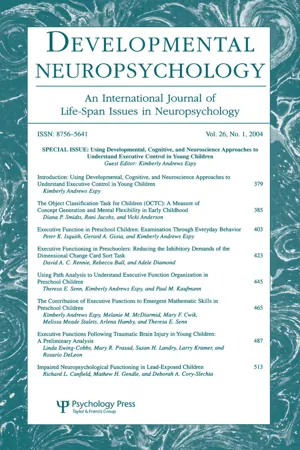
eBook - ePub
Using Developmental, Cognitive, and Neuroscience Approaches To Understand Executive Control in Young Children
A Special Issue of developmental Neuropsychology
- 168 pages
- English
- ePUB (mobile friendly)
- Available on iOS & Android
eBook - ePub
Using Developmental, Cognitive, and Neuroscience Approaches To Understand Executive Control in Young Children
A Special Issue of developmental Neuropsychology
About this book
Information
Impaired Neuropsychological Functioning in Lead-Exposed Children
Richard L. Canfield
Division of Nutritional Sciences College of Human Ecology Cornell University
Division of Nutritional Sciences College of Human Ecology Cornell University
Mathew H. Gendle
Department of Psychology Elon University
Department of Psychology Elon University
Deborah A. Cory-Slechta
Department of Environmental and Occupational Medicine UMDNJ-Robert Wood Johnson Medical School
Department of Environmental and Occupational Medicine UMDNJ-Robert Wood Johnson Medical School
Neuropsychological functions were assessed in 174 children participating in a longitudinal study of low-level lead exposure. At age 5½ years, children were administered the Working Memory and Planning Battery of the Cambridge Neuropsychological Testing Automated Battery. Measures of sociodemographic characteristics of the family, prenatal and perinatal risk, quality of caregiving and crowding in the home, and maternal and child intelligence were used as covariates to test the hypothesis that children with higher lifetime average blood lead concentrations would perform more poorly on tests of working memory, attentional flexibility, and planning and problem solving. The lifetime average blood lead level in this sample was 7.2 micrograms per deciliter (μg/dL; range: 0-20 μg/dL). Children with greater exposure performed more poorly on tests of executive processes. In both bivariate and multivariate analyses, children with higher lifetime average blood lead concentrations showed impaired performance on the tests of spatial working memory, spatial memory span, intradimensional and extradimensional shifts, and an analog of the Tower of London task. Many of the significant associations remained after controlling for children's intelligence test scores, in addition to the other covariates. These findings indicate that the effects of pediatric lead exposure are not restricted to global indexes of general intellectual functioning, and executive processes may be at particular risk of lead-induced neurotoxicity.
Inorganic lead may be the most widespread neurotoxic pollutant on the planet, and investigations into the effects of lead exposure on children's cognitive and behavioral functioning are numerous (Pocock, Smith, & Baghurst, 1994). Eliminating lead from gasoline and paint has resulted in a sharp decline in the average blood lead levels of the U.S. population. Only a generation ago, the average blood lead level of U.S. residents was nearly 15 micrograms per deciliter (μg/dL); today it is approximately 2 μg/dL (Centers for Disease Control and Prevention [CDC], 1982, 2001). A concentration of 10 μg/dL or greater of lead in whole blood is currently defined as a level of concern by the CDC and the World Health Organization (WHO; CDC, 1991; WHO, 1995), but there is no evidence of a threshold value following which lead has no detectable effects on children's intellectual functioning.
This lack of evidence is perhaps not unexpected because there have been few investigations of children with lead levels below 10 μg/dL (Canfield et al., 2003). When such children have been the focus of study, the findings suggest that a unit increase in blood lead in the 0 to 10 μg/dL range is more detrimental to children's intellectual functioning than an equivalent increase within the 10 to 20 μg/dL range (Bellinger, Stiles, & Needleman, 1992; Canfield et al.. 2003; Lanphear, Dietrich, Auinger, & Cox, 2000). From the perspective of the recent past, a blood lead concentration of 10 μg/dL can be considered low, but according to some estimates such an exposure is 200 to 600 times higher than in preindustrial humans (Flegal & Smith, 1995). Thus, it remains unclear at what level lead can be considered to carry negligible risk.
Numerous prospective studies have documented that within the 10 to 30 g/dL range, children with higher blood lead score lower on various tests of psychometric intelligence (Baghurst et al., 1992; Bellinger et al., 1992; Dietrich, Berger, Succop, Hammond, & Bornschein, 1993; McMichael et al., 1988; Pocock et al., 1994; Wasserman et al., 1997), but it has long been suspected that lead has more specific effects on particular cognitive functions (Bellinger, 1995; Bellinger, Hu, Titlebaum, & Needleman, 1994; Cory-Slechta, 1995). There is some evidence supporting this view. Patterns of subtest performance on measures of psychometric intelligence are suggestive of more pronounced effects on visual-spatial skills (Bellingeretal., 1991; Dietrich et al., 1993; McMichael et al., 1988; Wasserman et al., 1997), attention (Bellinger et al., 1994), and executive functions (Bellinger et al., 1994) than on verbal abilities or knowledge base. Studies using traditional neuropsychological tests have tended to support this view (Baghurst et al., 1995; Stiles & Bellinger, 1993).
Executive and complex cognitive functions are known to involve mediation by both cortical and subcortical structures of the brain. The mesocorticolimbic system includes projections that integrate functions in hippocampus, prefrontal cortex, and nucleus accumbens (ventral striatum), with these circuits using dopamine and glutamate as primary neurotransmitters (Doyere, Burette, Negro, & Laroche, 1993; Gurden, Tassin, & Jay, 1999; Thierry, Gioanni, Degenetais, & Glowinski, 2000), Experimental studies have shown that lead exposure disrupts these systems, establishing both a neuroanatomical and neurochemical basis for its effects on cognitive function. Lead, for example, results in changes in dopamine receptors and dopamine release in nucleus accumbens, even though the other major dopamine system of the brain, the nigrostriatal pathway, is unaffected (Pokora, Richfield, & Cory-Slechta, 1996; Zuch, O'Mara, & Cory-Slechta, 1998). Alterations of glutamate receptors in nucleus accumbens of rats can actually mimic the effects of lead on learning (Bauter, Brockel, Pankevich, Virgolini, & Cory-Slechta, 2003). Numerous studies also report lead-induced changes in hippocampal function, including changes in glutamate release, receptor binding, and long-term potentiation, presumed to be an electrophysiological correlate of learning (Lasley & Gilbert, 1996, 2002; Lasley, Green, & Gilbert, 1998).
In this study, we examined the association of lead exposure with specific cognitive functions in a cohort of preschool-age children with predominantly low-level lead exposure. The children were followed prospectively beginning at age 6 months (Canfield, Espy, Henderson, & Cory-Slechta, 2002; Canfield et al., 2003; Carifield, Kreher, Cornwell, & Henderson, 2003; Lanphear et al., 1999), using the Working Memory and Planning Battery of the Cambridge Neuropsychological Test Automated Battery (CANTAB, Cambridge Cognition Limited, Cambridge, England). The CANTAB is a computerized testing battery that uses a touch screen interface that places few demands on language comprehension, production, or complex motor skills, making it suitable for use with children and nonhuman primates (Fray & Robbins, 1996). The individual tests that make up the Working Memory and Planning Battery have been derived from common clinical assessments and have been shown to detect subtle cognitive impairments during the asymptomatic phases of several frontosubcortical disorders (Fray & Robbins, 1996). The CANTAB was developed within the theoretical frameworks of Baddeley and Shallice (Baddeley, 1986; Shallice & Burgess, 1993) and was validated and standardized with comparative studies of humans and monkeys, functional neuroimaging, and studies of various clinical populations with localized lesions or neuropsychiatrie conditions involving damage to frontal circuits (Robbins, 1996).
The CANTAB has been used to measure executive functions in children as young as 4 years (Luciana & Nelson, 1998) and has been used to detect subtle cognitive alterations in children from at-risk populations, including neonatal intensive care unit survivors (Luciana, Lindeke, Georgieff, Mills, & Nelson, 1999), children with autism children (Hughes, Plumet, & Leboyer, 1999), and children with attention deficit hyperactivity disorder (ADHD; Kempton et al., 1999). It has also been used with adolescents and adults to measure the detrimental effects of neurotoxic exposure to gasoline vapors (Maruff, Burns, Tyler, Currie, & Currie, 1998) and inorganic mercury in adolescents and adults (O'Carroll, Masterton, Dougall, Ebmeier, & Goodwin, 1995). Because the CANTAB appears to be a promising tool for detecting the effects of neurotoxicants, assessing cognitive functions in children, and providing insights into the neural systems underlying neurocognitive impairments, we believed that it could be a powerful instrument for investigating subtle cognitive deficits that may be associated with very low level lead exposure in our cohort of young children.
Method
Participants
Participants were originally enrolled at 5 to 7 months of age for a study of lead dust control efficacy (Lanphear et al., 1999) and were invited to participate in a 5-year neurobehavioral study when the children were 24 to 30 months of age. Of the 276 children in the ori...
Table of contents
- Cover
- Using Developmental, Cognitive, and Neuroscience Approaches to Understand Executive Control in Young Children
- The Object Classification Task for Children (OCTC): A Measure of Concept Generation and Mental Flexibility in Early Childhood
- Executive Function in Preschool Children: Examination Through Everyday Behavior
- Executive Functioning in Preschoolers: Reducing the Inhibitory Demands of the Dimensional Change Card Sort Task
- Using Path Analysis to Understand Executive Function Organization in Preschool Children
- The Contribution of Executive Functions to Emergent Mathematic Skills in Preschool Children
- Executive Functions Following Traumatic Brain Injury in Young Children: A Preliminary Analysis
- Impaired Neuropsychological Functioning in Lead-Exposed Children
Trusted by 375,005 students
Access to over 1.5 million titles for a fair monthly price.
Study more efficiently using our study tools.
Frequently asked questions
Yes, you can cancel anytime from the Subscription tab in your account settings on the Perlego website. Your subscription will stay active until the end of your current billing period. Learn how to cancel your subscription
No, books cannot be downloaded as external files, such as PDFs, for use outside of Perlego. However, you can download books within the Perlego app for offline reading on mobile or tablet. Learn how to download books offline
Perlego offers two plans: Essential and Complete
- Essential is ideal for learners and professionals who enjoy exploring a wide range of subjects. Access the Essential Library with 800,000+ trusted titles and best-sellers across business, personal growth, and the humanities. Includes unlimited reading time and Standard Read Aloud voice.
- Complete: Perfect for advanced learners and researchers needing full, unrestricted access. Unlock 1.5M+ books across hundreds of subjects, including academic and specialized titles. The Complete Plan also includes advanced features like Premium Read Aloud and Research Assistant.
We are an online textbook subscription service, where you can get access to an entire online library for less than the price of a single book per month. With over 1.5 million books across 990+ topics, we’ve got you covered! Learn about our mission
Look out for the read-aloud symbol on your next book to see if you can listen to it. The read-aloud tool reads text aloud for you, highlighting the text as it is being read. You can pause it, speed it up and slow it down. Learn more about Read Aloud
Yes! You can use the Perlego app on both iOS and Android devices to read anytime, anywhere — even offline. Perfect for commutes or when you’re on the go.
Please note we cannot support devices running on iOS 13 and Android 7 or earlier. Learn more about using the app
Please note we cannot support devices running on iOS 13 and Android 7 or earlier. Learn more about using the app
Yes, you can access Using Developmental, Cognitive, and Neuroscience Approaches To Understand Executive Control in Young Children by Kimberly Andrew Espy in PDF and/or ePUB format, as well as other popular books in Psychology & Developmental Psychology. We have over 1.5 million books available in our catalogue for you to explore.