Practical and provocative, this book serves as a guide for those who want a deeper look into the human psyche and a more encompassing vision of the less predictable aspects of the mind.
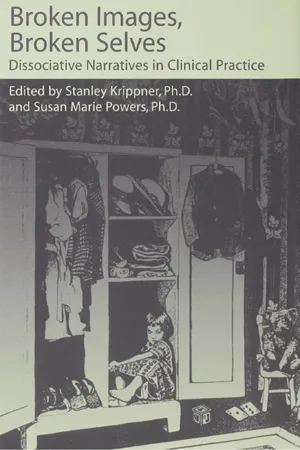
eBook - ePub
Broken Images Broken Selves
Dissociative Narratives In Clinical Practice
- 372 pages
- English
- ePUB (mobile friendly)
- Available on iOS & Android
eBook - ePub
Broken Images Broken Selves
Dissociative Narratives In Clinical Practice
About this book
Information
PART I

The Realm of Dissociation
CHAPTER 1
Dissociation in Many Times and Places
Stanley Krippner
A TRIO OF DISSOCIATIVE EXPERIENCES
Over the years, I have observed, heard about, and read many events described as “dissociative.” In this chapter, I discuss several of these incidents and present a model that I believe helps to describe and compare them, even though they took place in many different times and places. These events and their description set a tone for the book as they portray the many ways in which images and selves can be broken and, in some instances, reconstructed.
In 1990, I was invited to attend a 6-hour toque ritual held by the Children of St. Anthony at their Santería center on the outskirts of Havana, Cuba. The first liturgy paid tribute to Elegua, the orisha or deity held to be the keeper of roads and crossings. The center was filled with depictions of St. Anthony as well as such Santería orishas as Changό, the chief of dance and lightning, and Babalu-Aye, the lord of epidemics and healing. The major orisha honored on that occasion was the hermaphrodite Obatala, whose white robes symbolize purity, justice, peace, and wisdom.
In one room of the center, a magnificent shrine had been assembled in honor of Obatala. It blended white fabrics with strands of blue, the favored color of Obatala’s consort, Yemaya, the queen of the oceans and the patroness of the entire center. In another room, musicians played three Santeria tambor bata (or drums), while dozens of participants sang and danced. One of the babalawos (male mediums) was “mounted” by Yemaya and began to adopt stereotypic female gestures, attempting to perform healings for those in need by rubbing his hands over the afflicted body parts of the supplicants and embracing them.
As the final liturgy began to wind down in the early evening (to avoid violating the government’s 7:00 p.m. curfew), the orishas left their human “instruments.” A “eucharist” (from the mammoth outlay of cakes and cookies) was served to each of the men and women, Marxists and Catholics, adults and children, and dark-skinned and light-skinned individuals who had come together to evoke healing, meaning, and ecstasy from an ancient spiritual tradition. This tradition had crossed the Atlantic in the horrendous form of slave ships but, in a modified configuration, had firmly established itself in the Americas under the name “Santería,” that is, “the way of the saints” (Krippner & Welch, 1992, pp. 138–139).
The term “dissociative” is appropriately applied to these phenomena in Cuba but I heard a remarkably different example of “dissociation” in 1993 when the U.S. philosopher, Jean Houston, told me about the time that her comedy-writer father took her with him when he delivered a script to Edgar Bergen, the famed ventriloquist. Houston recalled encountering Bergen, sitting with his back to them, talking with his dummy Charlie McCarthy, but this was no show business rehearsal. Bergen was asking Charlie existential questions: “What is the meaning of life?” “What does it mean to be truly good?” “Where is the human soul?” And the dummy seemed to answer with the wisdom of the millennia, his insight astounding Bergen as much as it impressed the Houstons.
Finally, Jack Houston announced their presence. Bergen turned around, embarrassed, and remarked, “Oh, hello, Jack and Jean. I see you caught us.” Jack Houston asked what was happening. Bergen replied, “I’m talking with Charlie. He’s the wisest person around.” Jack Houston probed, “But Ed, that’s your voice, your knowledge coming out of that dummy’s mouth.” Bergen answered, “Yes, Jack, I suppose it is. But, you see, when I ask him these questions and he answers, what he says is so much more than anything I know!” (Houston, 1996, p. 115).
Literature provides its readers with numerous accounts that could be regarded as “dissociative.” Since childhood, I have read and reread Robert Louis Stevenson’s (1886/1967) novella, The Strange Case of Dr. Jekyll and Mr. Hyde, because he claimed it was inspired by a terrifying dream. Woody and Bowers (1994) note that “Stevenson described the process that led to some of his best writing as one in which the characters took on an independent life of their own and seemed to move about and speak for themselves completely unaided” (p. 52). Stevenson looked forward to dreaming, hoping that something would emerge that would be sellable to magazines, and referred to the “little people” who adroitly unfolded plots while he watched their efforts as if from a stage box (Hennessey, 1974, p. 20). In this tale, Dr. Jekyll conjectures that people are plural rather than singular: “I hazard the guess that man will be ultimately known for a mere polity of multifarious, incongruous and independent denizens” (Stevenson, 1886/1967, p. 68). The potion conjured up in the physician’s laboratory evokes potentials that were always within him, appalling as they turn out to be when the loathsome Mr. Hyde assumes his identity.
The Jekyll-Hyde transformation, Stevenson’s frightening dream, and the writing process in which characters take “on an independent life of their own” would be considered instances of “dissociation” by many Western social and behavioral scientists. They would affix the same label to the behavior of the Children of St. Anthony at their Santeria center in Havana, as well as to Edgar Bergen’s reported philosophical conversations with Charlie McCarthy. This chapter describes other examples of “dissociation” in many times and places, within the framework of a model that can be used for cross-cultural comparison.
CROSS-CULTURAL STUDIES AND DISSOCIATION
The word “culture” is used to denote a historically transmitted pattern of meanings embodied in symbols—a system of concepts expressed in images by means of which people communicate and develop their knowledge and attitudes about life (Geertz, 1973, p. 89). Cross-cultural anthropologists, sociologists, and psychologists attempt to observe and uncover the reasons behind the differences and the commonalties among human experiences occurring in different cultural contexts. A basic view held by cross-cultural psychologists is that psychological generalizations cannot be held universally on the basis of research conducted in one sociocultural context, but must be demonstrated through cross-cultural research (Segall et al., 1990). This position is especially pertinent when applied to medical treatments; a particular intervention might be successful in one society (e.g., a Western culture) but inappropriate in another (e.g., a non-Western culture). However, a comparison of interventions from non-Western cultural settings may yield information that might enhance Western medicine and vice versa.
Westerners are prone to take terms with which they are familiar and superimpose them on phenomena in other cultures with which they are unfamiliar. Like other hypothetical constructs in the social sciences, “dissociation” is an attempt by a social group to describe, explain, or otherwise account for the world in which they live (Gergen, 1985, p. 266). So-called “dissociative” phenomena have been given varied labels and interpretations in different eras and locations, as well as in diverse historically and geographically situated interchanges among people. An understanding of this situation should prevent the reification of such expressions as “dissociation” and “dissociative disorders,” and the uncritical acceptance of the Western constructions of these phenomena.
Several definitions of dissociation are philosophical. Braude (1995) cautions that a “truly adequate definition” will have to await the development of a robust theory of dissociation. Nevertheless, he proposes that the term can be used if a state system of a human being (such as traits, skills, or alternate personalities) is separated from other parts of the system by phenomenological barriers (such as those due to an anesthetic) or epistemological barriers (such as those due to amnesia) erected by someone who is not aware of establishing the barrier. This obstruction can be broken down, at least in principle. This definition rules out suppression of which someone is consciously aware, as well as cases of conceptual naivete and limited self-awareness, for example, barriers observed among infants, the mentally handicapped, people with limited backgrounds (pp. 120–121).
Some definitions of dissociation are diagnostic. For example, the fourth edition of the American Psychiatric Association’s (1994) Diagnostic and Statistical Manual of Mental Disorders—Fourth Edition (DSM-IV) includes a section titled “dissociative disorders” (pp. 447–491). The essential feature of these disorders is said to be “a disruption in the usually integrated functions of consciousness, memory, identity, or perception of the environment. The disturbance may be sudden or gradual, transient or chronic” (p. 477). This differs somewhat from the World Health Organization’s (1993) International Statistical Classification of Diseases and Related Health Problems—Tenth Revision (ICD-10), which contains a section termed “dissociative (conversion) disorders” and a category termed “state of possession and trance.” Somatic aspects are given more emphasis in the ICD-10 than in the DSM-IV, and the ICD-10 simply lists “multiple personality” under “others” (Garcia, 1990).
Certain definitions of dissociation are theoretical and explanatory. The psychobiology of dissociation is “in its infancy” according to Brown (1994), but “may well be able to ultimately establish a neuro-physiological basis for the clinical observation of dissociative disorders” and elucidate “the neural substrate of dissociation” (p. 113). Nevertheless, Frankel (1994, p. 81) maintains that the DSM-IV’s definition implies a theoretical mechanism—one of only two categories that do so (the other being conversion disorders). Hilgard (1994) is forthright about the assumptions that underlie his conclusions about dissociation. For example, he states that subordinate cognitive systems exist, some sort of hierarchical control exists, and an overarching monitoring and controlling structure exists. Under special circumstances, these interacting systems may become somewhat isolated from each other (p. 38). Taking another perspective, Spanos and Burgess (1994) conceive a sociocognitive formulation of dissociative disorders in which individuals learn to construe themselves in ways that are created, legitimized, maintained, and altered through social interaction (p. 137).
Although fraught with difficulty because of overlapping symptomatology (Tillman et al., 1994, p. 404), other definitions are operational, depending on scores obtained on standardized tests or responses to semistructured interviews. Among the most widely used are the Dissociative Experiences Scale (Carlson & Putnam, 1993), the Structured Clinical Interview for DSM-IV Dissociative Disorders (Steinberg, 1992), the Dissociative Disorders Interview Schedule (Ross, 1989), and the Perceptual Alteration Scale (Sanders, 1986). Evaluations and comparisons of these measures have been provided by Carlson and Armstrong (1994) who conclude that a positive outcome of the validity controversy surrounding the dissociative disorders has been the rapid development of measures to “objectively diagnose and evaluate the treatment progress of these patients” (p. 171).
The definition that I have used for the purposes of this chapter (and that orients the remaining chapters) is descriptive rather than philosophical, diagnostic, theoretical, or strictly operational. For me, “dissociative” is an English-language adjective that attempts to describe reported experiences and observed behaviors that seem to exist apart from, or appear to have been disconnected from, the mainstream, or flow, of one’s conscious awareness, behavioral repertoire, and/or self-identity. Dissociation is a noun used to describe a person’s involvement in these reported dissociative experiences or observed dissociative behaviors. Dissociation contrasts with “association,” the binding or linking together of concepts and memories, a notion prominent in the writings of John Locke, Edward Hume, and other British empiricists of the seventeenth and eighteenth centuries. “Identity” has many meanings in psychology, but I use the term “self-identity” to describe a person’s definition of himself or herself, encompassing his or her body, gender, social roles, values, and goals.
I delimit dissociative phenomenological reports and behavioral observations to those pertaining to personal concepts and memories. Individuals harbor several identities (see Ornstein, 1986) and a multiplicity of memories covering their behavior, affect, sensations, and knowledge (see Braun, 1988). When these constellations become disconnected, the result can be described as “dissociation.” One example of dissociation would be ruptures in concepts of self-identity; another would be gaps in memories about time and space. Thus, my definition is congruent with Cardeña’s (1994) “domain of dissociation” and its focus on what it includes, such as disconnections or disengagements regarding people and their environment (p. 23).
My definition tries to avoid the epistemological errors that Braude (1995, pp. 116–120) has detected in many other definitions—for example, those that accentuate supposed “concurrent engagement” in two cognitive processes that occur simultaneously, supposed “conflict” between two cognitive processes, and supposed “lack of integration” between two cognitive processes. In addition, in my definition the designations “dissociative” and “dissociation” are made on the basis of observed behavior and verbal reports, but the nature of such behavior and the veridicality of these reports are issues best addressed by other perspectives. Finally, being aware of the countless and often contradictory uses of the term “consciousness” (Natsoulas, 1994) I use the phrase “conscious awareness” to indicate the experient’s firsthand access to his or her stream of consciousness at any given point in time.
A MODEL FOR CROSS-CULTURAL COMPARISONS
To some extent, dissociative phenomena are the outcome of beliefs and practices that differ substantially in diverse times and places. These phenomena are complex socially canalized performances that change over time; they rarely consist of a discrete, enduring state or process (Kirmayer, 1994, pp. 93–94). In order to make cross-cultural comparisons, I have utilized a set of terms proposed by Ruth-Inge Heinze (1993, pp. 202–203) to study the development of either conscious awareness or dissociation and, at the same time, observe the increase or decrease of volitional control at a given point in time. Other writers (e.g., Braun, 1988) have described dissociation in terms of a continuum, but Heinze’s terminology is multidimensional.
A patient suffering from fugue and loss of identity in a mental hospital may experience “uncontrolled dissociation,” whereas a tribal practitioner, whose identity supposedly has been transformed or replaced by discarnate “angels,” “saints,” or “spirits,” may be engaging in “controlled dissociation.” A seasoned camper might awaken to a morning sunrise, reporting a spontaneous onrush of “uncontrolled awareness,” that is, an intense appreciation of nature that appears to have occurred with no apparent volitional control. A mathematician may spend hours in a condition of highly “controlled awareness,” concentrating on a perplexing problem.
However, the descriptor of an individual’s experience may shift, sometimes within minutes. A patient being treated for posttraumatic stress disorder (PTSD) in group therapy may exert controlled awareness, paying close attention to the ongoing process. Suddenly, he may deliberately “tune out” of the session because h...
Table of contents
- Cover
- Title
- Copyright
- Contents
- About the Editors
- About the Contributors
- Introduction
- Part I. The Realm of Dissociation
- Part II. Narratives of Dissociative Experiences
- Part III. Truth and Culture
- Name Index
- Subject Index
Trusted by 375,005 students
Access to over 1.5 million titles for a fair monthly price.
Study more efficiently using our study tools.
Frequently asked questions
Yes, you can cancel anytime from the Subscription tab in your account settings on the Perlego website. Your subscription will stay active until the end of your current billing period. Learn how to cancel your subscription
No, books cannot be downloaded as external files, such as PDFs, for use outside of Perlego. However, you can download books within the Perlego app for offline reading on mobile or tablet. Learn how to download books offline
Perlego offers two plans: Essential and Complete
- Essential is ideal for learners and professionals who enjoy exploring a wide range of subjects. Access the Essential Library with 800,000+ trusted titles and best-sellers across business, personal growth, and the humanities. Includes unlimited reading time and Standard Read Aloud voice.
- Complete: Perfect for advanced learners and researchers needing full, unrestricted access. Unlock 1.5M+ books across hundreds of subjects, including academic and specialized titles. The Complete Plan also includes advanced features like Premium Read Aloud and Research Assistant.
We are an online textbook subscription service, where you can get access to an entire online library for less than the price of a single book per month. With over 1.5 million books across 990+ topics, we’ve got you covered! Learn about our mission
Look out for the read-aloud symbol on your next book to see if you can listen to it. The read-aloud tool reads text aloud for you, highlighting the text as it is being read. You can pause it, speed it up and slow it down. Learn more about Read Aloud
Yes! You can use the Perlego app on both iOS and Android devices to read anytime, anywhere — even offline. Perfect for commutes or when you’re on the go.
Please note we cannot support devices running on iOS 13 and Android 7 or earlier. Learn more about using the app
Please note we cannot support devices running on iOS 13 and Android 7 or earlier. Learn more about using the app
Yes, you can access Broken Images Broken Selves by Stanley Krippner,Susan Powers in PDF and/or ePUB format, as well as other popular books in Psychology & Mental Health in Psychology. We have over 1.5 million books available in our catalogue for you to explore.