eBook - ePub
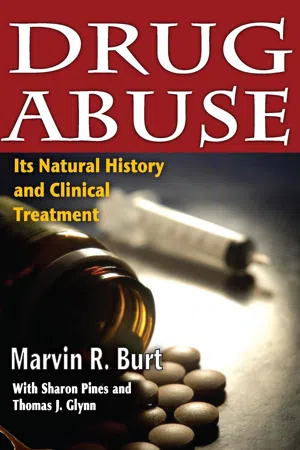
Drug Abuse
Its Natural History and Clinical Treatment
- 362 pages
- English
- ePUB (mobile friendly)
- Available on iOS & Android
eBook - ePub
About this book
The success or failure of drug treatment programs have long been evaluated by assessing the clients' progress while in treatment and their status upon completion. This approach does not provide a complete assessment or an adequate picture of treatment outcomes over time. A comprehensive evaluation of the success or failure of treatment should also include client status in the years following treatment for a fair assessment of the long-term efficacy of any drug-treatment program. What happens to former clients who left treatment? What influence did the treatment have on their lives? These are the questions that Marvin R. Burt seeks to answer with the follow-up studies included in this book. By selecting samples of former clients treated by two of the largest drug treatment agencies in the U.S. and control groups, Burt compares client behavior in terms of drug abuse, criminal activity, and socioeconomic productivity before, immediately following, and well after treatment. The findings in this book challenge many common assumptions about drug treatment programs. Burt finds larger than expected positive behavioral changes in clients regardless of treatment duration or type, and demographic or background characteristics. Whether the results are attributable to the clients' maturation, commitment to change, or a reduction in the availability of drugs, the positive results of treatment are encouraging. This volume provides valuable insight into the natural history of drug abuse and outcomes for client groups.
Information
Topic
PsicologiaSubtopic
Studi sullo sviluppo globalePART I
FOLLOW-UP STUDY OF FORMER CLIENTS OF THE DISTRICT OF COLUMBIA’S NARCOTICS TREATMENT ADMINISTRATION
Chapter I
SUMMARY
This follow-up study assesses the experiences of clients who had contact with/or received treatment from the Narcotics Treatment Administration in Washington, D.C. The basic questions addressed are:
- What happened to former clients who left treatment?
- What influence did treatment seem to have on post-treatment outcomes of former clients?
The first question is answered by determining the status of former clients at the time of interview. The second question is considerably more difficult to answer. It requires that the effects of treatment be isolated from all other effects which might have influenced the post-treatment outcomes of the former clients.
Technically, answering the second question should require an experimental design in which prospective clients, who apply and are qualified for admission to NT A programs, are randomly assigned to treatment and control groups.
Of course, such a random assignment to experimental groups (i.e., modalities of treatment) and control groups (i.e., no treatment) is not feasible. Random assignment to treatment groups is not feasible because the determination of which treatment a client is assigned is a function of his own desires as well as professional judgement as to which treatment would be most effective for him. Assignment to a control group would be unconscionable. A responsible public program cannot refuse to treat a heroin addict simply because it desires to conduct an evaluation study. This would violate professional ethics as well as HEW regulations on protecting human subjects.
Due to the impossibility of employing a truly experimental design, a “next best” alternative was sought. It was decided to draw samples retrospectively (i.e., after the fact) of clients who actually entered methadone maintenance and abstinence programs. Due to the impossibility of randomly assigning prospective clients to control groups, it was decided to use as control groups individuals who applied for treatment, were accepted, but left within five days. The majority of the control group actually left within one or two days (prior to obtaining their first medication or counseling session).
Due to the belief that the period of time a client is out of treatment influences his post-treatment outcome, the sample was further segmented into the year in which the client left treatment. Three years were chosen: 1971, 1972, and 1973.
Sample Selection
The universe of clients was partitioned into six treatment groups and three nontreatment (control) groups. Because all clients who entered treatment subsequent to January 1970 were required to register at the Central Medical Intake (CMI), the initial universe consisted of all clients registered at the Central Medical Intake during the period of January 1971 through December 1973. Three time periods were specified during which the client must have left treatment: January to December 1971, January to December 1972, and January to December 1973. The universe was partitioned into type of treatment (or no treatment) received as well as the period during which clients left treatment. The following matrix shows that the sample was partitioned into those clients who left methadone maintenance,1 left abstinence,2 and those who registered at CMI and left within five days during each of the three years.

Three types of behavioral outcomes were investigated:
- Drug use
- Criminal activity
- Socioeconomic productivity
Comparisons were made during three time periods:
- The two-month period immediately prior to entering treatment
- The two-month period immediately after leaving treatment
- The two-month period immediately prior to being interviewed
Measurements were made to determine changes realized by each group comparing the three time periods. The measurements were then compared between the experimental and control groups to determine whether the changes appear to be attributable to the program in question or outside factors. Then comparisons were made among the three years to detect significant differences.
Because few NTA clients were enrolled in drug-free programs, “abstinence” was defined to include methadone detoxification from heroin as well as drug free programs. The overwhelming majority of the abstinence clients was enrolled in methadone detoxification.
The: sample for each cell was randomly generated from the universe of all clients who left treatment (including dropouts as well as graduates) with the following exceptions:
- No client who was under eighteen years of age when first leaving NTA was included
- No client who was first admitted before January 1, 1970, was included
Fony names were randomly selected for each cell using the NTA computer listings and the data contained in the CMI files. Once the 40 names in each cell were finally determined, there were no substitutions for any reason.
The sample respondents were tracked, interviewed, and urine specimens were obtained to validate their responses to questions concerning their use of drugs.
The: methodology is discussed in Chapter IV.
Natural History of Drug Abuse
The: results of this study provide some insights into the natural history of drug abuse as well as direct answers to the questions concerned with differential outcomes of different client groups.
Chapter VI presents detailed data on the characteristics and backgrounds of the clients interviewed. In summary, the typical client was a black male, twenty-one to twenty-five years old, who had completed the 11th grade. He had used heroin daily for at least two years, had first participated in some type of crime by age eighteen, and was unemployed. Chapter VII analyzes clients’ changes in behavior in terms of the various groups of interest.
The behavior of all the respondents (including the control and treatment groups) is shown in Tables 1-1 and 1-2. Substantial reductions in drug taking occurred between the two-month periods before entering treatment, after leaving treatment, and before being interviewed (Table 1-1). Only 7 percent of the respondents used heroin daily compared to 69 percent prior to entering NT A.1
TABLE I-1
Drug Use (percentage)

TABLE I-2
Employment and Criminal Activity (percentage)

Employment increased (Table 1-2) but this was less dramatic than the decrease in drug taking. Engagement in illegal activities decreased from 44 percent of the respondents before entering NTA ro 24 percent during the period two months prior to the interview. This reduction in reported illegal activities is confirmed by the substantial reduction in the percentage of clients arrested.2
These data show drug abusers progressing from frequent use of heroin and other illicit drugs and engagement in other illegal activities to considerably less involvement in illicit drug use and illegal activities. By the time they were interviewed, 22 percent of the respondents were fully recovered and 58 percent were “partially” or “marginally” recovered (as defined in Chapter VII).
What Has Happened to Former Clients Who Left Treatment!
This discussion focuses on the three major groups of clients — methadone maintenance, abstinence, and control — ignoring the year in which they left treatment. Subgroups (as well as these major groups) are addressed in Chapter VII.
Three types of behavioral outcomes were investigated:
- Drug use
- Criminal activity
- Socioeconomic productivity
Comparisons were made during three time periods:
- The two-month per...
Table of contents
- Cover Page
- Title Page
- Copyright Page
- Contents
- Preface
- Acknowledgments
- Part I Follow-up Study of Former Clients of the District of Columbia’s Narcotics Treatment Adminstration
- Part II A Follow-up Study of Former Clients of New York City’s Addiction Services Agency
- Part III A Follow-up Study of Former Clients of Drug Treatment Programs in Washington, D.C. and New York City
Trusted by 375,005 students
Access to over 1.5 million titles for a fair monthly price.
Study more efficiently using our study tools.
Frequently asked questions
Yes, you can cancel anytime from the Subscription tab in your account settings on the Perlego website. Your subscription will stay active until the end of your current billing period. Learn how to cancel your subscription
No, books cannot be downloaded as external files, such as PDFs, for use outside of Perlego. However, you can download books within the Perlego app for offline reading on mobile or tablet. Learn how to download books offline
Perlego offers two plans: Essential and Complete
- Essential is ideal for learners and professionals who enjoy exploring a wide range of subjects. Access the Essential Library with 800,000+ trusted titles and best-sellers across business, personal growth, and the humanities. Includes unlimited reading time and Standard Read Aloud voice.
- Complete: Perfect for advanced learners and researchers needing full, unrestricted access. Unlock 1.5M+ books across hundreds of subjects, including academic and specialized titles. The Complete Plan also includes advanced features like Premium Read Aloud and Research Assistant.
We are an online textbook subscription service, where you can get access to an entire online library for less than the price of a single book per month. With over 1.5 million books across 990+ topics, we’ve got you covered! Learn about our mission
Look out for the read-aloud symbol on your next book to see if you can listen to it. The read-aloud tool reads text aloud for you, highlighting the text as it is being read. You can pause it, speed it up and slow it down. Learn more about Read Aloud
Yes! You can use the Perlego app on both iOS and Android devices to read anytime, anywhere — even offline. Perfect for commutes or when you’re on the go.
Please note we cannot support devices running on iOS 13 and Android 7 or earlier. Learn more about using the app
Please note we cannot support devices running on iOS 13 and Android 7 or earlier. Learn more about using the app
Yes, you can access Drug Abuse by Marvin R. Burt,Sharon Pines,Thomas J. Glynn in PDF and/or ePUB format, as well as other popular books in Psicologia & Studi sullo sviluppo globale. We have over 1.5 million books available in our catalogue for you to explore.