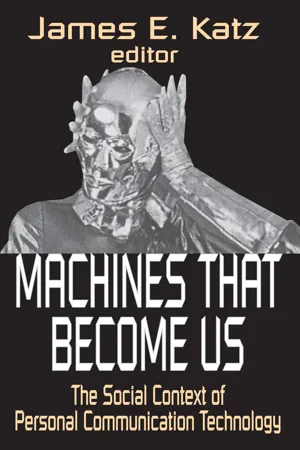
eBook - ePub
Machines That Become Us
The Social Context of Personal Communication Technology
- 346 pages
- English
- ePUB (mobile friendly)
- Available on iOS & Android
eBook - ePub
About this book
Social critics and artificial intelligence experts have long prophesized that computers and robots would soon relegate humans to the dustbin of history. Many among the general population seem to have shared this fear of a dehumanized future. But how are people in the twenty-first century actually reacting to the ever-expanding array of gadgets and networks at their disposal? Is computer anxiety a significant problem, paralyzing and terrorizing millions, or are ever-proliferating numbers of gadgets being enthusiastically embraced? Machines that Become Us explores the increasingly intimate relationship between people and their personal communication technologies.In the first book of its kind, internationally recognized scholars from the United States and Europe explore this topic. Among the technologies analyzed include the Internet, personal digital assistants (PDAs), mobile phones, networked homes, smart fabrics and wearable computers, interactive location badges, and implanted monitoring devices. The authors discuss critical policy issues, such as the problems of information resource access and equity, and the recently discovered digital dropouts phenomena.The use of the word become in the book's title has three different meanings. The first suggests how people use these technologies to broaden their abilities to communicate and to represent themselves to others. Thus the technologies become extensions and representatives of the communicators. A second sense of become applies to analysis of the way these technologies become physically integrated with the user's clothing and even their bodies. Finally, contributors examine fashion aspects and uses of these technologies, that is, how they are used in ways becoming to the wearer. The conclusions of many chapters are supported by data, including ethnographic observations, attitude surveys and case studies from the United States, Britain, France, Italy, Finland, and Norway. This approach is especially valuable
Information
1
Introduction
James E. Katz
This book examines how personal technologies, especially those related to interpersonal communication, are assimilated into people’s lives, bodies, and homes. The contributors explore the consequences of this ongoing assimilation for people’s self-images and social relationships. People through their interaction, face-to-face and with machines, create reality, and these chapters seek to understand this process more deeply.
The use of the word ‘become’ in the book’s title is used in three ways. The first is how people use these technologies to broaden their abilities to communicate and to represent themselves to others. Thus the technologies ‘become’ extensions and representatives of the communicators. A second sense of the word ‘become’ applies to the analysis of the way these technologies become physically integrated with the user’s clothing and even body. Finally, contributors examine fashion aspects and uses of these technologies, that is, to be becoming to the wearer.
Some authors have a particular interest in the ‘second skin,’ that is clothing and fashion, and the way they relate to emerging technology and potentials forms of communication. Here we wish to analyze the confluence of these elements as both a means to extend human communication capabilities (in both physical and symbolic terms), and as a subject itself of interpersonal communication. In this regard, attention will be devoted to the way individuals and groups use technology as a symbol or luxury, particularly in the context of fashion and style.
Communication technologies of interest range from the Internet and mobile phones to personal digital assistants (PDAs) and interactive badges. Also within our ambit are the communication technology environments that are being created. These include ‘smart homes’ as well as ‘information oases’ and other distributed systems. Such capabilities, at their more mundane levels, might alert individuals when it is time to take a prescription drug or buy fresh milk, and may integrate diet, purchasing, and entertainment functions. Since not only the technologies but also their mediated images are becoming an important part of socially constructed and contested environments, we want to see how these images are presented to potential consumers. A related question is how their entry into the public sphere affects discourse and sub-cultural identities and norms. Here the focus includes the use of communication technology in public space and the elaboration of style and fashion canons.
The general topic of fashion, body, and social interaction in relationship to communication technology is interesting from a theoretical viewpoint. This is because many scholars and researchers have speculated as to the relationship between the built environment—which is increasingly being built into us—and our behavior and social relationships. Yet because of the disciplinary nature of the organization of intellectual life, it is often difficult to engage in productive dialog across boundaries of intellectual specialization. Our purpose then was to bring together internationally recognized experts in the sub-areas of this theme and seek ways to create insight and new understandings. The cross-fertilization we sought is not always easy to achieve, nor are the benefits immediately clear. But given both the intriguing nature of the new issues, and their pertinence to a variety of concerned audiences, we thought it was a goal well worth pursuing.
Issues that will be explored in the chapters ahead include the way fashion, communication technology, and social and sub-group behavior affect:
- The way people live, act, and relate in both public and private space;
- Social relationships in friendship circles, and family, work, and professional environments;
- Those in the ambient social and physical environment of the user;
- The use of technologies and their symbols in personal fashion and status displays;
- The phenomenology of personal communication technology that is attached to or implanted in the human body.
The present volume grew out of a Rutgers University conference held in 2001, as was noted in the preface. That event represented a step in an intellectual journey. It is but one example of the multifaceted response to recent major changes in global activities that have reverberations throughout society. Through technological progress and market reorganization, social interaction across distance and among social networks has been increasing. This in turn has led to an enormous variety of opportunities, modes of expression and social organizations. Yet the reverberations of these forces have also raised sharp concerns at a variety of levels.
Many policymakers and critics have voiced fears about what these personal communication technologies are doing to people and societies. Their concerns range from the Individual level (do they really increase happiness or does their use cause depression?) to society’s structure (do they reduce or enhance equality of access to important political and economic opportunities?). Yet all too often, both the empirical base of knowledge and the utility of social scientific theories have been found wanting.
In response to the intellectual challenge and need for practical guidance, scholars from around the world have begun working in this area. Until recently, these attempts to gather data and pierce conceptual boundaries started from independent centers. However, there has started to be increasing cooperation in seeking an understanding about the relationships between humans and their communication tools.
Some of these efforts, sponsored by the European Union, have been aimed at improving the well-being of the citizenry. In other cases, growing out of concern about the adequacy and relevance of recent theory building efforts, particularly macro-systems theory, individual scholars have taken it upon themselves to try to organize cross-disciplinary working groups to advance beyond current conceptual categories.
One such effort was a major international conference held at Triennale di Milano, January 11-12, 2001, in Milan Italy. Its title was ‘Il corpo umano tra tecnologie, comunicazione e moda’ (The human body between technologies, communication and fashion). This event was an instance of a ‘self-organizing network’ of scholars creating itself, and was supported by a variety of organizations, including the Comune di Milano Assessorato Moda ed Eventi, Politecnico di Milano, and the Universita Degli Studi di Trieste. The Rutgers conference ‘Machines that Become Us ‘ from which the present volume is drawn, is conjoined with this earlier event. As such, it seeks to capitalize and build on that impressive event. Doubtless the Rutgers conference, the fruit of which you hold in your hands, will lead to still other efforts as scholars seek to gain an empirically based understanding of the relationship between people and their tools.
This book is organized into three sections. They are:
- Theoretical perspectives
- National and cross-cultural studies
- Subcultures, technologies and fashion
The first section on theoretical perspectives reviews recent attempts to understand the way that social scientists (and literary critics) have sought to understand the role of personal technology in people’s lives. Several of the authors then suggest new ways that this relationship could be perceived.
This section is led by the editor, James E. Katz, (chapter 2) who explores the way in which technology is integrated into people’s lives and most especially bodies. Expanding on earlier work with Eleanor Wynn (who is now an ethnographer at Intel), Katz sets forth a theoretical perspective on the relationship. Indeed, this view frames many of the chapters that follow. By emphasizing the integration of communication and other personal technology into people’s lives, homes, and bodies, he shows how people continue to modify and control their environment for their own advantage. This perspective stands in contrast to others which emphasize the special or unique characteristics of technology. The claims advanced for special or different contexts are typically seen in the works of the post-modernists, such as Turkle. Yet he points out that these issues have been visited before, even several times before. Leo Marx, and his classic book, The Machine in the Garden, is a case in point. Katz notes that even if history does not repeat itself line-by-line, it at least has a familiar melody.
Mark Aakhus (chapter three) uses data gathered (and co-interpreted) by his students to understand a puzzle uncovered by prior research suggesting that many people do not experience their information and communication technologies as solutions to their communication problems. This odd fact raises questions about conventional understandings about the relationship between communicators, their communication tools, and the communication activities they construct. This presentation reflects on preliminary findings about the role of ICTs and ‘personal communication and information infrastructures’ in the way young adults handle the time and coordination problems they experience in their living arrangements. These findings suggest that, in making sense of ICTs in everyday life, it is important to understand the everyday, practical theories people develop that mediate the material aspects of communication with idealized understandings of communication. The trajectory of ‘machines becoming us and us becoming machines’ then is subject to the emergent modes of reasoning about technology and communication available in society, such as the ‘Apparatgeist theory,’ which Aakhus also explored earlier with Katz in their co-edited volume Perpetual Contact.
Leslie G. Haddon (chapter 4) recalls how the concept of ‘domestication’ has started to achieve some currency in approaches to understanding how information and communication technologies (ICTs) find a place in our lives. As one of the creators of the terms, he probes how it derived originally from more general studies of the process of consumption, in his chapter here, he sets out how this framework can provide a useful way of bringing together a range of assumptions and perspectives of how people view their relationships with ICTs. He then explores how the concept can be seen as a precursor to the ‘machines that become us’ perspective and the utility of the new concept as a potential successor to ‘domestication’ approaches.
Chantal de Gournay and Zbigniew Smoreda (chapter 5) carefully track important changes in the way people have cycled through the use of the mobile phone technology. They consider two parallel trends (spatial localization of communication and general homomorphism of sociability) and find a paradox. At a local level, the resulting homogeneity of social circles produces a ghettolike social form. They conclude that some of the elements of the ghetto phenomenon exist, though without the cultural and ethnic characteristics of its traditional (and often pejorative) urban form. They locate the question of identity (sharing a common culture or religion) under the construct of conformity. Here they define the term as conformity to a lived situation, social status, and life-style. But they also probe the phenomenon at international levels. Here they visualize the formation of social networks based on the same status homophily principle. That is, people congregate and coalesce around identities of gender, professional affiliation, and personal taste and style. They hold that this is likely to result in the permanent co-existence of two cross-straining forms: ‘communitarianism’ on the one hand, and ‘global ghettoes’ on the other.
Leopoldina Fortunati (chapter 6) analyzes possible answers to the question: why is it that machines become us or why do we become machines? In another volume (Mediating Bodies, forthcoming) she examines premises and some social processes which push the machine into the human body. In this chapter, she further develops her theoretical exploration, asking if there is some ultimate anchoring that will permit a sense (if not necessarily a reality) of separation of body and technology. As she pursues this line of inquiry, she notes that machines are penetrating further into the body and, if the reader would permit, the soul, while at the same time the mind is exerting its will over ever-greater ranges and types of machine. She concludes that the question is not answerable partly because humans have always been a creation of both themselves and their technology. At the same time, she notes that what being human is will continue to give us godlike powers over each other and over our environment.
In the second section, the level analysis shifts to national and cross-cultural studies. The leadoff chapter is by Ronald E. Rice and James E. Katz who report on their project, called Syntopia. The Syntopia Project, briefly summarized at the beginning of their chapter, is a multi-year study that looks at the role of the Internet in access, civic and community involvement, and social interaction and expression. The project, which also involves Dr. Philip Aspden of the U.S. National Academy of Sciences, is based on nationally representative telephone surveys of Internet usage collected in 1995, 1996, 1997, and 2000. The chapter highlights these results from the perspective of dropouts, a little studied phenomenon. The terms ‘Internet dropouts’ and ‘digital dropouts’ designate a phenomenon that to many appeared not possible to exist. Yet, as demonstrated in their chapter, not only does it exist but is widespread.
Axel Franzen (chapter 8) continues the discussion of communication technology’s large-scale social effects. He notes that the Internet’s diffusion has raised concern as to how it will affect individuals’ social capital. Franzen discusses the theoretical considerations and existing empirical evidence of the Internet’s effect on people’s social involvement. He then presents one of the largest and best-designed studies to assess the empirical evidence on this question. The study, which he helped design and execute, is a longitudinal study earned out in Switzerland in 1998 and 2001. He used three measures of social involvement. Participants were asked to report the number of friends and the time they spent with friends the week before responding to the survey. The survey also contains a modified version of the UCLA Loneliness Scale. All three measures indicate that the use of the Internet does not affect people’s social involvement and also does not induce increased feelings of loneliness. The findings support the theme originally explored in 1995 by Katz and Aspden, and which have been further confirmed by much later studies.
Olga Vershinskaya (chapter 9) paints a broad empirical picture of the evolution of the ICT usage in post-perestroika Russia. She draws her insights from four surveys she conducted. She is also able to comment on and describe change in the symbolic meaning of ICTs. The stages include an initial one, the snapshot of which was taken in 1988, where there was little interest in or value placed upon ICTs. This was followed by a ‘waking up’ in the beginning of the 1990s. By the middle of the 1990s, an amazing transformation had taken place. PCs became the first priority for families that had children, and they also became symbols of success. However, somewhat surprisingly, there remained a low demand for communication services. Stratification among users and non-users appears to be a stubborn problem that will give rise to problems for years to come.
Enid Mante and Jeroen Heres (chapter 10) explore the place of the mobile phone, the Internet, and other ICTs within the domestic environment. They describe the change in positioning and integration of mobile phone and Internet in the Netherlands during the cusp between the late twentieth and early twenty-first centuries. Remarkably quick diffusion has taken place for both devices. Making use of earlier research of Katz and Batt and of quantitative data from the EURESCOM P903 research on Cross-cultural Attitudes to ICTs in everyday life, they explore the question of whether this quick adoption reflects a domestication perspective, and what the ‘machines that become us’ perspective might offer. They note that compared to the mobile phone, the Internet is being adopted much more slowly. In the view of the often ignored non-user, the mobile phone and the Internet are becoming simply acceptable ‘facts of life.’ This is true regardless whether the non-user has any immediate plans to use these technologies. They conclude that machines and new devices can clearly become accepted into our everyday lives, and that they can become not just pets in the domestic environment but part and parcel of daily routines, self-images, and, in essence, the wallpaper of life.
J. J. Beckers, Enid Mante, and H. G. Schmidt (chapter 11) used a panel method to explore how Dutch people, generally known for their quick acceptation of new technology, responded to some new ICT opportunities. They begin by noting that nearly every household has a fixed telephone connection and in over 60 percent of the households a personal computer is present. Also the number of persons that use the Internet has drastically increased in the past two years. However, a study done among the members of the Dutch KPN Test Panel indicates that the use of this new technology is not entirely anxiety free. This Test Panel is a fairly representative sample of the Dutch population with a slight overrepresentation of males and people with a senior vocational education. In this study 565 panel members participated. Though living on the whole in technologically ‘smart’ houses and having developed various skills in using the personal computer and the Internet, significant correlations have been found within the panel between sex, age, education, daily occupation, and computer anxiety. The findings suggest that with regard to the members of the Test Panel, new technology has not become domesticated yet. Though their houses appear to have become technologically smart, their residents haven’t reached that point yet. The findings also raise questions about how new technology, even today, is being introduced. To perceive oneself to be in control of this technology, the need to use it, and the measure of relaxedness are strongly correlated with a lack of anxiety. These factors could be of use as guidelines to develop ‘smart’ technology.
Truls Eric John sen (chapter 12) discusses mobile technology, and the cell phone in particular, as a gift. In this detailed ethnographic study, he traces the use of these devices among young people in Norway. One of Dr. Johnsen’s main points is that the mobile telephone acts as ‘social glue’ among teens, and therefore is understood as an important artifact in their lives. It is not just the more instrumental sides of the communication that is important, but also the exchange of expressions and greetings.
Christian Licoppe (chapter 13) compares landline with mobile phones. He notes that an important distinction includes de-c on t ex tualization in space (there is no fixed setting associated...
Table of contents
- Cover Page
- Half title
- Title Page
- Copyright
- Dedication
- Contents
- Preface
- Acknowledgements
- 1. Introduction
- Part 1: Theoretical Perspectives
- Part 2: National and Cross-Cultural Studies
- Part 3: Subcultures, Technologies, and Fashion
- Coda
- About the Editor and Contributors
- Index
Trusted by 375,005 students
Access to over 1.5 million titles for a fair monthly price.
Study more efficiently using our study tools.
Frequently asked questions
Yes, you can cancel anytime from the Subscription tab in your account settings on the Perlego website. Your subscription will stay active until the end of your current billing period. Learn how to cancel your subscription
No, books cannot be downloaded as external files, such as PDFs, for use outside of Perlego. However, you can download books within the Perlego app for offline reading on mobile or tablet. Learn how to download books offline
Perlego offers two plans: Essential and Complete
- Essential is ideal for learners and professionals who enjoy exploring a wide range of subjects. Access the Essential Library with 800,000+ trusted titles and best-sellers across business, personal growth, and the humanities. Includes unlimited reading time and Standard Read Aloud voice.
- Complete: Perfect for advanced learners and researchers needing full, unrestricted access. Unlock 1.5M+ books across hundreds of subjects, including academic and specialized titles. The Complete Plan also includes advanced features like Premium Read Aloud and Research Assistant.
We are an online textbook subscription service, where you can get access to an entire online library for less than the price of a single book per month. With over 1.5 million books across 990+ topics, we’ve got you covered! Learn about our mission
Look out for the read-aloud symbol on your next book to see if you can listen to it. The read-aloud tool reads text aloud for you, highlighting the text as it is being read. You can pause it, speed it up and slow it down. Learn more about Read Aloud
Yes! You can use the Perlego app on both iOS and Android devices to read anytime, anywhere — even offline. Perfect for commutes or when you’re on the go.
Please note we cannot support devices running on iOS 13 and Android 7 or earlier. Learn more about using the app
Please note we cannot support devices running on iOS 13 and Android 7 or earlier. Learn more about using the app
Yes, you can access Machines That Become Us by James E. Katz in PDF and/or ePUB format, as well as other popular books in Social Sciences & Artificial Intelligence (AI) & Semantics. We have over 1.5 million books available in our catalogue for you to explore.