This collection of essential data on eleven Asian economies outlines new trends and highlighting increasing differences between developed and developing countries. The book features a detailed analysis of the state of the construction industry and its economic effects in Australia, China Mainland, China Hong Kong, India, Indonesia, Japan, South Korea, Philippines, Singapore, Sri Lanka and Vietnam.
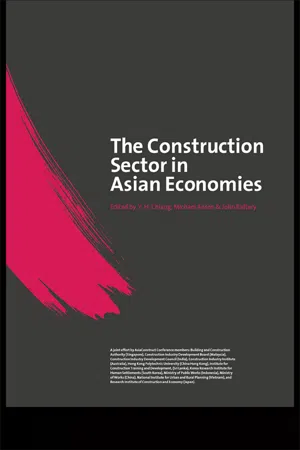
- 512 pages
- English
- ePUB (mobile friendly)
- Available on iOS & Android
eBook - ePub
The Construction Sector in the Asian Economies
Chapter 1: Regional overview
J. Raftery, M. Anson, Y.H. Chiang and S. Sharma
1.1 Setting the scene
Following the Chinese government’s announcement of its 20 billion dollars accelerated building programme upon being selected as a host for the 2008 summer Olympics, one newspaper wrote ‘the news brought jubilant celebrations among the Chinese soccer fans, this also brought smiles to the lips of consultants, contractors and suppliers across geographic boundaries’. Globalization, advances in technology and changes in the structure of the global economy are presenting new challenges to the US$3.22 trillion construction industry worldwide (Reina and Tim, 2000).
Until 2002, in the last 15 years, the Asian region’s construction industry had grown dramatically, as had its economy, productivity, and investment in research and development (R&D). The region’s construction production was valued at over US$1000 billion in the 1990s, the number of employees running into millions. The eleven countries spent $910 billion in 1997 as construction sector investment even though the combined GDP of all ten countries (as of 2002 prices) was less than three quarters of that of the United States in the same year. Japan unequivocally tops in terms of the GDP, its construction spending, as well as the level of technology in Asia. The Asian construction market is the largest overseas market for Japanese construction companies, as about 70 per cent of the sum total of overseas construction orders in fiscal 2000 came from Asia. However several Asian countries are emulating Japan in developing their economies by increasing their capacities in high technology, and by developing a skilled labour force and better social and physical infrastructure. Resources are being devoted to high technology production, processing and distribution, including improving the quality and skills of the construction labour force.
The survey presented in this book represents the construction sector in ten participating countries of the AsiaConstruct group – Australia, the People’s Republic of China (China), India, Indonesia, Japan, the Republic of Korea (South Korea), Malaysia, Singapore, Sri Lanka and Vietnam, plus Hong Kong, the Special Administrative Region of China. The AsiaConstruct Conference is modelled on EuroConstruct. However, Asia is no less, if not more, diverse than Europe in a number of social-economic and political ways. Whilst Europe has its European Currency Unit, different Asian countries have different currencies, languages, cultures, legal and government systems. Even Hong Kong is so different from its motherland, China, that its capitalist way of living is guaranteed until 2047 under the ‘one country, two systems’ principle. What follows is a cross-sectional study of the Asian construction sector covering a time-series beginning in the early 1990s.
1.2 The macroeconomy
1.2.1 Asia boom Asia bust
The economic landscape has changed quite dramatically over the 1990s both in Asia and internationally. The experiences in Asia in the 1990s however were mind boggling. The economic growth and subsequently the construction sector in many Asian economies have seemed to have much to do with Japan. With the benefit of hindsight, it is now clear that the Japanese economic boom of the late 1980s led to an unsustainable bubble in asset prices not only in Japan but across the Asian region as well. Mera and Renaud (2000a) attributed the massive direct and portfolio investment in these economies initially to the appreciation of the yen after the Plaza Agreement of 1985 and then to her economic stagnation after the collapse of her stock and property markets. Initially Japanese firms had to find cheaper production bases in many Asian countries, thus contributing to the economic growth of these countries. Later, not only global but also Japanese investors needed to look outside Japan for investment opportunities in Asia. Many Asian economies were showing high economic growth rates (World Bank, 1993) as a result of the direct investment and booming trade, becoming targets of global ‘hot’ money.
Mera and Renaud (2000a) noted the correlation between this massive influx of direct investment to Asian economies and their economic growth between 1990 and 1996, especially when compared with the stagnation of the Japanese economy. The property boom and the immense investment in infrastructure projects across the region grew out of this environment. However, when massive capital flows, themselves much the result of deregulation and globalization of capital markets, met with imprudent and even corrupt banking practices, and again with the benefit of hindsight, property busts could only be inevitable. In the middle of 1997, Thailand fought to defend her exchange rate in vain and was forced to let the Thai baht suffer a very sharp downturn. The rest, as they say, is history.
The bursting of that bubble in the late 1990s ushered in a period of uncertainty, confusion and crisis. This, however, also presented an opportunity for correction to the economic overdrive experienced in the 1990s. The economic crisis and its reverberations had continued to be the primary focus of attention for some years. The property sector, and consequently the construction sector, will continue to experience its boom and bust. Its volatility is not expected to diminish as the capital markets become more fully integrated with each other and globalized. There is a need to understand the structure of the Asian property and construction market so that a clearer background could provide better insight for a better understanding of the fundamentals. This in turn will benefit the formulation and implementation of various institutions and strategies to tame the cycles and to improve the competitiveness and productivity of the sector within individual economies.
1.2.2 Economic recovery: not a mere economic euphoria
Nevertheless, there was growing evidence that economic recovery among the crisis-hit countries had entered a more positive phase from the first or second quarter of 1999. Several countries had experienced a deep contraction in output and employment during 1998. The economies of China and India were able to sustain their surprising vigour even during the turmoil of 1998 but with few signs of a breakthrough on the domestic fiscal front or in the renewal of foreign investor confidence. In other countries experience has been mixed. Within the region, economic growth varied between countries as illustrated in Table 1.1. In countries that saw a remarkably sustained growth throughout the 1990s, recovery from the crisis was fairly rapid demonstrating the resilience of the economies and also a favourable external environment that permitted strong export-led recovery. Particularly noteworthy is the resilience of the Chinese and Indian economies and their undiluted strength that seems to have played a significant role in the rapid turnaround of the crisis in Asia.
Economic growth remained strong, averaging 7.3 per cent across the region, as domestic demand for investment and consumer goods continued to rise. The transition economies of China and Vietnam expanded most rapidly in 1996 by 9.7 and 9.0 per cent respectively. Malaysia and Indonesia followed, with growth rates of 8.2 and 7.8 per cent respectively. Policy makers of the two large economies of China and India continued to keep inflation in check by tightening money supply and price controls on some crucial products. China tamed its inflation rate to 6.1 per cent from 14.8; India managed to pare inflation to 8.5 per cent from 10.3 on average. Korea’s economic recovery had been remarkable. GDP growth recorded 10.7 and 8.8 per cent in 1999 and 2000 respectively.
Table 1.2 presents macroeconomic indicators as a preview to countries’ economic performance. There is a point of caution: indicators such as unemployment rate vary in definition from country to country and the numbers themselves may not be directly comparable. The historical overview suggests the effects of financial crisis were deeply entrenched in the country’s employment in almost all countries. Macroeconomic developments in Asia in the 1990s had turned out to be more favourable in many ways than would have been expected at the beginning of the decade with economic growth averaging at 3–5 per cent, the unemployment levels by contrast were not so good and unemployment continued rising unabated even as the economies began to recover.
Table 1.1 Asia-Pacific: real GDP growth (annual per cent change)
Table 1.2 Asia-Pacific: macroeconomic indicators (mean value, 1995–2001)
Current account deficits in most countries had been widened, giving rise to concern from foreign lenders and investors in the past 7 years, until 2002. However, prospects for reform remained strong in the original ASEAN economies such as the Philippines, Indonesia, Singapore and Malaysia. These nations had not only concentrated on lowering trade barriers and investment hurdles, but also agreed to establish a formal framework for financial cooperation. Envisaged first and foremost as a safety mechanism, the framework is expected to serve later as a foundation for a joint monetary market. Privatization continued to advance slowly and unevenly because the authorities in most of Asia were uncertain that the hoped-for economic benefits and efficiency gains would outweigh the negative social implications of large layoffs.
On the general foreign investment front, the increased flexibility of rules and regulations had contributed to the continuation of fairly large inflows and to the growth of intra-regional investments. China continued to attract over US$40 billion as FDI consistently every year after 1997. While foreign investor interest remains strong, the prospects for implementing many investment proposals will be determined not only by high domestic growth and favourable global market conditions, but also by improvements in the institutional framework, including the protection of property rights, the creation of regulatory agencies to supervise previously publicly owned service monopolies, a stable and transparent tax and incentive regime, and price and trade liberalization. This also applies to the other countries in the study.
One of the enduring features of the Asian economic landscape over the past decades had been the gradual implementation of the widespread programme of microeconomic reform. The major reforms include dismantling of barriers to foreign trade, financial deregulation, corporatization and privatization of the government business enterprises including new regulatory arrangements.
It was observed that such reforms initiated during the period had helped create a rather comprehensive legal framework, in parallel with the strong deployment of strategy, planning and development orientation, thereby contributing significantly to the upgrade of sector management efficiency at the macro level. Production forces had been rearranged. General corporations and strong companies had been established and consolidated for continued intensive investment in order to renovate technologies, increase production capacities, and boost competitiveness of the sector products, thus preparing the necessary prerequisites towards regional and international economic integration in the next period. In terms of structural changes, China joined the WTO thereby committing to a wide range of reforms. The benefits of these reforms will be felt in the medium and long term in the construction industry. In Australia, the implementation of GST heralded the beginning of the new set of reforms.
1.2.3 Economic outlook for the decade
Asia experienced a golden decade of uninterrupted high growth between 1986 and 1996, in the context of rapid development over the last 40 years, until 2002. A massive inflow of funds from the developed world during the sustained boom eventually led to substantial oversupply in many sectors, and to an extraordinary bust. Over the decade before the crisis, the emerging economies of Asia averaged real GDP growth rates of 8–9 per cent per year.
Table 1.3 Asia-Pacific: real GDP growth (annual per cent change)
In the decade 2001–2010, this average annual growth rate is expected to fall back to 5–6 per cent per year as shown in Table 1.3. There are a few basic reasons. Structural problems, particularly in the corporate sector, will take many years to resolve. Lack of progress on reform will affect fickle investor/financial market confidence (leading to reduced inflow of funds) and financial constraints on business will linger. The rate of capital accumulation/inflow, which drove the last boom, is not expected to return to pre-crisis levels in the near future. Importantly, there was less scope for labour force growth, and productivity and technological gains. Asia increasingly competes with the developed world, rather than simply being a cheaper place to undertake labour-intensive tasks. It is rapidly ‘closing the gap’ and growth will trend down to developed-economy levels.
The setback of 2002 brought about by the financial crisis in 1997 had forced the governments across the region to face up to some tough issues of business and political culture, the rationalization and reform of financial sectors, and increases in foreign ownership limits. The countries which remain the strongest in the long term will be those which have removed these types of distractions from doing business, and allow the natural advantages of low costs, good infrastructure and education standards to come to the fore.
1.2.4 The property cycle
The performance of the Asian property market was drastically affected by the economic crisis of 1997/98 with recovery hinging on a revival of foreign investment in the region, which in turn, will be reliant on an improved risk/return profile and increased attractiveness of business potential. The economic indicators showed positive signs towards the recovery of the regional economy and property industry. Some property sectors have shown early recovery signs, as indicated by the increase in the Jakarta retail occupancy rate, which reached 88.2 per cent at the end of 1999, reflecting an increase of 7.9 per cent from 1998. However, property prices in Hong Kong were beset with negative equities, which showed no sign of improving. In Japan, the greying population, the uncertainty about the ‘Japan Inc’ and the banks’ inability to extend loans have collectively caused the continuous slide in property prices and prevented the recovery of the property sector (Mera and Heikkila, 2000). These problems were structural in nature and not easy to fix. It is difficult to generalise about the current and future state of property markets. Each is at a different point in the property cycle and each will be influenced in the future by different supply/demand relationships.
Although the regional property markets operate independently of each other in supply and demand, there have been broad similarities in cyclical movements over the 1990s. In the late 1980s high construction levels occurred, as a result of rising rents amid an anticipation of boom times. The high construction levels, coupled with stagnant demand by the early 1990s, led to oversupply of varying degrees in each of these countries, and rental levels began to fall. During this period construction activity remained high as a result of the overhang from the boom, and the time lag in realising that supply was well ahead of demand up until the financial crisis in 1997. In general, while Asian economies had recovered somewhat, the construction industry was flat on its back, primarily a consequence of the construction boom of 1997. Industry analysts said that it would take 2–5 years to fill up the existing supply of office towers, upscale shopping complexes and luxury housing. Indonesia had a huge stock of empty buildings and the government had had marginal impact in turning this situation around, not only because of the political turmoil.
Prices in many Asian cities were much closer to economic fundamentals than before the crisis, reports the Asian Development Outlook, a publication of the ADB. The words ‘negative equity’ are sending shudders down the backs of government and property developers alike in Hong Kong as even in 1998 – well into the financial crisis – prime downtown land in Hong Kong, China and Tokyo was selling for more than $100,000 a square metre. Prices of high-end condominium units in Malaysia and the Philippines fell by as much as 40–50 per cent in some locations from their 1997 peak values. In dollar terms, office rental rates in 12 Asian cities fell by an average of 34 per cent. Indonesia, which experienced the steepest depreciation (83 per cent), had the second sharpest drop in rents. The transaction activity in Malaysia contracted up to 47.6 per cent in value, despite a low prime office rents decline (lower than 10 per cent) in 1998. In the Philippines average rents in the CBD’s best buildings discounted by as much as 35 per cent towards the end of 2000.
Market inefficiencies account for some differences between major cities rather than exchange rate movements. If rents are not allowed to fall with declining demand, either because of regulations or because landowners restrict supply, then commercial space may go unoccupied. Occupancy rates close to 50 per cent in Shanghai and Hanoi suggest that markets in those cities are not allowed to clear (ADB, 1999).
Property industry is the upstream industry of the construction sector, and the housing sector has been considered as a major economic stimulant (Mera and Heikkila, 2000, The Economist, 2002a). The cases of the property sector in many Asian economies have also demonstrated the close linkage between the property and the capital markets (Mera and Renaud, 2000b; The Economist 2002b). There is certainly much room for intra-regional cooperation in improving the governance and transparency in the capital markets and particularly the banking sector of most of the Asian economies. Improved information and market efficiency are instrumental in getting back the confidence of the investment community. Only then will the property and subsequently the construction sectors finally benefit from a return of capital inflows, businessmen and house-buyers.
1.3 The construction industry
1.3.1 The asian construction sector
Because of the massive domestic construction undertaken by Japan, Asia had always been a major construction market in terms of spending and growth. Low (1991a) identified that over a 15-year period between 1970 and 1984, Asia was the third largest region after North America and Western Europe in terms of construction spending. In addition, all the four sub-regions (West Asia, South East Asia, South Asia and East Asia) had average annual growth rates that were more than the average of all 19 sub-regions under survey. In particular, Hong Kong, Indonesia, Malaysia, Singapore and South Korea all had average annual growth that was value-added by construction of more than 20 per cent, thus putting them in the highest of the six growth categories (Low, 1991b).
Based on annual surveys conducted by Engineering News Record, Bon and Crosthwaite (2000) showed that in 1998, Japan had the second highest level construction spending after the US. On a per capita basis, Japan spent the most. In terms of total construction spendi...
Table of contents
- Cover Page
- Title Page
- Copyright Page
- Figures
- Tables
- Foreword
- Chapter 1: Regional overview
- Chapter 2: Australia
- Chapter 3: China mainland
- Chapter 4: China Hong Kong
- Chapter 5: India
- Chapter 6: Indonesia
- Chapter 7: Japan
- Chapter 8: Malaysia
- Chapter 9: Singapore
- Chapter 10: South Korea
- Chapter 11: Sri Lanka
- Chapter 12: Vietnam
Trusted by 375,005 students
Access to over 1.5 million titles for a fair monthly price.
Study more efficiently using our study tools.
Frequently asked questions
Yes, you can cancel anytime from the Subscription tab in your account settings on the Perlego website. Your subscription will stay active until the end of your current billing period. Learn how to cancel your subscription
No, books cannot be downloaded as external files, such as PDFs, for use outside of Perlego. However, you can download books within the Perlego app for offline reading on mobile or tablet. Learn how to download books offline
Perlego offers two plans: Essential and Complete
- Essential is ideal for learners and professionals who enjoy exploring a wide range of subjects. Access the Essential Library with 800,000+ trusted titles and best-sellers across business, personal growth, and the humanities. Includes unlimited reading time and Standard Read Aloud voice.
- Complete: Perfect for advanced learners and researchers needing full, unrestricted access. Unlock 1.5M+ books across hundreds of subjects, including academic and specialized titles. The Complete Plan also includes advanced features like Premium Read Aloud and Research Assistant.
We are an online textbook subscription service, where you can get access to an entire online library for less than the price of a single book per month. With over 1.5 million books across 990+ topics, we’ve got you covered! Learn about our mission
Look out for the read-aloud symbol on your next book to see if you can listen to it. The read-aloud tool reads text aloud for you, highlighting the text as it is being read. You can pause it, speed it up and slow it down. Learn more about Read Aloud
Yes! You can use the Perlego app on both iOS and Android devices to read anytime, anywhere — even offline. Perfect for commutes or when you’re on the go.
Please note we cannot support devices running on iOS 13 and Android 7 or earlier. Learn more about using the app
Please note we cannot support devices running on iOS 13 and Android 7 or earlier. Learn more about using the app
Yes, you can access The Construction Sector in the Asian Economies by Michael Anson,Y.H. Chiang,John Raftery in PDF and/or ePUB format, as well as other popular books in Business & Architecture General. We have over 1.5 million books available in our catalogue for you to explore.