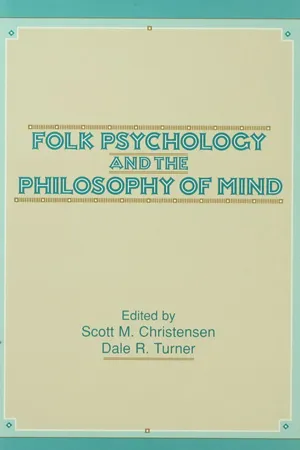
Within the past ten years, the discussion of the nature of folk psychology and its role in explaining behavior and thought has become central to the philosophy of mind. However, no comprehensive account of the contemporary debate or collection of the works that make up this debate has yet been available. Intending to fill this gap, this volume begins with the crucial background for the contemporary debate and proceeds with a broad range of responses to and developments of these works -- from those who argue that "folk theory" is a misnomer to those who regard folk theory as legitimately explanatory and necessary for any adequate account of human behavior.
Intended for courses in the philosophy of mind, psychology, and science, as well as anthropology and social psychology, this anthology is also of great value in courses focusing on folk models, eliminative materialism, explanation, psychological theory, and -- in particular -- intentional psychology. It is accessible to both graduate students and upper-division undergraduate students of philosophy and psychology as well as researchers. As an aid to students, a thorough discussion of the field and the articles in the anthology is provided in the introduction; as an aid to researchers, a complete bibliography is also provided.
- 472 pages
- English
- ePUB (mobile friendly)
- Available on iOS & Android
eBook - ePub
Folk Psychology and the Philosophy of Mind
About this book
Information
Publisher
Psychology PressYear
2013Print ISBN
9780805809312
9781138411678
Edition
1eBook ISBN
9781134993727
II
THE CASE AGAINST THE CASE AGAINST BELIEF
7
Three Kinds of Intentional Psychology*
FOLK PSYCHOLOGY AS A SOURCE OF THEORY
Suppose you and I both believe that cats eat fish. Exactly what feature must we share for this to be true of us? More generally, recalling Socrates’ favorite style of question, what must be in common between things truly ascribed an intentional predicate – such as “wants to visit China” or “expects noodles for supper”? As Socrates points out, in the Meno and elsewhere, such questions are ambiguous or vague in their intent. One can be asking on the one hand for something rather like a definition, or on the other hand for something rather like a theory. (Socrates of course preferred the former sort of answer.) What do all magnets have in common? First answer: they all attract iron. Second answer: they all have such-and-such a microphysical property (a property that explains their capacity to attract iron). In one sense people knew what magnets were – they were things that attracted iron – long before science told them what magnets were. A child learns what the word “magnet” means not, typically, by learning an explicit definition, but by learning the “folk physics” of magnets, in which the ordinary term “magnet” is embedded or implicitly defined as a theoretical term.
Sometimes terms are embedded in more powerful theories, and some-times they are embedded by explicit definition. What do all chemical elements with the same valence have in common? First answer: they are disposed to combine with other elements in the same integral ratios. Second answer: they all have such-and-such a microphysical property (a property which explains their capacity so to combine). The theory of valences in chemistry was well in hand before its microphysical explanation was known. In one sense chemists knew what valences were before physicists told them.
So what appears in Plato to be a contrast between giving a definition and giving a theory can be viewed as just a special case of the contrast between giving one theoretical answer and giving another, more “reductive” theoretical answer. Fodor (1975) draws the same contrast between “conceptual” and “causal” answers to such questions and argues that Ryle (1949) champions conceptual answers at the expense of causal answers, wrongly supposing them to be in conflict. There is justice in Fodor's charge against Ryle, for there are certainly many passages in which Ryle seems to propose his conceptual answers as a bulwark against the possibility of any causal, scientific, psychological answers, but there is a better view of Ryle's (or perhaps at best a view he ought to have held) that deserves rehabilitation. Ryle's “logical behaviorism” is composed of his steadfastly conceptual answers to the Socratic questions about matters mental. If Ryle thought these answers ruled out psychology, ruled out causal (or reductive) answers to the Socratic questions, he was wrong, but if he thought only that the conceptual answers to the questions were not to be given by a microreductive psychology, he was on firmer ground. It is one thing to give a causal explanation of some phenomenon and quite another to cite the cause of a phenomenon in the analysis of the concept of it.
Some concepts have what might be called an essential causal element (see Fodor 1975, p. 7, n6). For instance, the concept of a genuine Winston Churchill autograph has it that how the trail of ink was in fact caused is essential to its status as an autograph. Photocopies, forgeries, inadvertently indistinguishable signatures – but perhaps not carbon copies – are ruled out. These considerations are part of the conceptual answer to the Socratic question about autographs.
Now some, including Fodor, have held that such concepts as the concept of intelligent action also have an essential causal element; behavior that appeared to be intelligent might be shown not to be by being shown to have the wrong sort of cause. Against such positions Ryle can argue that even if it is true that every instance of intelligent behavior is caused (and hence has a causal explanation), exactly how it is caused is inessential to its being intelligent – something that could be true even if all intelligent behavior exhibited in fact some common pattern of causation. That is, Ryle can plausibly claim that no account in causal terms could capture the class of intelligent actions except per accidens. In aid of such a position – for which there is much to be said in spite of the current infatuation with causal theories – Ryle can make claims of the sort Fodor disparages (“it's not the mental activity that makes the clowning clever because what makes the clowning clever is such facts as that it took place out where the children can see it”) without committing the error of supposing causal and conceptual answers are incompatible.1
Ryle's logical behaviorism was in fact tainted by a groundless anti-scientific bias, but it need not have been. Note that the introduction of the concept of valence in chemistry was a bit of logical chemical behaviorism: to have valence n was “by definition” to be disposed to behave in such-and-such ways under such-and-such conditions, however that disposition to behave might someday be explained by physics. In this particular instance the relation between the chemical theory and the physical theory is now well charted and understood – even if in the throes of ideology people sometimes misdescribe it – and the explanation of those dispositional combinatorial properties by physics is a prime example of the sort of success in science that inspires reductionist doctrines. Chemistry has been shown to reduce, in some sense, to physics, and this is clearly a Good Thing, the sort of thing we should try for more of.
Such progress invites the prospect of a parallel development in psychology. First we will answer the question “What do all believers-that-p have in common?” the first way, the “conceptual” way, and then see if we can go on to “reduce” the theory that emerges in our first answer to something else – neurophysiology most likely. Many theorists seem to take it for granted that some such reduction is both possible and desirable, and perhaps even inevitable, even while recent critics of reductionism, such as Putnam and Fodor, have warned us of the excesses of “classical” reductionist creeds. No one today hopes to conduct the psychology of the future in the vocabulary of the neurophysiologist, let alone that of the physicist, and principled ways of relaxing the classical “rules” of reduction have been proposed. The issue, then, is what kind of theoretical bonds can we expect – or ought we to hope – to find uniting psychological claims about beliefs, desires, and so forth with the claims of neurophysiologists, biologists, and other physical scientists?
Since the terms “belief and “desire” and their kin are parts of ordinary language, like “magnet,” rather than technical terms like “valence,” we must first look to “folk psychology” to see what kind of things we are being asked to explain. What do we learn beliefs are when we learn how to use the words “believe” and “belief”? The first point to make is that we do not really learn what beliefs are when we learn how to use these words.2 Certainly no one tells us what beliefs are, or if someone does, or if we happen to speculate on the topic on our own, the answer we come to, wise or foolish, will figure only weakly in our habits of thought about what people believe. We learn to use folk psychology as a vernacular social technology, a craft; but we don't learn it self-consciously as a theory – we learn no metatheory with the theory – and in this regard our knowledge of folk psychology is like our knowledge of the grammar of our native tongue. This fact does not make our knowledge of folk psychology entirely unlike human knowledge of explicit academic theories, however; one could probably be a good practicing chemist and yet find it embarrassingly difficult to produce a satisfactory textbook definition of a metal or an ion.
There are no introductory textbooks on folk psychology (although Ryle's The Concept of Mind might be pressed into service), but many explorations of the field have been undertaken by ordinary language philosophers (under slightly different intentions) and more recently by more theoretically minded philosophers of mind, and from all this work an account of folk psychology – part truism and the rest controversy – can be gleaned. What are beliefs? Very roughly, folk psychology has it that beliefs are information-bearing states of people that arise from perceptions and that, together with appropriately related desires, lead to intelligent action. That much is relatively uncontroversial, but does folk psychology also have it that nonhuman animals have beliefs? If so, what is the role of language in belief? Are beliefs constructed of parts? If so, what are the parts? Ideas? Concepts? Words? Pictures? Are beliefs like speech acts or maps or instruction manuals or sentences? Is it implicit in folk psychology that beliefs enter into causal relations, or that they don't? How do decisions and intentions intervene between belief-desire complexes and actions? Are beliefs introspectible, and if so, what authority do the believer's pronouncements have?
All these questions deserve answers, but one must bear in mind that there are different reasons for being interested in the details of folk psychology. One reason is that it exists as a phenomenon, like a religion or a language or a dress code, to be studied with the techniques and attitudes of anthropology. It may be a myth, but it is a myth we live in, so it is an “important” phenomenon in nature. A different reason is that it seems to be a true theory, by and large, and hence is a candidate – like the folk physics of magnets and unlike the folk science of astrology – for incorporation into science. These different reasons generate different but overlapping investigations. The anthropological question should include in its account of folk psychology whatever folk actually include in their theory, however misguided, incoherent, gratuitous some of it may be. (When the anthropologist marks part of the catalogue of folk theory as false, he may speak of false consciousness or ideology, but the role of such false theory qua anthropological phenomenon is not thereby diminished.) The proto-scientific quest, on the other hand, as an attempt to prepare folk theory for subsequent incorporation into, or reduction to, the rest of science, should be critical and should eliminate all that is false or ill founded, however well entrenched in popular doctrine. (Thales thought that lodestones had souls, we are told. Even if most people agreed, this would be something to eliminate from the folk physics of magnets prior to “reduction.”) One way of distinguishing the good from the bad, the essential from the gratuitous, in folk theory is to see what must be included in the theory to account for whatever predictive or explanatory success it seems to have in ordinary use. In this way we can criticize as we analyze, and it is even open to us in the end to discard folk psychology if it turns out to be a bad theory, and with it the presumed theoretical entities named therein. If we discard folk psychology as a theory, we would have to replace it with another theory, which, while it did violence to many ordinary intuitions, would explain the predictive power of the residual folk craft.
We use folk psychology all the time, to explain and predict each other's behavior; we attribute beliefs and desires to each other with confidence – and quite unself-consciously – and spend a substantial portion of our waking lives formulating the world – not excluding ourselves – in these terms. Folk psychology is about as pervasive a part of our second nature as is our folk physics of middle-sized objects. How good is folk psychology? If we concentrate on its weaknesses we will notice that we often are unable to make sense of particular bits of human behavior (our own included) in terms of belief and desire, even in retrospect; we often cannot predict accurately or reliably what a person will do or when; we often can find no resources within the theory for settling disagreements about particular attributions of belief or desire. If we concentrate on its strengths we find first that there are large areas in which it is extraordinarily reliable in its predictive power. Every time we venture out on a highway, for example, we stake our lives on the reliability of our general expectations about the perceptual beliefs, normal desires, and decision proclivities of the other motorists. Second, we find that it is a theory of great generative power and efficiency. For instance, watching a film with a highly original and unstereotypical plot, we see the hero smile at the villain and we all swiftly and effortlessly arrive at the same complex theoretical diagnosis: “Aha!” we conclude (but perhaps not consciously), “he wants her to think he doesn't know she intends to defraud his brother!” Third, we find that even small children pick up facility with the theory at a time when they have a very limited experience of human activity from which to induce a theory. Fourth, we find that we all use folk psychology knowing next to nothing about what actually happens inside people's skulls. “Use your head,” we are told, and we know some people are brainier than others, but our capacity to use folk psychology is quite unaffected by ignorance about brain processes – or even by large-scale misinformation about brain processes.
As many philosophers have observed, a feature of folk psychology that sets it apart from both folk physics and the academic physical sciences is that explanations of actions citing beliefs and desires normally not only describe the provenance of the actions, but at the same time defend them as reasonable under the circumstances. They are reason-giving explanations, which make an ineliminable allusion to the rationality of the agent. Primarily for this reason, but also because of the pattern of strengths and weaknesses just described, I suggest that folk psychology might best be viewed as a rationalistic calculus of interpretation and prediction – an idealizing, abstract, instrumentalistic interpretation method that has evolved because it works and works because we have evolved. We approach each other as intentional systems (Dennett 1971), that is, as entities whose behavior can be predicted by the method of attributing beliefs, desires, and rational acumen according to the following rough and ready principles:
(1) A system's beliefs are those it ought to have, given its perceptual capacities, its epistemic needs, and its biography. Thus, in general, its beliefs are both true and relevant to its life, and when false beliefs are attributed, special stories must be told to explain how the error resulted from the presence of features in the environment that are deceptive relative to the perceptual capacities of the system.
(2) A system's desires are those it ought to have, given its biological needs and the most practicable means of satisfying them. Thus intentional systems desire survival and procreation, and hence desire food, security, health, sex, wealth, power, influence, and so forth, and also whatever local arrangements tend (in their eyes – given their beliefs) to further these ends in appropriate measure. Again, “abnormal” desires are attributable if special stories can be told.
(3) A system's behavior will consist of those acts that it would be rational for an agent with those beliefs and desires to perform.
In (1) and (2)“ought to have” means “would have if it were ideally ensconced in its environmental niche.” Thus all dangers and vicissitudes in its environment it will recognize as such (i.e., believe to be dangers) and all the benefits – relative to its needs, of course – it will...
Table of contents
- Cover Page
- Half Title Page
- Title Page
- Copyright Page
- Dedication
- Contents
- Contributors
- Acknowledgments
- Introduction
- I The Elimination of Folk Psychology
- II The Case Against the Case Against Belief
- III Connectionism:The Death of Folk psychology?
- References
- Author Index
- Subject Index
Trusted by 375,005 students
Access to over 1.5 million titles for a fair monthly price.
Study more efficiently using our study tools.
Frequently asked questions
Yes, you can cancel anytime from the Subscription tab in your account settings on the Perlego website. Your subscription will stay active until the end of your current billing period. Learn how to cancel your subscription
No, books cannot be downloaded as external files, such as PDFs, for use outside of Perlego. However, you can download books within the Perlego app for offline reading on mobile or tablet. Learn how to download books offline
Perlego offers two plans: Essential and Complete
- Essential is ideal for learners and professionals who enjoy exploring a wide range of subjects. Access the Essential Library with 800,000+ trusted titles and best-sellers across business, personal growth, and the humanities. Includes unlimited reading time and Standard Read Aloud voice.
- Complete: Perfect for advanced learners and researchers needing full, unrestricted access. Unlock 1.5M+ books across hundreds of subjects, including academic and specialized titles. The Complete Plan also includes advanced features like Premium Read Aloud and Research Assistant.
We are an online textbook subscription service, where you can get access to an entire online library for less than the price of a single book per month. With over 1.5 million books across 990+ topics, we’ve got you covered! Learn about our mission
Look out for the read-aloud symbol on your next book to see if you can listen to it. The read-aloud tool reads text aloud for you, highlighting the text as it is being read. You can pause it, speed it up and slow it down. Learn more about Read Aloud
Yes! You can use the Perlego app on both iOS and Android devices to read anytime, anywhere — even offline. Perfect for commutes or when you’re on the go.
Please note we cannot support devices running on iOS 13 and Android 7 or earlier. Learn more about using the app
Please note we cannot support devices running on iOS 13 and Android 7 or earlier. Learn more about using the app
Yes, you can access Folk Psychology and the Philosophy of Mind by Scott M. Christensen,Dale R. Turner in PDF and/or ePUB format, as well as other popular books in Psychology & History & Theory in Psychology. We have over 1.5 million books available in our catalogue for you to explore.