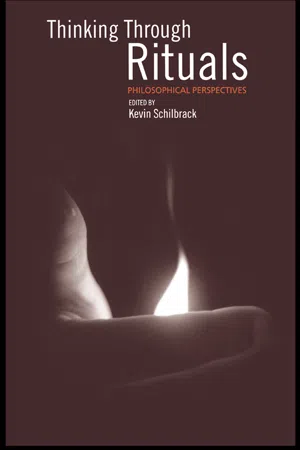
Many philosophical approaches today seek to overcome the division between mind and body. If such projects succeed, then thinking is not restricted to the disembodied mind, but is in some sense done through the body. From a post-Cartesian perspective, then, ritual activities that discipline the body are not just thoughtless motions, but crucial parts of the way people think.
Thinking Through Rituals explores religious ritual acts and their connection to meaning and truth, belief, memory, inquiry, worldview and ethics. Drawing on philosophers such as Foucault, Merleau-Ponty and Wittgenstein, and sources from cognitive science, pragmatism and feminist theory, it provides philosophical resources for understanding religious ritual practices like the Christian Eucharistic ceremony, Hatha Yoga, sacred meditation or liturgical speech.
Its essays consider a wide variety of rituals in Christianity, Judaism, Hinduism and Buddhism - including political protest rituals and gay commitment ceremonies, traditional Vedic and Yogic rites, Christian and Buddhist meditation and the Jewish Shabbat. They challenge the traditional disjunction between thought and action, showing how philosophy can help to illuminate the relationship between doing and meaning which ritual practices imply.
- 288 pages
- English
- ePUB (mobile friendly)
- Available on iOS & Android
eBook - ePub
About this book
Information
1
Ritual, body technique, and (inter) subjectivity
Nick Crossley
I.
Introduction
It is one of the most obvious features of rituals that they are “embodied,” that is, that we do them and that this “doing” is a bodily act. Rituals involve gestures, postures, dances, patterns of movement. If we are to make sense of rituals, it follows, we need to engage with this corporeality; that is, we need to make sense of rituals specifically as embodied practices. Until recently, this would have been difficult for philosophers and social scientists. With a few notable and important exceptions, “the body” and “embodiment” were not thematized or explored to any great extent within philosophical and social scientific discourse in the past. Tides have, however, turned. A multitude of perspectives now compete over the truths of corporeal life.
In this chapter, building upon earlier work on embodiment (esp. Crossley 1995, 2001), I seek to elucidate the nature of ritual, qua embodied practice. The perspective I use for this analysis combines insights from the phenomenology of Maurice Merleau-Ponty (1962, 1965), the sociology of Émile Durkheim (1915) and Marcel Mauss (1979), and the pioneering work of Pierre Bourdieu—which itself pulls together the insights of the other two camps. Through the tools that these different theorists provide, I hope to be able to reveal that and how rituals embody the practical wisdom of the individuals who perform them and the societies from which they derive. Rituals, I will argue, are a form of embodied practical reason.
The interplay of sociology and philosophy, or more specifically phenomenology, within the paper will, I hope, demonstrate both the respective value of these approaches and one of the key ways in which they can be made to work together in a mutually informing manner. Specifically, as this paper belongs to a collection on philosophical conceptions of ritual, I hope that the paper demonstrates how phenomenological philosophy allows us simultaneously to clarify, deepen, and question concepts and analyses that have been generated within a more sociological framework. Phenomenology can dissect and unravel sociological concepts and observations to a greater degree than might ordinarily be the case, generating new insights in doing so. However, to give sociology its due, the very process of doing so entails that phenomenology is prepared to learn from sociology, to accept the empirical discipline of this science, and to philosophize around “phenomena” which are always already defined and constituted through social scientific work.
The chapter begins with a brief reflection upon Mauss’ (1979) conception of ‘body techniques.” I outline Mauss’ notion and attempt to use the work of Merleau-Ponty, in particular, to expand and deepen it. This allows me to frame ritual analytically and to raise a question which is central to the rest of the chapter, namely, what purpose do rituals serve? What are they “for”? In response to my own question, I begin by suggesting that rituals embody a practical understanding of the societies in which they are situated, and suggest that they may have a role therein of restoring and protecting order. From this point I then consider, in greater detail, the potentially transformative effect of some rituals upon human subjectivity. The power of rituals to establish order and contribute to the maintenance of social stability, I argue, stems in part from their power to tap into the deeper corporeal basis of human subjectivity. Finally, in an attempt both to illustrate my arguments and to counter the possibility that I might seem to be suggesting that rituals are, in some sense, necessarily “conservative,” I consider the extended example of protest rituals.
Prior to doing any of this, however, I should add an important qualification. The meaning of the concept of ritual belongs to the “fuzzy logic” (Bourdieu 1992) of everyday language use. We use “ritual” to identify a wide range of quite different forms of social practice and individual behavior: everything from the “exotic” magical or religious practices of “other” cultures, through both the high ceremonies or festivals and the bureaucratic procedures of our own, to everyday “interaction rituals” (Goffman 1967), personal habits, compulsive behaviors, and even the psychotherapeutic procedures intended to cure such compulsions. Doubtless we could identify common threads running through each of these types of practice, not least, for example, their repetitive nature; but repetition is scarcely exclusive to ritual activity, unless we are prepared to call all forms of repetitive activity “rituals,” and the question must necessarily be posed of whether anything is. Are there properties of those activities we call rituals which are both sufficiently exclusive to them and sufficiently inclusive of them to constitute their essence and thus afford us the possibility of a watertight definition? The answer, I suggest, is that this is highly unlikely in light of the abovementioned diversity of uses of the term “ritual.” It seems more likely that, like Wittgenstein’s (1953) “games,” rituals enjoy a family resemblance rather than a fixed and clear essence. We would be ill-advised, therefore, to attempt to define ritual in a neat or conclusive fashion. Rather, we must work with its “fuzziness.” Furthermore, for this reason it is also inadvisable to attempt an analysis of ritual that would apply to all cases. We cannot say that “all rituals are like this” or “all rituals have this function.” The meaning, function, and characteristics of rituals will be different in different cases. Indeed, even the same ritual may change in these respects over time, as rituals necessarily belong to the flow of historical time. It is my contention that my analysis applies, in varying degrees, to a great many diverse types of ritual, but it would be unwise, given this fuzziness, to suggest that it applies to them all. My analysis, both taken as a whole and in its various elements, will apply to some rituals more than others. I will offer examples and illustrations of this applicability along the way, and will conclude, as noted earlier, with an extended consideration of the applicability of my analysis as a whole to the example of protest rituals.
II.
Body techniques
The starting point for my analysis is the contention that rituals are a form of what Marcel Mauss (1979) has termed “body techniques.” At one level, I use this term simply to denote that rituals are embodied. They entail bodily activity, patterned movements, or postures. Prayer, for example, might involve kneeling, closing one’s eyes, and clasping one’s hands, whilst rituals of greeting entail a bow or a handshake. In some cases, the meaning of the movement or posture may be more important in a ritual than its precise mechanical manifestation. It may be important, for example, that deference is clearly demonstrated or that a duty of some form is performed, without much importance attaching to the precise manner in which deference is expressed or duty performed. In other cases, specific bodily forms may be prescribed but only generally: for example, one must bow, but the precise details of the bow are unimportant. Often, however, ritual entails not only that something is done, but also that it is done in a highly specific way, by means of quite specific gestures and movements. Participants in a ritual know, because they have learned precisely how to, for example, bow in this ritual or clasp their hands or hold the objects and instruments used in the ritual.
The concept of body techniques has further implications than this, however. Mauss defines them as (culturally) specific “uses” of the body and, as such, likens them to tools. Body techniques, Mauss writes, are the “ways in which from society to society men [sic] know how to use their bodies” (Mauss 1979:97). Cultural variations in the ways that people walk, talk, swim, run, carry, make love, spit, sleep, etc., indicate that groups learn to use their bodies in specific ways, for specific purposes, he argues, in much the same way that they learn to use the other raw materials in their environment. Indeed, Mauss claims that “[t]he body is man’s first and most natural instrument. Or more accurately, not to speak of instruments, man’s first and most natural technical object, and at the same time technical means, is his body” (Mauss 1979:104). This is interesting and prompts a key question which this chapter will attempt to address; namely, what are rituals used for? What purpose do they serve? Where this may be obvious with respect to some body techniques, such as hunting methods or swimming styles, it is less so for many rituals which do not manipulate the external world or modulate our relationship with it in any obvious way. The concept of the body as a “tool” is one which Mauss fails to elaborate, however, and is potentially problematic, as indeed is the notion that the body has uses, is an “object,” or is a “means.” Although, as I note below, other aspects of Mauss’ account suggest an interesting challenge to Cartesian dualism, this particular notion could be read in a Cartesian way, implying that “the body” is a mere tool or vehicle through which something “other,” a mind or mental being, pursues its projects.
An elucidation of this problem and the basis of a solution to it can be found if we open our analysis up to the insights of phenomenology, and particularly the work of Merleau-Ponty (1962, 1965) and the later Husserl (1970, 1973). The Cartesian, Merleau-Ponty (1962) observes, views the human body, including his/ her own body, as an object. Indeed, they regard it as merely one more object in the world, akin to the rocks and stones of their natural environment, albeit perhaps an object with which they are in closer contact. Descartes (1968 [1648]) claims to have arrived at this view via a process of philosophical meditation upon his experience. He knows that his body is distinct from himself, he argues, because he has been led, through the course of his meditations, to doubt the existence of his body but not the existence of his self. Indeed, as the cogito famously establishes, as long as he thinks, whether to doubt or affirm, he cannot doubt his own existence as a thinking being. Thus, his mind or self and body can exist independently and must be distinct. As Husserl (1970) argues, however, Descartes’ meditations were prejudiced by prior acceptance of certain of the claims of the emerging sciences of his day, including Galileo’s claims regarding “matter” and the nature of the body (see also Ryle 1949). Descartes’ meditations are not the radical philosophical meditations, prior to science and capable of grounding it, that Descartes suggests. They already presuppose certain of the fundamental definitions and assumptions of science, and this structures their trajectory. It is only because Descartes already assumes that “his body” is “mere matter” and because he thereby believes that it is distinct from his conscious being that he is able to doubt its existence without thereby risking the self-contradiction of denying his own existence. A more radical philosophical reflection upon subjective experience, which suspends belief in all scientific claims and definitions, Husserl continues, reveals this conception of “bodies” to be an abstraction which ignores important features of “bodies” as actually experienced. More importantly, as Merleau-Ponty’s (1962) extension of Husserlian ideas shows, it is not true of our experience of our own bodies. We do not, in the first instance, experience “our body” for Merleau-Ponty. Our body is not an external object in our experience. Rather our experience is, in the first instance, an embodied experience of a world which transcends us, that is, a world beyond our own embodied being. Sensuous experience is directed outwards and the body is the very texture of this experience. It intends a world. Insofar as we do have experiences of “our bodies,” furthermore, this is always itself an embodied experience. Indeed, we must say in such cases that “the body” experiences itself:
I am not front of my body, I am in, or rather I am it…. We do not merely behold as spectators the relations between the parts of our bodies and the correlations between the visual and tactile body: we are ourselves the unifier of these arms and legs, the person who both sees and touches them…. If we can still speak of interpretation in relation to the body, we shall have to say that it interprets itself.
(Merleau-Ponty 1962:150; my emphasis)
The same, I suggest, must be said of “uses” of the body. If “use” and “tool” are appropriate terms to use in relation to body techniques, we will have to say that the body makes use of itself. Another less cumbersome way of putting this would be to say that body techniques are acquired and embodied cultural competencies. Thus, to say that rituals are body techniques is to say that they are manifestations of embodied cultural competence and understanding, uses which we, qua bodies, make of ourselves for specific purposes.
A final important element that Mauss adds to his definition of body techniques is that they are both social and habitual in nature, and belong to the realm of practical reason. That is to say, they belong to the realm of the habitus:
I have had this notion of the social nature of “the habitus” for many years. Please note that I use the Latin word—it should be understood in France— habitus. The word translates infinitely better than “habitude” (habit or custom), the “exis” the “acquired ability” and “faculty” of Aristotle (who was a psychologist). It does not designate those metaphysical habitudes, that mysterious “memory”, the subject of volumes or short and famous theses. These “habits” do not vary just with individuals and their imitations; they vary between societies, educations, proprieties and fashions, prestiges. In them we should see the techniques and work of collective and individual practical reason rather than, in the ordinary way, merely the soul and its repetitive faculties.
(Mauss 1979:101)
This quotation, notwithstanding my earlier point about Mauss’ possibly dualistic formulation, suggests an interesting challenge to Cartesianism. Mauss is suggesting that at least some of our patterns of bodily activity constitute forms of reason— reason which, qua habit, is irreducible to our conscious and reflective life and which, consisting as it does in uses which the body makes of itself, cannot be separated from the body. Again he fails to offer much clarification of this point, but again Merleau-Ponty’s (1962) work can be used to provide this clarity. The human manner of being-in-the-world, Merleau-Ponty argues, is constituted by way of knowledge, understanding, and intention (in the phenomenological sense). Human beings are not “in” the world as an object might be “in” a box. Our world exists for us as a meaningful pole of our experience, as something we know and understand. For the Cartesian, such “knowledge” and “understanding” are properties of the mind and, as such, are distinct from our bodily life. Furthermore, they are generally conceived in propositional or thetic terms, as knowledge-that or conceptual understanding. Against this, Merleau-Ponty, echoing Wittgenstein (1953), Ryle (1949), and also Heidegger (1962), argues that our primary grasp upon the world, our primary way of knowing and understanding it, consists in practical know-how and mastery. And this, in turn, is irreducibly embodied. To know or understand, in this primary sense, is to be able to do something, and that doing is necessarily a bodily doing. Furthermore, it is often a doing which is done without reflective or conscious intention and whose “principles” we cannot articulate in conscious terms by way of concepts. Indeed, our reflective-discursive grasp upon the world is, for Merleau-Ponty, founded upon our prior mastery of language qua body technique. What we “do” with language, we “do” in an embodied way. It is as bodies that we enjoy a practical mastery of language. Speech is an acquired use of the body, a cultural-corporeal competence. And so too is the perceptual grasp upon the world that our reflection and discourse reflect and discourse upon. Perception entails acquired uses of the body, body techniques. Even the capacity to distinguish colors is an acquired use of the body for Merleau-Ponty:
To learn to see colours is to acquire a new way of seeing, a new use of one’s own body: it is to recast the body image. Whether a system of motor or perceptual powers, our body is not an object for an ‘I think’, it is a grouping of lived through meanings which moves towards its equilibrium.
(Merleau-Ponty 1962:153; my emphasis)
Where Mauss (1979) refers to “habitus” in his formulation of “body techniques,” Merleau-Ponty refers to “habit” What Merleau-Ponty means by “habit” is much the same as what Mauss means by “habitus,” however. Specifically, he seeks to challenge naive and mechanistic conceptions of habit, such as those posited in the work of the psychological behaviorists (for example, Pavlov 1911). Habit, he argues, is not a mechanical linking of stimulus and response but rather a sediment of active learning experiences and thus a practical form of embodied know-how and understanding:
We say that the body has understood and habit has been cultivated when it has absorbed a new meaning and assimilated a fresh core of significance.
(Merleau-Ponty 1962:146)
If habit is neither a form of knowledge nor an involuntary action what then is it? It is knowledge in the hands, which is forthcoming only when bodily effort is made, and cannot be formulated in detachment from that effort. The subject knows where the letters are on the typewriter as we know where one of our limbs is, through knowledge bred of familiarity which does not give us a position in objective space.
(Merleau-Ponty 1962:144)
We said earlier that it is the body which understands in the acquisition of habit. This way of putting it will appear absurd, if understanding is subsuming a sense datum under an idea, and if the body is an object. But the phenomenon of habit is just what prompts us to revise our notion of ‘understand’ and our notion of the body. To understand is to experience the harmony between what we aim at and what is given, between the intention and the performance—and the body is our anchorage in a world.
(Merleau-Ponty 1962:144)
Body techniques then, are forms of practical and pre-reflective knowledge and understanding. They are our way of being-in-the-world, that is, of acting in the world, rendering it intelligible and constituting it as a meaningful context for action. They render the world meaningful and stable for us, providing us with relatively stabilized ways of “making out” in the world and of coping with the situations that we find ourselves thrown in. They “anchor” us in situations which are simultaneously physical and social:
Although the body does not impose definite instincts upon us, as it does other animals, it does at least give to our life the form of generality, and develops our personal acts into stable dispositional tenden...
Table of contents
- Cover Page
- Title Page
- Copyright Page
- Thinking Through Rituals
- Contributors
- Acknowledgments
- Introduction: On the Use of Philosophy In the Study of Rituals
- 1: Ritual, Body Technique, and (Inter) Subjectivity
- 2: Practice, Belief, and Feminist Philosophy of Religion
- 3: Rites of Passing Foucault, Power, and Same-Sex Commitment Ceremonies
- 4: Scapegoat Rituals In Wittgensteinian Perspective
- 5: Ritual Inquiry the Pragmatic Logic of Religious Practice
- 6: Ritual Metaphysics
- 7: Philosophical Naturalism and the Cognitive Approach to Ritual
- 8: Theories and Facts On Ritual Simultaneities
- 9: Moral Cultivation Through Ritual Participation: Xunzi’s Philosophy of Ritual
- 10: The Ritual Roots of Moral Reason: Lessons from M m ṃs
- 11: Ritual Gives Rise to Thought: Liturgical Reasoning In Modern Jewish Philosophy
- 12: Ritual and Christian Philosophy
- 13: Religious Rituals, Spiritually Disciplined Practices, and Health
Trusted by 375,005 students
Access to over 1.5 million titles for a fair monthly price.
Study more efficiently using our study tools.
Frequently asked questions
Yes, you can cancel anytime from the Subscription tab in your account settings on the Perlego website. Your subscription will stay active until the end of your current billing period. Learn how to cancel your subscription
No, books cannot be downloaded as external files, such as PDFs, for use outside of Perlego. However, you can download books within the Perlego app for offline reading on mobile or tablet. Learn how to download books offline
Perlego offers two plans: Essential and Complete
- Essential is ideal for learners and professionals who enjoy exploring a wide range of subjects. Access the Essential Library with 800,000+ trusted titles and best-sellers across business, personal growth, and the humanities. Includes unlimited reading time and Standard Read Aloud voice.
- Complete: Perfect for advanced learners and researchers needing full, unrestricted access. Unlock 1.5M+ books across hundreds of subjects, including academic and specialized titles. The Complete Plan also includes advanced features like Premium Read Aloud and Research Assistant.
We are an online textbook subscription service, where you can get access to an entire online library for less than the price of a single book per month. With over 1.5 million books across 990+ topics, we’ve got you covered! Learn about our mission
Look out for the read-aloud symbol on your next book to see if you can listen to it. The read-aloud tool reads text aloud for you, highlighting the text as it is being read. You can pause it, speed it up and slow it down. Learn more about Read Aloud
Yes! You can use the Perlego app on both iOS and Android devices to read anytime, anywhere — even offline. Perfect for commutes or when you’re on the go.
Please note we cannot support devices running on iOS 13 and Android 7 or earlier. Learn more about using the app
Please note we cannot support devices running on iOS 13 and Android 7 or earlier. Learn more about using the app
Yes, you can access Thinking Through Rituals by Kevin Schilbrack in PDF and/or ePUB format, as well as other popular books in Philosophy & Comparative Religion. We have over 1.5 million books available in our catalogue for you to explore.