eBook - ePub
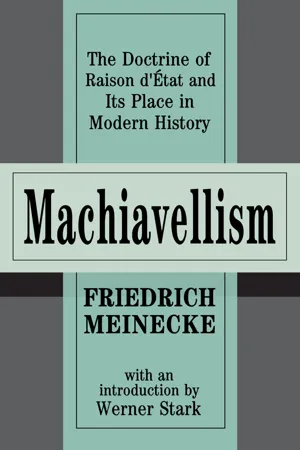
Machiavellism
The Doctrine of Raison d'Etat and Its Place in Modern History
- 438 pages
- English
- ePUB (mobile friendly)
- Available on iOS & Android
eBook - ePub
Machiavellism
The Doctrine of Raison d'Etat and Its Place in Modern History
About this book
Here is a study, by a recognized master in the field of intellectual history, of the challenge put by Machiavelli to the idea that there is a universal moral law governing human behavior. Should the political leader act according to the maxim of "my country right or wrong," or should elites follow the principle of "let justice be done?" Friederich Meinecke, an acknowledged founder of cultural history as a field, follows the discussion of this theme from Machiavelli through such major figures as Richelieu, Frederick the Great, and Hegel, and presents conclusions of enduring significance.
Book One
The Age of Nascent Absolutism
Chapter One
Machiavelli
WHATEVER the circumstances the business of ruling is, as we have remarked, always carried out in accordance with the principles of raison d’état. Raison d’état may be deflected or hindered by real or imaginary obstacles, but it is part and parcel of ruling. It is not realized, however, as a principle and an idea until a particular stage of development has been reached; namely when the State has become strong enough to break down those obstacles, and to lay down its own unqualified right to existence in the face of all other vital forces. An account of this process from the standpoint of universal history would have to embrace and compare all cultures; it would have to begin by examining the idea of raison d’état in the ancient world, and analysing its relationship with the spirit of that epoch. For both the free city-states and the monarchies of antiquity are teeming with the problems of raison d’état and with attempts to formulate it. In the dialogue between the Athenians and the citizens of Melos, given by Thucydides in Book 5 (ch. 85 ff.), the harsh and frightening aspects of raison d’état and power politics are stated very succinctly. In his Phoenician Virgins, Euripides makes Eteocles say: ‘For if one must do evil, then it is good to do it for the sake of authority; but otherwise one ought to act rightly.’1 In Book 5 of his Politics, Aristotle gives a picture of the rationally conceived way in which a tyrant can rule. In Book 3 of De officiis, Cicero discussed fully from the Stoic point of view the conflict between morality and what is useful to the State, and stated regretfully: Utilitatis specie in republica saepissime peccatur (ch. 11). The great historical works of Tacitus are steeped in the idea of raison d’état; as evidence of this we may quote one statement, from the lips of Cassius in Book 14 of the Annals: Habet aliquid ex iniquo omne magnum exemplum, quod contra singulos utilitate publica rependitur. Subsequently, after he had been republished by Justus Lipsius in 1574, Tacitus became the great teacher of raison d’état (though not to any great extent for Machiavelli, who drew chiefly on Livy, Aristotle and Xenephon); then for a whole century there blossomed a literature of Tacitists1 who exploited him politically. Justus Lipsius himself put together his grammar of politics (Politicorum sive civilis doctrinae libri sex, qui ad principatum maxime spectant, 1589) entirely out of maxims from antiquity, principally from Tacitus; he thus made available a mine of information (which is still valuable today) about the opinions of the ancient world on the subject of raison d’état. And even if the ancients had not coined for it any particular expression which was in general use, yet we frequently meet with ratio reipublicae in Cicero, and ratio et utilitas reipublicae in Florus.2
Polytheism and a secular view of human values were what nourished raison d’état in antiquity. At the period when the city-state was flourishing, the thing most worth living for was the State itself. The ethics of individual and of national conduct thus coincided, and so there was no conflict between politics and ethics. There was also no universal religion, to try and restrict by its commands the free exercise of State powers. The national religion which existed tended rather to favour this free exercise, by glorifying heroism. As the city-state began to dissolve, the heroic ideal passed over into the new form which power assumed in the State where men struggled fiercely, each for himself; this was the State of the ruthless man of power, classically portrayed by Plato in Callicles of the Gorgias.3 Altogether the ancient conception of raison d’état remained at this time firmly fixed in personalities, and served to vindicate the mode of action which was forced on contemporary rulers by pressure of the situation. It never seemed to rise (or at least not at all consistently) towards the conception of a supra-individual and independent state personality, which would stand over against the actual rulers of the time.4
An epilogue and a final crushing judgment on the ancient view of raison d’état was given by Christianity, when Augustine said: Remota justitia quid sunt regna nisi magna latrocinia.1 The new universal religion set up at the same time a universal moral command, which even the State must obey, and turned the eyes of individual men on otherworldly values; thus all secular values, including heroism as the herald of power politics and raison d’état, were caused to give ground. Then in the Middle Ages Germanic jurisprudence combined with Christian ethics in keeping down the State. The State certainly existed in the Middle Ages, but it did not rank supreme. Law was set above it; it was a means for enforcing the law. ‘Politics and raison d’état were not recognized at all in the Middle Ages.’ Naturally, of course, the general practice was different from this theoretical view. Therefore, ‘since there was no place in the legal and constitutional theory of mediaeval times for the demands of policy, these forced their own elemental way out’.2
But in the later Middle Ages these irregular outlets began to be regularized. The struggle between Church and Papacy fostered the conscious power politics of great rulers like the Emperor Frederick II and Philip IV of France. The Emperor Charles IV in Germany and King Louis XI in France were examples of a thoroughly unscrupulous and rational art of government, based on their own authority. Even the Church itself, by its inner transformations, by the progressive permeation of the Papacy with worldly political interests, by the often very utilitarian approach of the Church Councils, and by the rational perfecting of Papal finance, paved the way for a new spirit in the art of government. The strongest motive for this, however, still lay in the incipient growth of national States, and in the struggles of the more important dynasties, whose possessions had been amassed by feudal methods, to safeguard these possessions by non-feudal means, by adhesive methods of government. The universal ideas of this mediaeval corpus christianum moved continuously towards a new centre of Will concentrated in the State.
Late mediaeval thought began further to distinguish the ideal law of Nature from statute law, and thereby to diminish the influence which Germanic jurisprudence had hitherto exerted on the State. ‘Henceforth the power of the State is set above statute law, and comes under natural law. Thus it is no longer the case that every insignificant individual right is placed outside the grasp of the State; it is only the great fundamental principles of Natural Law that remain beyond its reach.’3
Here and there at this time one notices a few basic admissions of the new conception of necessity of State. In the fourteenth century Philipp von Leiden, a priest in the service of the Count of Holland, wrote de cura reipüblicae et sorte principantis; he advanced the proposition that a territorial ruler ought to revoke a privilege which he had granted to a single town or to a single person, if it was injuring the publica utilitas.1 In an even more general manner Jean Gerson declared in 1404 that if any laws conflicted with the aim of maintaining the peace (which was the supreme purpose of the State in the Middle Ages), then the laws ought to be interpreted more in accordance with that aim, or they would have to be completely abolished, since necessitas legem non habet.2 Even more audacious was a certain doctor of theology in the service of the Duke of Burgundy, named Jean Petit. In a long and exceedingly sophistical dissertation, which he delivered in Paris in March 1408, he defended his master for having caused the murder of Duke Louis of Orleans; and he went on to say that promises and alliances between noblemen did not need to be kept, if keeping them would entail injury to the ruler and to the commonwealth. He even said that to keep such promises would be completely against the laws of God and Nature.3
A systematic search among the sources and authors of the late Middle Ages would probably discover still further opinions of this kind, and thus throw light on the gradual and continuing loosening up of the mediaeval feudal barriers. But a theory on a grand scale has not yet grown up out of it.
Nevertheless the modern Western world has inherited one legacy of extraordinary importance from the Christian and Germanic Middle Ages. It has inherited a sharper and more painful sense of the conflict between raison d’état on the one hand, and ethics and law on the other; and also the feeling which is constantly being aroused, that ruthless raison d’état is really sinful, a sin against God and divine standards, a sin against the sanctity and inviolability of the law of the good old times. The ancient world was already familiar with these sins of raison d’état, and did not omit to criticize them, but without taking them very much to heart. The very secularity of human values in the ancient world made it possible to view raison d’état with a certain calmness and to consider it the outcome of natural forces which were not to be subdued. Sinfulness in antiquity was still a perfectly naïve sinfulness, not yet disquieted and frightened by the gulf between heaven and hell which was to be opened up by Christianity. This dualistic picture of the world, which was held by dogmatic Christianity, has had a deep influence even on the period of a Christianity that is growing undogmatic; and it has given the problem of raison d’état this deeply felt overtone of tragedy, which it never carried in antiquity.
It was therefore a historical necessity that the man, with whom the history of the idea of raison d’état in the modem Western world begins and from whom Machiavellism takes its name, had to be a heathen; he had to be a man to whom the fear of hell was unknown, and who on the contrary could set about his life-work of analysing the essence of raison d’état with all the naïvety of the ancient world.
Niccolo Machiavelli was the first to do this. We are concerned here with the thing itself, not with the name for it, which he still did not possess. Machiavelli had not yet compressed his thoughts on raison d’état into a single slogan. Fond as he was of forceful and meaningful catch-words (coining many himself), he did not always feel the need to express in words the supreme ideas which filled him; if, that is, the thing itself seemed to him self-evident, if it filled him completely. For example, critics have noticed that he fails to express any opinion about the real final purpose of the State, and they have mistakenly deduced from this that he did not reflect on the subject.1 But, as we shall soon see, his whole life was bound up with a definite supreme purpose of the State. And in the same way his whole political way of thought is nothing else but a continual process of thinking about raison d’état.
Machiavelli’s system of thought was brought into being by an absolutely special and sublime, and at the same time extraordinary, conjunction of events: the coinciding of a political collapse with a spiritual and intellectual renaissance. In the fifteenth century Italy enjoyed national independence, and was, in the pregnant words of Machiavelli (Principe, ch. 20), in un certo modo bilanciata by the system of five States which kept each other within bounds: Naples, the Papal States, Florence, Milan and Venice. There was growing up in Italy, fostered by all the realistic elements in Renaissance culture and directly promoted by the arrangement (which was just coming into fashion) of having permanent embassies, a form of statecraft which was carried on according to fixed and definite rules. This statecraft culminated in the principle of divide et impera, it taught that everything ought to be considered with a view to its usefulness, it surmounted all religious and moral limitations in a naïvely playful manner, but itself functioned by means of relatively simple and mechanical operations and thought-processes.1 Only the catastrophes which overtook Italy after 1494, with the invasion by the French and the Spanish, the decline of Neapolitan and Milanese independence, the precipitate change in the form of government in Florence, and most of all the collective impact of foreign countries on the entire Apennine peninsula—only these catastrophes succeeded in maturing the spirit of politics to that point of passionate strength, depth and acuteness, which is revealed in Machiavelli. As a secretary and diplomat of the Florentine Republic until the year 1512, he learnt everything that Italian statecraft had achieved up to that time, and he was also beginning already to shape his own original thoughts on the subject. What caused them to pour out suddenly after 1512 was the crushing fate which overtook both him and the republic in that year. As a member of the party which had been overthrown and was being temporarily persecuted, Machiavelli, in order to re-establish himself, was forced to seek the favour of the new rulers, the Medicis, who were once more in power. Thus a conflict arose between his own personal and egotistical interests, and the ideals of republican freedom and the city-state which he had held up to now. It is indeed the greatness of Machiavelli that he strove now to settle this conflict, and bring it to a final issue. Against the obscure and not particularly attractive background of his own naïve and unscrupulous egoism, there came into being the new and masterly reflections on the relation between republic and monarchy, and about a new national mission of monarchy; it was in a context of all this that the whole essence of raison d’état, compounded of mingled ingredients both pure and impure, both lofty and hateful, achieved a ruthless expression. He had reached his fortieth year—the age at which productive scientific minds often give of their best—when after 1513 he wrote the little book about the prince and the Discorsi sopra la prima deca di Tito Livio.
A spiritual and intellectual renaissance must also, as we said, have been a formative influence. Machiavelli did not by any means absorb the whole of the Renaissance movement. He did not share its religious needs, or its urge towards speculative philosophy; and, although unconsciously steeped and bathed in its aesthetic spirit, he still did not value its artistic attempts particularly highly. His passionate interest was the State, the analysis and computation of its different forms, functions and conditions for existence; and thus it was that the specifically rational, empirical and calculating element in Italian Renaissance culture reached its peak in him. But a mere cool consideration of questions of political power would not have signified any complete spiritual and intellectual renewal. The faith and energy necessary to sustain it, and out of which the ideal of a rebirth could grow, were, so far as Machiavelli shared in them, of ancient origin. The spirit of antiquity was certainly not signalized in him (as it was in so many humanists of the Renaissance) by a merely learned and literary regeneration, with the bloodless rhetorical inspiration of a schoolmaster. Often his enthusiasm for the heroes and thinkers of antiquity shows a somewhat classicist lack of independence and judgment. But in the main the element of antiquity in him rose anew out of the tradition and hereditary feeling, which in Italy had never been entirely lost. In spite of his outward respect for the Church and for Christianity (frequently mingled with irony and criticism), and in spite of the undeniable influence which the Christian view had on him, Machiavelli was at heart a heathen, who levelled at Christianity the familiar and serious reproach (Disc., II, 2) of having made me...
Table of contents
- Cover
- Half Title
- Title
- Copyright
- CONTENTS
- Dedication
- EDITOR’S PREFACE
- EDITOR’S INTRODUCTION
- INTRODUCTION
- Book One THE AGE OF NASCENT ABSOLUTISM
- Book Two THE AGE OF MATURE ABSOLUTISM
- Book Three MACHIAVELLISM, IDEALISM AND HISTORICISM IN RECENT GERMAN HISTORY
- INDEX
Trusted by 375,005 students
Access to over 1.5 million titles for a fair monthly price.
Study more efficiently using our study tools.
Frequently asked questions
Yes, you can cancel anytime from the Subscription tab in your account settings on the Perlego website. Your subscription will stay active until the end of your current billing period. Learn how to cancel your subscription
No, books cannot be downloaded as external files, such as PDFs, for use outside of Perlego. However, you can download books within the Perlego app for offline reading on mobile or tablet. Learn how to download books offline
Perlego offers two plans: Essential and Complete
- Essential is ideal for learners and professionals who enjoy exploring a wide range of subjects. Access the Essential Library with 800,000+ trusted titles and best-sellers across business, personal growth, and the humanities. Includes unlimited reading time and Standard Read Aloud voice.
- Complete: Perfect for advanced learners and researchers needing full, unrestricted access. Unlock 1.5M+ books across hundreds of subjects, including academic and specialized titles. The Complete Plan also includes advanced features like Premium Read Aloud and Research Assistant.
We are an online textbook subscription service, where you can get access to an entire online library for less than the price of a single book per month. With over 1.5 million books across 990+ topics, we’ve got you covered! Learn about our mission
Look out for the read-aloud symbol on your next book to see if you can listen to it. The read-aloud tool reads text aloud for you, highlighting the text as it is being read. You can pause it, speed it up and slow it down. Learn more about Read Aloud
Yes! You can use the Perlego app on both iOS and Android devices to read anytime, anywhere — even offline. Perfect for commutes or when you’re on the go.
Please note we cannot support devices running on iOS 13 and Android 7 or earlier. Learn more about using the app
Please note we cannot support devices running on iOS 13 and Android 7 or earlier. Learn more about using the app
Yes, you can access Machiavellism by Nathaniel Pallone, Nathaniel Pallone,Friedrich Meinecke in PDF and/or ePUB format, as well as other popular books in History & Historiography. We have over 1.5 million books available in our catalogue for you to explore.