- 289 pages
- English
- ePUB (mobile friendly)
- Available on iOS & Android
eBook - ePub
About this book
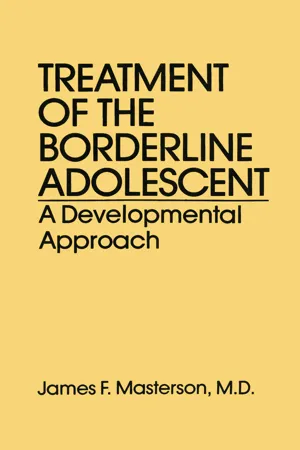
First published in 1986. This book is written for those students of the human condition who can face the sad facts of reality neither dismayed nor despairing but resolved to bring about what change they can through psychotherapy-that art which blends the magic of Gods, the faith of priests, the craftsmanship of artists, and the logic and reason of scientists.
Information
PART ONE
The Borderline Adolescent
CHAPTER 1
The Need for Treatment
HISTORY
Two historical psychiatric scapegoats—the Adolescent and the Borderline Syndrome—are brought together in this volume. Their separate developments have shown some intriguing parallels.
Approximately 15 years ago our knowledge about adolescents and the Borderline Syndrome was woefully confused. The chronologic age of the adolescent as well as the traditional belief that his myriad symptomatology comprised a turmoil normal to adolescence served as formidable barriers to understanding [85, 86]. Similarly, the former diagnostic focus on descriptive symptomatology and the psychodynamic focus on oedipal conflicts left the Borderline Syndrome vague and ill defined. At that time, with good cause, neither the Adolescent nor the Borderline Syndrome received much attention in psychiatric textbooks. Inevitably, this led to poor therapeutic results along with continual frustration.
In the intervening years the picture has brightened. Long-term psychiatric follow-up studies of young patients through and beyond the adolescent years have helped to clarify those psychopathological elements and in turn have led to more definitive therapy [82, 86]. Similarly, longterm psychoanalytic study of the Borderline Syndrome has revealed that the essence of the disorder rests neither diagnostically in the descriptive symptomatology nor psychodynamically in conflicts at the oedipal level of development. The work presented here and in a number of papers [87–89] depended on these two developments. Both the Adolescent and the Borderline Syndrome are no longer used as psychiatric scapegoats.
REVIEW OF THE PSYCHIATRIC DILEMMA OF ADOLESCENCE
A brief description of follow-up studies of adolescents reveals the background from which the present work on the Borderline Adolescent emerged.
In the early 1950s the notion was prevalent that adolescence was a time of such emotional turmoil that in a given patient it was difficult to decide whether he suffered from a psychiatric illness which required treatment or from so-called normal adolescent turmoil that would subside with further growth. This point of view, reflected in the diagnostic category of “adjustment reaction of adolescence” in the APA Manual, carried with it a potentially hazardous implication that treatment might be postponed and even be unnecessary, since the patient’s problems were related to his current growth stage and would disappear with time.
To view the situation objectively, I followed 78 adolescent out-patients for 5 years, or at least chronologically past their adolescent years, and found that, contrary to such a belief, they did not grow out of their difficulties. Time was not on their side. By far the majority, particularly those with personality disorders, were not able to make even a functional adjustment but continued to show both symptoms and impairment of functioning. A smaller number of those with a personality disorder, and most of those with a character neurosis or psychoneurosis, although they managed to make a functional adjustment to their difficulties, found better ways of dealing with their conflicts in an ameliorative way rather than resolving them. Consequently, with conflicts still smoldering, never quenched, they remained vulnerable to stress.
These patients were then compared with a control group of healthy adolescents and marked differences were found between the two groups in symptoms, ways of functioning, and family relationships. Adolescent turmoil did not produce enough symptomatology in the healthy as to make them appear to be psychiatrically ill. These findings were later confirmed by Offer [93].
The findings suggested that the psychiatric significance of adolescent turmoil had been overestimated; that it was at most an incidental psychodynamic factor that had little effect on the onset, course, and outcome of adolescent psychiatric disorders. It was but a way station along a path of psychiatric illness which began in childhood and followed its own inexorable course; it was only temporarily colored by the developmental stage of adolescence. Adolescent turmoil exerted its effect primarily by exacerbating and coloring preexistent pathology.
A revision of theory was suggested as follows. The psychiatric effects of adolescent turmoil may be viewed as a product of the interaction between the turmoil and the personality structure of the adolescent. In the healthy, where there is considerable integration and flexibility sufficient to withstand the onslaught of adolescent trauma, the ensuing turmoil produces, at most, subclinical levels of anxiety and depression. In those with characterological pathology whose personalities are rigidly organized and inflexible, it precipitates an acute clinical breakdown, often with psychosomatic symptoms, which may subside as the patient grows older but which usually leaves a residue of pathologic character traits. Adolescent turmoil has its most chaotic effect in those adolescents suffering from schizophrenia and severe personality disorders characterized by a relative lack of ego structure and adaptability in response to stress. Thus the adult personality will also reflect these earlier disturbances.
The Diagnosis of Personality Disorder
The diagnostic category of personality disorder in the APA manual was extremely unsatisfactory. It implied that the basic difficulty of the adolescent patient stemmed from a personality defect which began early in childhood and was manifested in behavior rather than symptoms, and which was relatively refractory to therapy. This diagnostic category confused the issue by implying that the patient did not have subjective symptoms, when in fact he did; it also shed no light on the exact nature and evolution of the personality defect nor on its effects and consequences. Actually the APA diagnostic category was a sentence rather than a diagnosis, since it condemned the patient to an inevitably poor therapeutic result.
Nevertheless, since the APA classification was in wide use, we employed it for statistical reasons in our study. The findings obtained from patients in the category of Personality Disorder are reproduced here exactly as I described them at that time for three reasons: (1) These led me to the work presented in this volume. (2) They are excellent illustrations of the consequences of inadequate treatment or no treatment to adolescent patients in later life. (3) In the last chapter I reevaluate these cases from the new perspective of the Borderline Syndrome and the psychodynamics of separation-individuation.
Table 1 presents the roster of patients with a diagnosis of personality disorder by level of psychiatric impairment. A brief description of each impairment group with an appropriate case illustration follows.
Severe and Moderate Impairment
| Severe | = | 16 |
| Moderate | = | 16 |
| Total | = | 32 |
The seven sociopaths who had had severe functional impairment at the approximate age of 16 continued to show severe functional impairment on follow-up 5 years later as judged by the following typical interim reports: inability to hold a job, drinking, gambling, taking drugs, police arrests, conflicts in relationships with people, and recurrent bouts of anxiety and depression, some with paranoid trends. The three passiveaggressive patients who had shown severe functional impairment still had a multitude of symptoms on follow-up, including anxiety, depression, psychoneurotic and psychophysiologic complaints, and bodily symptoms, with marked inhibitions of emotional expression due to their passiveaggressive character structure (in school, at work, etc.). The nine moderately impaired passive-aggressive patients also suffered from anxiety, depression, and psychophysiologic complaints as well as from difficulties with initiative. They were barely able to finish school and to maintain themselves for short periods of employment, usually at jobs well below their potential. Two cases follow.
Table 1. Patients with a Diagnosis of Personality Disorder

Severe Impairment: Example. A 15½-year-old girl, with a childhood history of having been a “feeding problem” and of soiling, had chronic feelings of inferiority, temper tantrums, nail-biting, thumb-sucking, and asthma. Since adolescence she had experienced recurrent and alternating episodes of depression and elation. She was repetitively a truant from school and in great conflict with her family. She came to the clinic in the setting of a depression, following rejection by a boy because she repulsed his sexual advances, and an impulsive suicide attempt by swallowing 15 aspirin tablets and 5 sleeping pills. On examination, it was our opinion that this patient had no major affect or thinking disorder, but that she represented a personality disorder, either inadequate or sociopathic in type.
The follow-up interview 5½years later, when the patient was 21, revealed that her interim course had been one of progressive deterioration. By age 18, she had attempted to attend college away from home but had become depressed, gained a lot of weight, felt rejected, and eventually returned home. At this time she engaged in sexual play with a male friend without excitement and was fearful of sexual intercourse. By age 21, the patient had given up school entirely, had left home, and had lived alone for 2 months. She had started to use narcotic drugs and had been arrested by the police for theft. She also had become involved in a sadomasochistic sexual relationship with an emotionally disturbed older man.
Moderate Impairment: Example. A 14-year-old boy, a psychopath, had complaints of anxiety, restlessness, concentration difficulty, school failures, obesity, rivalry with his sister, excessive concern about money, and conflict with an overprotective, overindulgent mother and a rejecting father.
When seen in a follow-up interview 6 years later, at age 20, he had been in college for 2 years but had failed several subjects. His inability to get up in the morning caused one failure, which he later circumvented by arranging afternoon classes. He suffered from procrastination and on the rare occasions when he studied, he experienced concentration difficulties and daydreaming. He was obese, impulsive, dependent, manipulative, and in conflict with his father. He was in constant need of money, which he spent impulsively. In the follow-up interview both the patient and his mother denied the presence of problems. Being away at school had minimized the tension involved in the conflict with his father, and by getting a job he had managed to augment his income to better satisfy his need for money.
Minimal and Mild Impairment
| Minimal | = | 6 |
| Mild | = | 5 |
| Total | = | 11 |
These patients, although their functioning had improved, also continued to show overt symptoms. All but one finished high school, commonly requiring extra time to do so; two were in college, two women worked as secretaries, two men were in the armed services, and five men worked at miscellaneous jobs. They complained of recurrent anxiety and depression, headaches, insomnia, feelings of inadequacy, obesity; the women complained of dysmenorrhea; all revealed overconcern with other bodily feelings and functions. One patient had epilepsy.
Minimal Impairment: Example. A 16-year-old boy, when first seen was markedly depressed, failing in school, hostile toward and in open conflict with a cold and distant father, and in social difficulty with his peers, as he had been since childhood. He did not graduate from high school, left home at age 18, and “for lack of anything else to do” went into the army; while in the service he experienced a dramatic change when he joined the Baptist Church at age 19. He had a good relationship with the minister and changed from being passive and withdrawn to being active socially and intensely interested in the Baptist Church and religion, to the point of evangelizing. He disliked army work, hated authority figures, and exhibited strong sadistic trends in his humor. Although he dated girls, he avoided emotional commitment and had no heterosexual activity. In addition, he had withdrawn from both his mother and his father. He admitted to having anxiety, insomnia, and feelings of inadequacy and on examination showed prominent defenses of repression, reaction formation, intellectualization, and denial.
Resolution of Conflicts in Personality Disorder
The eight patients with personality disorder of the passive aggressive type who were mildly or minimally impaired were examined further in follow-up interviews to ascertain their resolution of conflicts over dependency, sex, and aggression. In seven patients there was clear evidence of dependency on and conflict with the mother that had lessened very little over the course of time. They handled this either by continuing to live at home, which possibly enabled them to function better than they otherwise would, or by withdrawal from the parents as well as the home. In those who remained at home, the conflict with the mother seemed to persist almost intact and unabated from early adolescence. For example, two girls, both 21, were obese and living at home. One showed passive rebellion toward and withdrawal from her mother, and the other had episodes of depression.
As to sexual adjustment, two others have had sexual intercourse. One, a girl 21 years old, later declined a marriage proposal; the other, a boy 22, had not allowed himself to become emotionally committed to a girl. Five had been emotionally involved to the point of “going steady,” and five had dated without ever “going steady,” or having sexual intercourse.
Aggression continued to present a problem that was handled by defenses such as avoidance, denial, repression, reaction formation and intellectualization, rebellious acting out, or passively by provocation with withdrawal. Almost all gave evidence of some pathologic character traits; they varied from being passive, submissive, overcompliant, lacking initiative, with other immature emotional expression, to being withdrawn, suspicious, and perfectionistic, with much repression and denial of emotion.
Example
The 16-year-old boy described (pp. 9–10) provides a most striking example of reaction formation in response to aggressive and sexual impulses. This patient evidently transferred his dependency needs to the Baptist minister and, through identification with him and the church, changed from a passive to an active orientation toward his environment, being highly motivated by his new religious standards. Although he functioned better, it was at the cost, rather than through a satisfactory resolution, of his aggressive and sexual impulses, and he developed a markedly rigid, defensive character structure. That his elaborate reaction-formations have made him vulnerable to future stress is a justifiable inference.
Treatment of Personality Disorder
Our own treatment results described below certainly did not improve this dismal outlook. Eighteen patients with personality disorder received treatment once a week up to at least a year; the mothers and fathers were also seen once a week by a social worker. Seven improved; eleven did not. Of the seven who did improve during treatment, five were later found to be moderately impaired, two mildly impaired. In other words, they improved under treatment but when seen 4 to 5 years later they were still having considerable difficulties.
Those who improved usually had established dependent relationships in which they easily ventilated their complaints of anxiety, depression, and environmental conflicts. In the course of treatment, anxiety and depression subsided, environmental conflicts became minimized, and the patient’s functioning improved. However, such basic characterologic problems as passivity, dependency, and negativism, were usually inadequately dealt with so that although the patient had improved when he left treatment he ran into further difficulty. In those who did not respond there were a number of characteristics. Some therapists, threatened by the patient’s acting out, responded either permissively or punitively thereby repeating the patient’s problems with the parents. With other patients, despite the therapist’s efforts, it was not possible to circumvent their resistance. In still others, their basic character defects were not effectively dealt with. Two illustrative cases are described below.
Example 1
A 13-year-old boy presented a history since age 10, when his father died, of intense conflict with his mother and brother, excessive lying, stealing, truancy, and failing in school. The patient was seen in treatment for about a year. He had a dependent relationship with his therapist, and his interviews consisted mostly of discussing current activities and airing a long series of complaints about the mother’s rejection and nagging behavior, his anger and counter provocations, and his need to assert his masculinity. The therapist supported the patient’s constructive activity and tried to redirect his anger. The mother’s interviews consisted of repetitive hostile and rejecting complaint...
Table of contents
- Cover
- Halftitle
- Title
- Copyright
- Dedication
- Introduction
- Preface
- Acknowledgments
- Contents
- Prologue
- Part One the Borderline Adolescent
- Part Two the Therapeutic Process: Inpatient
- Part Three the Therapeutic Process: Outpatient
- Part Four Other Therapeutic Factors
- Epilogue
- Appendix Initial and Follow-up Psychological Testing: Nancy and Bill
- Bibliography
- Index
Trusted by 375,005 students
Access to over 1.5 million titles for a fair monthly price.
Study more efficiently using our study tools.
Frequently asked questions
Yes, you can cancel anytime from the Subscription tab in your account settings on the Perlego website. Your subscription will stay active until the end of your current billing period. Learn how to cancel your subscription
No, books cannot be downloaded as external files, such as PDFs, for use outside of Perlego. However, you can download books within the Perlego app for offline reading on mobile or tablet. Learn how to download books offline
Perlego offers two plans: Essential and Complete
- Essential is ideal for learners and professionals who enjoy exploring a wide range of subjects. Access the Essential Library with 800,000+ trusted titles and best-sellers across business, personal growth, and the humanities. Includes unlimited reading time and Standard Read Aloud voice.
- Complete: Perfect for advanced learners and researchers needing full, unrestricted access. Unlock 1.5M+ books across hundreds of subjects, including academic and specialized titles. The Complete Plan also includes advanced features like Premium Read Aloud and Research Assistant.
We are an online textbook subscription service, where you can get access to an entire online library for less than the price of a single book per month. With over 1.5 million books across 990+ topics, we’ve got you covered! Learn about our mission
Look out for the read-aloud symbol on your next book to see if you can listen to it. The read-aloud tool reads text aloud for you, highlighting the text as it is being read. You can pause it, speed it up and slow it down. Learn more about Read Aloud
Yes! You can use the Perlego app on both iOS and Android devices to read anytime, anywhere — even offline. Perfect for commutes or when you’re on the go.
Please note we cannot support devices running on iOS 13 and Android 7 or earlier. Learn more about using the app
Please note we cannot support devices running on iOS 13 and Android 7 or earlier. Learn more about using the app
Yes, you can access Treatment Of The Borderline Adolescent by James F. Masterson, M.D. in PDF and/or ePUB format, as well as other popular books in Psychology & Abnormal Psychology. We have over 1.5 million books available in our catalogue for you to explore.