How students are assessed can determine not only the quality, type, and degree of education they receive, but has long-term consequences for their future. Assessment by standardized testing often labels poor and minority children in ways that exclude them from opportunities, while failing to measure their true potential. Assessmentfor Equity and Inclusion confronts the debate between standardized testing and alternative assessment methods, locating strategies of assessment by which students are included rather than excluded.
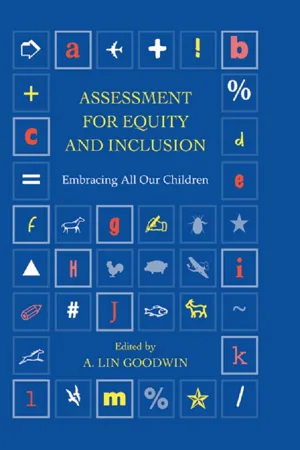
- 352 pages
- English
- ePUB (mobile friendly)
- Available on iOS & Android
eBook - ePub
About this book
Information
Chapter One
THE HISTORICAL AND POLICY FOUNDATIONS OF THE ASSESSMENT MOVEMENT
Since the 1920s, multiple-choice, standardized, commercial tests have been widely used to measure the achievement of American students. Over the decades, despite vigorous criticism from some quarters, these tests have been widely regarded as administratively convenient, inexpensive tools that could help solve an array of educational problems (National Commission on Testing and Public Policy 1990). In the late 1980s, however, a powerful movement called authentic assessment emerged (e.g., Mitchell 1992; Newmann, Secada, and Wehlage 1995; Wiggins 1989), seriously challenging the supremacy of the institution of standardized multiple-choice testing.
This chapter explores the history of the evolution of measuring a person’s academic attainment, from performance testing to oral and written examinations to multiple-choice testing, and, with current reform efforts, full circle back to performance appraisal.1 Our analysis is primarily limited to the context of tests, examinations, or assessments—whatever the noun—used in the policy arena. Other chapters in this volume will consider the use of such tests in the classroom. Thus, while we would generally agree with the use of performance-based assessment by teachers for decision making within the context of their classrooms for either formative or summative purposes, we shall not explore this dimension of the assessment movement except to note that the in-service and preservice infrastructure necessary to train teachers to develop and use such assessments currently is problematic.
We begin with a short recent history of the reasons for the increasing use of standardized multiple-choice tests in education, beginning in the late 1950s. We then look at the etymology of several of the key words used in the current debate—standards, assessments, examinations, and tests. Next, we posit testing as a technology, then describe the concept of a test and the various modes that can be used to test an individual. We then proceed to a historical description of the various modes of testing student attainment used over the centuries and why they receded from use or were discarded in favor of other modes. Finally, we offer a tentative prediction on the fate of the assessment movement in the policy arena.
A caveat is in order. Until the end of the nineteenth century, tests were what we now call “achievement tests.” They concentrated on attainment within a syllabus, curriculum, or craft. This tradition of measuring achievement/attainment is the sole focus of this chapter, although the advent of the psychological testing movement in the latter part of the nineteenth century altered testing—including achievement testing—profoundly. The changes in achievement testing arising from the mental testing movement are beyond the scope of this chapter. Suffice it to say that early proponents of mental testing claimed, and it was widely believed, that testing could do more than assess what people learned; it could now measure their underlying—some said innate—mental ability or intelligence. This belief has, from the beginning of this century to today, influenced how some people envision student achievement/attainment and the school’s role in fostering it. The controversy engendered by Herrnstein and Murray’s 1994 book The Bell Curve is a case in point.
RECENT HISTORY
Beginning in the late 1950s, four social forces combined to create a bull market for standardized testing (Haney, Madaus, and Lyons 1993). First was recurring public dissatisfaction with the quality of education and several concomitant waves of educational reform. Witness the Sputnik brouhaha of the 1950s, continuing with the basic skills movement of the 1970s, the release of the National Commission on Excellence in Education’s A Nation at Risk in the 1980s, and, finally, the Goals 2000: Educate America Act in this decade. In each of these reform waves, testing was seen as an important policy tool. Second was an array of federal and state legislation promoting or explicitly mandating standardized testing programs, beginning with the National Defense Education Act of 1958. Third was a broad shift in attention, signaled by the famous Coleman report (Coleman et al. 1966), from evaluating the inputs or resources devoted to education to measuring the outputs or results operationalized by student test performance on available multiple-choice tests. Finally, increased bureaucratization of society in general, and of schooling in particular (Wise 1979), made the technology of multiple-choice, standardized, commercial tests an attractive tool. Tests provided a means for categorizing people, educational institutions, and problems according to abstract, impersonal, and generalizable rules and helped to expedite formal and impersonal administrative procedures. These four factors were intimately related one to the other; for example, public dissatisfaction with the quality of education produced legislation that in turn contributed to increased bureaucratization (for details see Haney, Madaus, and Lyons 1993).
While space does not permit a development of how these four social forces impacted on the testing industry, impact they did. Haney, Madaus, and Lyons (1993) estimated that, by the end of the 1980s, between three and nine standardized tests were administered annually to each of the nation’s 44 million students. They also calculated that the nation invested between $311 million and $22.7 billion annually in state and local testing programs.2 To put these amounts in perspective, total national expenditure on elementary and secondary education in 1987–88 was about $169.7 billion (U.S. Department of Education 1991a); Haney and associates’ testing cost estimates range from 0.18 percent to 13 percent of that figure.
An indirect indicator, developed by Haney (1986), documents the increased attention over the decades to testing’s importance in the educational realm (Haney, Madaus, and Lyons 1993). To show growth in the volume of testing over time, he charted the number of citations under the rubric “testing” (as indicated by the number of column inches) from 1930 through 1985 in the Education Index. For comparative purposes, and because he argued curriculum issues should be a central focus of schooling, the number of citations under “curriculum” were also charted.3 The Haney data shown in Figure 1.1 are updated through 1994.
FIGURE 1.1 Education Index Listings Under Testing and Curriculum
Source: Haney, Madaus, and Lyouns 1993; Madaus and Reczek 1995; Education Index, 1932–1994

Figure 1.1 shows that the average annual number of column inches devoted to citations concerning curriculum has increased only modestly over the last 62 years—from 50 to 100 inches per year in the 1930s and 1940s to 100 to 150 in recent years. In contrast, column inches devoted to tests and scales have increased greatly, from only 10 to 30 in the 1930s and 1940s to well over 300 in the 1980s. The past few years have seen a decline in the number of citations regarding testing; however, the new rubric “performance-based assessment” was added to the Education Index in 1992 to reflect prevailing testing terminology, and those citations are not included in our update. We do include data for “curriculum-based assessment,” another category that was implemented in 1990. While these indices are admittedly crude, the data certainly highlight the prominence of testing in the education literature, particularly since the mid-1960s.
As noted above, the authentic (alternative) assessment movement emerged in the late 1980s. The seeds of this movement were sown in 1983, when Americans heard Orwellian news from the National Commission on Excellence in Education that the country was “a nation at risk” (the title of their explosive report). Since then, the public schools have been routinely portrayed as self-serving, mediocre, failing, inferior to those of competitor countries, injurious to students, and endangering our economic competitiveness and future as a world power. A Nation at Risk (1983) introduced the idea of testing as a major policy tool to combat these ills. Subsequently, there were several proposals for and, in one case, legislation authorizing a national testing scheme of one sort or another (e.g., Boyer 1983; Educate America 1991; Public Law 100-297; U.S. Department of Education 1984; U.S. Department of Education 1991a). By the end of the 1980s, some reports (e.g., Commission on the Skills of the American Workforce 1990; National Center on Education and the Economy 1989; Secretary’s Commission on Achieving Necessary Skills 1992) recommended that new national performance standards, measured by performance-based examinations (performance assessments, portfolios, and projects), be developed.
Assessment has been contrasted with “more artificial testing approaches” that “do not measure the ability to think deeply, to create, or to perform in any field” (Darling-Hammond, Ancess, and Falk 1995: 3, 6). Proponents argue that alternative forms of assessment must replace or, at the very least, complement the multiple-choice mode if teachers are to help students develop the conceptual and analytical skills needed to solve everyday problems and to prepare them for future vocational success. (Interestingly, it is the multiple-choice item that is most widely employed in the external testing programs of Japan, our economic arch-rival, to whom we are often compared unfavorably by some advocates of authentic assessment.) Advocates offer a litany of benefits associated with such assessments (albeit without much in the way of supporting evidence): they can drive the reform movement built around world-class standards; they are worth teaching to; they give teachers clear models of acceptable outcomes; they defeat negative test-preparation effects associated with multiple-choice tests; they have a positive influence on instruction and learning; they measure higher order skills; they motivate unmotivated students; and, finally, they are more equitable for assessing the progress of students who differ in race, culture, native language, or gender.4
Thus, alternative assessment has been promoted for two very distinct functions: as a high-stakes policy tool to drive educational reform, and as a tool for improving classroom instruction. Underpinning the alternative assessment movement is the belief that student learning and progress are best assessed by tasks that require active engagement—such as producing extended responses or some other tangible product that can be evaluated on its merits, investigating complex problems, generating material for portfolios, performing exhibitions, or carrying out experiments—rather than by having students select an answer from several alternatives. In part, this approach to appraising student attainment reflects a shift from a transmissionist view of learning to a constructivist one (Garcia and Pearson 1994).
Our premise, however, is that while assessment can assist in reform efforts, the nation cannot assess, test, nor examine its way out of its educational problems. Claims that authentic assessment is a “technological breakthrough” in solving such problems need to be treated with a healthy skepticism.5 While performance-based, high-stakes assessments may well be preferable to multiple-choice tests in terms of forcing teachers and students to pay attention to certain neglected aspects of the curriculum and learning, we nonetheless need to be clear that as a policy lever such assessments are a variation on the old theme of measurement-driven instruction (MDI) (Popham 1983); the principal difference is the form of the measures. And, it should be noted, in the context of MDI, performance-based measures are as corruptible as any multiple-choice measure (see Madaus and Greaney 1985). Finally, as we develop below, “authentic assessments” are not new, novel, nor innovative. They predate multiple-choice testing by centuries as standard forms of examining and assessing attainment or skills and historically have had problems associated with their use.
ETYMOLOGY OF KEY TERMS
Presently, advocates of educational reform prefer the term “assessment” to that of the traditional word “test” when talking about the process of determining student achievement. “Standards,” often modified by “world-class,” is also a cardinal term in the reformers’ vocabulary (see Ravitch 1995). The Oxford English Dictionary (OED) (Oxford English Dictionary 1993) reveals interesting etymologies for these terms.
First, in the OED the word standard has four general meanings pertinent to reform dialogue. In its oldest meaning (circa 1154), a standard may be a figure or object used as an emblem or symbol of a person or a group of people. Standard may also mean a model or example commonly accepted or adhered to; that is, a criterion set for usage or practice. These two meanings are implied in talks about, and efforts to develop, “world-class standards”—in particular, in academic disciplines. For example, the National Council of Teachers of Mathematics (NCTM) standards have been widely accepted and held as an exemplar for other academic disciplines to follow in developing a framework for teaching and learning (in fact, one variant of the latter meaning for standard refers to the “books or documents accepted by a church as the authoritative statement of its creed” [OED 1993]. The NCTM standards are analogus to this latter meaning). The NCTM standards are also important in a symbolic sense; they are emblematic of how serious most math educators are about educational reform. However, the demise of the standards developed by the National Center for History in the Schools (1994), also known as the national history standards, vividly illustrates the thorny problem of who gets to decide what will comprise the standards—the accepted emblematic canon for a discipline.
Two more contemporary OED meanings for the word standard seem to fit recent uses of the word. Standard can mean a level of excellence or attainment regarded as a measure of adequacy. It can also refer to something established as a rule or basis of comparison in measuring quality or value. Both of these latter meanings are implied, it seems, when reformers and policy makers use the normative term “world-class standards” and operationalize them through tests, assessments, or examinations.
Similarly, the OED also offers the following British meaning (circa 1870s): “Each of the recognized degrees of proficiency, as tested by examination, according to which school children may be classified” (italics added). As this meaning makes clear, when curriculum...
Table of contents
- Cover
- Halftitle
- Title
- Copyright
- Dedication
- Contents
- Acknowledgments
- Series Editor’s Foreword
- Introduction
- 1 The Historical and Policy Foundations of the Assessment Movement
- 2 Assessing Against the Grain: A Conceptual Framework for Alternative Assessments
- 3 Supporting Teaching and Learning for all Students: Policies for Authentic Assessment Systems
- 4 The Power of Possibilities
- 5 The Democratic, Child-Centered Classroom: Provisioning for a Vision
- 6 Awakening to the Mathematician Within: One Teacher’s Story
- 7 “I wouldn’t know I was Smart if I didn’t come to this Class”
- 8 Assessment as a way of Seeing
- 9 Toward the Development of an Improved Urban Teaching and Evaluation Process
- 10 Dilemmas of Assessment and Evaluation in Preservice Teacher Education
- 11 Educating the Rainbow: Authentic Assessment and Authentic Practice for Diverse Classrooms
- 12 Language, Culture, and the Assessment of African American Children
- 13 Moving the Mountain: Assessment and Advocacy for Children
- 14 Assessing Teacher Performance in a Diverse Society
- 15 Assessing the Dialogue of Teachers in a Multicultural Classroom: A Difficult Struggle
- 16 Parents as Allies for Alternative Assessment
- 17 Toward an Education of Consequence: Connecting Assessment, Teaching, and Learning
- Contributors
- Index
Trusted by 375,005 students
Access to over 1.5 million titles for a fair monthly price.
Study more efficiently using our study tools.
Frequently asked questions
Yes, you can cancel anytime from the Subscription tab in your account settings on the Perlego website. Your subscription will stay active until the end of your current billing period. Learn how to cancel your subscription
No, books cannot be downloaded as external files, such as PDFs, for use outside of Perlego. However, you can download books within the Perlego app for offline reading on mobile or tablet. Learn how to download books offline
Perlego offers two plans: Essential and Complete
- Essential is ideal for learners and professionals who enjoy exploring a wide range of subjects. Access the Essential Library with 800,000+ trusted titles and best-sellers across business, personal growth, and the humanities. Includes unlimited reading time and Standard Read Aloud voice.
- Complete: Perfect for advanced learners and researchers needing full, unrestricted access. Unlock 1.5M+ books across hundreds of subjects, including academic and specialized titles. The Complete Plan also includes advanced features like Premium Read Aloud and Research Assistant.
We are an online textbook subscription service, where you can get access to an entire online library for less than the price of a single book per month. With over 1.5 million books across 990+ topics, we’ve got you covered! Learn about our mission
Look out for the read-aloud symbol on your next book to see if you can listen to it. The read-aloud tool reads text aloud for you, highlighting the text as it is being read. You can pause it, speed it up and slow it down. Learn more about Read Aloud
Yes! You can use the Perlego app on both iOS and Android devices to read anytime, anywhere — even offline. Perfect for commutes or when you’re on the go.
Please note we cannot support devices running on iOS 13 and Android 7 or earlier. Learn more about using the app
Please note we cannot support devices running on iOS 13 and Android 7 or earlier. Learn more about using the app
Yes, you can access Assessment for Equity and Inclusion by A. Lin Goodwin in PDF and/or ePUB format, as well as other popular books in Didattica & Didattica generale. We have over 1.5 million books available in our catalogue for you to explore.